-
-
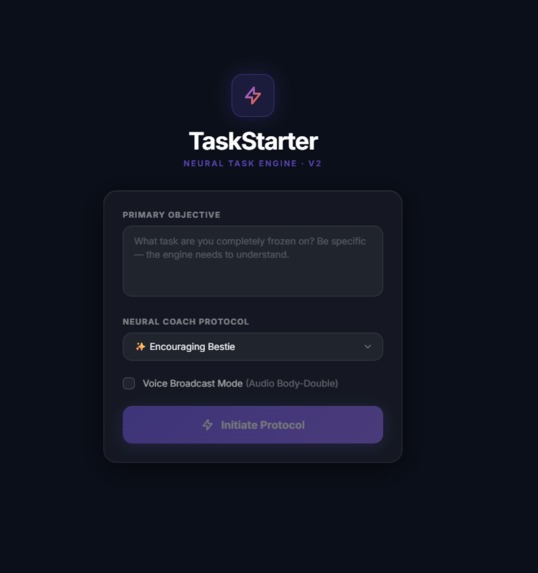
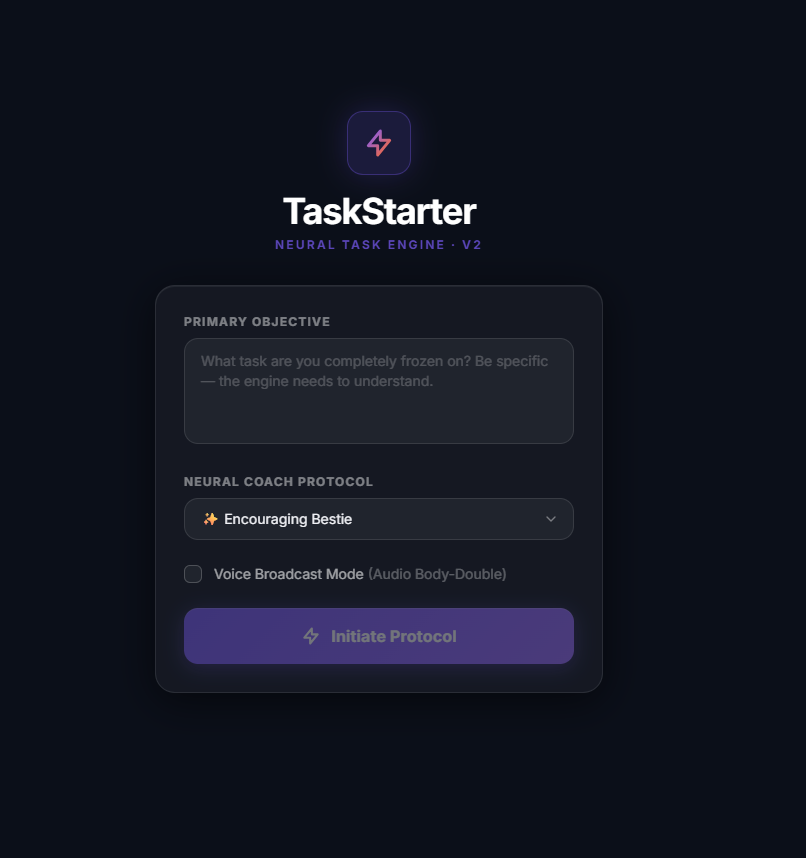
The starting point tell TaskStarter what you're frozen on. Pick your coach tone: Encouraging Bestie or Drill Sergeant.
-
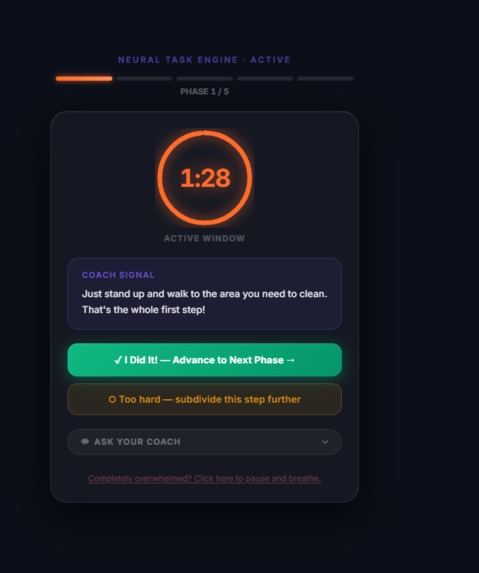
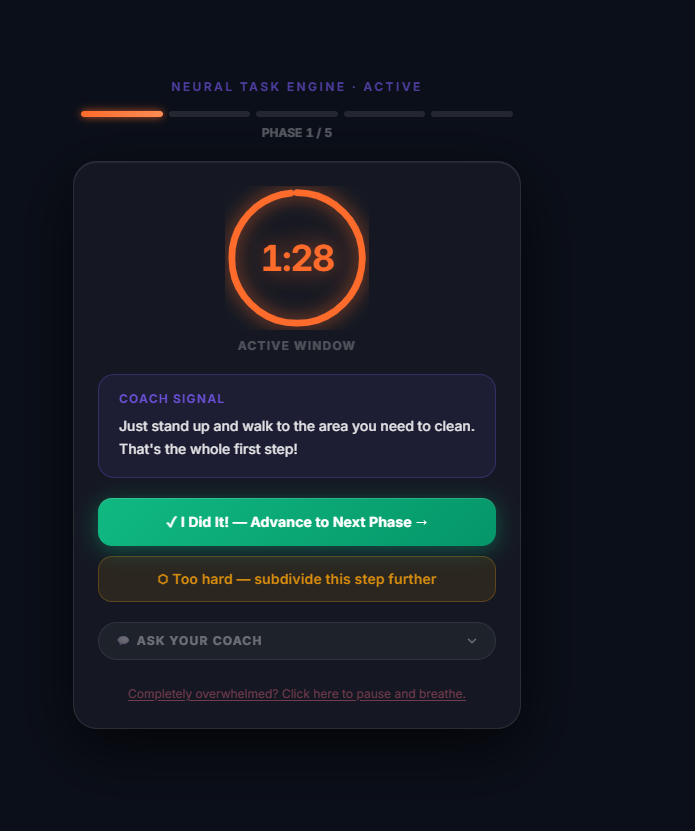
Step 1 of 5. A 90-second timer, a gentle nudge from your AI coach, and one tiny action. That's all you need to do right now
-
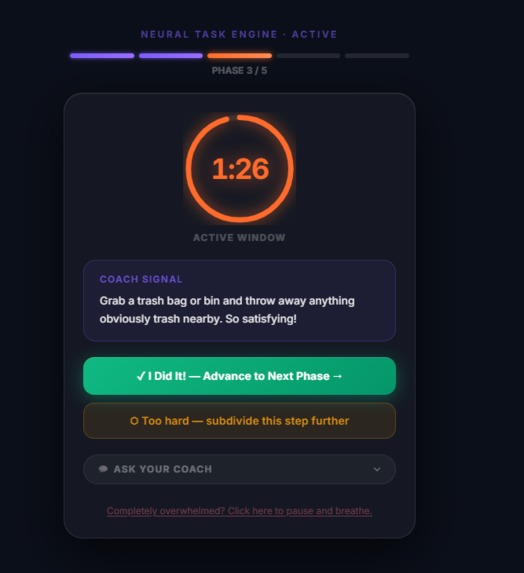
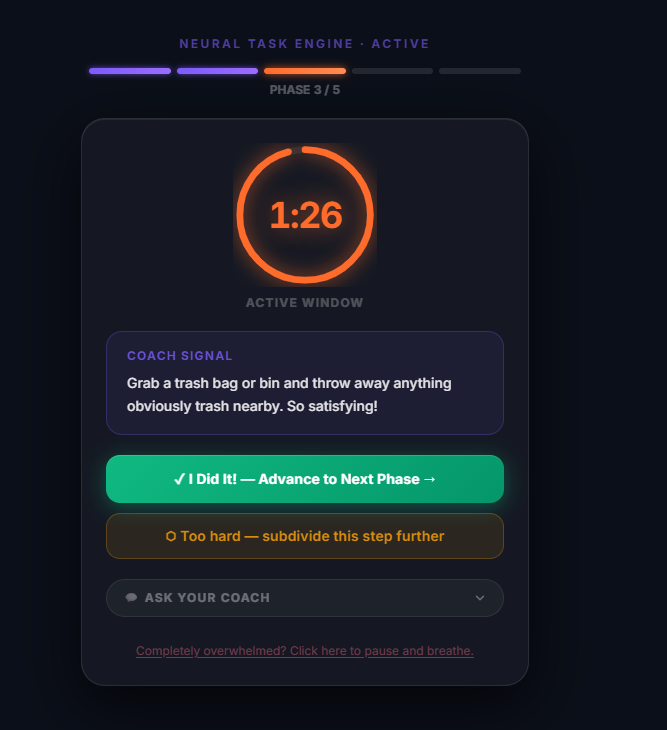
Progress bar fills as you move through phases. Stuck? "Subdivide this step further" breaks it down even more.
-
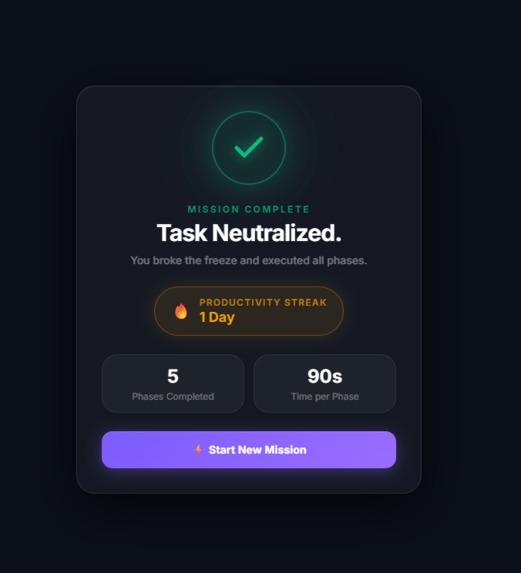
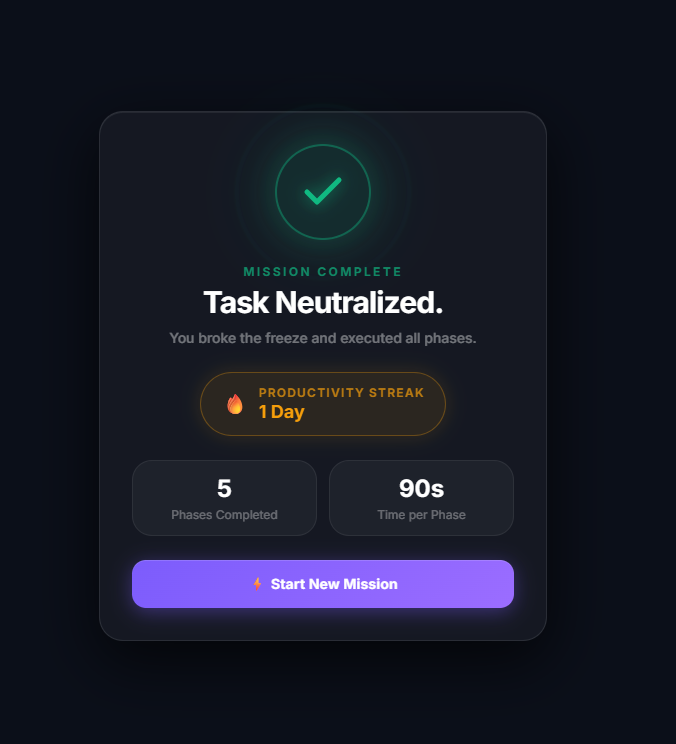
Mission complete. All 5 phases done, streak tracked. Not therapy just the push to get started.
Inspiration
I'm a pharmacy student, and between exams, freelance work, and deadlines, I know what it feels like to stare at a blank screen knowing exactly what I need to do and not being able to start. Not because I'm lazy, but because my brain just won't move.
This is called task paralysis, and it affects 100M+ people worldwide. It hits hardest for students, neurodivergent people, and anyone in a high-stress, low-resource environment who can't afford a coach or therapist.
Existing tools make it worse. To-do apps give you more tasks. Productivity timers add pressure. Therapy apps want you to reflect on your feelings. None of them solve the actual problem: starting.
This isn't just a hunch either body doubling is a documented ADHD productivity strategy. A 2023 study found task initiation improved by up to 65% when another person was present, even virtually, and CHADD's adult ADHD survey found over 70% identify procrastination as one of their most impairing symptoms. Recent academic work on AI-based "digital body doubling" frameworks (arxiv.org/abs/2507.06864) points in exactly this direction.
So I built TaskStarter an AI body-double that takes this validated technique and makes it scalable, free, and available 24/7.
What it does
The task breakdown system uses Claude as primary, with a local fallback generator ensuring the app never fully breaks even if the API is unavailable important for reliability. You type what you're stuck on in one sentence, that's it. Claude AI breaks it into 5 micro-steps, each under 2 minutes. The app shows you only Step 1. A voice reads it out loud and says "I'm right here." A 90-second timer runs silently. If you haven't moved, it nudges you gently no guilt, no pressure. Once you act, you move to the next step, and so on until completion, with a small celebration at the end.
If a user's input contains crisis-related language, the app immediately redirects to 988 (US) and iCall (India) because this is a productivity tool, not a mental health service, and we want to be very clear about that boundary.
How we built it
- Frontend: React + TypeScript (Vite), shadcn/ui components, glassmorphism dark theme
- Backend: Express.js API server
- AI - Task Breakdown: Claude API (Anthropic) takes any user task and returns 5 contextual micro-steps
- AI - Coaching: Gemini API (Google) powers an adaptive coach personality ("Encouraging Bestie" / "Sergeant" tones) that responds differently based on user behavior
- Voice: Web Speech API for text-to-speech, with tone-specific voice selection
- Gamification: progress tracking, confetti, completion rewards
I used Replit's AI agent significantly during development for scaffolding and implementation I directed the architecture, feature decisions, UX flow, ethics guardrails, and equity framing, and iterated through many rounds of testing and feedback. Disclosing this as instructed by the hackathon guidelines.
Without AI, this is just a timer app. The entire value is in contextual task breakdown "write my essay intro" and "reply to that email" need completely different first steps, and only an LLM can generalize this for any task in real time.
Challenges we ran into
- Getting the voice interaction to feel like presence rather than a notification took several iterations on tone, pacing, and wording
- Drawing a hard ethical line: this had to feel supportive without ever crossing into therapy or medical advice
- Crisis keyword detection that's sensitive without being alarming or triggering in itself
- Mid-build, GitHub's secret scanning flagged API keys that had been committed to a config file had to revoke and rotate both keys immediately and rebuild the config properly
- As a solo participant balancing this with semester exams, time management was its own task paralysis problem (fitting, given the project)
Accomplishments that we're proud of
- Built a working, end-to-end AI product solo in a week while studying for exams
- Two distinct AI systems working together (Claude for task breakdown, Gemini for adaptive coaching) rather than a single API call
- A genuinely novel interaction model body-doubling has strong research backing but no existing AI product implements it this way
- Kept the ethics boundary airtight: no diagnosis, no data storage, crisis redirect built in from day one
- Caught and fixed a real security issue (exposed API keys) before final submission
What we learned
- How to translate a vague feeling ("I can't start") into a concrete, testable product flow
- That the hardest part of building an AI product isn't the AI call itself it's the surrounding experience (timing, tone, voice, ethics) that makes it feel human
- Practical lessons in API security and git hygiene (secret scanning saved me from publishing live keys)
- How much research already exists validating ideas that feel intuitive this gave me more confidence in the direction
What's next for TaskStarter
- On-device/offline AI model for use without internet
- Multilingual support, starting with Hindi
- Optional local-only progress history (no data collection)
- Partnerships with student wellness programs
AT THE END, WHAT WE NEED IS JUST: STEP ONE.
Built With
- anthropic-claude-api
- audio
- css3
- express.js
- google-gemini-api
- html5
- javascript
- node.js
- react
- typescript
- web
- window.speechsynthesis


Log in or sign up for Devpost to join the conversation.