Inspiration
I'm currently diving into VLSI design, learning RTL, synthesis and everything in between, and alongside that I juggle several other engineering projects. Every project leaves a trail: notes to myself, simulation logs, synthesis reports, Git commits, quick chat messages like "I think it passes now".
The hardest part of learning and building at the same time isn't the work itself. It's coming back to it. After a few days away I'd open a project and spend the first hour rereading logs, wondering "Did that test actually pass, or did I just hope it did?"
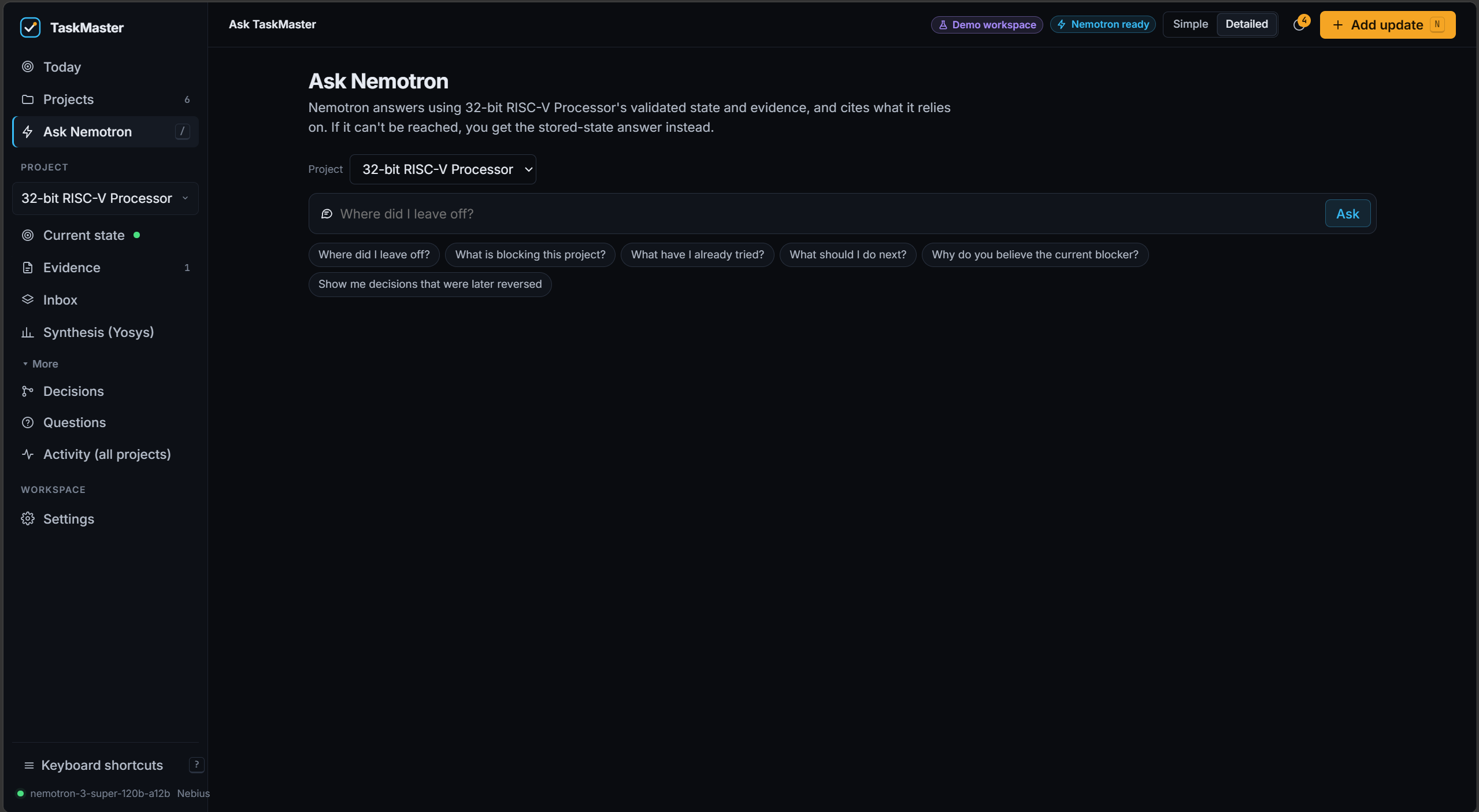
I wanted a personal AI that tidies up my work for me: something that reads everything I throw at it and tells me plainly where I left off and what to do next, without making things up. So, I built, TaskMaster.
What it does
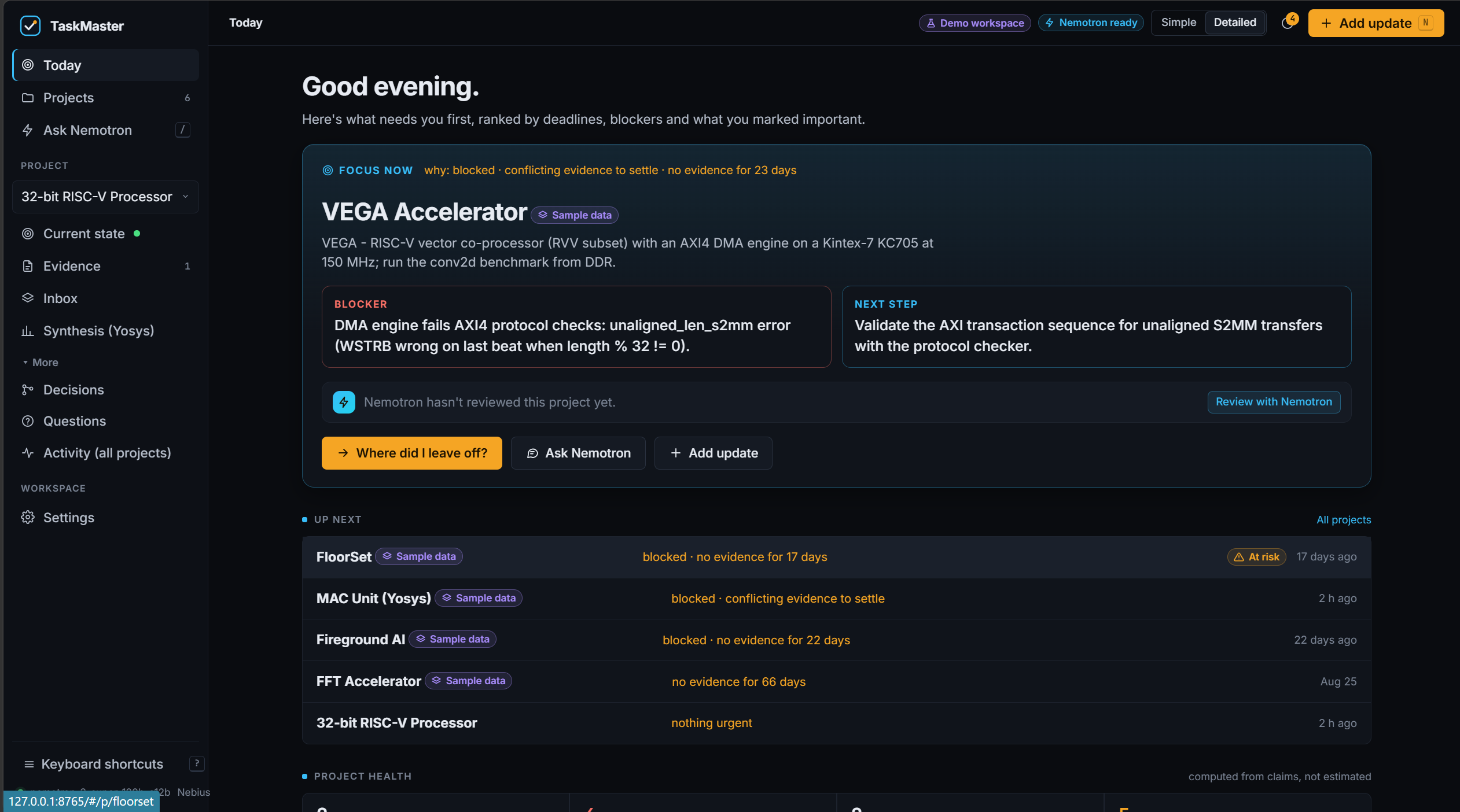
TaskMaster keeps an evidence log for each of my projects and turns it into a clear, always-current picture:
- Where I left off and what to do next, right at the top of every project.
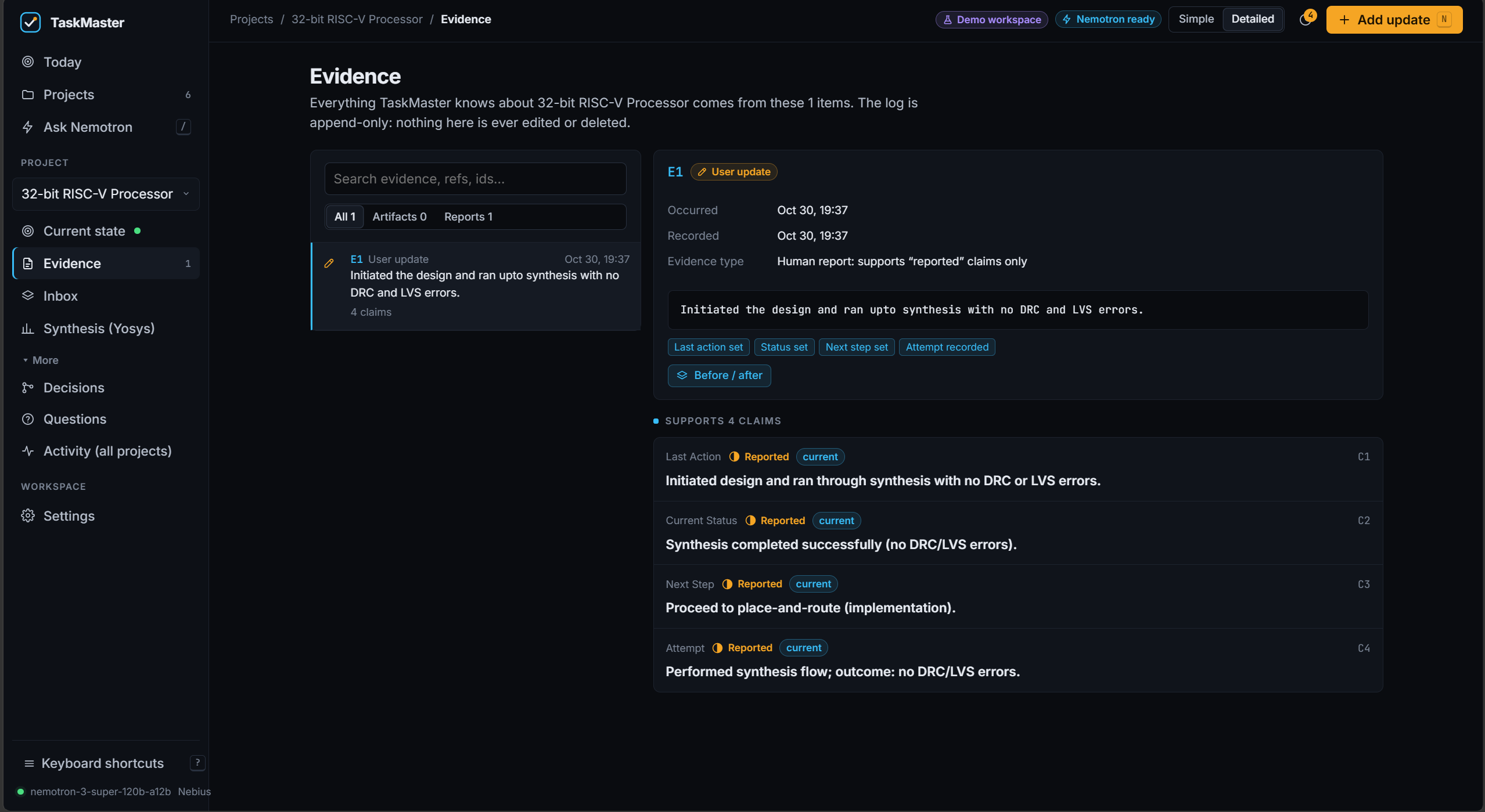
- What is verified (backed by a log, test or report) versus only reported (something someone said).
- Conflicts, flagged instead of silently overwritten. If a chat says "all tests pass" but the simulation log says six vectors fail, TaskMaster shows both and asks for a re-run.
- Every statement links to the exact evidence behind it, and nothing is ever deleted, so I can always see how a project got where it is.
It also ranks my projects by deadlines and blockers, reviews whether a project is on track, and on Windows pops up a compact window from any app with Ctrl+Alt+T.
My VLSI learning companion
Since I'm learning VLSI, I built TaskMaster's first engineering integration around Yosys, the open-source synthesis tool I use. I can import Yosys stat reports and TaskMaster will:
- Parse them and record the measurements as verified evidence (cell counts, flip-flops, cell types).
- Compare runs, e.g. single-cycle MAC vs. pipelined MAC, with the differences calculated exactly by code.
- Ask Nemotron to explain what changed and suggest the next experiment, clearly marked as interpretation, not fact.
- Show me the proposed update to my project before it's applied, so I can approve or discard it.
For someone still learning, this is gold: I don't just get numbers, I get an explanation, and I can trust which parts are measured and which are suggestions.
How I built it
- NVIDIA Nemotron 3 Super (
nemotron-3-super-120b-a12b) through Nebius Token Factory does the thinking: it reads each new piece of evidence and proposes structured changes, writes the "where you left off" summary, reviews projects and explains synthesis results. - A deterministic validator checks every proposal before it's saved. For example, only a real log or report can mark something verified, and a chat message can't overrule a test result. Nemotron proposes; the rules decide.
- SQLite stores an append-only evidence log and a version of the project state after every update, so I can travel back in time.
- A Python (standard library only) server and a plain JavaScript interface, with no frameworks or build step.
- 133 automated tests, many built from Nemotron's real outputs during development.
Challenges I ran into
- A citation doesn't make a sentence true. At first, the summary showed Nemotron's own sentences with the label of the claim they cited, and once a sentence didn't quite match its source. Now every labelled fact is the recorded claim itself, and Nemotron's wording appears separately and clearly marked.
- People claim results too. In a live run, a chat message saying "the failures are fixed" cleared a blocker that a failing simulation had established. I added a rule: a person's report can't overrule an artifact. That needs a re-run.
- Reasoning models need room to think. With a small response limit, Nemotron sometimes spent its whole budget reasoning and returned an empty answer. Giving it more space fixed it, and TaskMaster falls back gracefully if a reply can't be used.
What I learned
How to build something I can actually trust with an AI model at its heart: clear structure for the model, firm rules around it, and complete transparency about where every statement comes from. Nemotron is brilliant at the reasoning; the evidence should always have the final word.
What's next
I genuinely want to use TaskMaster every day as I go deeper into VLSI. Next on my list:
- Support for OpenLane and more chip-design reports.
- Integrations with CAD, ECAD and proprietary EDA tools (in the works).
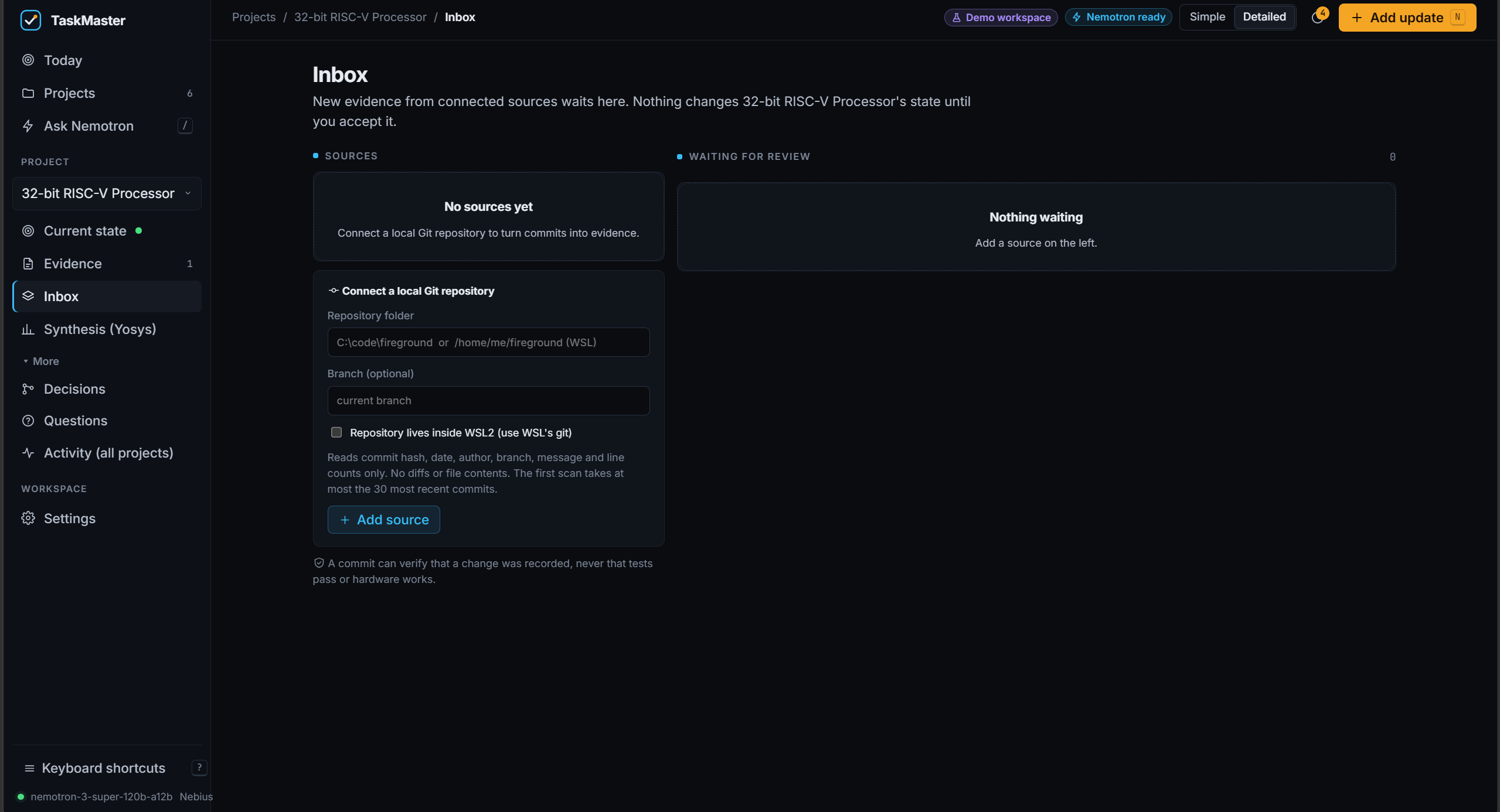
- Review before commit for every kind of update, not just Yosys reports.
The goal is simple: never again lose a day trying to remember where I left off.
Try it
- Live demo (read-only): browse five sample projects with saved Nemotron output. No setup needed.
- Run it yourself: clone the repo, run
python -m statetrace serve, and click Load sample project. No API key needed. Add a Nebius key to unlock live Nemotron features.
