-
-
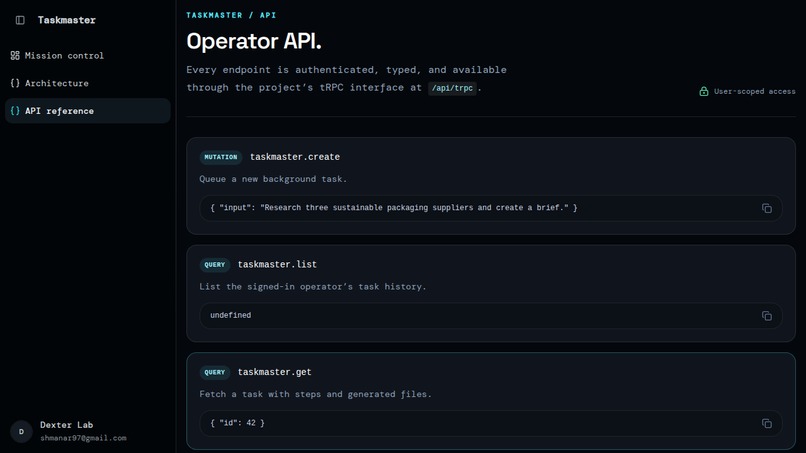
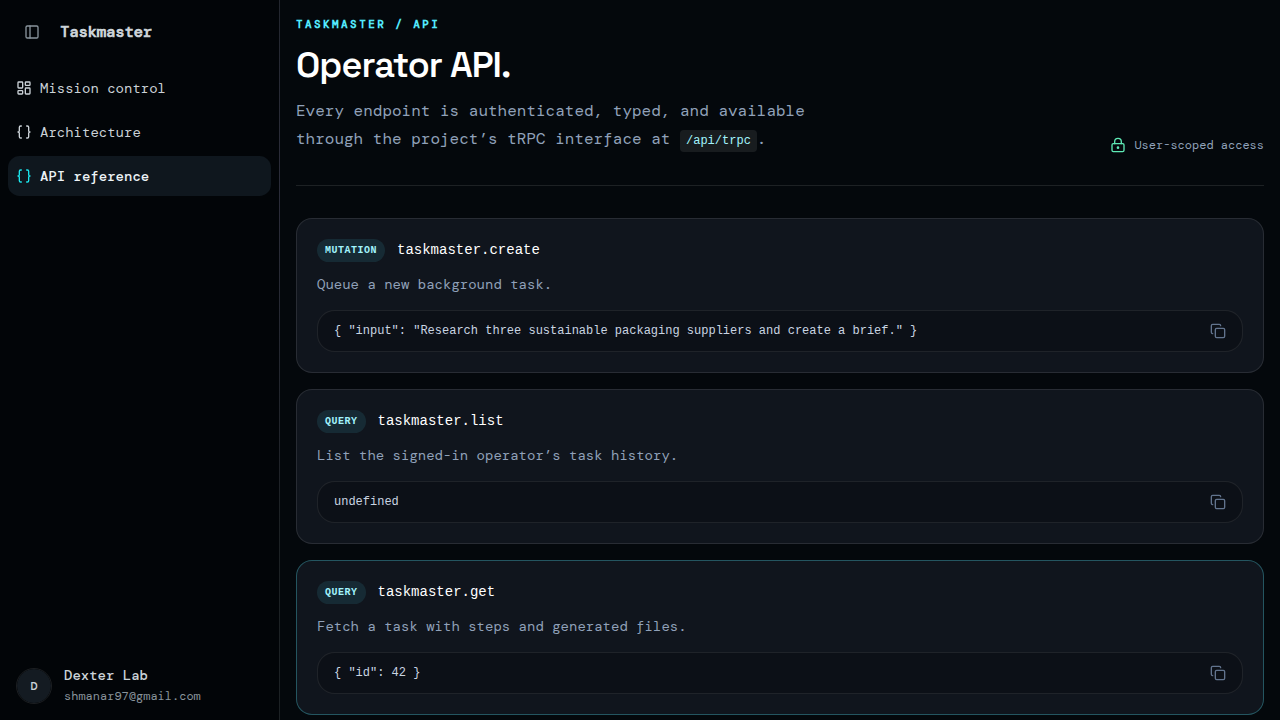
Typed Taskmaster API: create, list, cancel, resume, and inspect durable tasks.
-
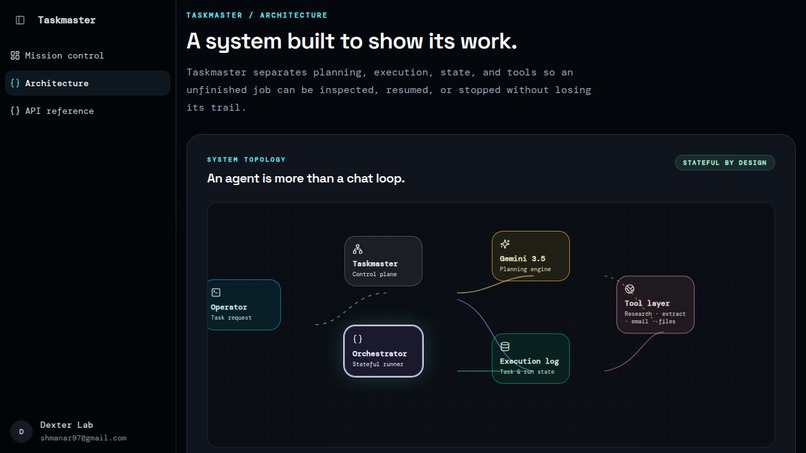
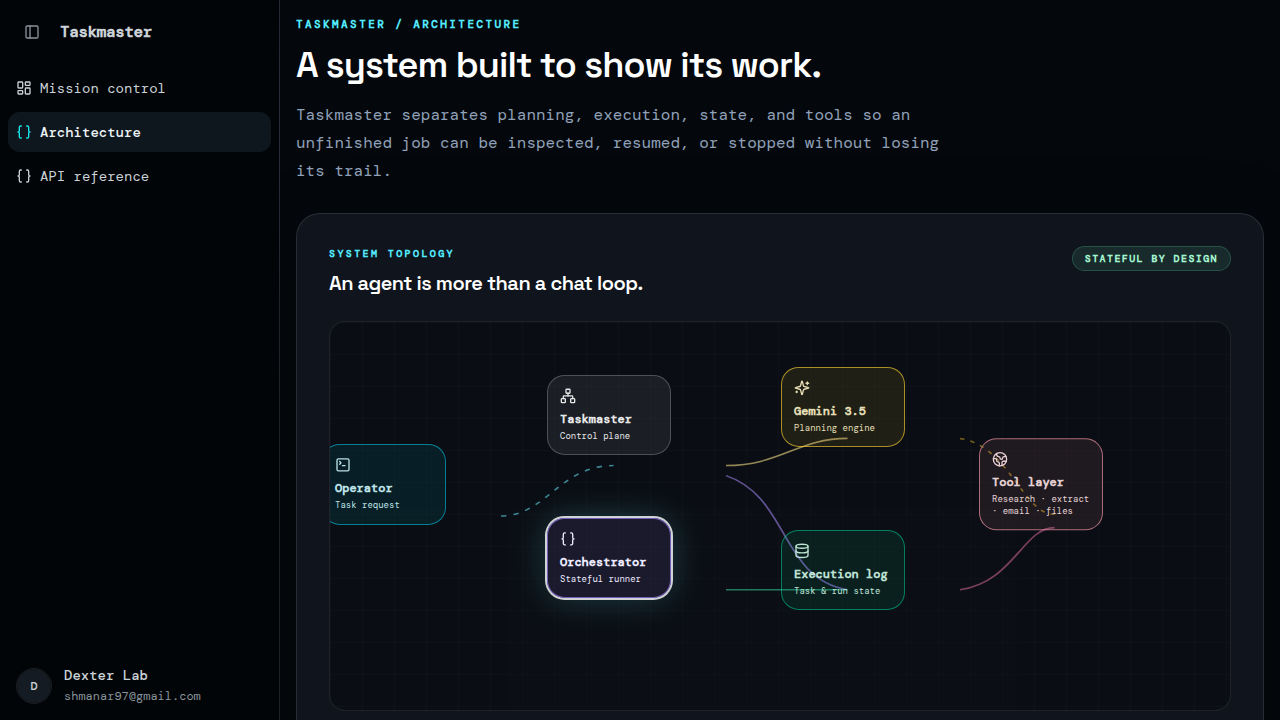
Interactive architecture: operator, Taskmaster control plane, Gemini 3.5, Cloud Run state, and constrained tools.
Inspiration
Most AI tools stop at an answer. For messy, multi-step work, people need an agent that can plan, carry out bounded actions in the background, recover safely, and prove what happened. Taskmaster was built to make that autonomous work visible and controllable.
What it does
Taskmaster is an autonomous AI work console. A user submits a mission and it becomes a durable two-to-five-step plan. The dashboard shows task state, ordered steps, tool activity, outputs, generated files, and controls to cancel or resume execution. The runner persists its plan and completed work so recovery does not duplicate finished actions.
How we built it
The interface uses React, TypeScript, Tailwind CSS, and a typed tRPC API. Express, Drizzle ORM, and MySQL provide durable task state and audit records. Gemini 3.5 Flash uses the official Google Gen AI SDK to create constrained plans, summaries, and source-aware public research. The deployed path runs on Google Cloud Run with Vertex AI service identity access and Google Cloud Storage for generated Markdown deliverables.
Taskmaster only executes registered tools: public research, supplied-text extraction, controlled email drafting or delivery, and Markdown-file creation. Tool inputs are validated, execution is logged, and malformed model plans fall back to safe bounded work instead of failing invisibly.
Challenges we ran into
Background execution on Cloud Run required explicit CPU allocation while a task is active. We also hardened the system against missing tool inputs, model timeouts, truncated planner JSON, and interrupted runs. Generated deliverables are stored through Google Cloud Storage and served through a validated download path.
Accomplishments we're proud of
We verified a live Cloud Run acceptance flow that created a task, cancelled it, resumed it, completed the agent workflow, produced a final summary, and downloaded a non-empty Markdown deliverable. The public video shows the working system, architecture, typed API, recovery controls, and Google Cloud evidence.
What we learned
A useful agent product needs more than a capable model. Making plans, state transitions, tool inputs, outputs, failure reasons, and human controls explicit turns background automation into something users can inspect and trust. The unified Google Gen AI SDK made it practical to keep local experimentation separate from a production-oriented Vertex AI path.
Built With
- ai-agents
- cloud-run
- express.js
- gemini
- google-cloud
- mysql
- node.js
- react
- trpc
- typescript

Log in or sign up for Devpost to join the conversation.