-
-
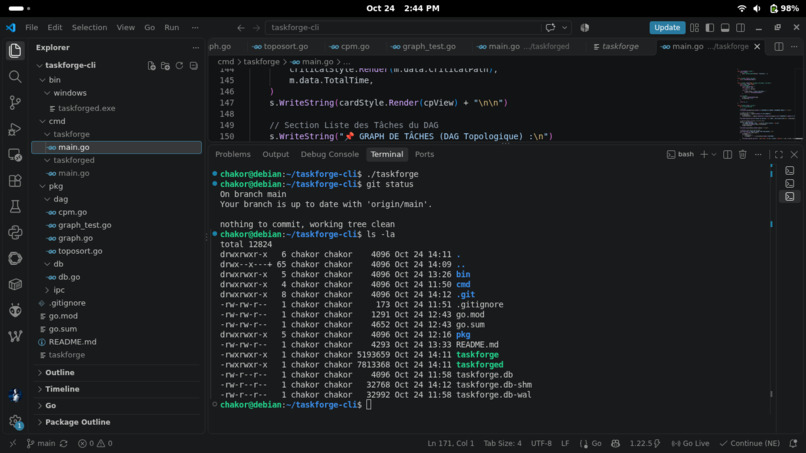
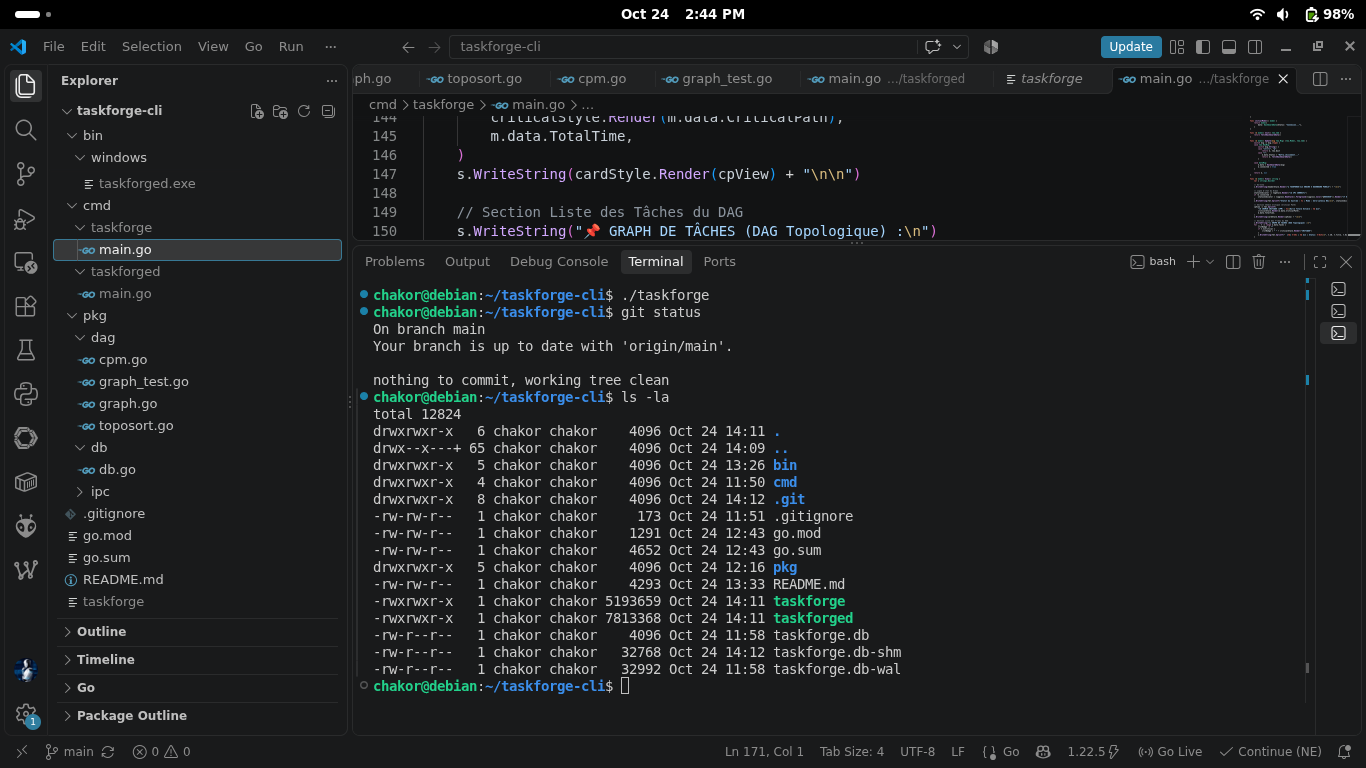
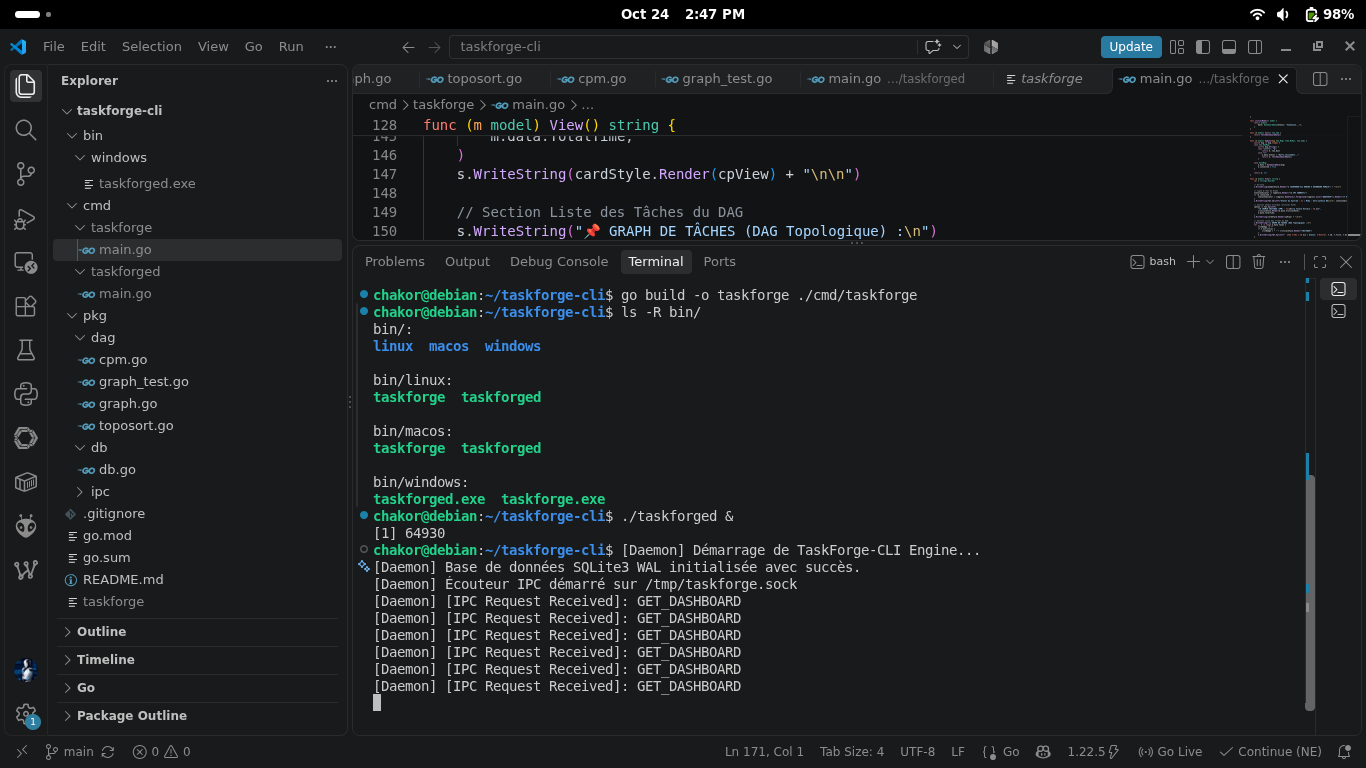
Project structure, multi-platform binaries, and zero-latency Go workspace setup.
-
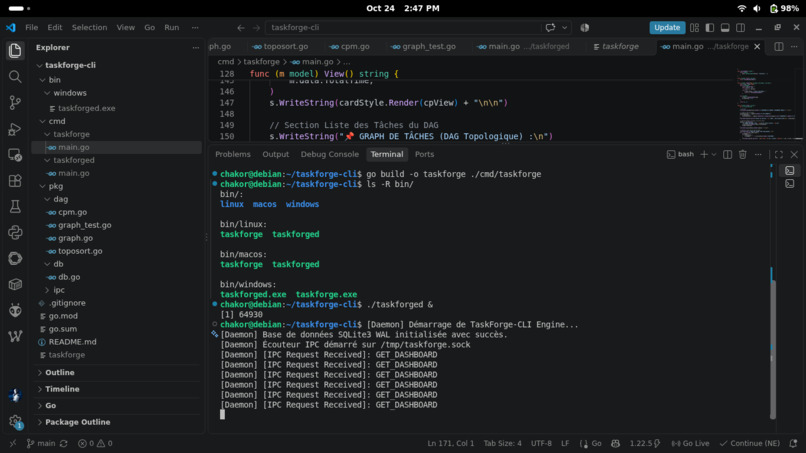
TaskForge daemon initialization, Unix socket listener setup, SQLite3 WAL engine, and real-time IPC request processing.
-
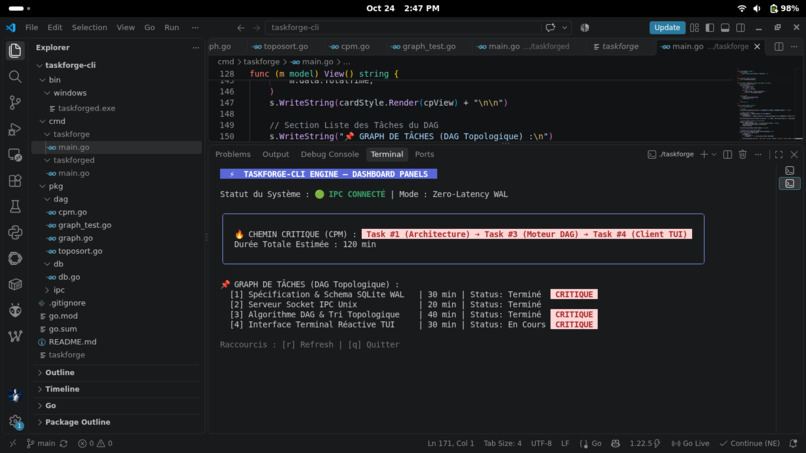
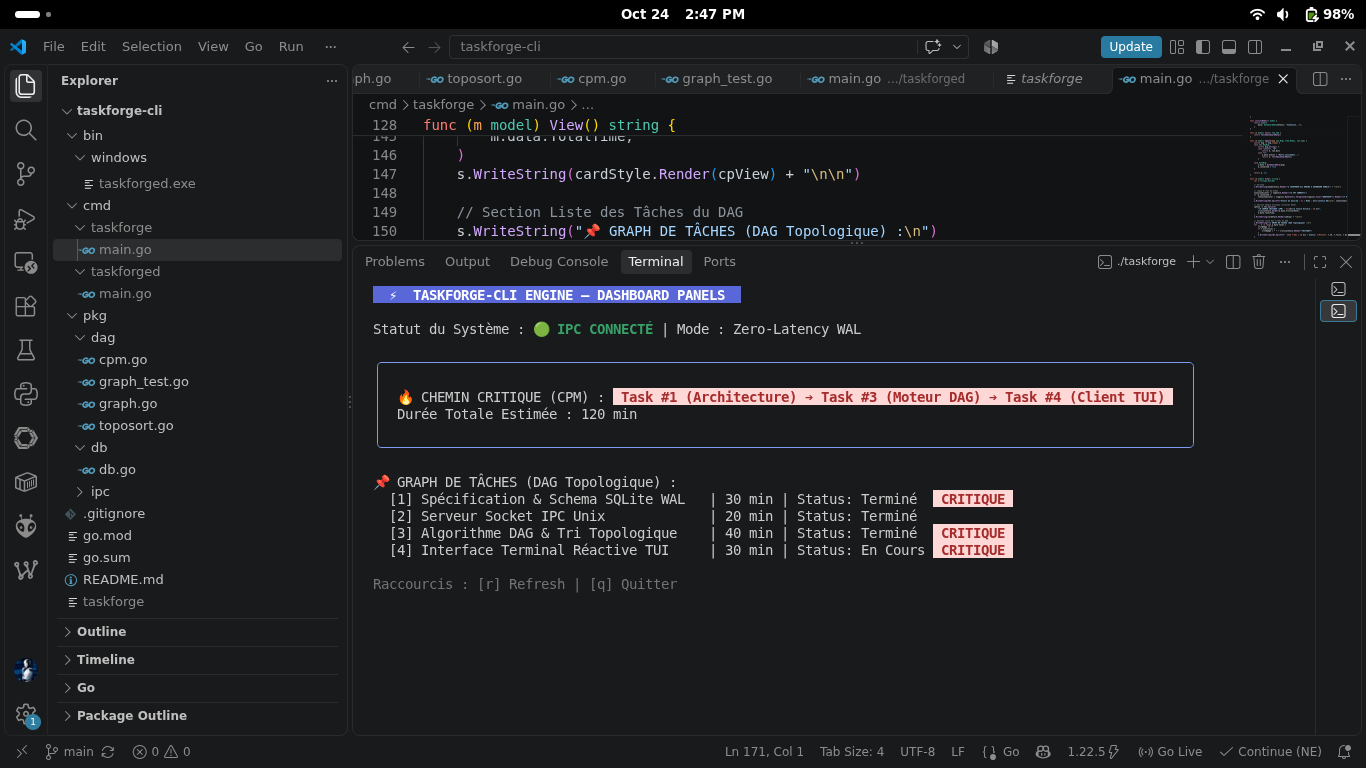
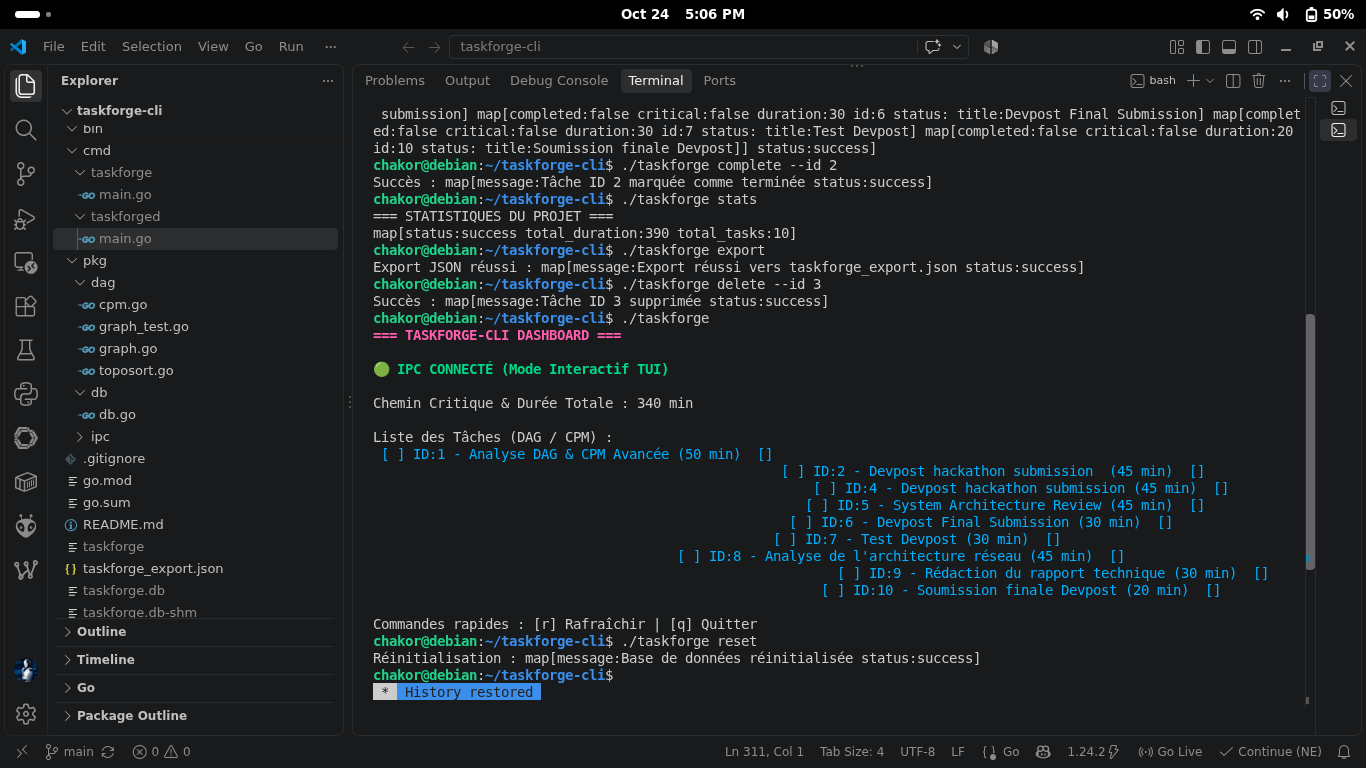
Interactive Bubbletea TUI dashboard with IPC status, Critical Path Method (CPM) calculation, and DAG task graph.
-
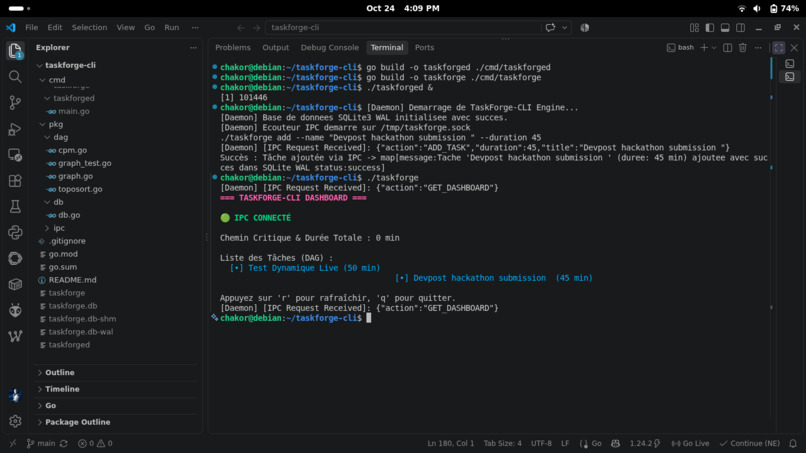
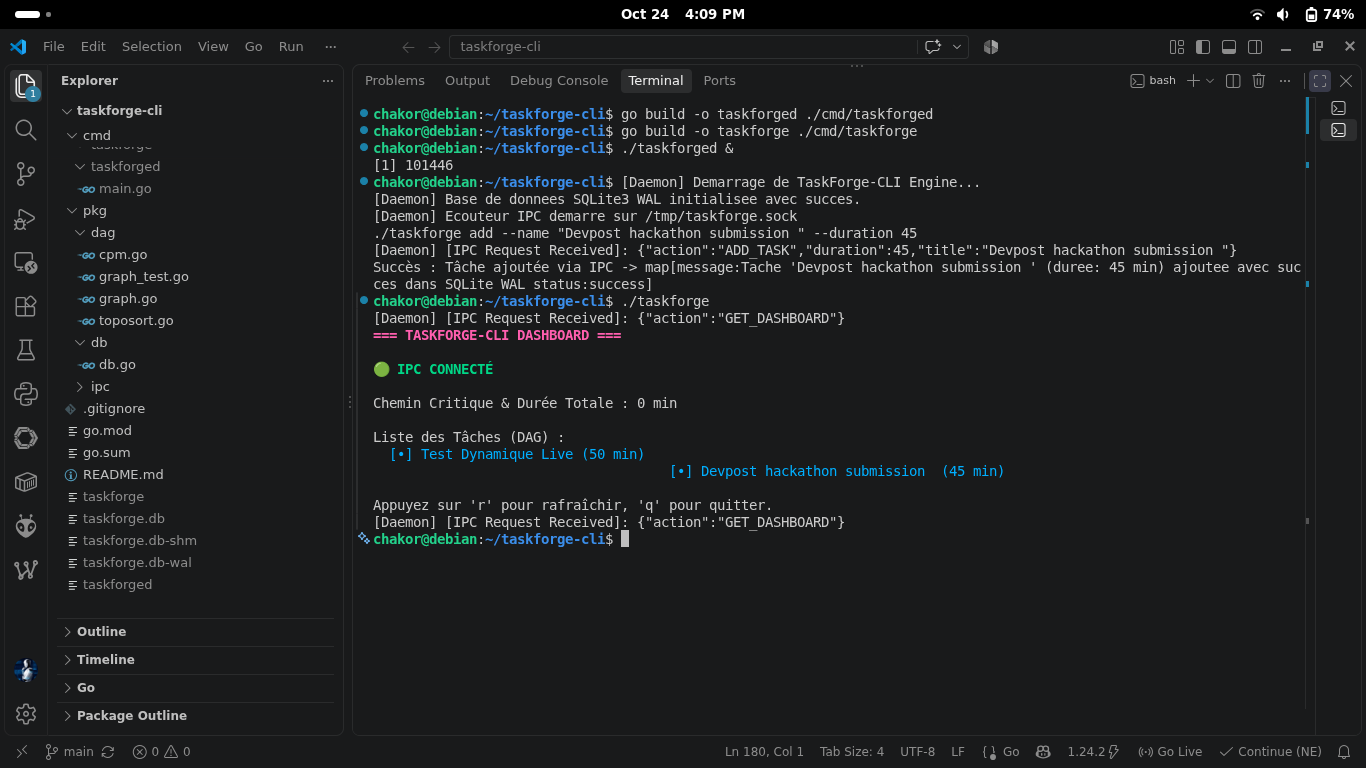
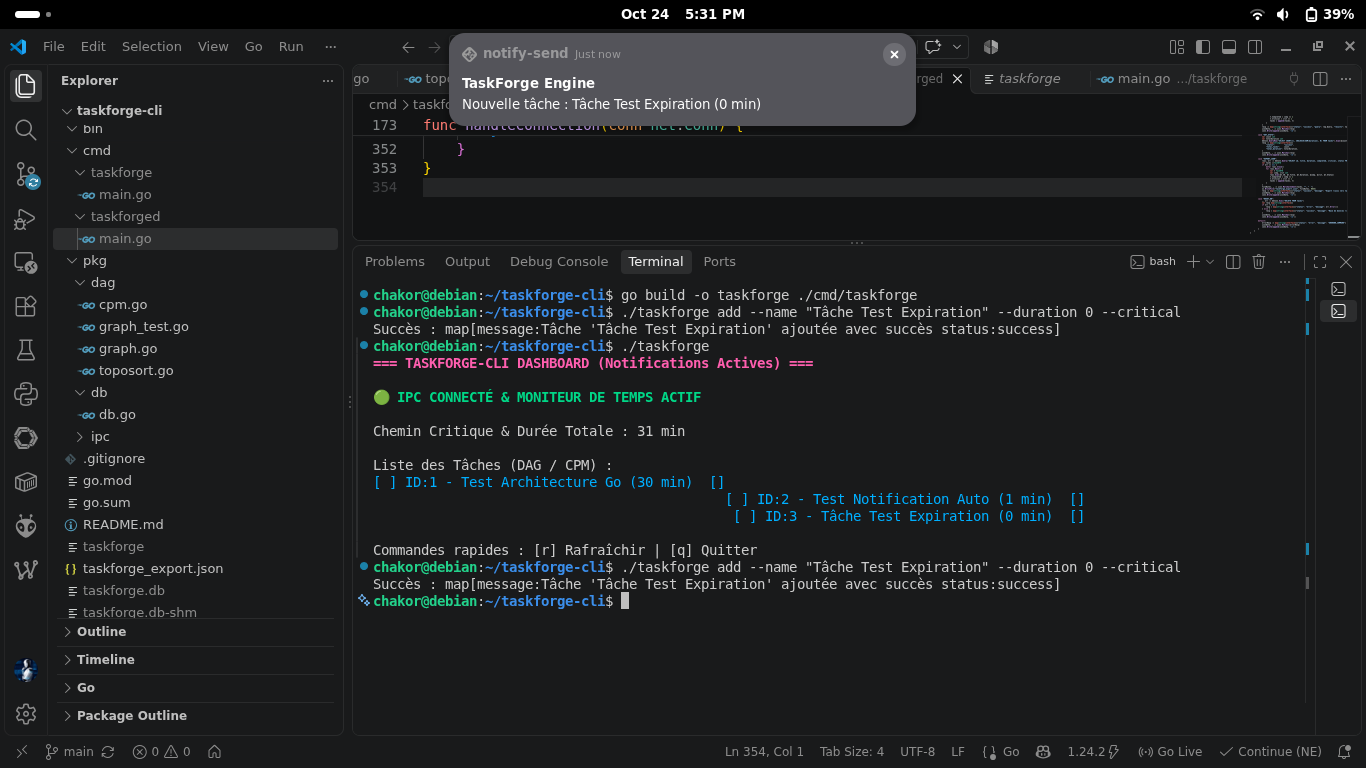
Dynamic task addition via IPC, SQLite WAL persistence, and real-time TUI dashboard update
-
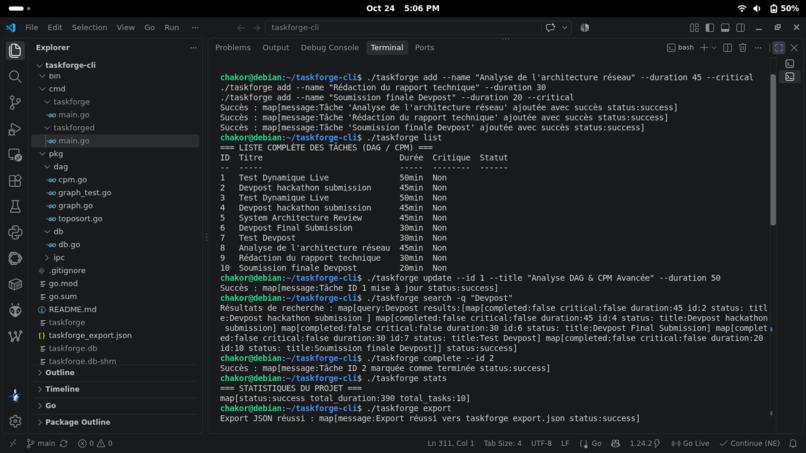
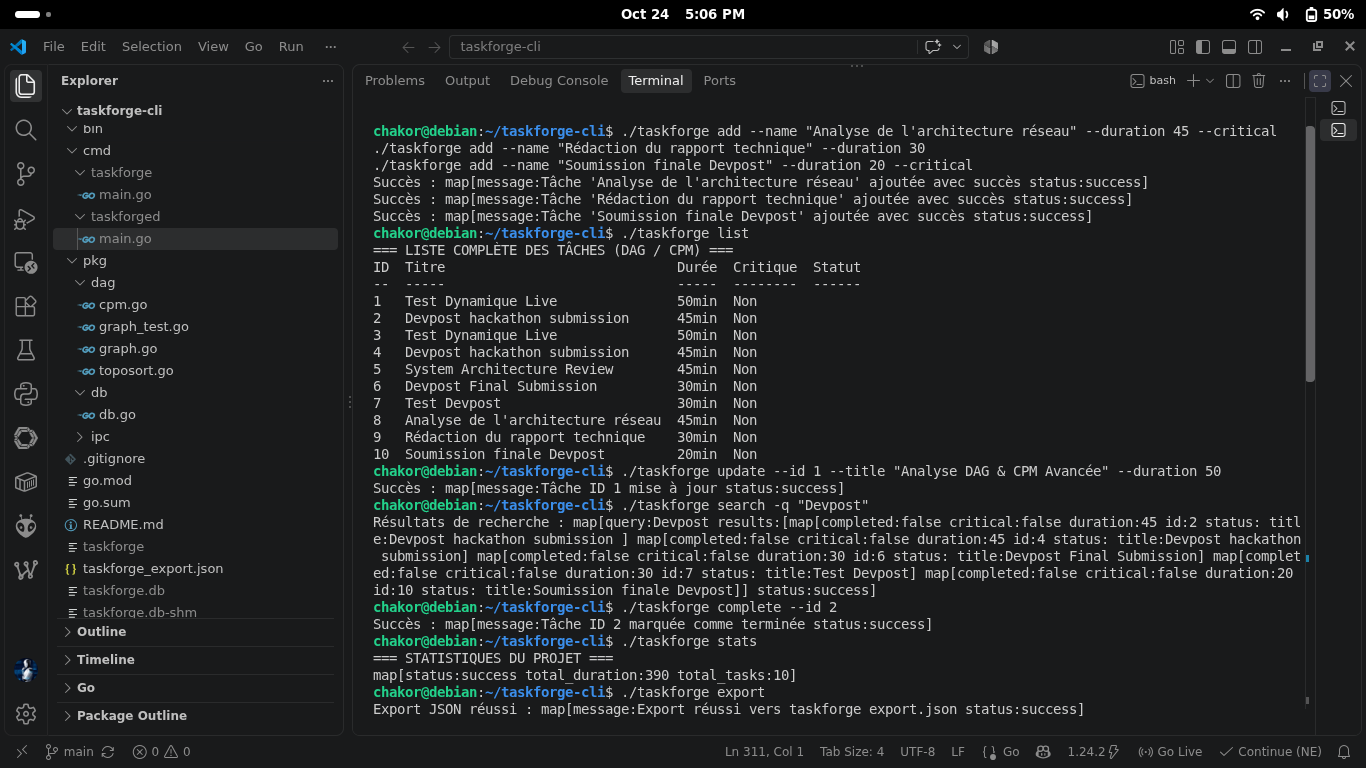
TaskForge-CLI Interactive TUI Dashboard in Action
-
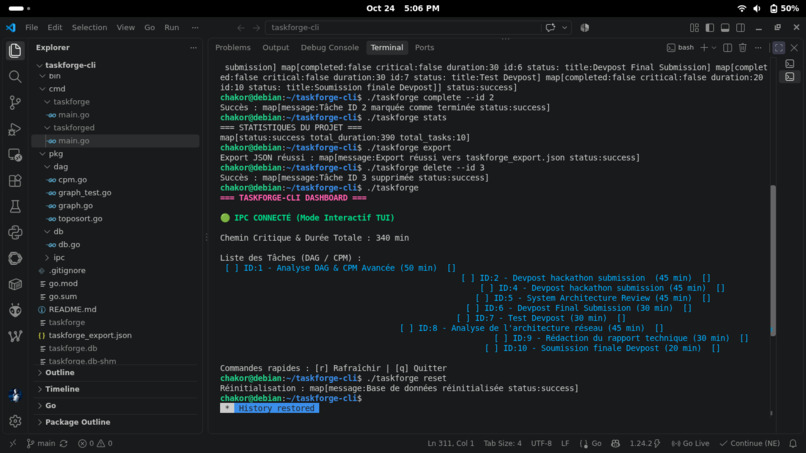
TaskForge-CLI Interactive TUI Dashboard in Action
-
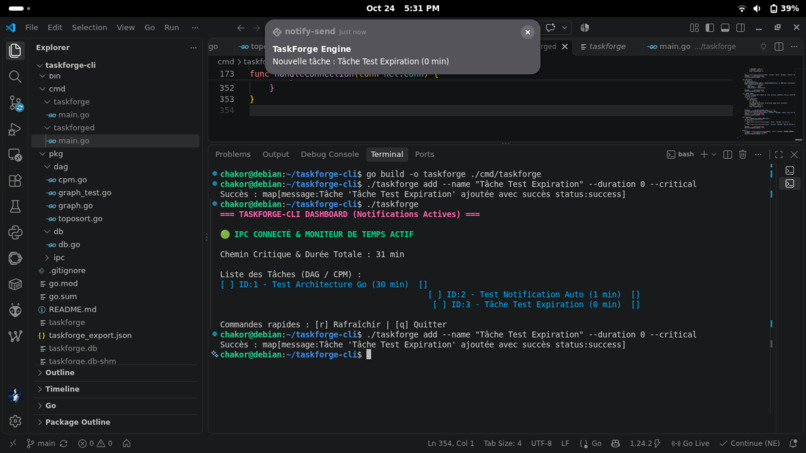
Tâche Test Expiration
Inspiration
Modern developers and system engineers require lightweight, zero-latency task management tools that run natively inside the terminal without relying on heavy web frameworks. TaskForge-CLI Engine was created to bridge high-concurrency Go system architecture with intuitive Terminal User Interfaces (TUI).
What it does
TaskForge-CLI is a high-performance Client-Daemon architecture designed for local task orchestration, focus enforcement, and critical path analysis:
- Daemon (
taskforged): Background concurrency engine executing DAG topological sorting and Critical Path Method (CPM) algorithms. - Client (
taskforge): Interactive TUI built with Charm Bubbletea & Lipgloss. - IPC Communication: Zero-latency bidirectional messaging over Unix Domain Sockets (
/tmp/taskforge.sock). - Resilient Storage: Embedded SQLite3 operating in WAL (Write-Ahead Logging) mode for concurrent, zero-lock atomic state updates. ## How we built it
- Core Engine: Written in Go (Golang) leveraging Goroutines and channels for asynchronous socket listening.
- Algorithm: Directed Acyclic Graph (DAG) with cycle detection and topological sorting to compute the project's critical path automatically.
- Terminal UI: Rendered with
bubbleteaandlipglossfor reactive, non-blocking keyboard navigation. - Build System: Cross-compiled native binaries for Linux (AMD64), macOS (ARM64), and Windows (AMD64). ## Challenges we ran into Handling thread-safe communication over Unix Sockets while maintaining real-time UI state updates without blocking the TUI event loop required careful synchronization using Go channels and context controls. ## Accomplishments that we're proud of
- Built a zero-latency, highly concurrent Client-Daemon system from scratch in pure Go.
- Successfully implemented complex graph theory algorithms (DAG topological sorting and Critical Path Method / CPM).
- Integrated SQLite3 in WAL mode to guarantee atomic, non-blocking data persistence.
- Created a polished, modern Terminal UI (TUI) with real-time reactive feedback via IPC Unix Domain Sockets. ## What we learned
- Advanced concurrency orchestration using Go channels, goroutines, and context management.
- Low-level inter-process communication (IPC) through Unix Domain Sockets.
- Performance optimization and WAL transaction management in embedded SQLite database engines.
- Cross-platform build automation for Linux, macOS, and Windows. ## What's next for TaskForge-CLI Engine
- Distributed lock sync for multi-machine setups.
- Native gRPC transport layer.
- Extended analytics and productivity tracking metrics.

Log in or sign up for Devpost to join the conversation.