-
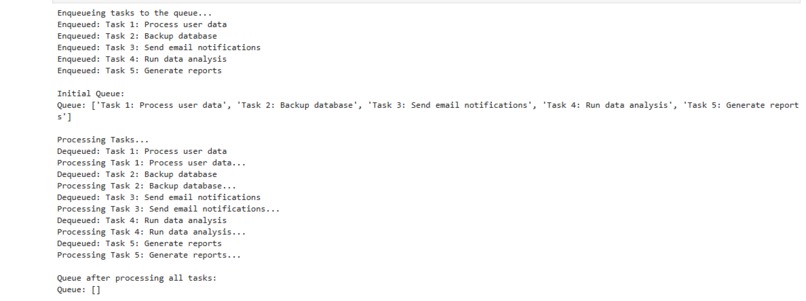
typical data to day task arrangement

Inspiration
The inspiration for this project comes from the need to manage tasks efficiently in both everyday life and complex systems. In real-world applications, such as customer service lines, print job processing, and operating system task scheduling, the order in which tasks are handled can greatly impact performance and user satisfaction. By implementing a queue-based task management system, this project simulates how simple, yet powerful data structures can bring order and efficiency to task processing, demonstrating the practical applications of computer science in solving real-world problems.
What it does
This project implements a task management system using a queue data structure. It simulates the process of managing and processing tasks in the order they are received, following the First-In-First-Out (FIFO) principle. The system enqueues tasks as they are added, processes each task sequentially by dequeuing them, and ensures that tasks are handled in the correct sequence without skipping or delaying any. The project demonstrates the practical application of the queue data structure in organizing and managing tasks efficiently, providing a clear example of how queues are used in real-world scenarios like scheduling, buffering, and task processing systems
How we built it
This project is built by following a structured approach, starting from the conceptual understanding of the queue data structure to its practical implementation in Python. Here's a step-by-step description of how the project is constructed:
- Conceptual Foundation: Understanding Queues: The project begins with a clear understanding of the queue data structure, which operates on the First-In-First-Out (FIFO) principle. This foundational knowledge is crucial, as the entire project is built around this concept, where tasks are managed and processed in the order they are received.
- Setting Up the Environment: The next step involves setting up the development environment using a Jupyter notebook.
- Implementing the Queue Class: The core of the project is the implementation of the Queue class in python which includes: i. init(): Initializes an empty list to store the queue items. ii. is_empty(): Checks if the queue is empty. iii. enqueue(item): Adds a new item to the end of the queue. iv. dequeue(): Removes and returns the item from the front of the queue. v. peek(): Returns the item at the front of the queue without removing it. vi. size(): Returns the number of items in the queue. vii. str(): Provides a string representation of the queue for easy visualization.
- Generating Task Data: A function generate_tasks() is created to simulate a list of tasks that need to be managed. This function returns a list of tasks represented as strings, which are then added to the queue.
- Enqueuing Tasks: The generated tasks are enqueued into the Queue using the enqueue() method. This step simulates the real-world scenario where tasks are added to a queue as they come in.
- Processing (Dequeuing) Tasks: To simulate task processing, a loop is implemented that dequeues each task from the front of the queue and processes it. After each dequeue operation, the state of the queue is printed to visualize the task management process.
- Running and Testing The complete code is run to test the system. The output shows the sequence in which tasks are enqueued, processed, and the final state of the queue after all tasks have been handled. ## Challenges we ran into
- Understanding Queues: Grasping the FIFO principle can be tricky for beginners. *Correct Implementation: Ensuring enqueue and dequeue operations work correctly. *Real-World Integration: Adapting the simple queue to more complex applications.
Accomplishments that we're proud of
This project showcases my ability to implement and apply a simple key data structure, solve problems effectively, and produce clear, well-documented code, reflecting my growth and skills as a programmer.
What we learned
I’ve learned how to create and use a queue for task management, improved my problem-solving skills, and got better at writing clear code and documentation.
What's next for TaskFlow: A Queue-Based Task Management System.
Next, I can expand the project by adding features like task prioritization, creating a user interface, or integrating it with real-world applications. This will help deepen my understanding and make the project more practical and useful.
Built With
- jupyernotebook
- python

Log in or sign up for Devpost to join the conversation.