Inspiration
As undergraduate students at NTU, we constantly wrestle with the hardest part of any assignment: just getting started. Obviously, we all value our careers and academic goals because we think they are the foundation of our future, but the activation energy required to break away from a screen and open a textbook is incredibly steep.
If we look at it as a physics problem, the "doomscrolling inertia" is high, and the barrier to entry for studying feels insurmountable compared to the zero-friction dopamine loop of TikTok or Instagram.
We realised that relying purely on an internal locus of control—sheer willpower and self-discipline—wasn't a sustainable strategy for the modern attention economy. We needed a strict external locus of control to physically force the momentum. However, looking at the current app ecosystem, there is a massive disconnect. We have screen-time blockers that users inevitably bypass or delete out of frustration, and we have dedicated study apps (like Pomodoro timers) that require you to already have the motivation to launch them.
There was no unified system holding students accountable for both. So, we built TaskDeposit to bridge that gap. Instead of just blocking your apps, it uses your social media cravings as the exact trigger to start your study session, enforcing "positive friction."
What it does
TaskDeposit intercepts you when you try to open a distracting app and demands a "deposit" of productive effort before letting you through.
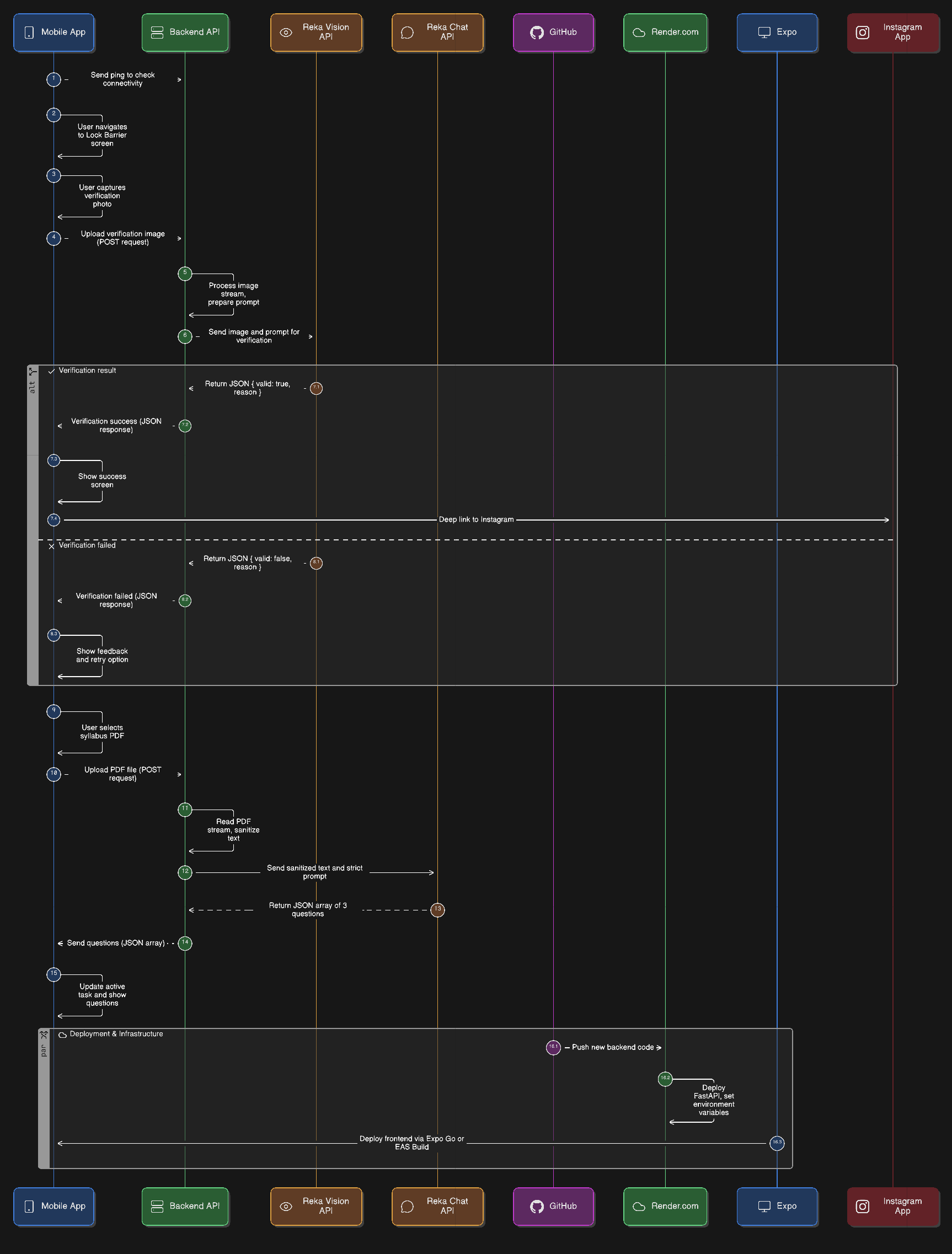
Users upload their actual class syllabus or lecture notes (PDFs). The app's AI generates specific, short-answer questions based directly on that material. To unlock Instagram for 15 minutes, you must handwrite the answer to the generated question on a physical piece of paper and snap a photo. The app's multimodal AI analyzes the image, verifies that it is a legitimate handwritten attempt (rejecting photos of keyboards, blank pages, or random objects), and only then unlocks your screen time.
How we built it
TaskDeposit is a complete, full-stack multimodal pipeline:
- The Frontend: Built using React Native and Expo, utilizing
expo-camerafor hardware-native image capture andexpo-document-pickerfor local file uploads. - The Backend: A Python server built with FastAPI and hosted live on Render.com. It uses
io.BytesIOandpypdfto securely extract text from uploaded lecture materials. - The Brain: Integrated directly with Reka AI. The backend utilizes the
reka-flashmodel via two separate endpoints: the Chat API for text-based question generation from PDFs, and the Vision API for analyzing Base64-encoded image payloads to validate handwritten user attempts.
Challenges we ran into
Building an end-to-end AI mobile app on a tight hackathon clock presented a few massive hurdles, especially when executing the final technical sprints solo:
- AI Payload Formatting: Bridging the gap between file streams from a mobile device and strict AI API requirements was difficult. Reka AI's Vision model required highly specific
[{"type": "image_url"...}]arrays, while the text-generation prompt required sanitized string inputs. Corrupted hidden characters in academic "cheat sheet" PDFs initially caused the API to reject requests, requiring me to build a sanitization step into the Python pipeline. - OS-Level Screen Blocking: True background app interception requires deep native Android permissions (
UsageStatsManagerandSYSTEM_ALERT_WINDOW). Because injecting native Java modules risked breaking the Expo build environment right before the deadline, we engineered a "Proxy Launcher" workaround. TaskDeposit uses React Native'sLinkingAPI to act as a custom home screen wrapper, capturing the intent to open an app, running the AI validation loop, and then deep-linking the user to the native social media app upon success.
Accomplishments that we're proud of
As absolute beginners to coding, we are really grateful for the knowledge gained throughout this hackathon, from the workshops to actually working on the project itself. Our most unforgettable moment was celebrating when we were able to view our app and live edits from the test phone. It felt like such a huge accomplishment especially as novice coders.
What we learned
This project for was a crash course in full-stack architecture. We learned how to move data seamlessly from a native mobile camera sensor, over the internet to a cloud-hosted Python server, pipe that data into an enterprise multimodal LLM, and return a programmatic JSON response that controls mobile UI states. More importantly, We learned how to pivot quickly when hitting technical roadblocks, finding creative engineering solutions to simulate complex OS behavior.
What's next for TaskDeposit
The immediate next step is ejecting from Expo to build the custom Native Android plugins required for true background interception. From there, we want to expand the AI Tutor capabilities to support spaced repetition, tracking which syllabus questions the user struggles with and automatically bringing them back up the next time they try to open YouTube.
Built With
- camera
- documentpicker
- eas-ready
- expo-sdk-54
- expo.io
- fastapi
- react-native-0.81
- rekaai
- render.com
- router


Log in or sign up for Devpost to join the conversation.