-
-
Logo Page
-
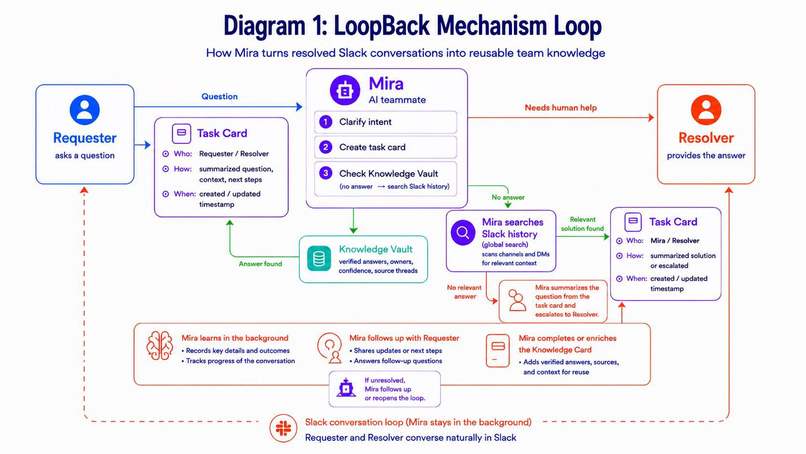
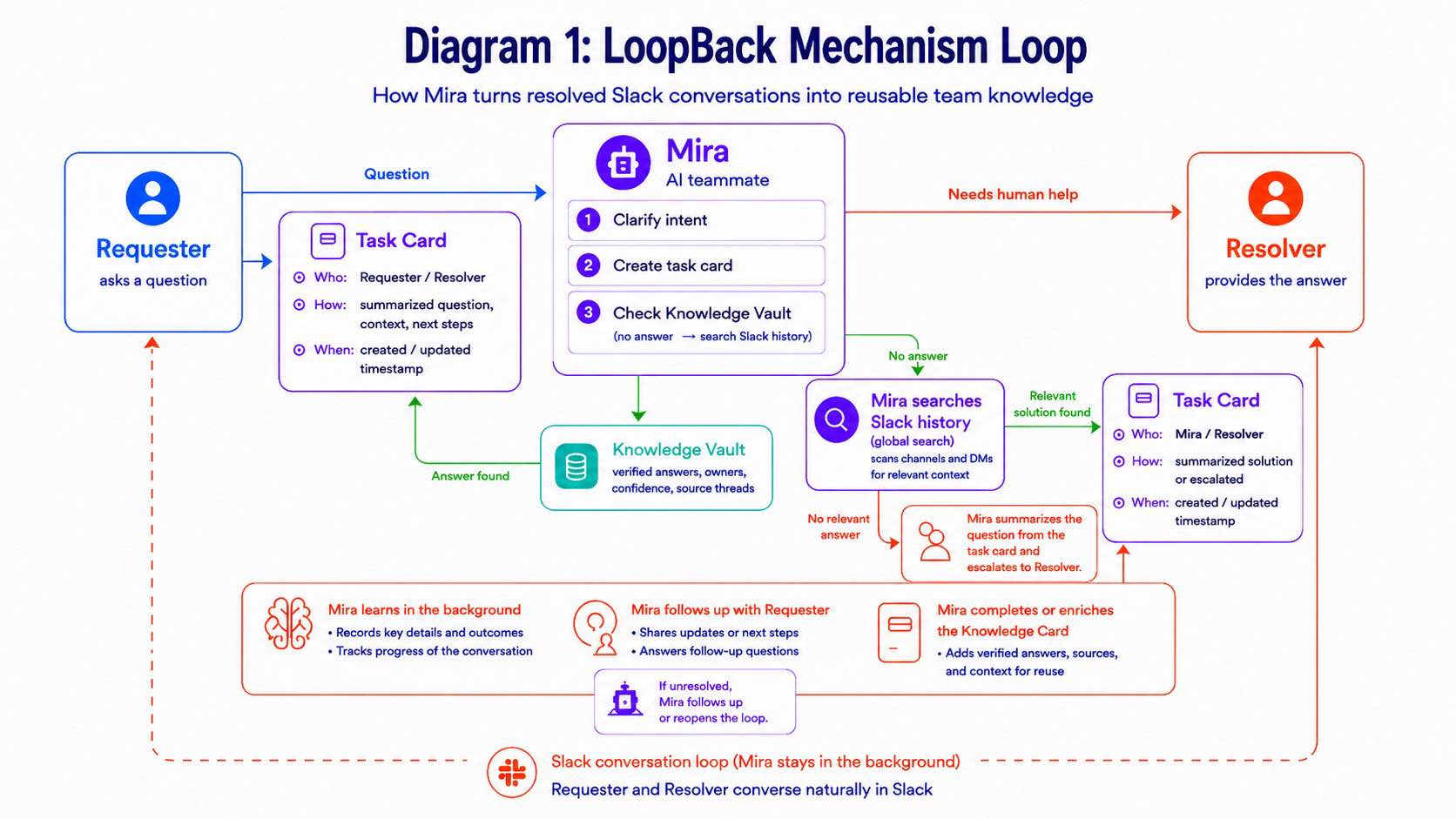
Diagram 1: LoopBack Mechanism Loop
-
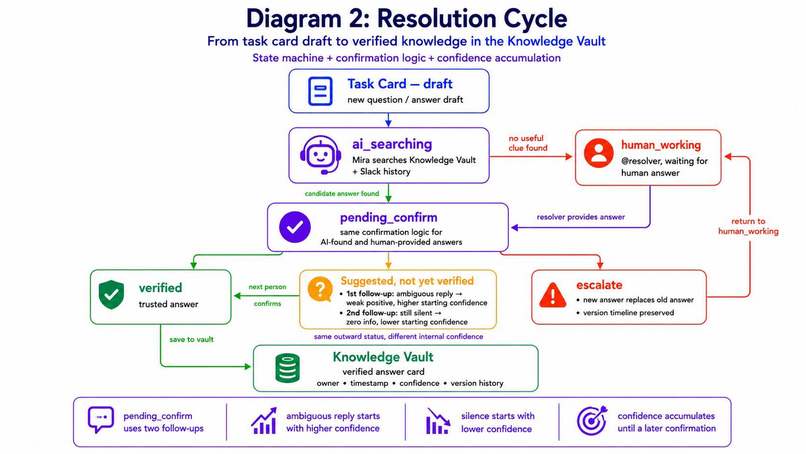
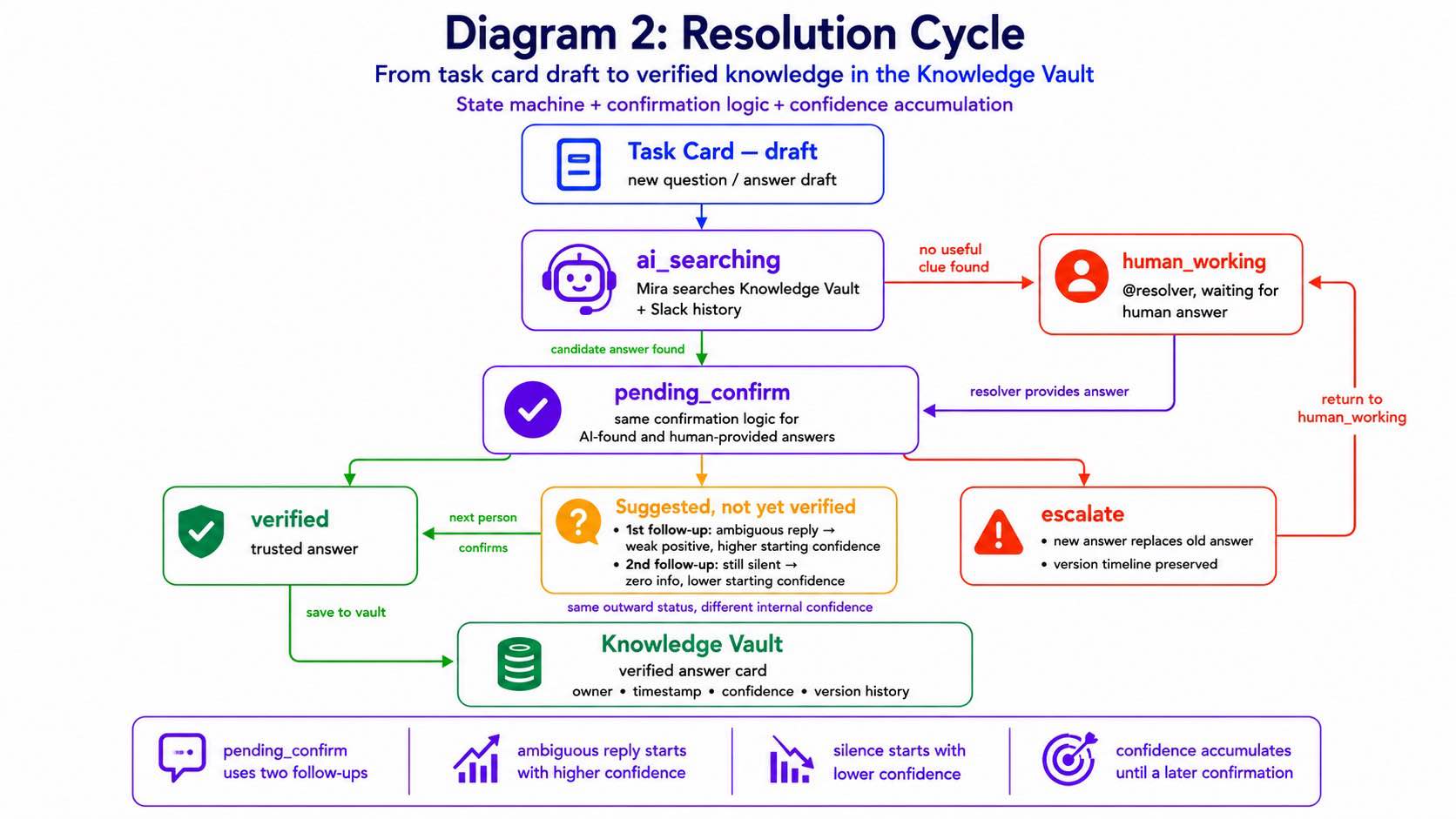
Diagram 2: Resolution Cycle
Inspiration
In Slack, valuable knowledge is created every day, but most of it disappears as soon as the thread goes quiet.
Workplace knowledge often starts with a simple question and a teammate who has the context to answer it. But once the conversation ends, that knowledge is usually buried in a thread. The same questions resurface, the same people are interrupted, and useful explanations never become shared knowledge. That pattern inspired LoopBack: the problem was not a lack of answers, but that resolved answers were not becoming reusable organizational memory.
We also realized that the most trustworthy workplace knowledge often starts with humans. It starts with the context held by the people closest to the work, becomes more reliable when requesters confirm what actually helped, and gains credibility when owners verify what the team should trust. LoopBack combines AI with product mechanisms designed around how workplace knowledge is created, validated, and maintained, helping teams turn everyday conversations into reliable, reusable knowledge that grows stronger over time.
At the center of LoopBack is Mira, an AI teammate in Slack that helps turn resolved conversations into reusable knowledge. With Mira, a useful exchange happens naturally: one person asks, another person answers, and Mira can lightly ask whether that answer should be saved. In both cases, humans remain the source of truth.
LoopBack turns those resolved Slack conversations into human-confirmed knowledge that can be found, reused, and improved over time.
As these conversations accumulate, they reveal patterns in recurring questions, knowledge gaps, and areas that need attention. Repeated questions are not just support load; they can signal problems in a product, document, policy, or process.
Every solved problem should become organizational memory. Every recurring pattern can be leveraged to point to improvement next.
That is the idea behind LoopBack.
What it does
LoopBack turns resolved Slack conversations into reusable, human-confirmed knowledge, while helping teams discover what repeated questions reveal about their documentation, processes, and products.
It combines two components: Mira, an AI teammate in Slack, and the Knowledge Vault, a living knowledge base built from resolved team conversations. Mira supports existing workflows instead of replacing them. People continue asking and answering questions as they always have, while Mira helps valuable knowledge persist.
Mira works in ambient capture mode, following Slack conversations as they unfold. When a question appears, she can surface relevant knowledge, help clarify the issue, and identify useful resolutions for human confirmation before saving them to the Knowledge Vault.
When asked a question, Mira first searches the Knowledge Vault for a verified answer. If none exists, she searches available team context, summarizes relevant information, asks clarifying questions when needed, and escalates to the appropriate resolver if necessary. Once resolved, the conversation can become a new Knowledge Vault entry. [Refer to Diagram 1: LoopBack Mechanism Loop].
Every entry preserves the original discussion and evolves through human feedback. Suggested answers can be confirmed by requesters and verified by knowledge owners, allowing confidence to grow as knowledge is reused rather than treating every answer as equally trustworthy.
As the Knowledge Vault grows, LoopBack begins to identify recurring patterns across conversations. Repeated questions become signals of knowledge gaps, documentation issues, unclear processes, or product friction. These insights appear in the Channel Insights Canvas, helping teams focus on improvements that address root causes instead of repeatedly answering the same questions.
How we build it
The system follows a three-tier resolution flow. Tier 1 retrieves trusted answers from the Knowledge Vault using semantic vector search powered by OpenAI embeddings and Supabase. Tier 2 uses Claude-powered agentic tool use to investigate the question across Slack conversations and the team’s analytics codebase. Slack’s Real-Time Search API provides access to relevant past discussions, while connected tools allow Mira to examine code schemas and metric definitions. Tier 3 flags unresolved questions with a visible “?” status, making knowledge gaps easy for Product Owners to identify without creating unnecessary @mentions.
Knowledge can also be captured from everyday Slack conversations. Through the Events API, Mira follows activity as it happens. When she detects a useful question-and-answer exchange, she can post a lightweight Block Kit prompt asking whether it should be saved to the Knowledge Vault, making knowledge capture part of the existing conversation rather than a separate documentation task.
Trust is built into the system through human feedback. Knowledge progresses from suggested answers to verified entries, with every entry preserving its source thread, version history, and confidence score. This allows AI to support retrieval, investigation, and knowledge organization while humans remain responsible for confirming what should be trusted and reused. [Refer to Diagram 2: Resolution Cycle]
As the Knowledge Vault grows, LoopBack analyzes recurring questions—whether resolved or still open—to surface Channel Insights in Slack Canvas. These patterns help teams identify knowledge gaps, documentation issues, process friction, and product improvement opportunities that no single conversation can reveal.
Challenges we ran into
The hardest challenges were not about connecting Slack, AI, search, and storage. They were about deciding how Mira should behave inside a real team.
We had to design for trust - the confidence of knowledge. Not every answer should enter the Knowledge Vault as verified knowledge. A clear confirmation should strengthen confidence, while silence or ambiguous feedback should keep an answer unconfirmed rather than treating it as either correct or wrong. As an answer is reused successfully across independent conversations, its confidence can grow over time. The challenge was designing a system where knowledge could become more trustworthy through real use—without being careless, overly conservative, or dependent on one person responding every time.
And we had to decide when Mira should step in. Valuable knowledge often appears in ordinary conversations without anyone mentioning her, but a helpful assistant can quickly become intrusive. Mira needed to recognize useful exchanges, ask before saving them, and remain quiet when the signal was unclear.
The central design challenge was finding the right balance: helpful but not intrusive, fast but not careless, and automated without removing human judgment.
Accomplishments that we're proud of
Most knowledge products still rely on someone to document, organize, and maintain them. LoopBack offers a lightweight approach to workspace knowledge management: every question, answer, and confirmation helps shape the Knowledge Vault naturally, almost like training a new teammate through everyday work. Mira helps the team understand each problem, while the team’s real conversations teach Mira how the product, the workflow, and the organization fit together. Over time, the system becomes more useful simply because people continue working the way they already do.
When Claude Tag launched midway through the project, we stepped back, compared the two experiences, and quickly clarified what made LoopBack distinct. Claude Tag is designed to help answer questions. LoopBack is designed to make sure the same question does not need to be answered twice. It remains focused on organizational knowledge—capturing resolved human conversations, turning them into reusable memory, and surfacing patterns that reveal where documentation, processes, or products need to improve.
Finally, we are proud that LoopBack does not stop at answering repeated questions. As resolved conversations accumulate, it turns repeated questions into Enhancement Opportunities, helping channel owners and product owners see where documentation, process, policy, or product experience may need to improve.
What we learned
The biggest lesson was how much thought real product design requires—especially when building inside a tool people use every day. Every button, notification, and interaction in Slack shapes how people work, so even a small feature has to earn its place.
The hardest questions were not technical. Building an AI product like LoopBack taught us that as AI lowers the barrier to creation and makes technology easier to replicate, what endures is thoughtful product design—something built with enough care to know when to help, how to fit into people’s work.
That is why LoopBack does not stop at answering questions; it also turns repeated questions into opportunities to improve the system around them.
What's next for LoopBack
First, keep the Knowledge Vault trustworthy. Building a knowledge base is easy. Keeping it accurate over time is much harder. We want LoopBack to detect Vault decay through usage patterns—for example, when an answer keeps being surfaced but no longer receives positive confirmation. Owners should also have lightweight review workflows to update, re-verify, or retire stale knowledge.
Second, expand from channel-level knowledge to organization-wide memory. LoopBack currently works within individual channels. The next step is helping knowledge move safely across teams—so a solution discovered in Engineering can help Product, Support, or Operations without being recreated. That requires a stronger permissions model. Some knowledge should be shared broadly, while sensitive information from channels like HR or Legal must remain restricted. Cross-channel discovery, with the right access controls, is what turns LoopBack from a channel tool into an organizational knowledge system.
Third, turn Enhancement Opportunities into action. Currently, LoopBack can identify repeated questions and surface them as product signals. Next, we want to streamline what happens after that signal appears. Mira could gather related conversations across support channels, draft a clear problem statement, identify the teams involved, propose an improvement, and help move the work toward implementation—even generating an initial code or documentation draft when appropriate. That is how LoopBack evolves from a system that responds to questions into a proactive knowledge partner—one that not only remembers what the team has learned, but helps the team act on it.
Built With
- anthropic-claude-api
- block-kit
- github-api
- python
- railway
- slack-api
- slack-bolt-for-python
- slack-real-time-search-api

Log in or sign up for Devpost to join the conversation.