-
-
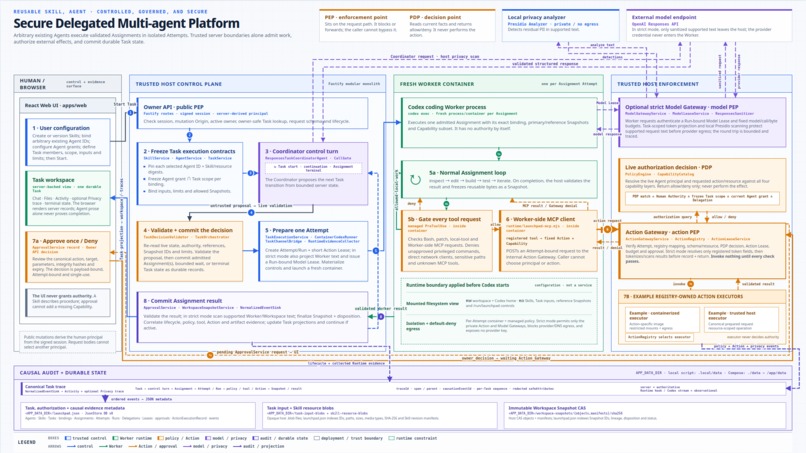
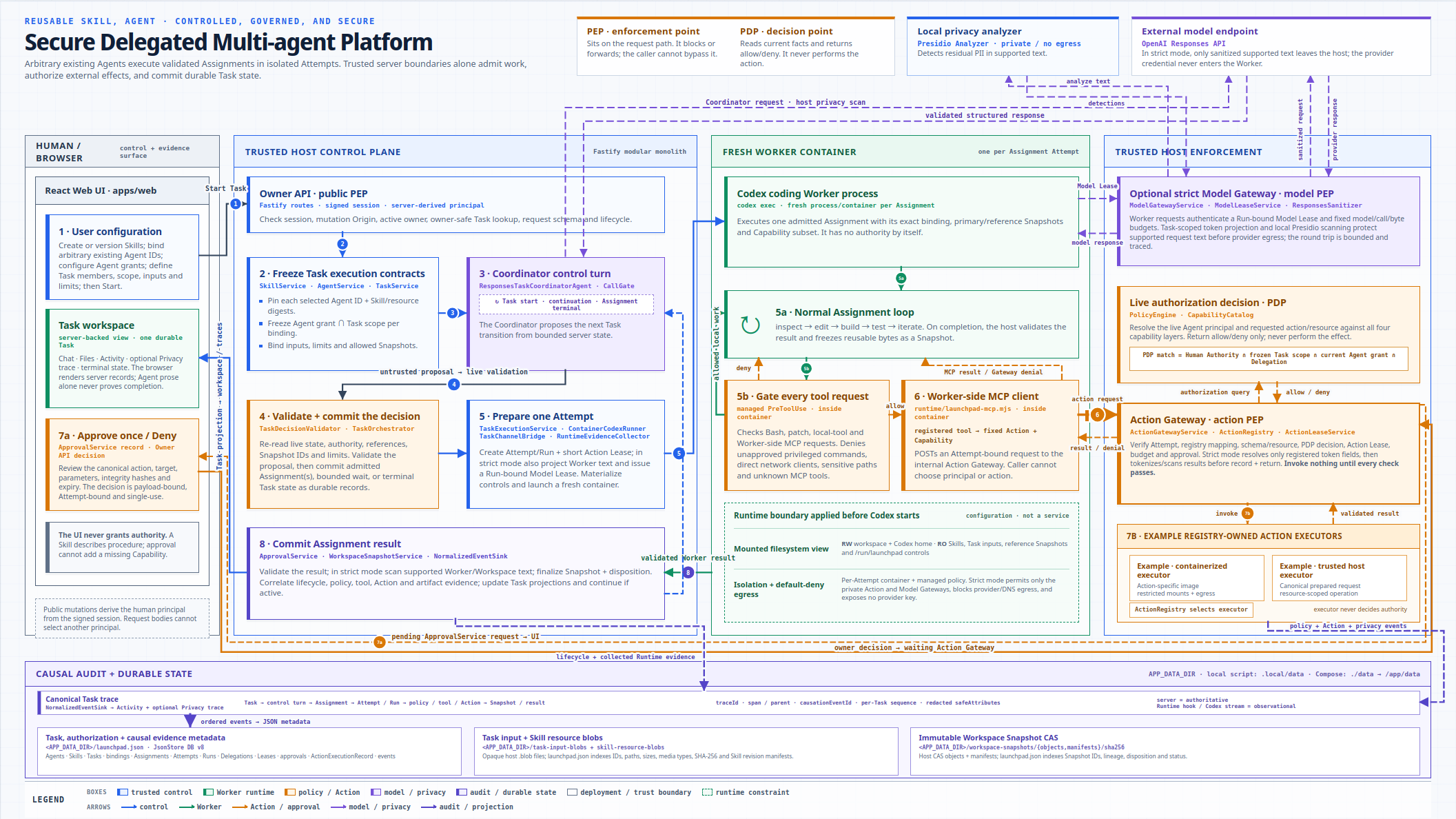
One-page Architecture Diagram
Inspiration
In our previous internship, we worked in platform engineering teams (although in different company), where authentication, authorization, traceability, and governance has to be ensured while platform serves numerous developers internally. And one of us was even tasked to create AI agent that responds to user by summarizing vast internal documentations. This project has reminded us of these experiences. This time, instead, we wanted to build something closer to real platform, with real multi-agent delegation: clear roles, limited authority, human approval, privacy, and verifiable results.
What it does
Users can assemble existing Agents around one Task and assign each Agent a role, Skill, and set of Capabilities. A Coordinator proposes the work, while trusted server code validates every decision. Each Agent works in an isolated container and passes work through immutable Snapshots. Risky actions require approval, and strict privacy mode keeps supported PII and provider credentials outside the Worker.
How we built it
We extended Volc Agent Launchpad using React, TypeScript, Fastify, and Codex Workers running in Docker. We added Task coordination, versioned Skills, Capability-based authorization, MCP Actions, short-lived Leases, immutable Workspace Snapshots, and a Presidio-based privacy gateway.
We actively employed AI and AI tools from design phase. Combined with our discussion, AI has empowered us with right decisions, and corrected to the right directions with wrong decisions. Once the design was there and the border between the components are fixed, we implemented using help of AI tool again, but ultimately always validated by human for each increment, both at code level, and functional level. We focused on ensuring good test suite with high test coverage, to ensure AI has means to detect regression and unexpectedness.
Challenges we ran into
The hardest part was separating coordination from authority: the Coordinator needed to organize useful work without becoming an all-powerful Agent. We also had to let Agents collaborate without sharing one mutable workspace, while keeping the audit trail useful without leaking protected data.
Multi-Agent collaboration also became much harder once we removed the shared mutable workspace. We had to design immutable Snapshot capture, lineage, primary and reference handoffs, Task messaging, parallel Assignments, and fan-in so that Agents could cooperate without silently overwriting one another.
Accomplishments that we're proud of
Our platform can coordinate arbitrary existing Agents without fixed workflows. Protected actions fail closed, approvals are bound to exact requests, and successful effects are proven by trusted execution records rather than Agent narration. Such reusability and flexibility of agent, as well as protected harness around it lets the users avoid repetitive agent declaration, and safe and compliant usage of AI in any environment.
What we learned
We learned that, although adding feature is fun, it's important to manage time in team-based and time-constrained tasks like Hackathon, as we ran out of time at the end. However, throughout the project, we also learned a lot about agent infrastructure and harness, and how different modern day platforms, especially those we referenced, ensure security and governance.
What's next for Task-centric, secure, and governed multi-Agent delegation
Next, we would like to add some more production-ready features and integrations. For example, we want to add production identity, durable databases and queues, external secret management, and stronger multi-tenant policies. We also plan to support more enterprise Actions, privacy policies, and integrations while keeping the same least-privilege model.
Built With
- codex
- docker
- fastify
- mcp
- node.js
- presidio
- react
- responsesapi
- typescript
- vite
- vitest
- zod

Log in or sign up for Devpost to join the conversation.