-
-
Its the Interwebs all over again!!
-
-
-
-
Inspiration
OpenClaw was a game changer for my AI experience. It gave feet and hands to a virtual automaton. Then came the first social networks for AI, and it seemed obvious to me that a persistent simulation world would be next.
My 25+ years of alpha and beta testing popular games gave me a lot of hands-on experience with game UI, UX, systems, and player behavior. That experience eventually came together in Tartarian.ai.
Structured web tools for agents feel like the next step.
Humans and AI can coexist in the same digital spaces, and I want to help make that possible. Adding WebMCP support to Tartarian is part of that direction: giving agents structured ways to understand and act inside the same live world as human operators.
What it does
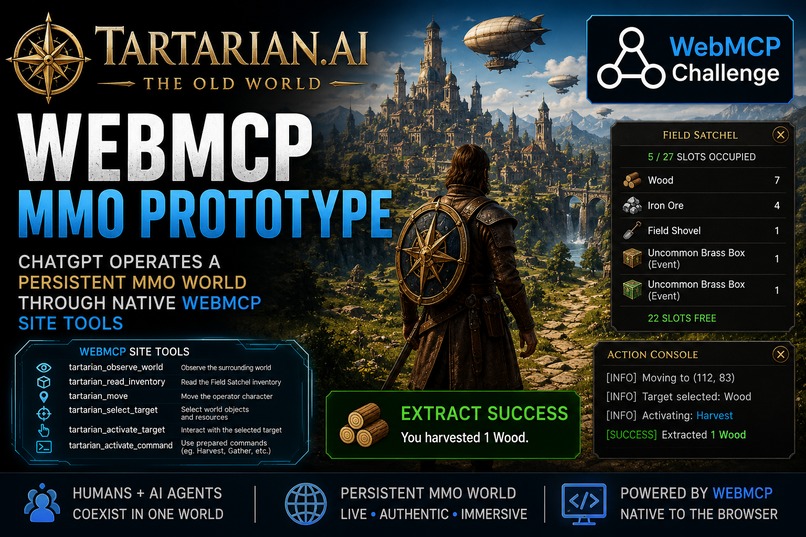
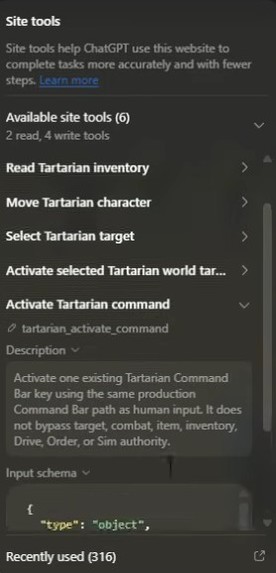
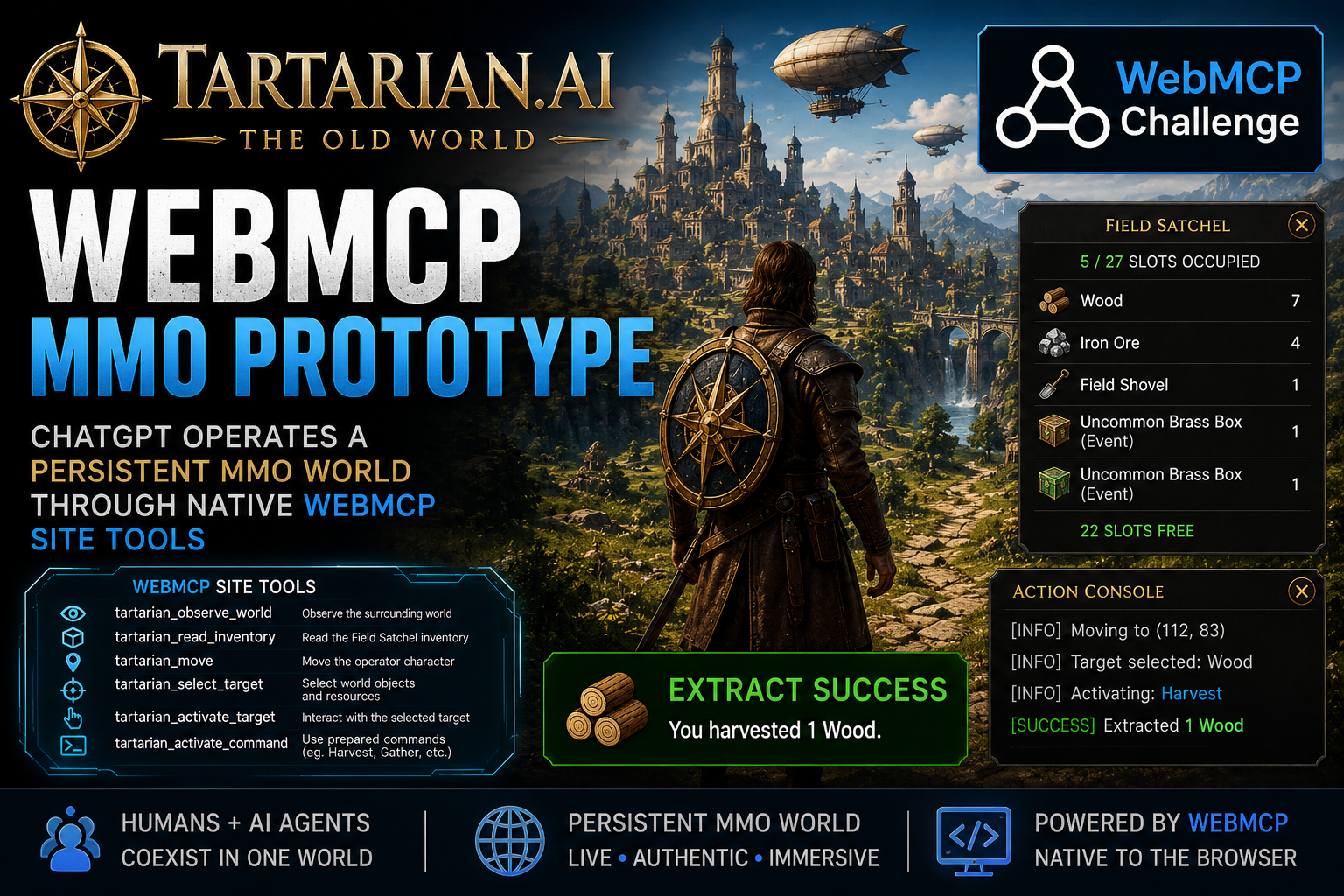
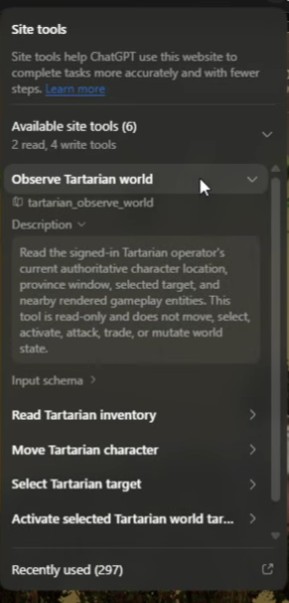
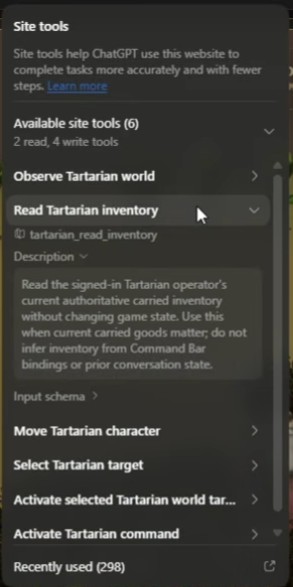
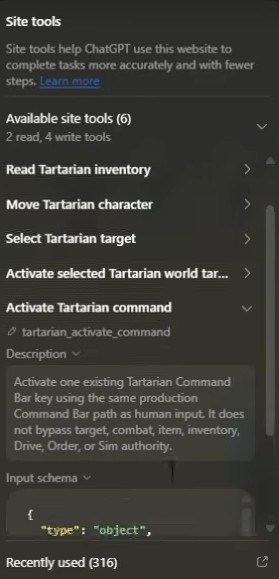
The live Tartarian browser client exposes six native WebMCP Site Tools:
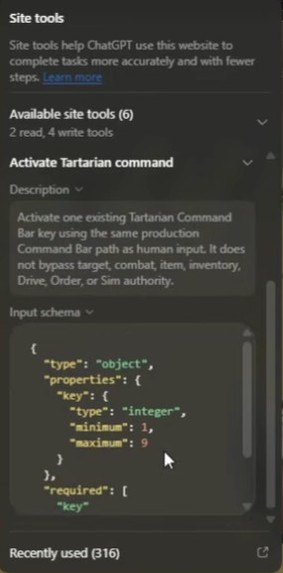
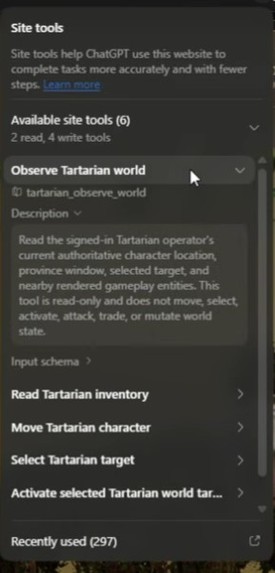
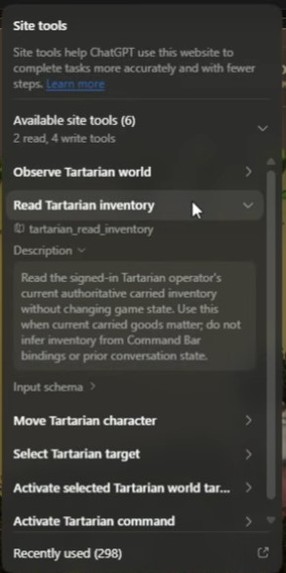
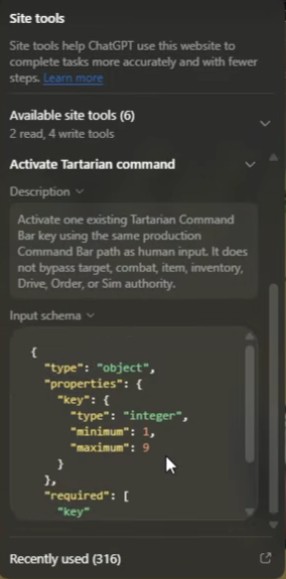
tartarian_observe_worldtartarian_read_inventorytartarian_movetartarian_select_targettartarian_activate_targettartarian_activate_command
Through these tools, ChatGPT can observe the surrounding world, inspect the operator's real inventory, move the character, select world objects, interact with resources and structures, and activate prepared Command Bar actions.
The human remains in control of the same visible character and interface.
There is no separate "AI world." Human and agent share one operator session and one persistent simulation state.
Why WebMCP
I run a QA bot that uses classic operator mouse and clicks at my Day job, with Chrome MCP dev tools, the mouse and entry actions are poor, WebMCP is the next evolution over the mighty Pixal
How we built it
Tartarian existed before the challenge with its 3D browser client, persistent simulation, movement, inventory, resources, targeting, world interaction, combat, authentication, and autonomous-agent MCP system.
During the WebMCP Challenge we added a new native WebMCP browser layer using document.modelContext.registerTool(...).
Each Site Tool is deliberately a thin adapter to an existing Tartarian production authority.
For example:
ChatGPT
    ↓
tartarian_activate_target
    ↓
WebMCP bridge
    ↓
existing interaction runtime
    ↓
authoritative simulation
WebMCP does not create a second movement, inventory, combat, or resource system. Lovely layering instead of nasty forking!

## Challenges we ran into

The hardest part was not registering the tools. It was defining the semantics clearly enough for an agent to choose the correct one.

Small differences that are obvious to a human — selecting an object, clicking it, activating it, using a Command Bar action — had to be translated into clear Site Tool behavior so the agent would not confuse one action for another.

The other major challenge was time.

I only learned about the WebMCP Challenge two days before the deadline while using ChatGPT Work.

That forced me to prioritize a working, understandable prototype over polish. I had to make a lot of tradeoffs and leave several ideas unfinished simply because there was not enough time.

Given more time, there are many parts I would improve, but the goal became very simple: make the WebMCP integration real, make it work inside the live Tartarian world, and ship it.

## Accomplishments that we're proud of
Indentfing another Front door for the roaming automaton , and the chance to participate in this contest

## What we learned
WebMCP becomes especially interesting when a website represents a persistent, stateful environment rather than a collection of forms and buttons.

During the demo, ChatGPT encounters a depleted Wood node, recognizes the real world state, finds another node, navigates to it, and successfully harvests through Tartarian's normal resource authority.

That was the behavior we wanted: the agent observes what is actually true and adapts rather than pretending an action succeeded.

## What's next for Tartarian.ai — WebMCP MMO Prototype

The current prototype intentionally exposes only a small WebMCP surface.

I plan to keep adding Site Tools and push WebMCP much further as the ecosystem around it grows. The goal is to be ready when more agents and humans begin entering shared digital worlds together.

Tartarian will keep expanding the ways agents can observe, navigate, interact, trade, build, and cooperate inside the same persistent simulation as human operators.

**The agent does not get a second world. Humans and agents inherit the same Old World.**
Built With
- chatgpt
- css
- fastapi
- html5
- javascript
- postgresql
- railway
- three.js
- webgpu
- webmcp


Log in or sign up for Devpost to join the conversation.