-
-
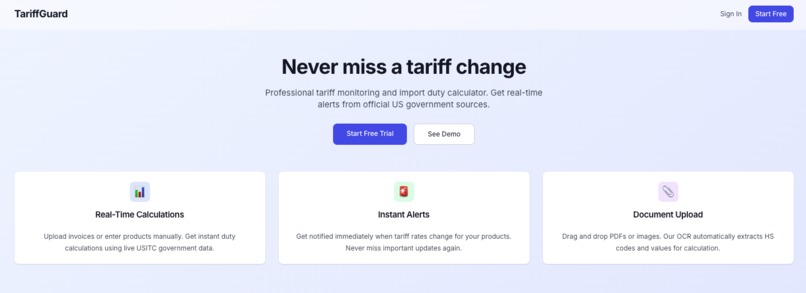
Tarrifguard
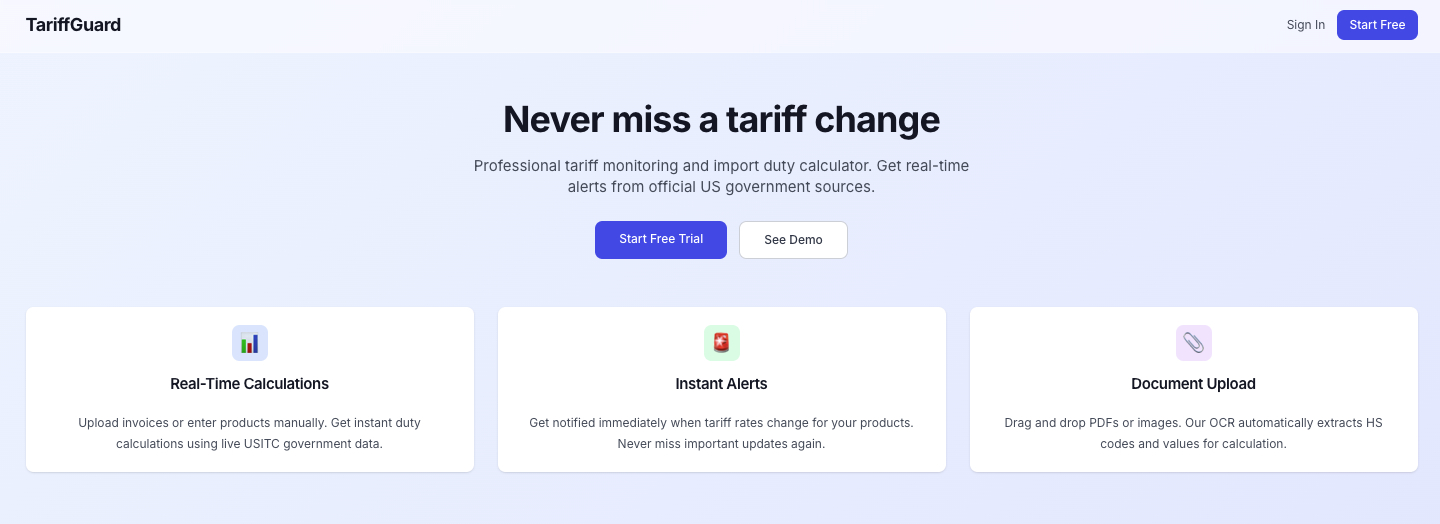
THE PROBLEM WE'RE SOLVING
Global trade has become a minefield for businesses. Since 2018, the US alone has initiated 10 new Section 301 investigations, with 407 active antidumping and countervailing duty orders creating a constantly shifting regulatory landscape. The impact is devastating:
- $144 billion in added manufacturing costs reported by the National Association of Manufacturers
- 87% of small and medium manufacturers forced to raise prices due to tariff uncertainty
- Implementation timelines of 10-15 months mean tariffs can change while your goods are in transit
- Tariff rates ranging from 7.5% to over 3,400% depending on product category and country of origin
- Real companies like Stokes Robotics have faced $168,000 in unexpected tariff costs on a single $200,000 order
The fundamental issue: businesses are flying blind. They can't predict when investigations will convert to tariffs, they can't calculate real-time exposure on active shipments, and by the time they react, it's too late. This isn't just a compliance problem—it's an existential threat to supply chain economics.
WHY TARIFFGUARD? (WE ACTUALLY TALKED TO CUSTOMERS)
Here's what we learned from two procurement business owners that existing solutions completely miss:
The Incumbent Problem
Yes, there are trade compliance platforms out there—Descartes, Amber Road, Thomson Reuters ONESOURCE. But here's what procurement teams told us:
1. "We don't need another compliance tool. We need a decision-making platform."
- Existing tools tell you tariff codes and current rates
- They DON'T tell you which investigations are likely to hit your shipments in 90 days
- They DON'T calculate real-time exposure on goods already in transit
- They're backward-looking compliance checkers, not forward-looking risk intelligence
2. "The enterprise solutions cost $50K+ and take 6 months to implement."
- One procurement director said: "By the time we get Thomson Reuters fully integrated, the tariff landscape has changed three times"
- SMBs are completely priced out of these tools
- The $200 billion tariff tax on small businesses exists partly because they can't afford the tools large companies use
3. "We need to know while goods are on the water, not after they dock."
- Current shipment tracking tells you WHERE your container is
- It doesn't tell you if a Section 301 investigation affecting your shipment just advanced to the next stage
- One owner described scrambling to reroute $2M in electronics when China semiconductor tariffs were announced—but his tracking system never flagged the risk
What Makes TariffGuard Different
Real-Time Investigation Tracking + Active Shipment Monitoring in One Platform
Nobody else connects these two data streams. Existing tools either:
- Track investigations (but don't tie them to your specific shipments), OR
- Track shipments (but don't monitor the regulatory environment)
We built the integration layer that was missing.
Built for Procurement Teams, Not Compliance Lawyers
Designed for SMBs, Scalable to Enterprise
- No 6-month implementation
- No $50K annual contracts
- Works day one with just your supplier list and shipping routes
The Insight That Led Here
Both procurement owners said the same thing: "We found out about tariff changes from our freight forwarder AFTER the shipment already landed."
That's insane. The Federal Register publishes investigation updates. The USTR announces preliminary determinations. The data is public—but nobody built a system that monitors it in real-time AND ties it to specific shipments.
So we did.
OUR SOLUTION
TariffGuard Intelligence is a dual-platform system that transforms how businesses navigate trade uncertainty:
1. Trade Intelligence Dashboard
- Real-time tracking of all Section 301 investigations, AD/CVD cases, and Section 232 reviews
- Predictive analytics based on historical patterns (20% conversion rate for Section 301, typical 10-15 month timelines)
- Country-risk matrices showing active investigations and probability-weighted tariff exposure
- Historical trend analysis covering 407+ active duty orders
2. Shipment Risk Monitor
- Live tracking of tariff exposure for in-transit goods
- Dynamic risk scoring (Low/Medium/High) based on investigation status, route, and timeline
- Cost impact calculator showing potential exposure across different scenarios
- Alternative route recommendations with comparative risk analysis
- Automated alerts when investigations affecting your shipments advance
WHY THIS MATTERS
Small businesses currently bear a $200 billion annual tariff tax according to the US Chamber of Commerce, largely because they lack the sophisticated trade compliance infrastructure of Fortune 500 companies. TariffGuard democratizes that capability.
When tariffs hit, businesses need months to adjust supply chains, renegotiate contracts, and find alternative sources. Our 10-15 month average timeline data shows there is a window to act—but only if you have the intelligence infrastructure to see what's coming.
THE TECHNOLOGY
Built on Next.js/React with TypeScript for maximum reliability and scalability. Real-time data visualization using Chart.js and D3.js. Responsive design works on mobile for supply chain managers in the field. Dark mode because professionals work around the clock. Export functionality for board presentations and compliance documentation.
IMPACT POTENTIAL
If we can help businesses avoid even 10% of unexpected tariff costs, we're talking about $14+ billion in savings for US manufacturers alone. More importantly, we're enabling small businesses to compete globally with the same intelligence tools currently available only to multinational corporations.
Customer validation before we wrote a line of code. That's how you know you're solving a real problem.
This is infrastructure for the new era of trade policy volatility. And we built it in a weekend.
CHALLENGES WE RAN INTO
Data standardization - Government sources publish investigation data in inconsistent formats. The Federal Register uses different HS code formats than USTR notices. We built parsers that normalize across sources, but handling edge cases (especially for multi-year investigations with amended scopes) required significant iteration.
Real-time calculation complexity - Computing risk scores across multiple variables (investigation stage × conversion probability × shipment timeline × product category) while maintaining sub-second response times was harder than expected. We had to optimize our algorithms and implement smart caching.
Making complexity actionable - Trade law is Byzantine. Our initial dashboards were accurate but overwhelming. The breakthrough came from customer feedback: "Don't show me Federal Register citations—show me dollar exposure and alternative routes." We rebuilt the entire UI around decision-making, not compliance.
Time constraints - Building two integrated platforms in a weekend meant ruthless prioritization. We focused on core intelligence workflows first, leaving advanced features like automated route optimization for future iterations.
ACCOMPLISHMENTS THAT WE'RE PROUD OF
Customer validation before we wrote a line of code - We talked to real procurement business owners first. Their feedback shaped every feature decision. One said, "This is what we've been asking our freight forwarder for." That's how you know you're solving a real problem.
Bridging the data gap - Nobody else connects investigation tracking with shipment monitoring. We built the integration layer that turns compliance data into business intelligence—that's genuinely novel in this space.
Democratizing enterprise capability - Tools like Thomson Reuters ONESOURCE cost $50K+ annually. We designed TariffGuard to work day one for SMBs while remaining scalable to enterprise. If we can help businesses avoid even 10% of unexpected tariff costs, we're talking about $14+ billion in savings for US manufacturers alone.
Real-time risk quantification - Our system doesn't just say "tariff risk exists"—it shows exactly what procurement teams need to see with dollar amounts, risk levels, and alternative actions.
Speed of execution - From concept to working dual-platform system in one weekend. The time pressure forced clarity—we built exactly what businesses need, nothing extraneous.
WHAT WE LEARNED
Talk to customers first - Customer validation before building is critical. Our initial concept was different, but procurement owner conversations revealed the real pain point: knowing about risks while goods are in transit, not after they dock.
Complexity is the enemy - Trade law is inherently complex, but our job is to absorb that complexity and output simple decisions. The best features turn 50 pages of Federal Register notices into "High Risk - Act Now."
Integration is harder than features - Building investigation tracking is straightforward. Building shipment monitoring is straightforward. Connecting them in a way that produces reliable, real-time risk scores across hundreds of product categories and routes—that's where the engineering challenge lives.
The window exists - When tariffs hit, businesses need months to adjust supply chains, renegotiate contracts, and find alternative sources. Our 10-15 month average timeline data shows there is a window to act—but only if you have the intelligence infrastructure to see what's coming.
WHAT'S NEXT FOR TARIFFGUARD INTELLIGENCE
Automated route optimization - Beyond recommending alternatives, we'll build an engine that automatically calculates optimal routing across cost, timeline, and risk variables.
Predictive investigation modeling - Use ML to predict which product categories and countries are likely targets for NEW investigations based on trade volume patterns, political signals, and historical precedent.
API and integrations - Connect TariffGuard directly to ERPs, freight management systems, and customs brokers so risk intelligence flows automatically into existing workflows.
Regulatory expansion - Extend beyond US tariffs to EU, UK, and other major trade regimes. Global businesses face trade uncertainty everywhere—we can be the intelligence layer for all of it.
The vision - TariffGuard becomes the operating system for trade risk intelligence—the platform every business checks before signing a supplier contract, placing an order, or routing a shipment. We're enabling small businesses to compete globally with the same intelligence tools currently available only to multinational corporations.
Built With
- claude
- next.js
- qdeveloper
- supabase
- typescript
- vercel


Log in or sign up for Devpost to join the conversation.