-
-
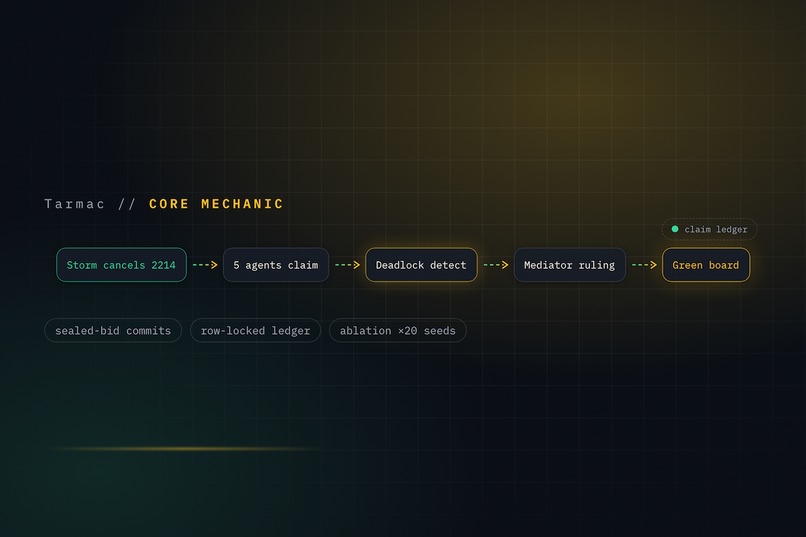
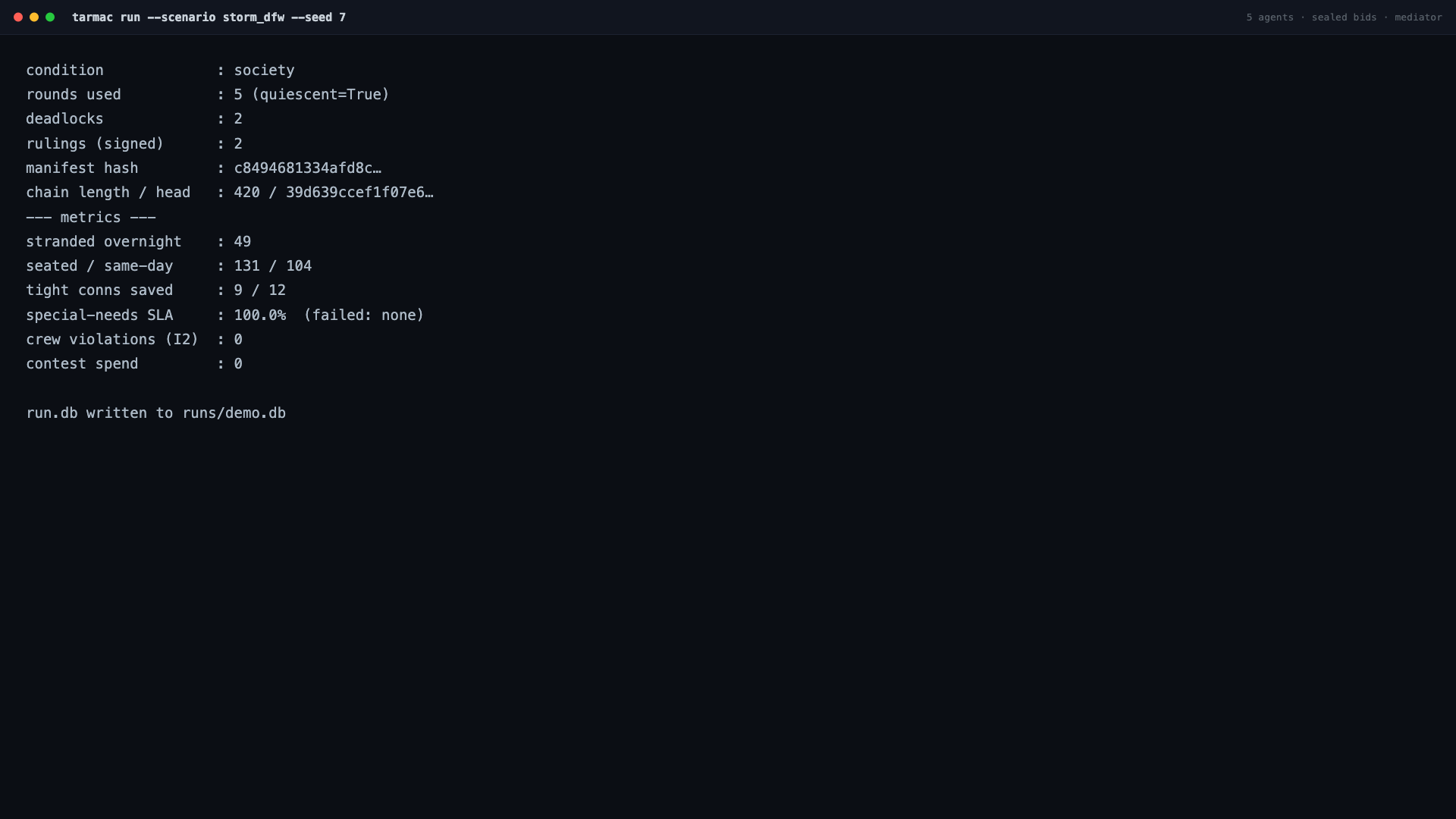
Overview: the problem and the society at a glance (five conflicting agents over a scarce seat ledger).
-
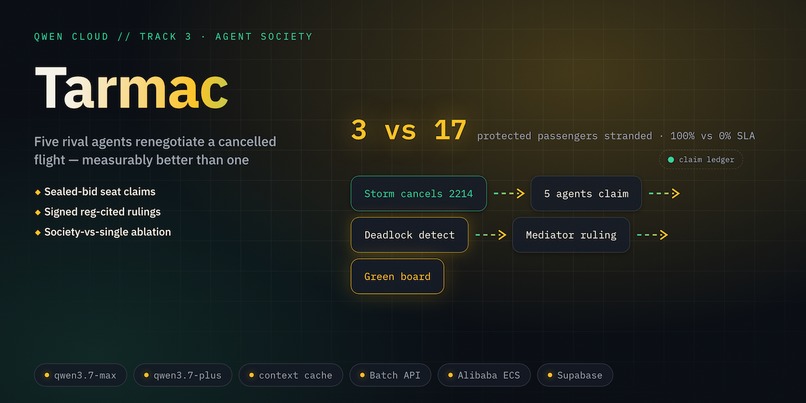
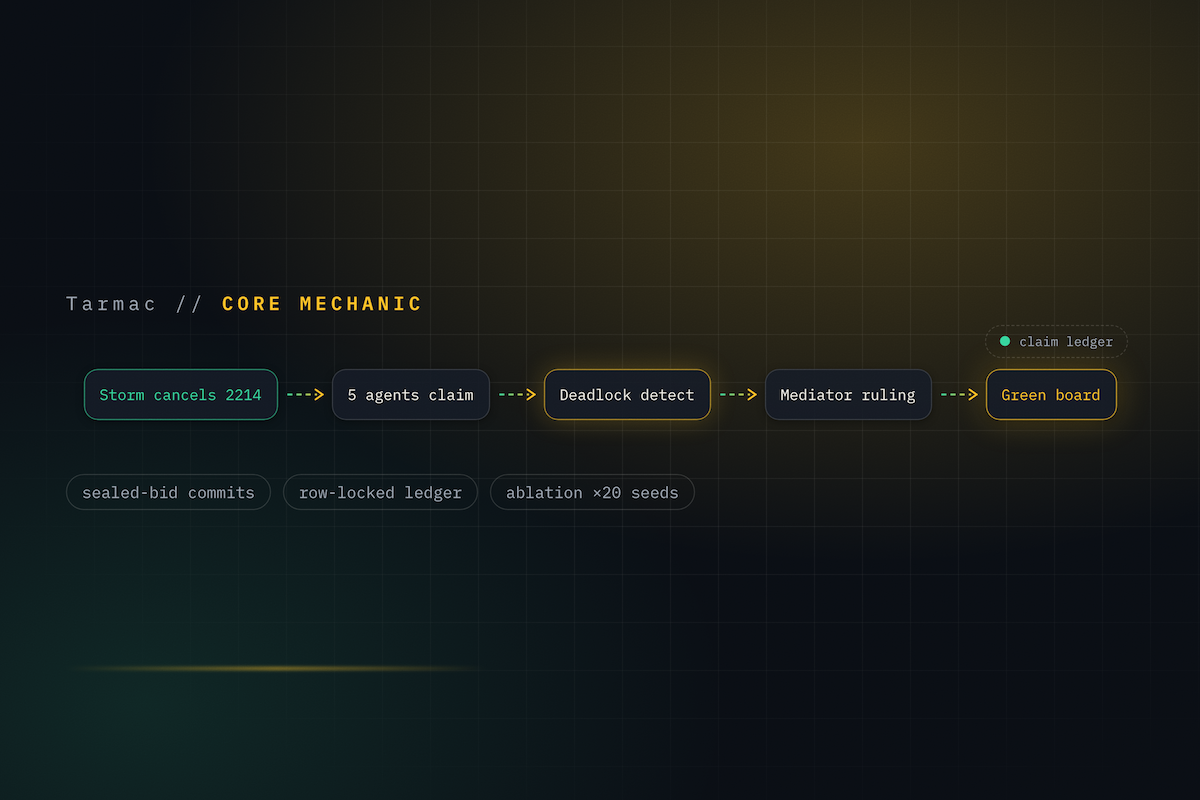
Architecture: negotiation flow — sealed bids → row-locked ledger → deadlock → signed mediator ruling → hash-chained log.
-
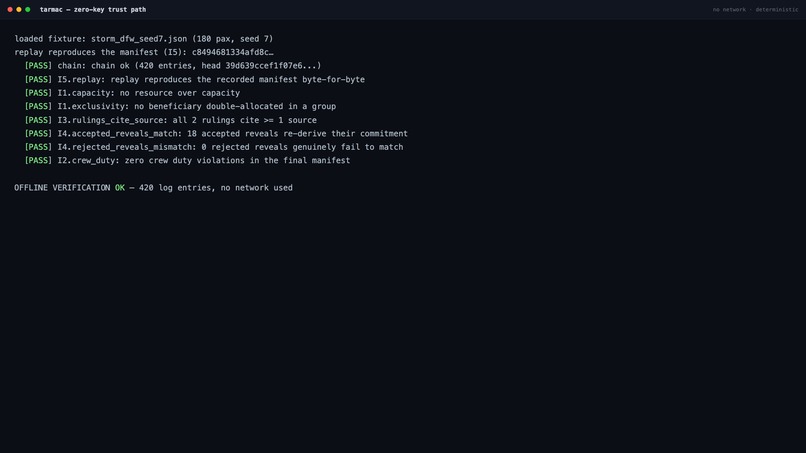
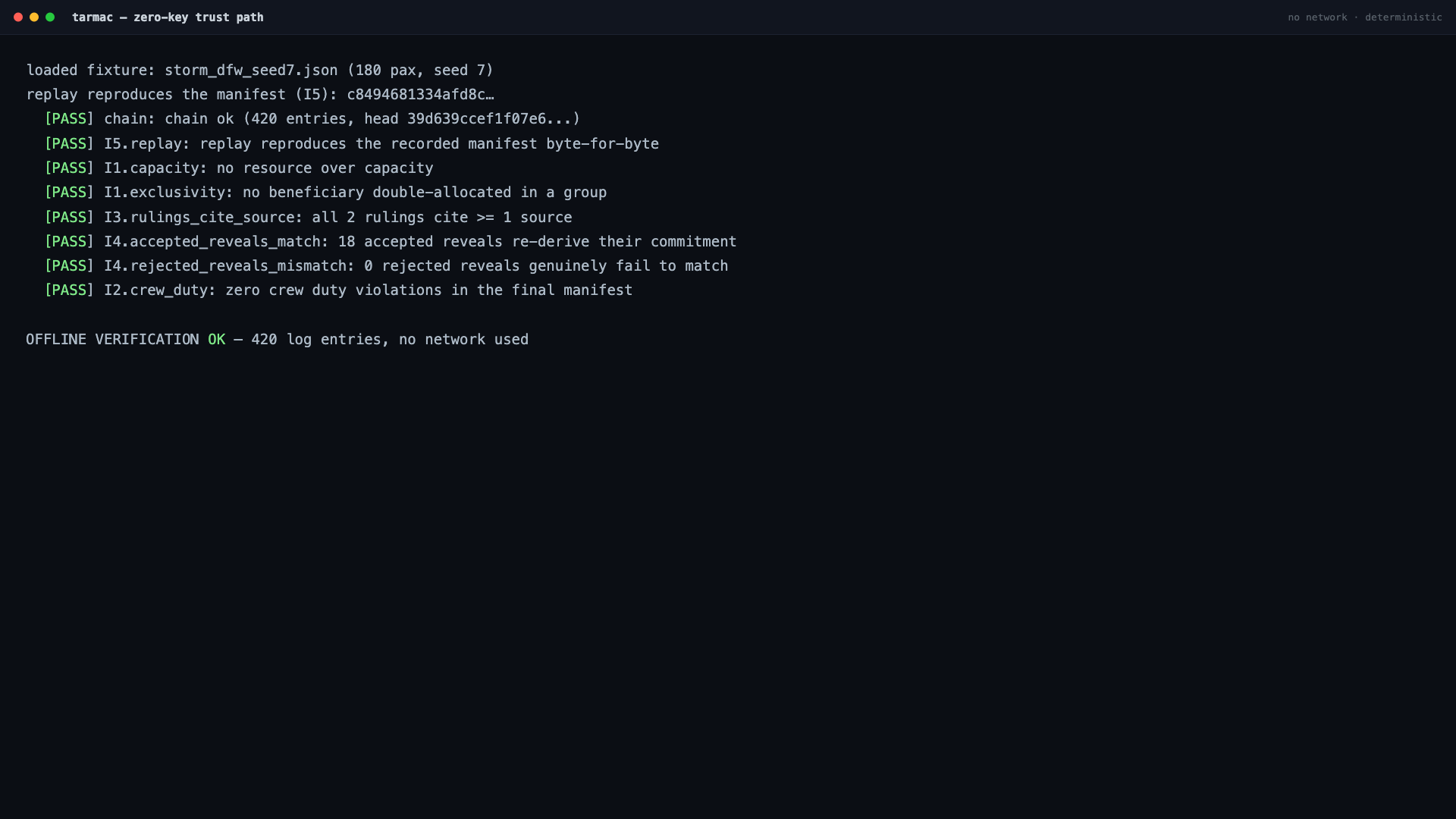
Offline, zero-key run: the deterministic society negotiating with no API key, byte-identical every time.
-
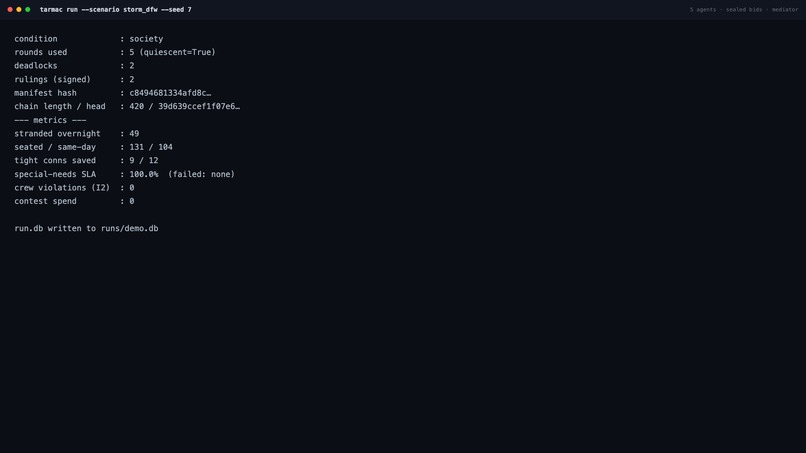
Negotiation close-up: sealed-bid commit/reveal and contested claims resolving on the ledger.
-
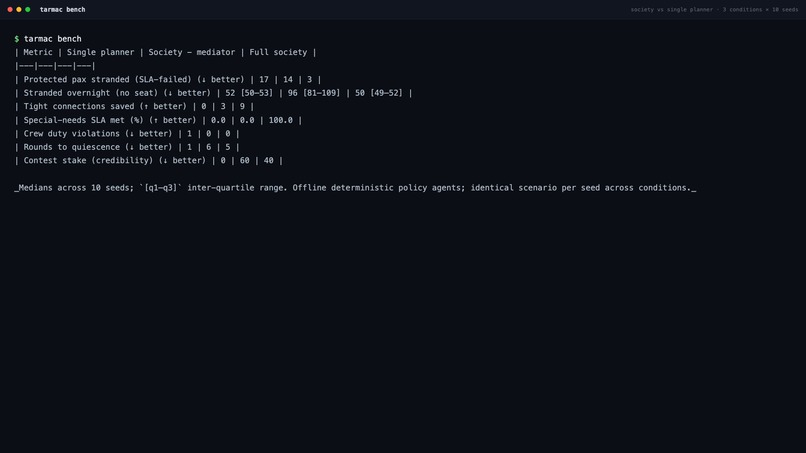
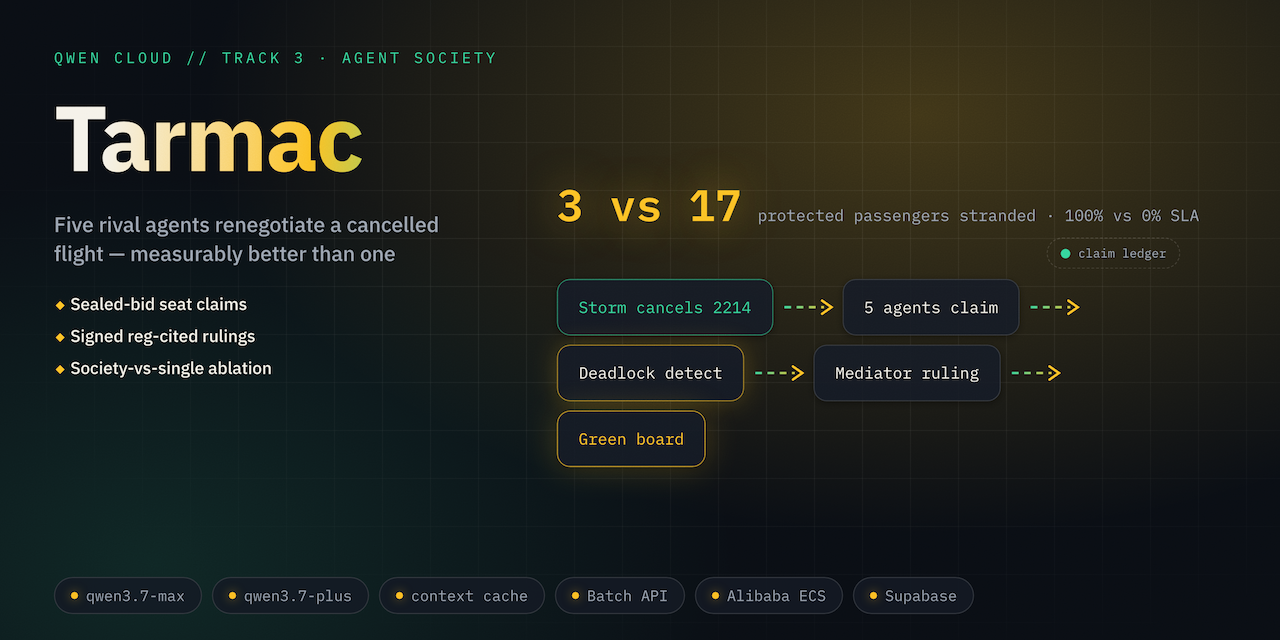
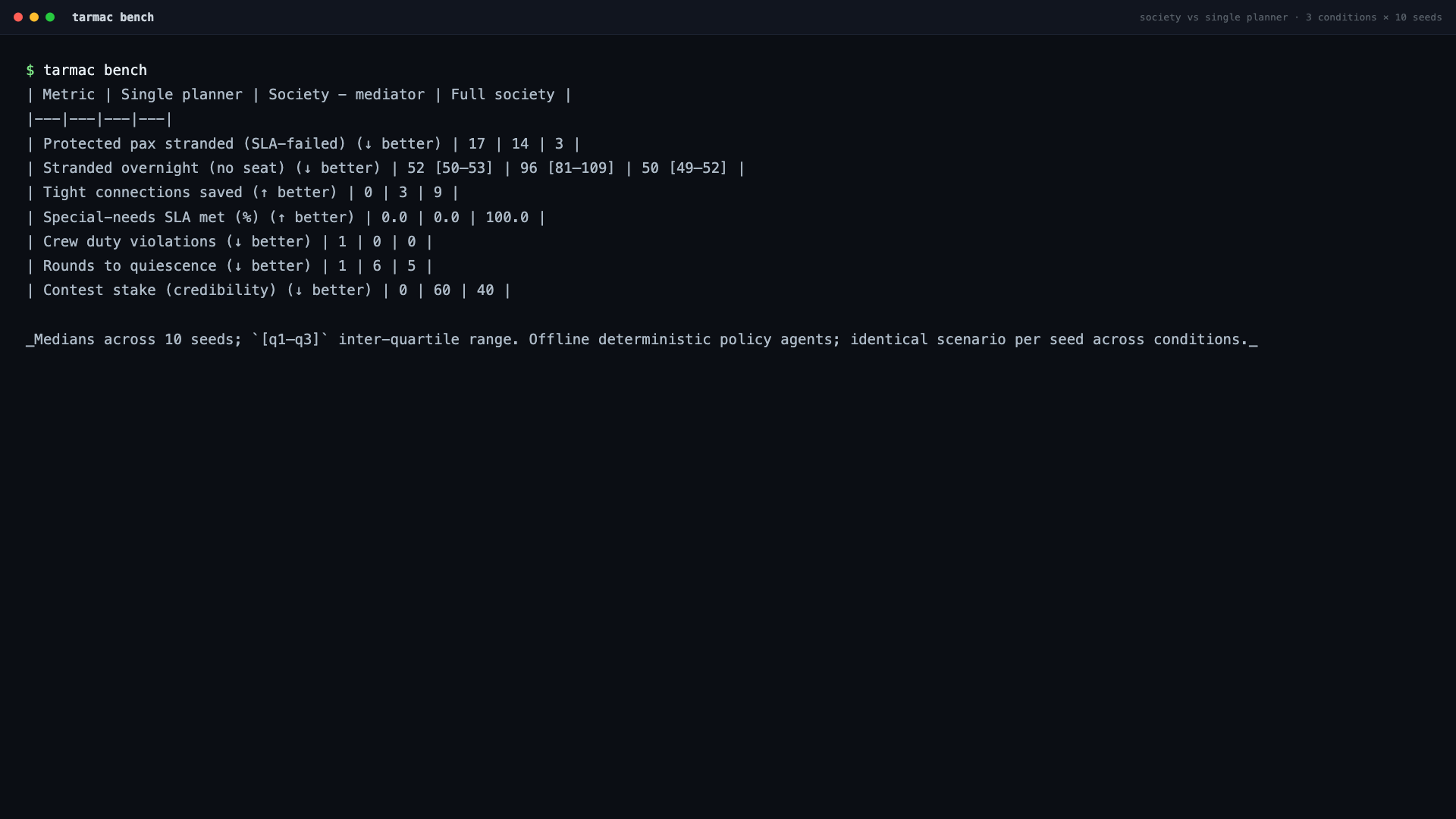
The one number: 3 vs 17 protected passengers stranded, 100% vs 0% special-needs SLA — the measurable gain over a single planner.
-
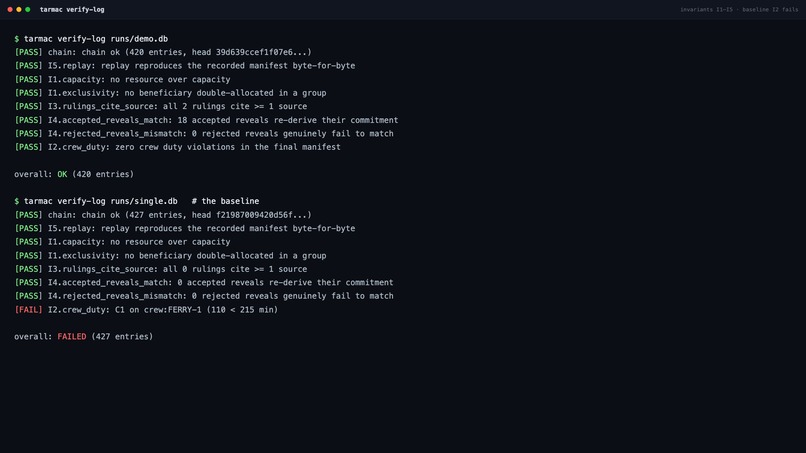
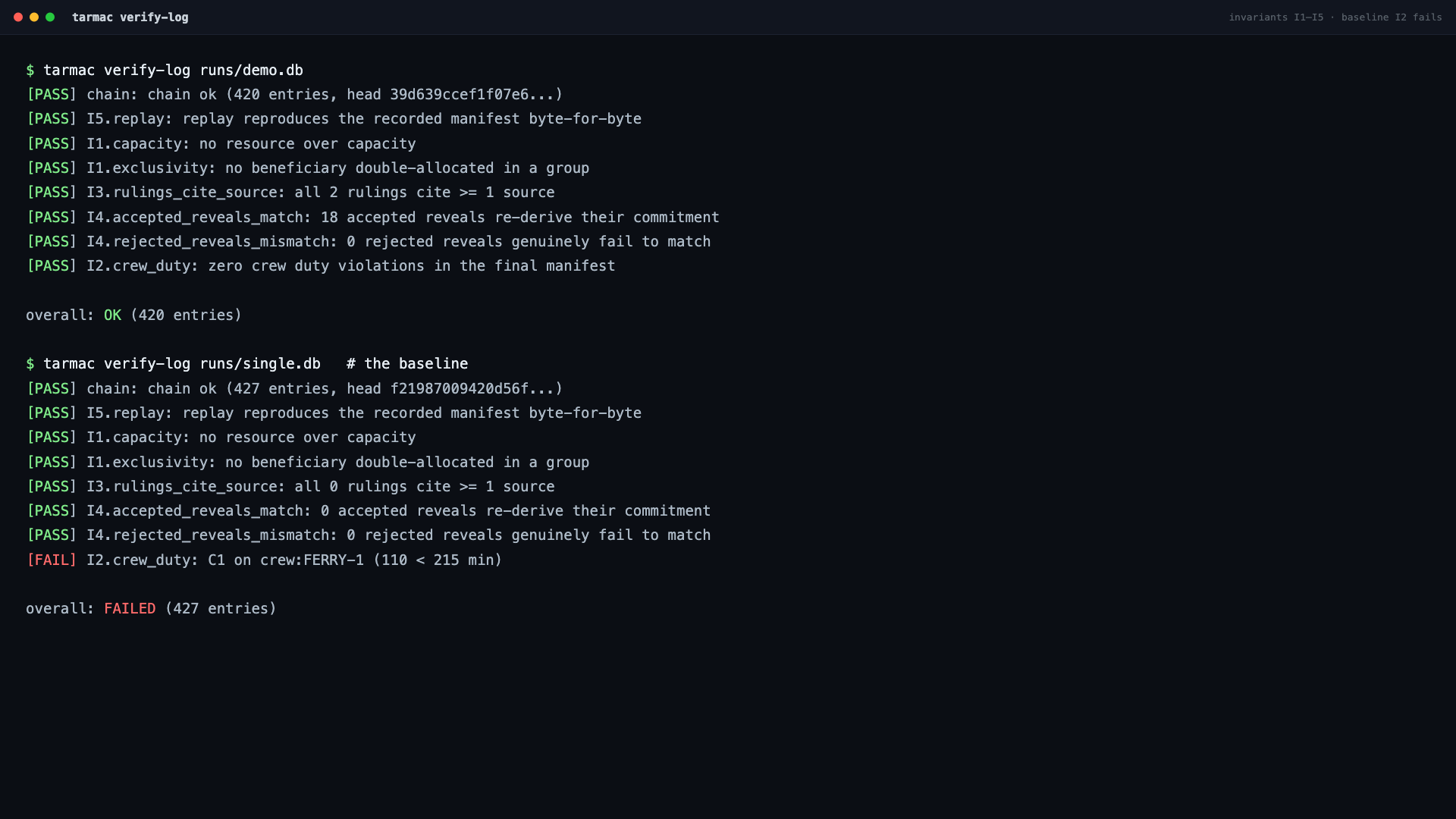
Auditability: Ed25519-signed, regulation-cited rulings and the hash-chained decision log that replays byte-for-byte.
-
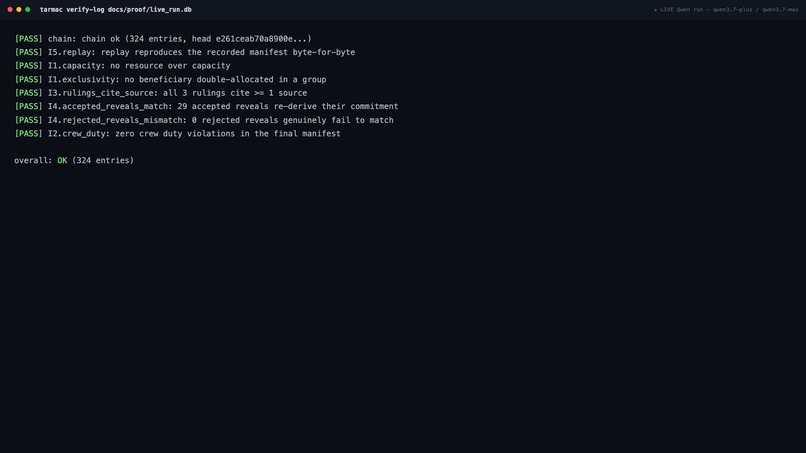
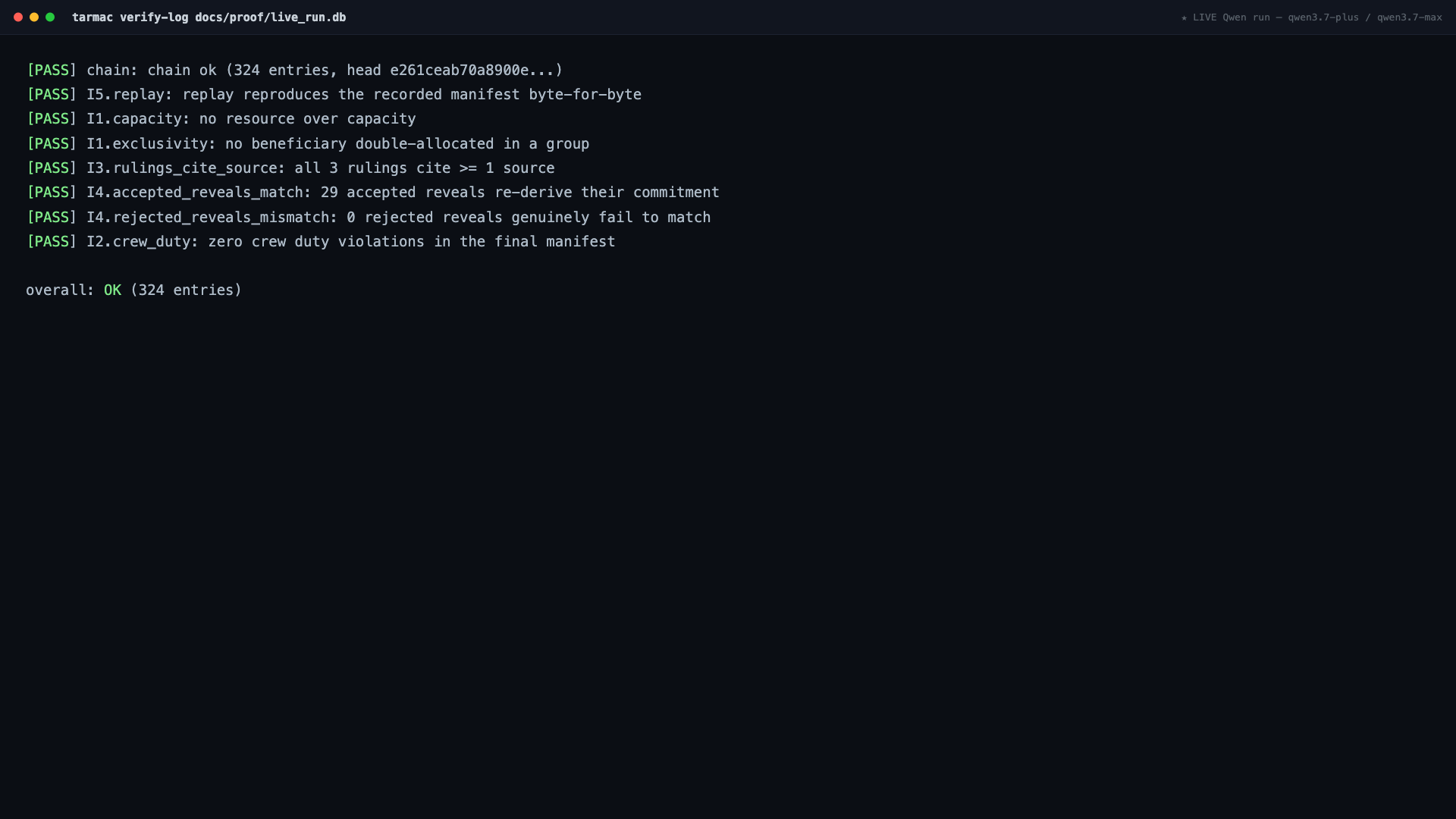
Live on Alibaba Cloud: the Function Compute `/verify` endpoint re-checking the committed live Qwen run in the cloud.
-
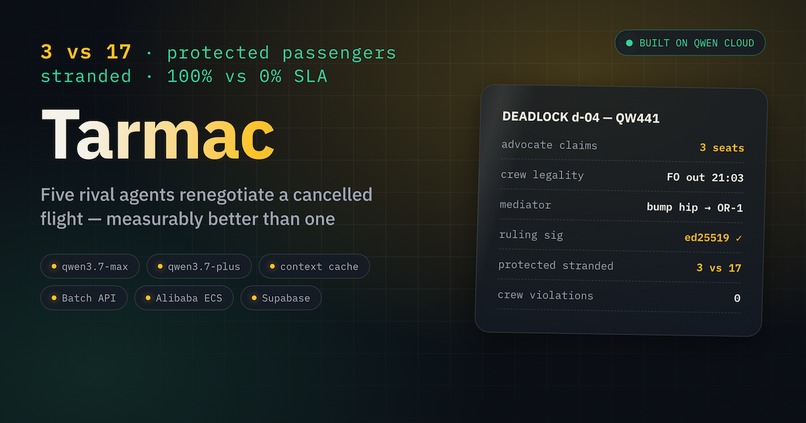
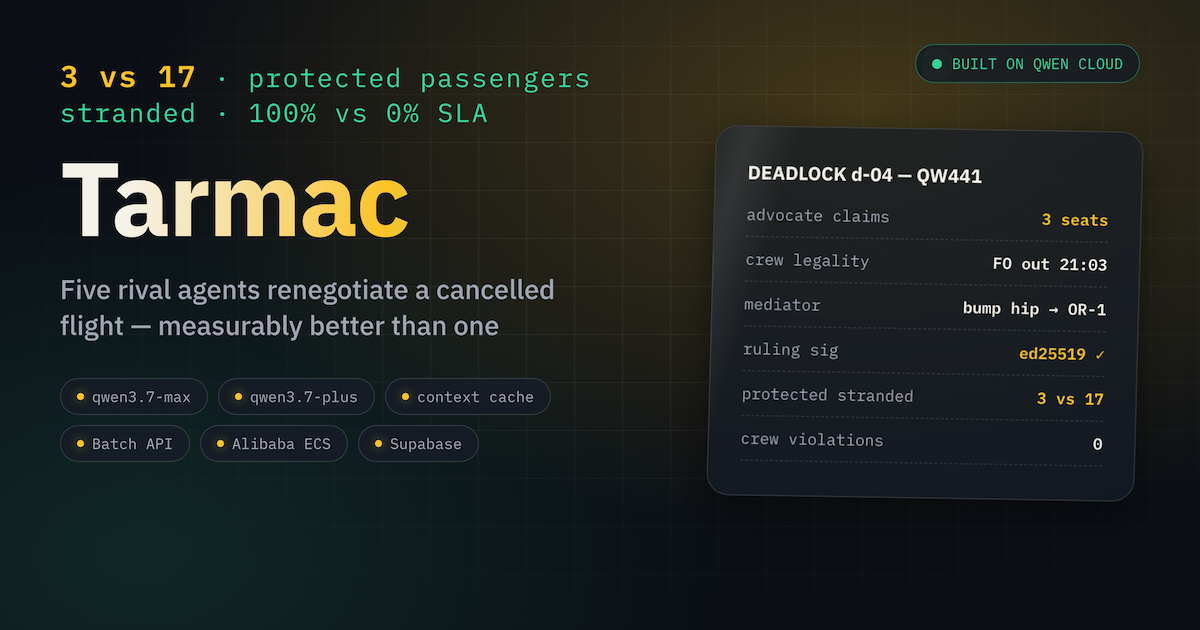
Social/OG card (branding closer).
Inspiration
A 12-year-old flying alone watches the DEPARTED board go red at 6 PM. Behind a door, one dispatcher with two phones is deciding whether she or a transplant cooler gets the last seat to Denver. Airline irregular operations are exactly this: too few seats, too many people who each have a legitimate, conflicting claim, and one overworked human resolving it under pressure. We wanted to rebuild that decision not as a single all-knowing planner, but as an agent society with real, mechanical conflict — and then prove, with a number, that the society does better than the lone planner.
What it does
Tarmac is an airline-disruption agent society where the conflict is the architecture. Five Qwen agents hold genuinely opposed objectives — Rebooking wants throughput, Crew-Legality enforces duty clocks, Gate/Ground owns turnaround feasibility, Hotel guards the voucher budget, and the Passenger-Advocate fights for minors, medical couriers, and wheelchair passengers. They negotiate through claims on a shared seat ledger backed by SQLite row locks: a claim is a typed function call, not a sentence, so contention has physics — two threads racing the last seat, exactly one wins (tested).
- Sealed-bid negotiation — in contested rounds agents post
SHA256(claim ‖ nonce)commitments before revealing; any reveal that doesn't re-derive its digest is rejected (invariant I4). Negotiation that is provably leak-free. - Mechanical deadlock detection — a wait-for cycle, or a resource contested for two or more rounds, triggers mediation. Never vibes-based.
- Signed, cited rulings — the Duty-Manager mediator reads all five structured position papers and issues a binding, Ed25519-signed ruling that cites the regulation it stands on (invariant I3). With the public key you can verify what was decided and on what regulation without trusting the database.
- Credibility currency — contesting a claim costs points, winning refunds them with a premium, losing burns them — argument is bounded economically, no infinite loops.
- Hash-chained decision log — every event extends the chain;
tarmac replayre-derives the identical manifest with zero API keys (invariant I5).
The one number (the track's ask, a measurable efficiency gain over single-agent baselines): on the frozen storm_dfw storm (180 displaced passengers, 139 legal seats), across 10 seeds, the full society strands 3 protected passengers (medical courier, minor, wheelchair, tight connections) versus 17 for the single greedy planner — at 100% special-needs SLA versus 0%, 9 tight-connection saves versus 0, and zero crew duty violations versus one (a tested invariant, not a hope). The kicker: the same society stripped of its mediator strands 96 overnight — worse than a lone planner — proving the mediator is load-bearing, not decoration.
The negotiation core ships as a domain-agnostic library, tarmac-society (ClaimLedger, DeadlockDetector, Commitment, Mediator, Society, verify_log), with a formal spec (state machine plus invariants I1–I5). examples/meeting_rooms.py reuses it for meeting-room booking in about 20 lines to prove it isn't airline-shaped.
How we built it
Python 3.12, shipped as a CLI plus library (tarmac / tarmac-society), not a web app. Storage is SQLite with real row-level locking so ledger contention is physical.
Built on Qwen Cloud — the transport is swappable but the reasoning is Qwen-only. Five role agents run on qwen3.7-plus (persona-stable objectives across ~60 turns per run, cheap enough to actually benchmark); the Duty-Manager mediator runs on qwen3.7-max with thinking enabled, adjudicating five conflicting position papers with citations. Structured output makes every Claim/Position/Ruling machine-checkable (malformed is rejected); function calling gives ledger ops typed state mutations with row locks; context cache reuses the 4k-token storm prefix every turn (roughly 10x cost saving); the Batch API runs the 60-run ablation offline at -50%; and text-embedding-v4 retrieves regulation passages so rulings cite sources. The LiveQwen DashScope integration is not vaporware behind a flag — 19 deterministic tests (tests/test_qwen_transport.py, a stub OpenAI-shaped client) drive the real wire path offline (model routing, embedded-JSON-schema structured output, single reject-and-retry on invalid JSON, the enable_thinking mediator flag, per-agent filtering, and text-embedding-v4 batching). Flipping on --live executes that already-verified path; it only adds tokens, not new code.
Deployed on Alibaba Cloud Function Compute: a thin WSGI wrapper (infra/fc/) runs the society on managed python3.10 in ap-southeast-1, deployed straight from source with Serverless Devs (no container registry), at https://tarmac-xceukceokg.ap-southeast-1.fcapp.run. Its /verify endpoint re-runs the full invariant suite against the committed live Qwen run byte-for-byte, in the cloud — so the same replay that guards the offline path is proven server-side on Alibaba Cloud. Quality and security are gated in CI (ruff + mypy, 330 pytest tests at 100% coverage in ~5s, a zero-key offline-replay judge path, CodeQL, Dependabot + pip-audit, TruffleHog, build verification), versioned by python-semantic-release.
Challenges we ran into
- Making negotiation lockable, not literary. Free-text agents produce nothing you can audit or replay. We forced every claim through a typed function call against a row-locked ledger, so a race for the last seat has exactly one winner — and wrote the concurrency test that proves it.
- Proving the mediator earns its cost. It's easy to assert a society beats a planner; the track asks you to measure it. We built
ablation_bench.py(3 conditions x 10 seeds) and were kept honest by our own result: the society without its mediator is worse than a lone planner (96 stranded). That negative column is the strongest evidence in the submission. - Verifying the live Qwen wire path without burning tokens. We drove the DashScope structured-output contract, one-retry logic, thinking flag, and embeddings against a stub OpenAI-shaped client in 19 deterministic tests, so
--liveruns an already-verified path — then ran one full live end-to-end run to capture real model judgement.
Accomplishments that we're proud of
- A measured agent society — 3 versus 17 protected passengers stranded, 100% versus 0% special-needs SLA — not a group-chat demo.
- Ed25519-signed, regulation-cited rulings you can verify without trusting the database.
- 330 tests at 100% coverage, a zero-key offline judge path (
verify_offline.py, exit 0), and a reusabletarmac-societyprotocol library with a formal spec. - A negative ablation column that proves the mediator is load-bearing — we published the result that could have embarrassed us.
- Both a real end-to-end live Qwen run (324-entry hash-chained log,
qwen3.7-plusroles +qwen3.7-maxmediator, all invariants PASS, replays byte-for-byte) and a live Alibaba Cloud Function Compute deployment whose/verifyre-checks that run in the cloud.
What we learned
Conflict is a feature of a multi-agent system, not a bug to be smoothed away — but only if it's mechanical. The moment a claim became a typed ledger mutation instead of a sentence, deadlock became detectable, mediation became triggerable, and the whole society became measurable. An unmeasured agent society is exactly the demo this track is drowning in; the measurement is the moat.
What's next for Tarmac
- Deepen the live surface — the orchestrator is already deployed on Alibaba Cloud Function Compute (
/verifyre-checks the live Qwen run in the cloud); next is streaming per-round ruling signatures and cache-hit stats. - More live DashScope runs across seeds — one full live run is already committed at
docs/proof/live_run.db; next is a multi-seed live ablation alongside the offline one. - Publish
tarmac-societyto PyPI and grow the seeded storm generator toward a live GDS integration.


Log in or sign up for Devpost to join the conversation.