-
-
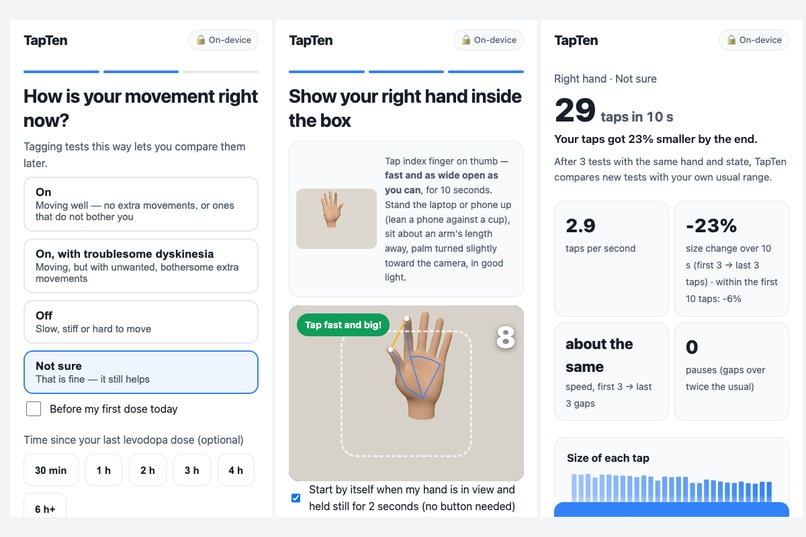
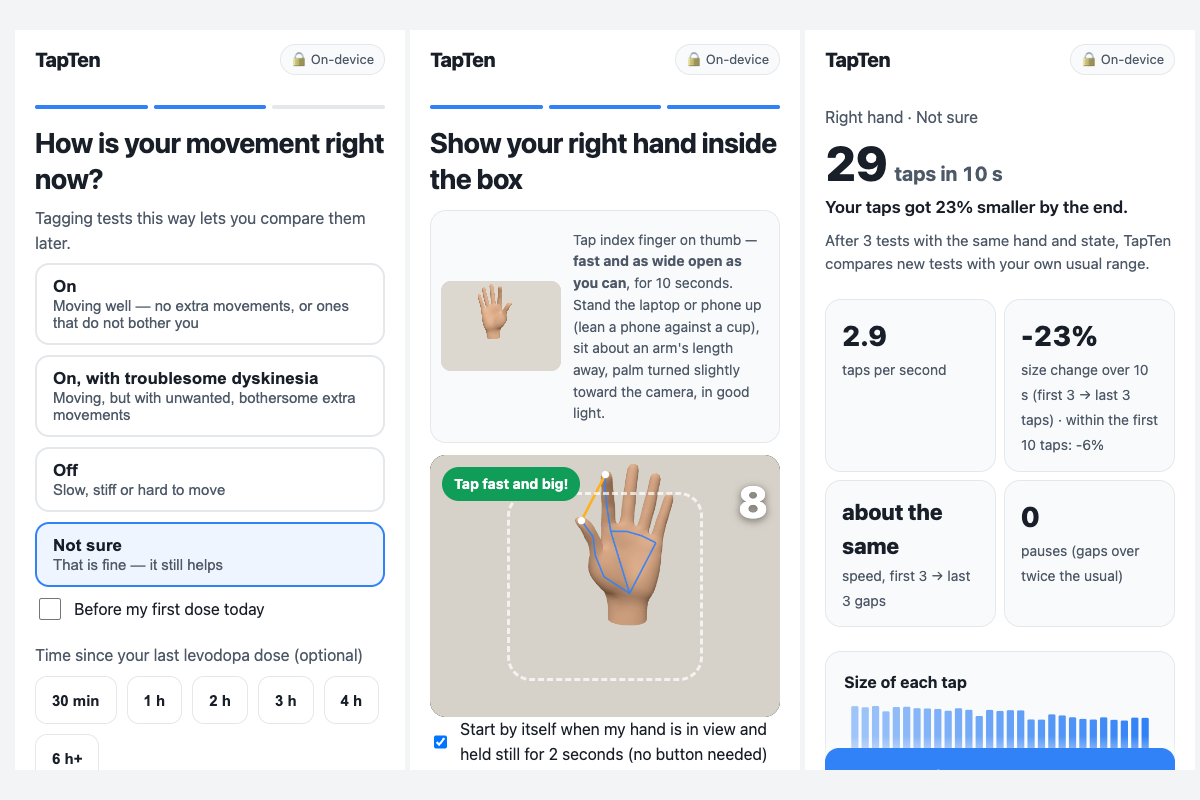
Movement state → auto-start test → result, on a phone (camera input: synthetic 3D hand)
-
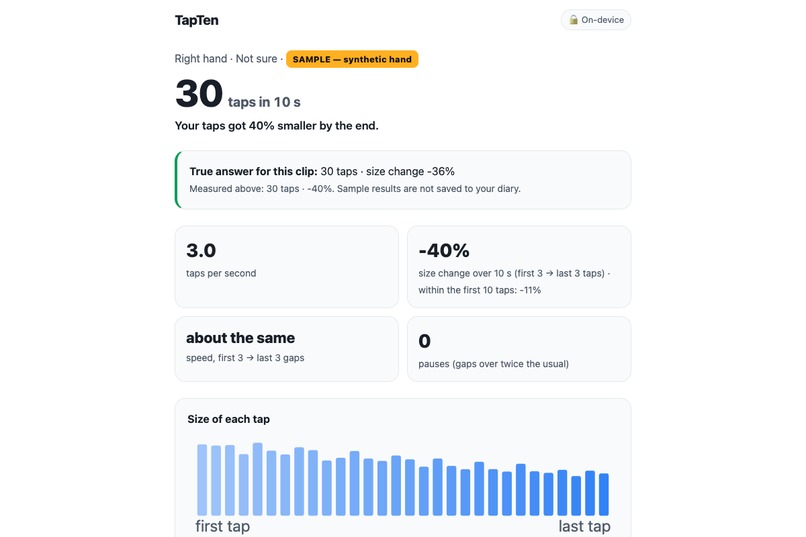
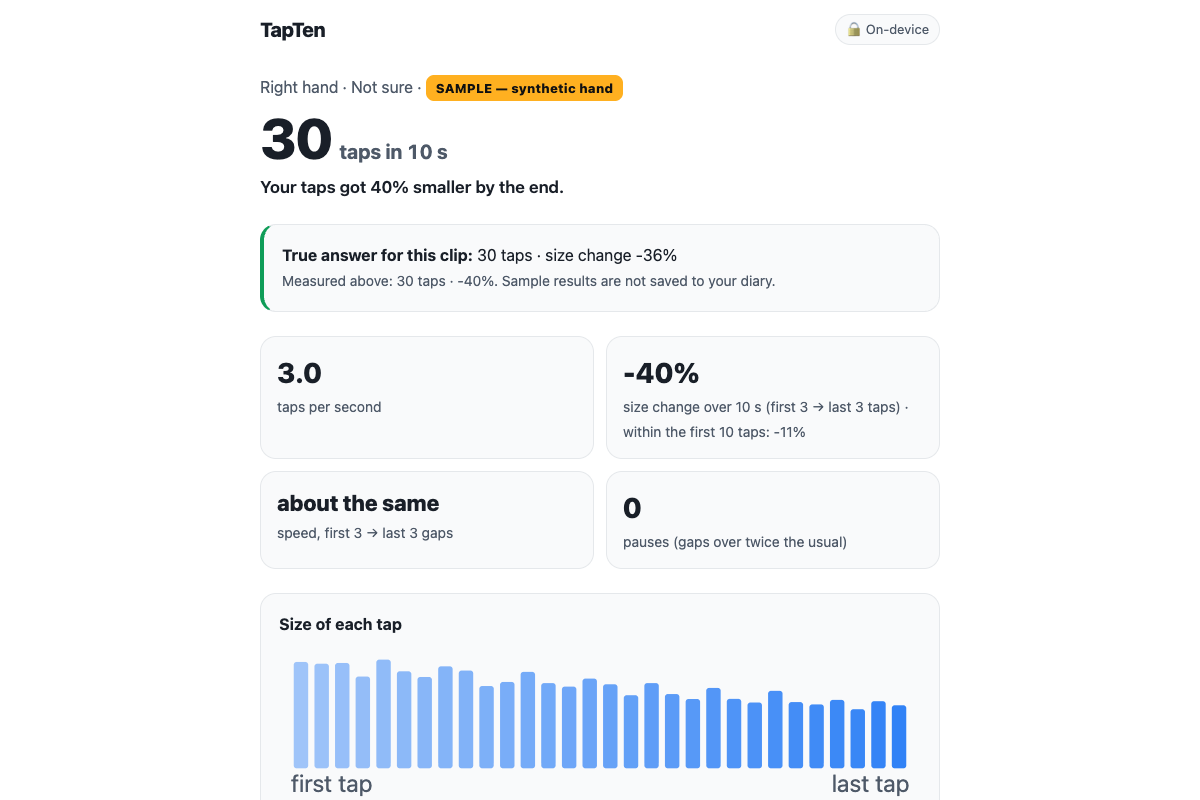
Sample clip: measured 30 taps / −40 % vs true 30 taps / −36 %
-
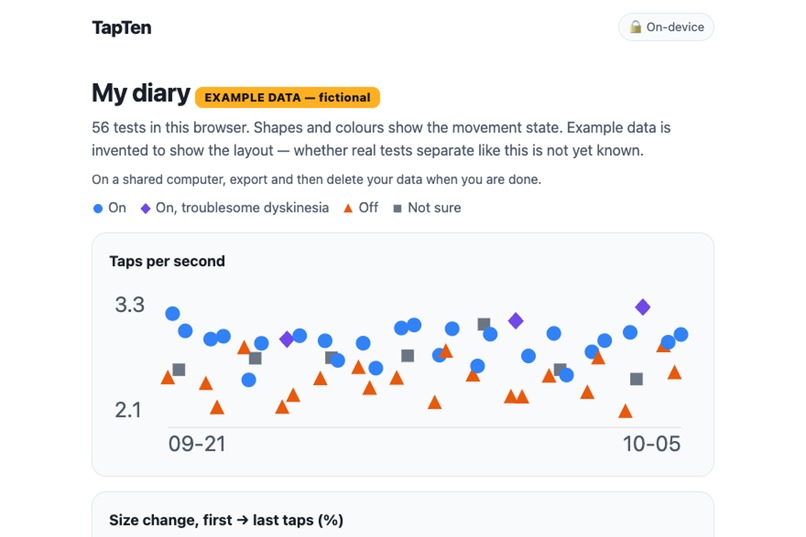
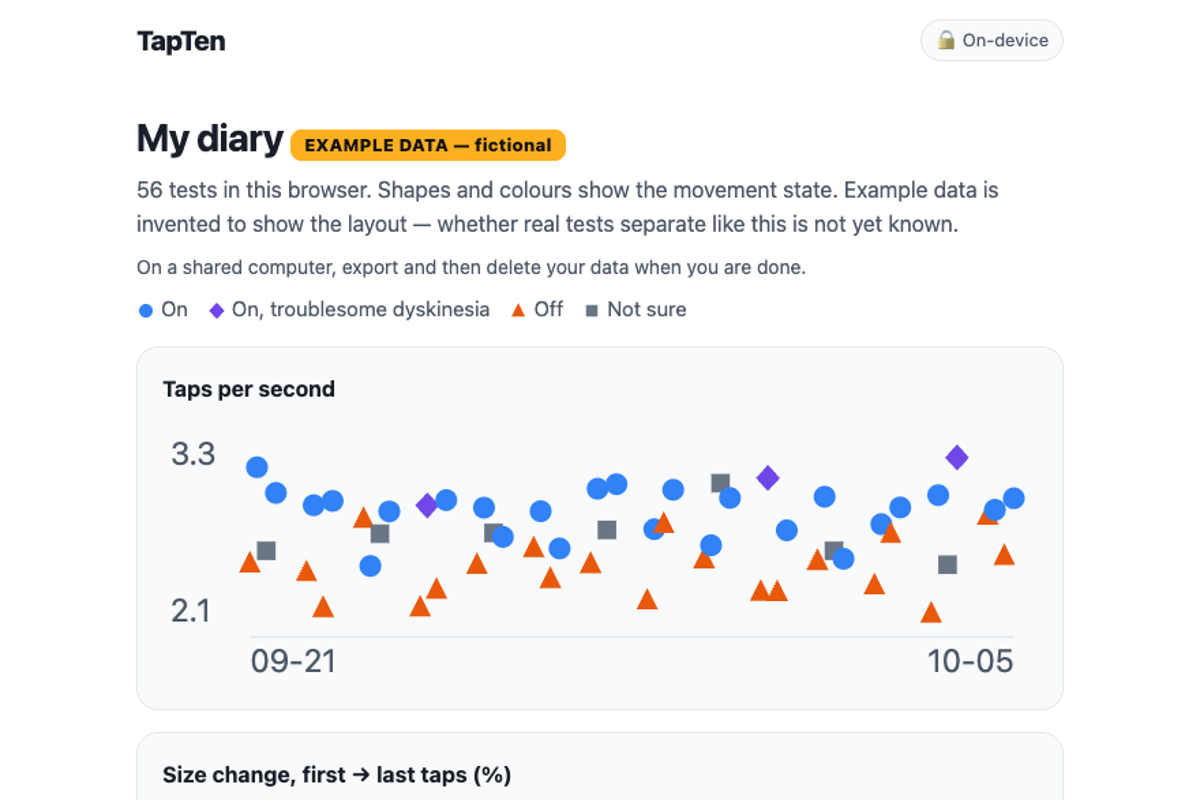
Private diary — example data (fictional)
-
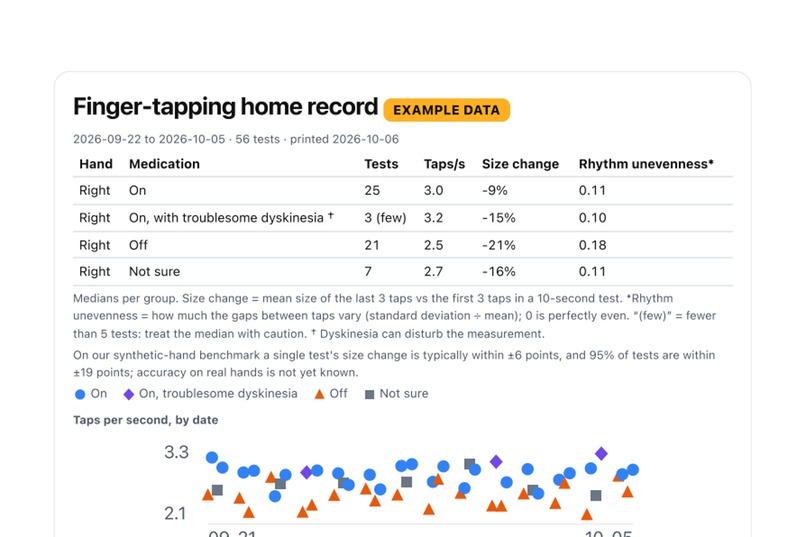
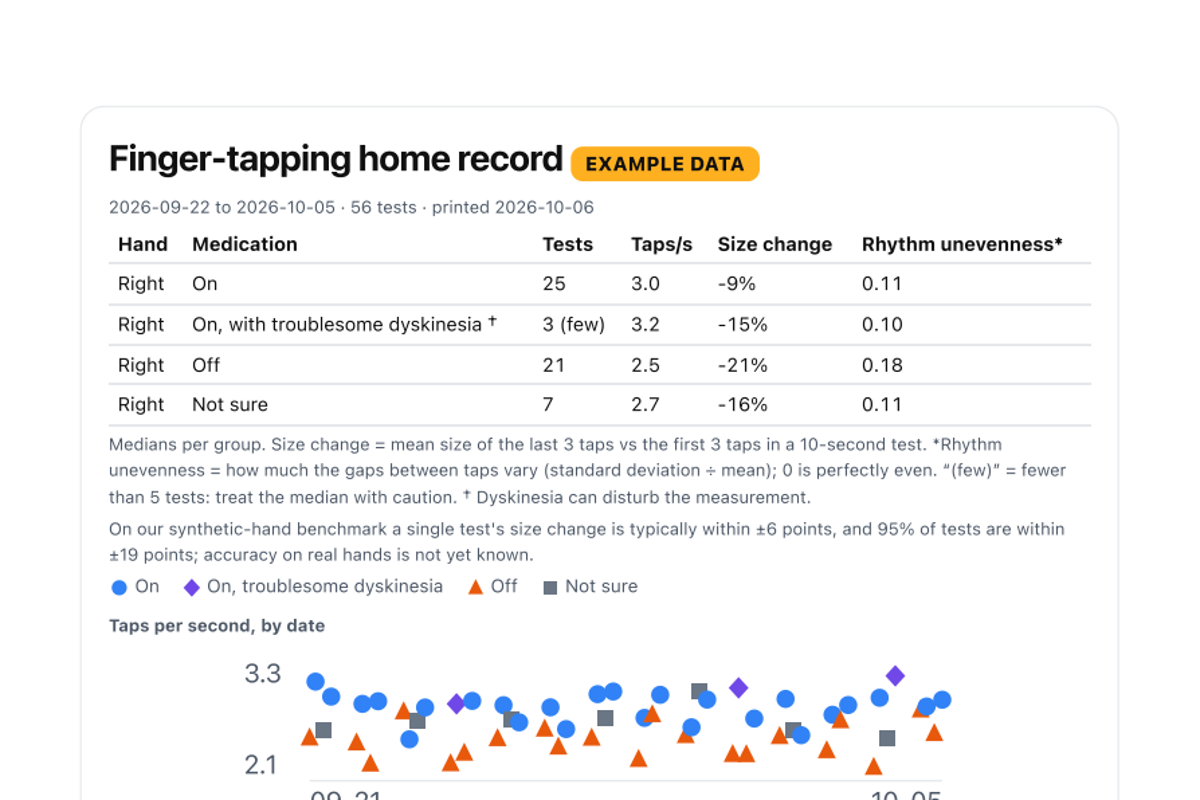
One-page clinic sheet — example data (fictional)
-
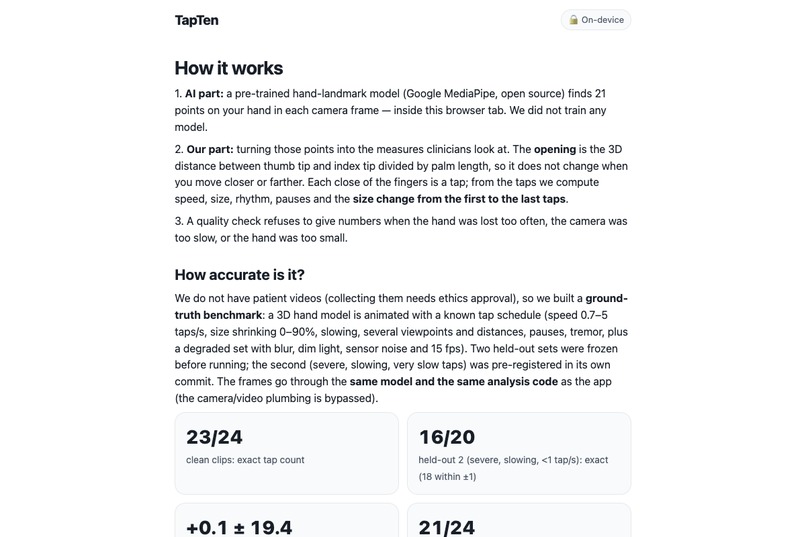
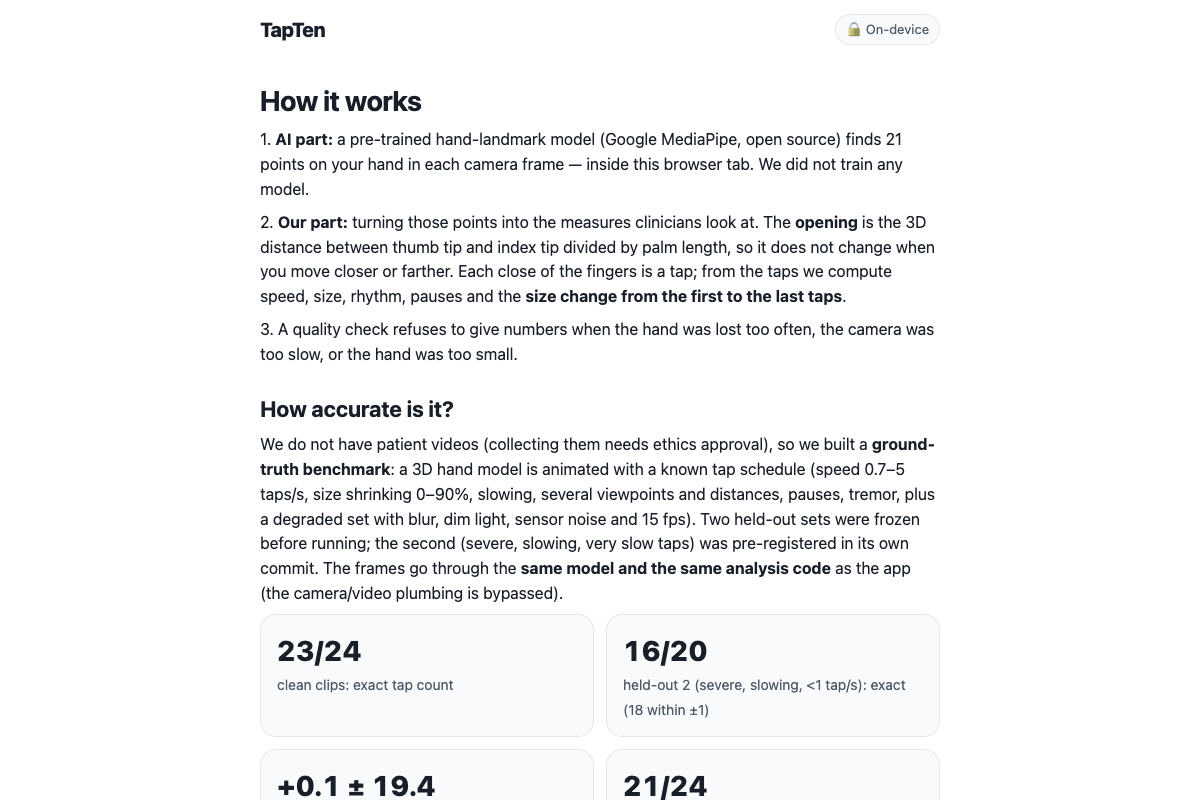
Ground-truth benchmark incl. two held-out sets
One-page project description (PDF): https://github.com/Ryugi62/tapten/blob/main/docs/TapTen-one-page.pdf · Code: https://github.com/Ryugi62/tapten · Live: https://ryugi62.github.io/tapten/
Inspiration
People with Parkinson's disease usually see a neurologist every few months. In between, "how did you move when your medication wore off?" is answered from memory.
At the bedside, one of the most informative checks takes seconds: finger tapping (MDS-UPDRS Part III, item 3.4). You tap your index finger on your thumb ten times, as fast and as big as you can. The clinician watches whether the taps get slower and, especially, smaller toward the end — the "decrement".
Phone screen-tap tests can measure speed, but a finger hitting glass cannot show how wide the fingers open. A webcam can. TapTen uses a fixed 10-second window, as many digital tapping tests do, so every test is comparable.
What it does
- The test, from any webcam. Choose the hand and tag how you move right now (adapted from the Hauser home motor diary: on / on with troublesome dyskinesia / off / not sure), plus "before first dose" and time since the last levodopa dose (one-tap chips). A looping clip shows the movement. The test starts by itself once the hand is in view and held still for 2 seconds — no clicking with a shaky hand — with a 5-second countdown and beeps.
- Numbers first. Taps in 10 s, taps per second, size change from the first 3 to the last 3 taps, speed change (first vs last gaps) and pauses, with a bar for every tap; the clinic-style first-10-tap size change is in Details.
- No over-interpretation. On our benchmark 95 % of single tests are within ±19.4 points (worst 38.9), so a single result is described in plain words without judgement, and size is hidden when the camera runs below 24 fps. After 3 tests with the same hand and medication state, TapTen compares each new test with your own usual.
- A quality gate. No numbers when the hand was lost in more than 15 % of frames, the camera ran under 15 fps, the hand was too small, or the test was too short. It says what to fix.
- A private motor diary and a clinic sheet. Tests stay in this browser (export / import / delete). One click prints a one-page sheet with medians per state and a chart of taps per second against minutes since the last dose.
- No webcam? "Try a sample recording" runs the whole pipeline on a synthetic-hand clip and shows the true answer next to the measured one. A video file can be analysed too (its original frame rate cannot be checked, so record at 30 fps).
- Safety copy everywhere: do not change medication based on these numbers; normal ranges for this home test are not known; it cannot tell whether someone has Parkinson's.
How we built it
- The AI part (not ours): Google MediaPipe Hand Landmarker — pre-trained, bundled with the site — gives 21 3D hand points per frame inside the browser tab. We trained no model.
- Our part: turning those points into clinical measures, and proving how well that works.
- Opening: 3D distance thumb tip ↔ index tip, divided by palm length (wrist ↔ middle knuckle), so moving closer to the camera doesn't change it.
- Taps: gap fill → 3-frame median (removes single-frame glitches) → 60 ms smoothing → hysteresis peak/trough detection with a threshold of ¼ of the recording's own opening range. Tiny off-rhythm glitches and closes faster than 10 Hz are ignored; small in-rhythm taps are kept; a partial first tap (recording started mid-close) is dropped.
- Timing: tap intervals use the camera frame's own timestamp (
requestVideoFrameCallback), not the render time. - Code: plain JavaScript in Clean Architecture layers (
domain←application←adapters←ui). 36 unit tests and a layer check run in GitHub Actions on every push.
How accurate is it?
We have no patient videos yet, because collecting them needs ethics approval. Instead we built a ground-truth benchmark. A rigged 3D hand is animated with a known tap schedule, and the frames go through the same MediaPipe model and the same analysis code as the app. Only the camera and video plumbing is bypassed; the full app path was checked separately with a synthetic fake webcam.
| set | clips | exact tap count | within ±1 |
|---|---|---|---|
| clean | 24 | 23 | 24 |
| degraded (blur, dim light, noise, half at 15 fps) | 12 | 9 | 11 |
| held-out 1 (in-distribution; 1–5 taps/s, new viewpoints, some with 5 Hz tremor; first run 21/24 on earlier code) | 24 | 21 | 23 |
| held-out 2 (pre-registered in its own commit before running: severe 70–90 % decrement, slowing, < 1 tap/s, small taps) | 20 | 16 | 18 |
- Our own target missed or met, stated plainly: exact count on ≥ 90 % of clips — we got 69/80 (86.3 %), not met. The misses come from three causes: 15-fps degraded clips, tiny fast late taps in severe decrement, and tremor on top of taps.
- Size change vs truth: bias 0.1 points, 95 % limits of agreement ±19.4 points; single-clip errors are wide (worst 38.9 points), which is why single tests aren't interpreted.
- Proportional bias: error vs true size change has slope -0.12 — severe shrinking tends to be under-read.
- Severe decrement (true ≤ −60 %): median error 9.3 points. The very smallest late taps at 3 taps/s with an 80 % shrink were still missed (25/30 and 27/30) — reported as a limit, not hidden.
- Slowing: flagged in 6/6 slowing clips (median error 1.9 points).
- Pauses: found 9/10, with 3/70 false pauses.
- Quality gate: refused 6/6 deliberately bad recordings (hand lost 30 %, 8 fps, hand 2.4 m away).
- Absolute tap size depends on the viewpoint: median error per view 0.8 % / -28.3 % / -32.8 %. So TapTen leads with size change and asks people to compare tests taken the same way.
- Every clip, including the misses:
docs/bench-table.md.
Limits, plainly: a synthetic hand is not a person. It has no skin texture, no real tremor and no real-world lighting. No person — with or without Parkinson's — has been measured yet.
Privacy
- The page's Content-Security-Policy is
connect-src 'self': it can only talk to its own site. The model and engine are bundled, and there is no account. - Found while testing: the MediaPipe runtime tries to send a usage log to
odml.pa.googleapis.com, and TapTen's policy blocks it. You can see this in the browser console, and a test keeps network code from creeping back in.
How it differs from existing work
- PARK web finger-tapping test (Islam et al., npj Digital Medicine 2023) scores severity 0–4 from webcam video for research.
- VisionMD (npj Parkinson's Disease 2025) is open-source desktop software that analyses recorded videos locally for clinicians and researchers.
- FastEval Parkinsonism (PMC10853559) and video hand-pose bradykinesia work (arXiv 2308.14679) serve clinicians.
- TapTen's difference is four things: nothing is uploaded, no score, a live quality gate, and medication timing (movement state + time since dose) on a one-page sheet for the clinic.
Challenges we ran into
- Slow, noisy taps were double-counted. At 1.5 taps/s with blur and noise, single-frame glitches looked like extra taps (19 counted vs 14 true in our first degraded run). A 3-frame median and a range-based threshold fixed it. Because we tuned on that set, we added held-out sets; the second was pre-registered in its own commit before it was ever run. They come from the same generator, so they test over-tuning, not real-world shift.
- Our first glitch filter would have hidden severe disease. Reviewers pointed out that dropping "tiny" taps also drops the tiny late taps of a severe decrement — exactly the clinical signal. The filter now drops a tiny swing only if it also breaks the rhythm, and we pre-registered a second held-out set of severe cases in a separate commit before running it.
- Seeking a video handed the tracker stale frames. We now wait for the new frame to be presented and copy it to a canvas first.
- The rigged hand model had no bone hierarchy, so we wrote forward kinematics to make it tap.
Accomplishments that we're proud of
- An accuracy table with exact answers, a held-out set, negative tests for the quality gate, and our missed target reported as missed.
- The privacy claim is enforced in code, and checking it caught a real outgoing request.
What we learned
- How clinicians actually rate bradykinesia, and why amplitude decrement and medication timing matter.
- That "it works on my webcam" is not evidence — a benchmark with exact answers, frozen before running, is.
What's next (planned — not done)
- Measure real people: healthy volunteers first (test–retest, hand-counted slow-motion video).
- Then a study with people with Parkinson's and their neurologists.
- Both-hand asymmetry.
- An offline cache for the 19 MB tracker download.
- A left/right hand check (computed already; the warning stays off until verified on real hands).
TapTen is a tracking tool and a research prototype. It is not a diagnosis, not an MDS-UPDRS score, and not cleared or approved as a medical device.

Log in or sign up for Devpost to join the conversation.