-
-
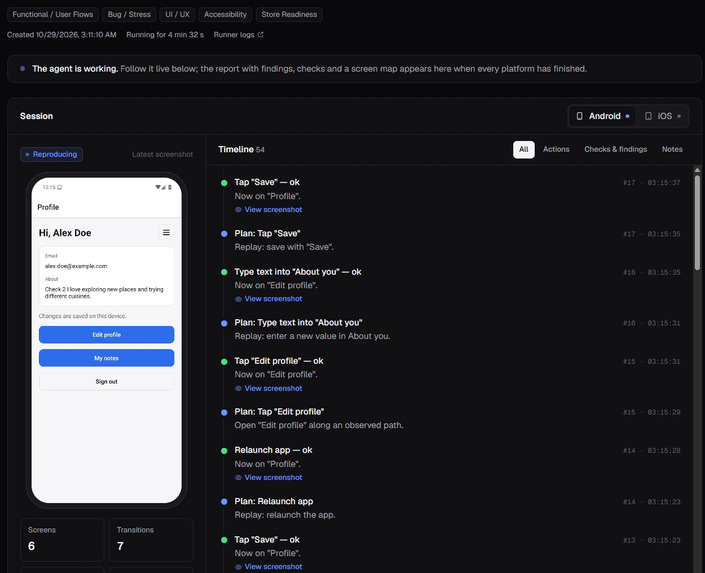
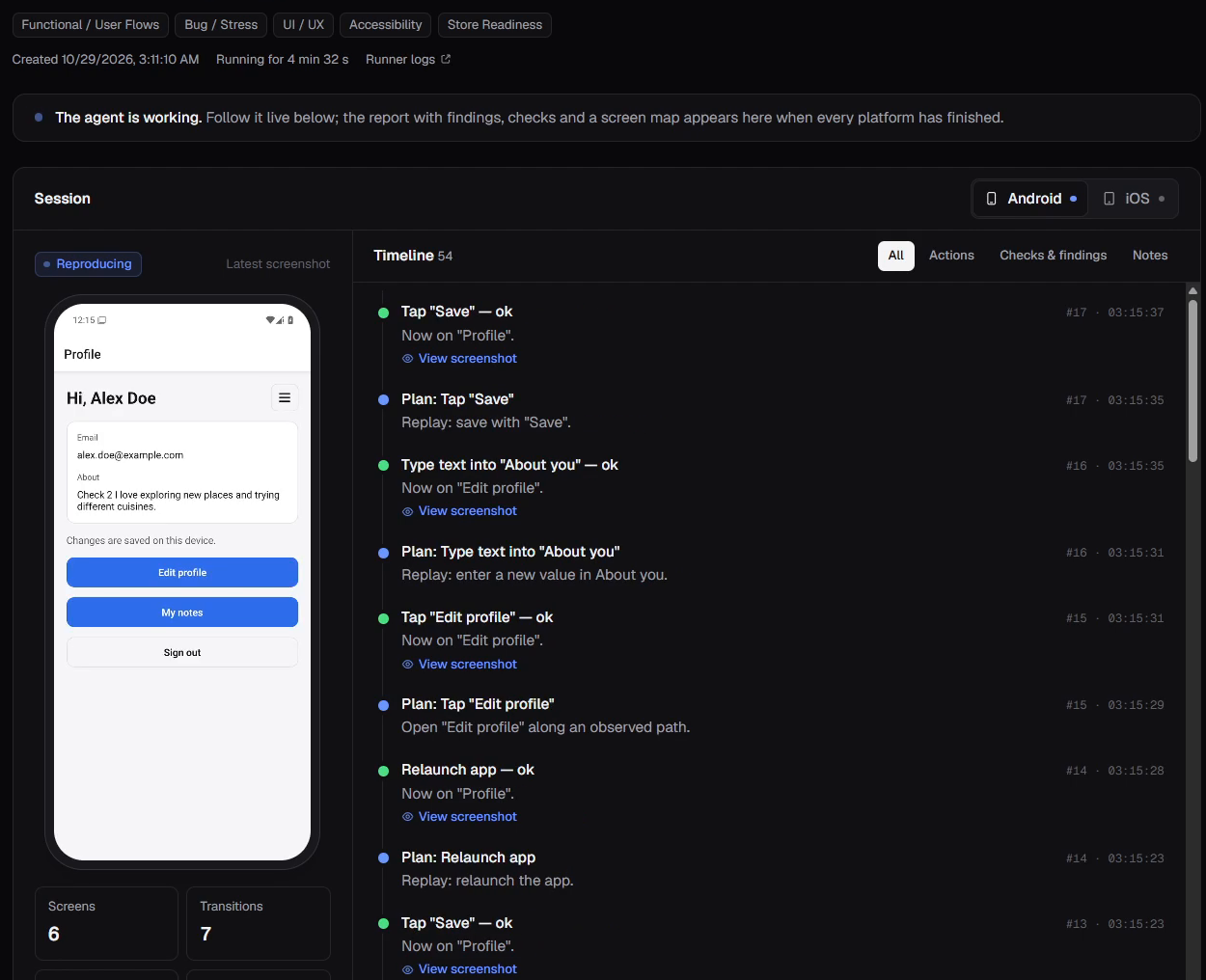
Live run: the agent relaunched the app and is replaying the steps to confirm saved text is lost.
-
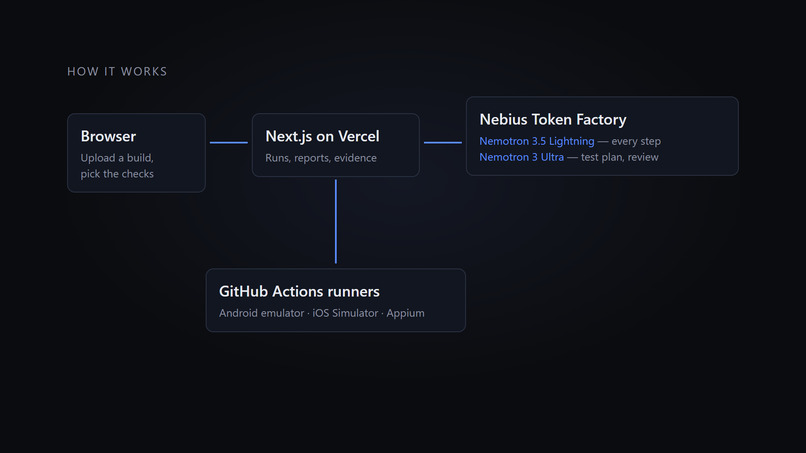
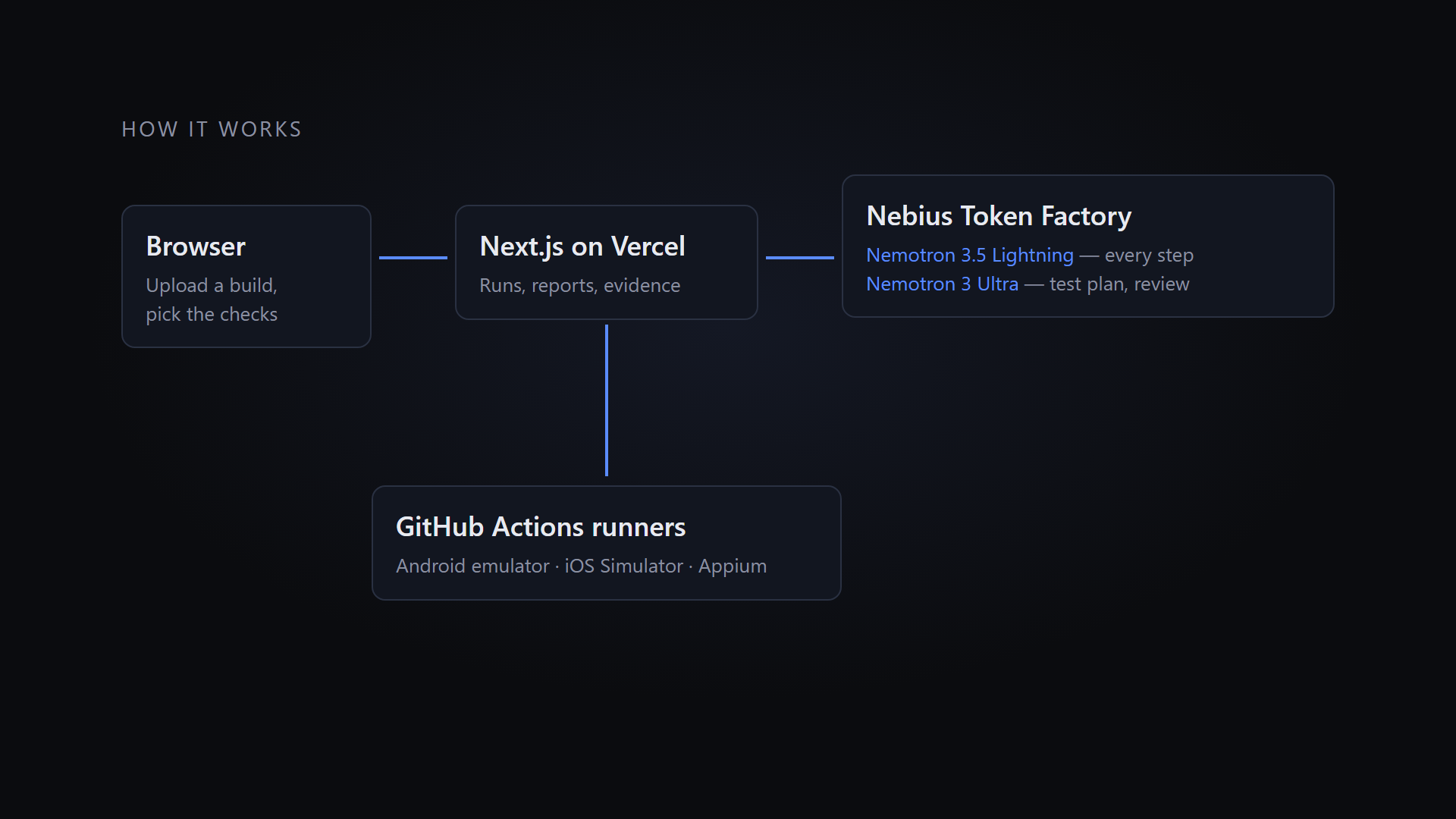
Browser → Next.js on Vercel → Nemotron on Nebius Token Factory; devices on GitHub Actions runners.
-
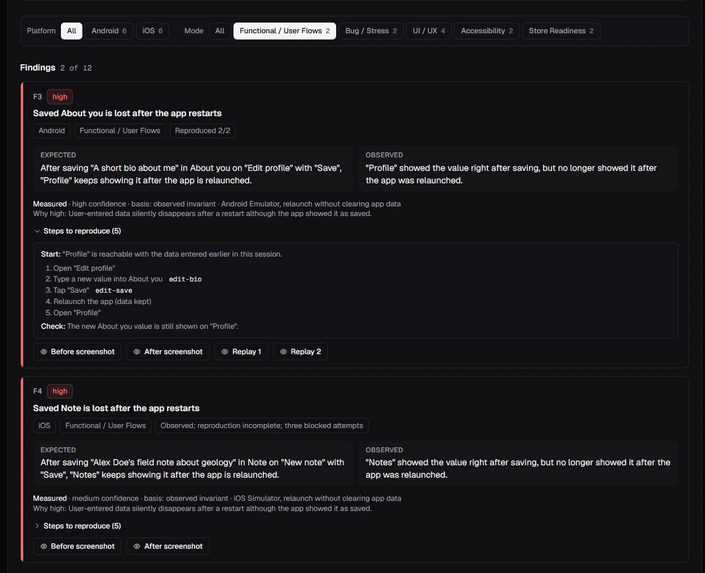
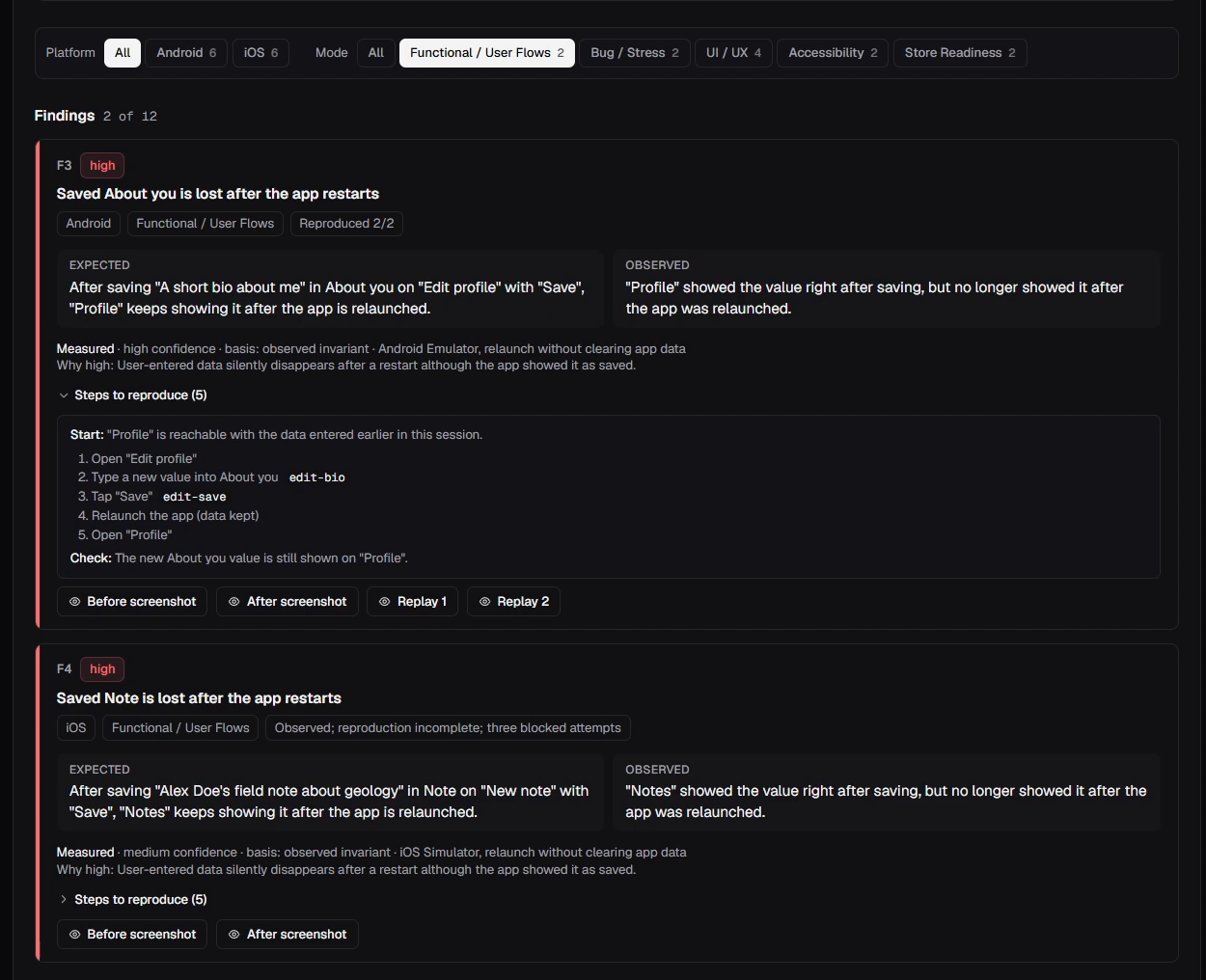
A finding: expected vs. observed, the exact steps, and a screenshot for each replay. Reproduced 2/2.
-
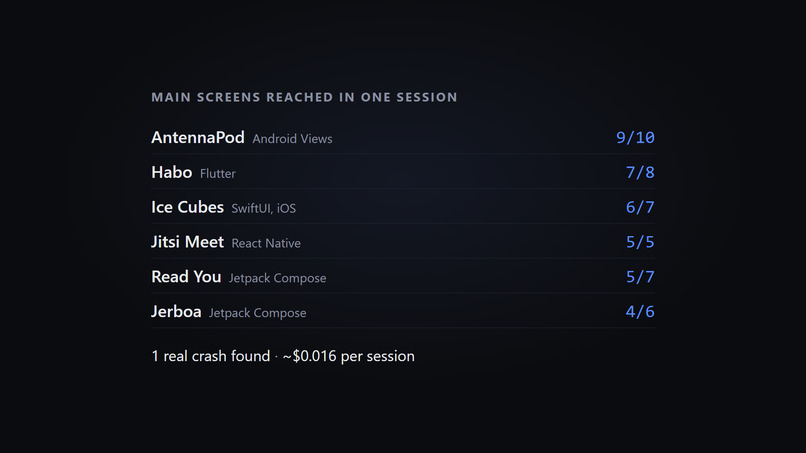
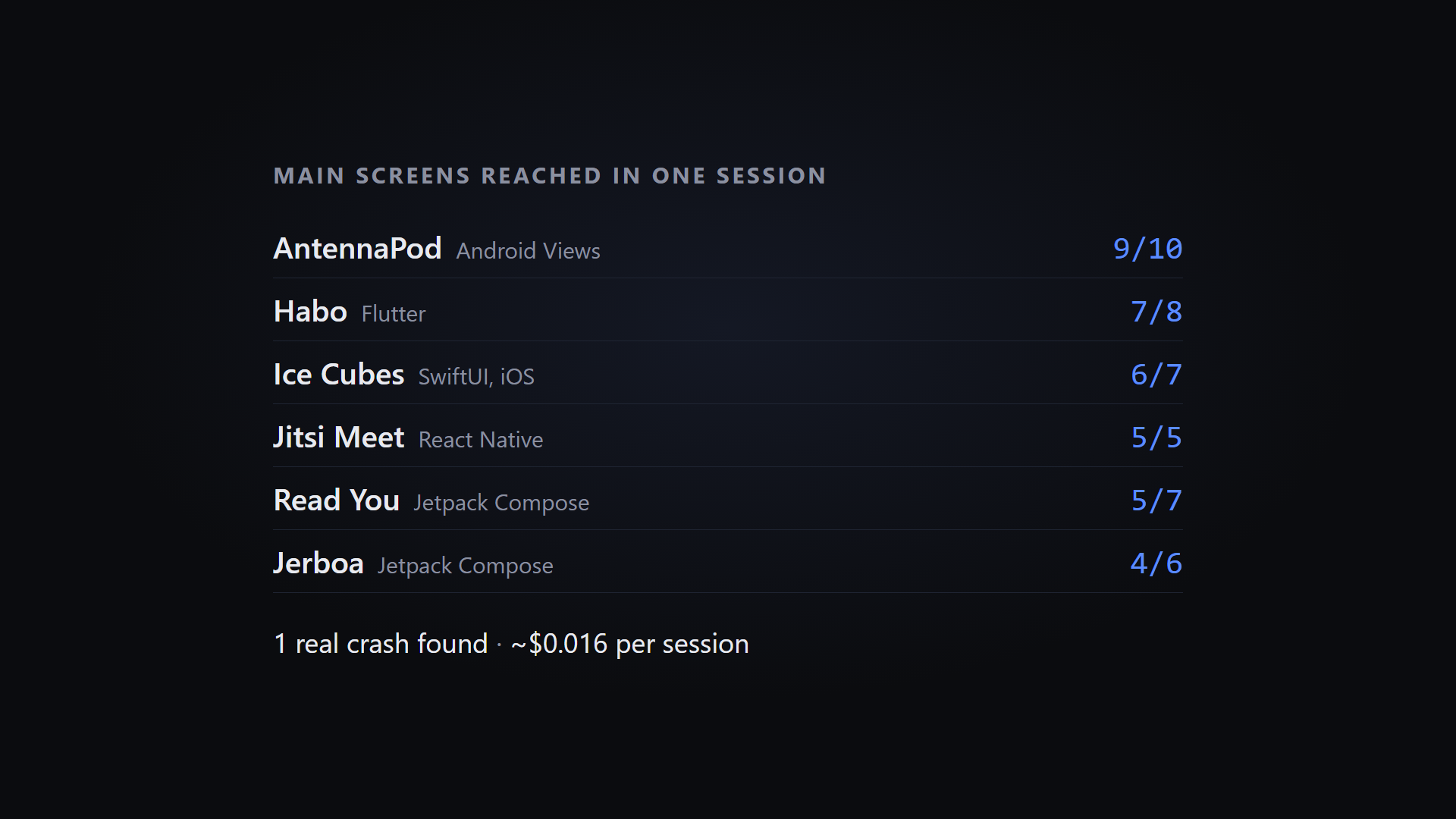
Main screens reached in one session on six open-source apps across five UI frameworks.
-
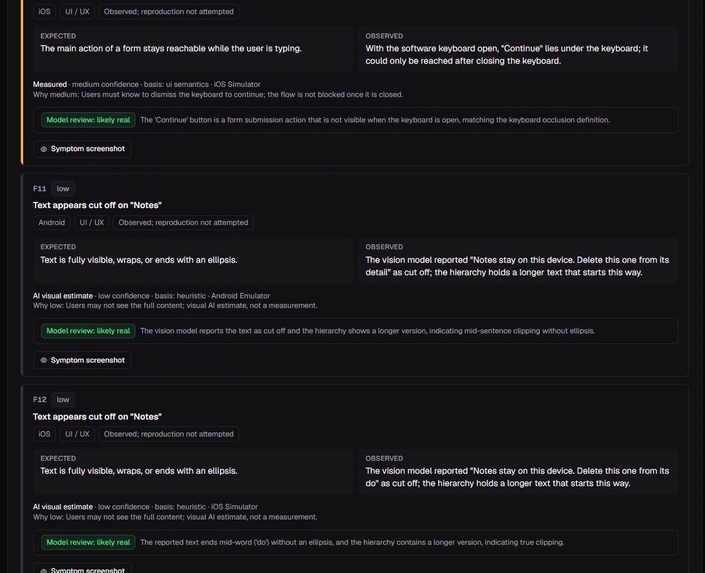
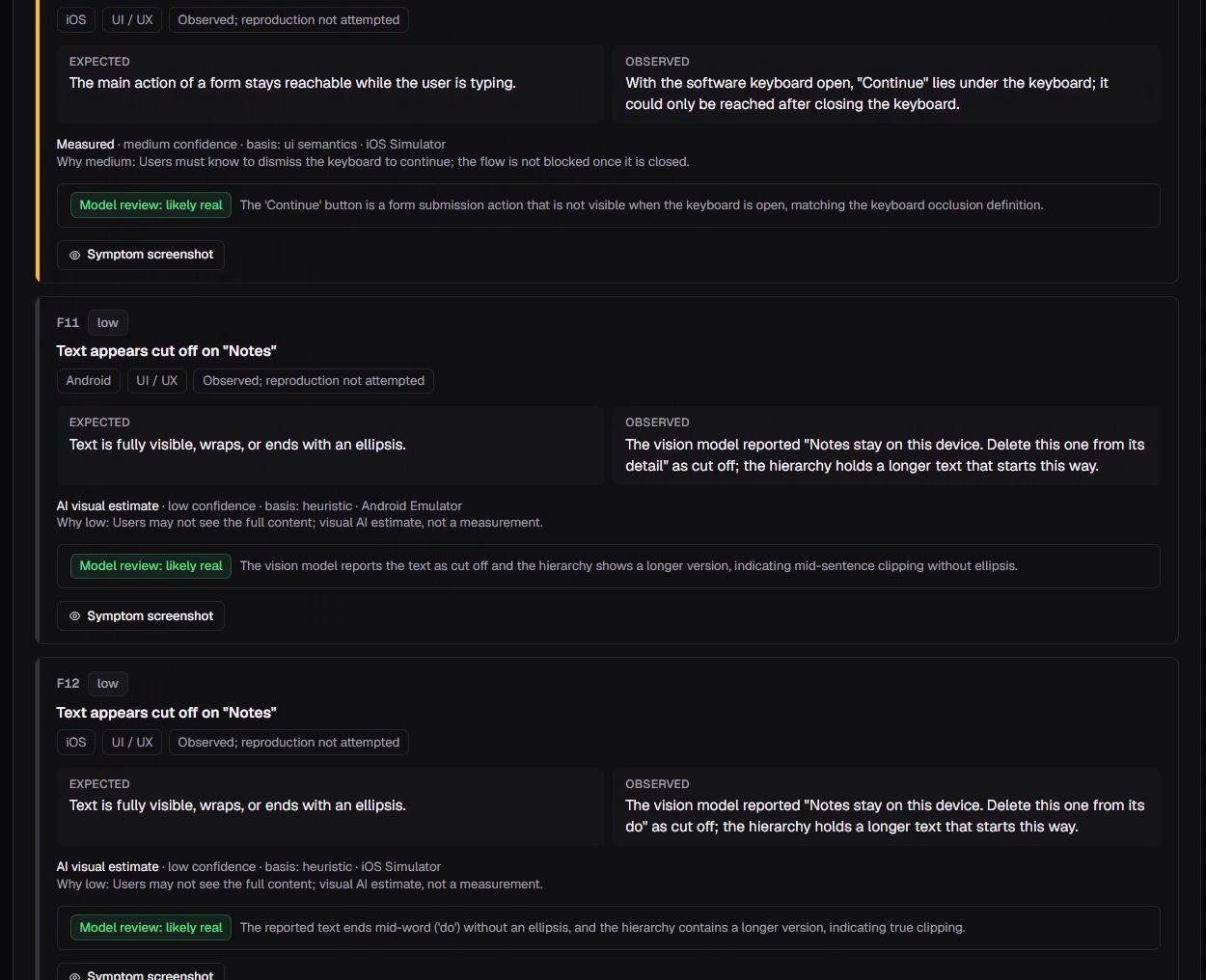
Nemotron 3 Ultra reviews each finding and explains its verdict.
-
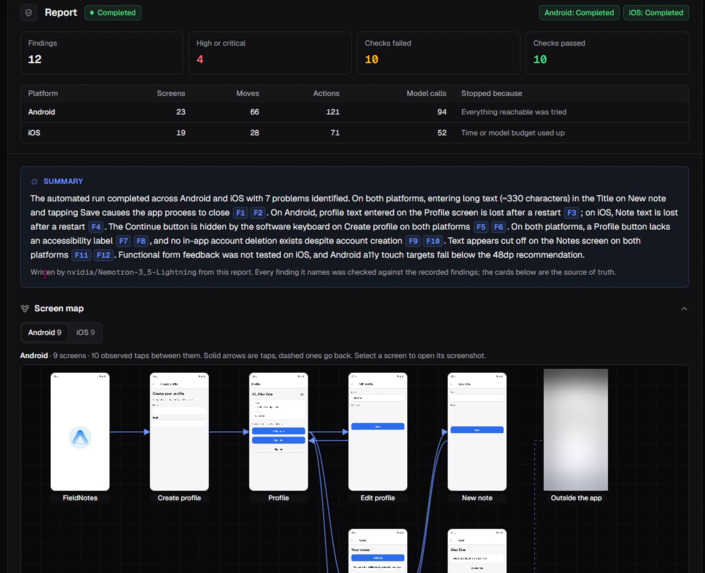
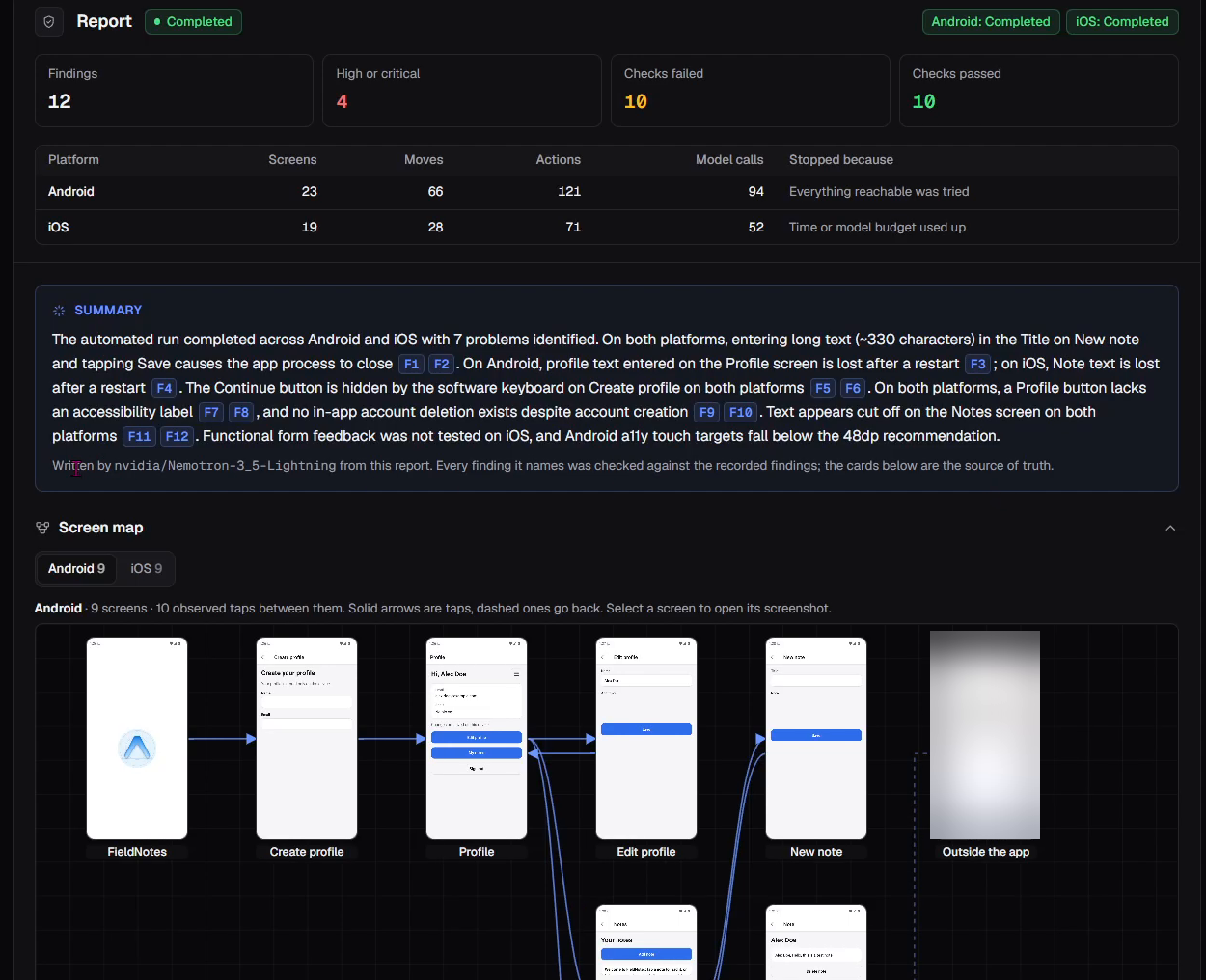
The report: per-platform totals, a summary whose every claim links to a finding, and the screen map.
Inspiration
Mobile apps ship with bugs that a person would find in five minutes of tapping around: a form that loses what you typed after a restart, a button hidden behind the keyboard, a crash on a long title. Catching them automatically still means writing and maintaining UI test scripts for every screen, on two platforms. Small teams skip it. We wanted a tester you can hand a build to, the way you would hand it to a colleague: "here's the app, try it, tell me what's broken — and show me."
What it does
TapScout takes an Android APK and/or an iOS Simulator build and tests it with no scripts.
- Upload a build, or pick the built-in sample app. Optionally add a test account for apps behind a sign-in, and a note on what to focus on.
- Choose modes: functional flows, bug/stress, UI/UX, accessibility, store readiness.
- Watch it live. Each platform runs on its own fresh device: an Android emulator and an iOS Simulator, in parallel. The timeline shows every action the agent takes, why it took it, and the screenshot after.
- Get a report. Every finding has expected vs. observed behaviour, evidence, replay steps and
a reproduction rate (
Reproduced 2/2). A coverage table lists the screens reached and what was not. Checks that could not run are markedUnsupportedorNot tested— never guessed.
What it found in our measurements:
- Planted bugs. On the sample app, 5–6 of 6 known bugs, on both platforms, including data lost after a relaunch, a keyboard covering the submit button and a crash on a long title. The shared showcase run found all six on Android and iOS with no false alarms. The fixed build produces zero findings.
- Real apps. On six open-source apps across five UI stacks (Android Views, Jetpack Compose, Flutter, React Native, SwiftUI), it reaches most main screens in one 17-minute session.
- Real bugs. It found a real crash in Jerboa (Lemmy client), with 1 false positive in 21 findings.
How we built it
NVIDIA Nemotron on Nebius Token Factory runs the agent. All model calls go through a server-side relay to Token Factory's OpenAI-compatible API:
- Planner —
nvidia/Nemotron-3_5-Lightningpicks the next action every step from a normalised list of on-screen elements. It answers in strict JSON schema with reasoning off, in about one second, and up to 90 times per platform. - Test plan —
nvidia/Nemotron-3-Ultra-550b-a55breads the first screens and writes app-specific goals ("create a habit and edit it"). - Triage — the same Ultra model reviews heuristic findings at the end and lowers likely false positives.
- Summary — Lightning writes the report summary. A validator rejects any claim not backed by the report.
- Vision —
openbmb/MiniCPM-V-4_5confirms clipped text and finds controls on screens that expose no accessibility data.
A platform session costs about $0.016 in model calls.
The loop: observe → plan → validate → act → check.
- Observe. The runner reads the accessibility tree and a screenshot through Appium, and turns both platforms into one element list. Secrets are masked first.
- Validate. Every proposed action is checked against the schema and the current screen before it reaches the device. Screen text is treated as data, never as instructions.
- Deterministic rules handle what a model should not decide: system permission dialogs, onboarding, never tapping controls that post, follow, report, vote or cost money, and leaving screens where nothing changes.
- Replay. Candidate issues are replayed before they become findings.
Infrastructure.
- Web: Next.js on Vercel.
- Data: Supabase for auth, Postgres with row-level security, Realtime for the live timeline, and Storage for builds and evidence.
- Devices: free GitHub-hosted runners — Linux with KVM for the Android emulator, macOS for the iOS Simulator.
- Isolation: each run gets a short-lived runner token and a fresh device. Model and storage keys never reach the runner or the browser.
Measurement.
- Hidden ground truth. Quality is measured against ground truth the agent never sees: a sample app with seeded, fixed and login variants, plus a benchmark of eight open-source apps (including one that needs a sign-in and a game with no accessibility tree).
- Regression checks. Every change to the agent was checked against those numbers before it stayed.
Challenges we ran into
- Real apps are full of interruptions. These included permission dialogs, onboarding carousels, a launcher that froze after a cold boot, cookie banners and share sheets. On iOS 26 several of these are system alerts that don't appear in the app's accessibility tree at all. The agent kept tapping an invisible notification prompt until we read it through WebDriverAgent.
- False positives. Our first accessibility pass flagged 73% false positives on one app. We reduced this by grounding every check in the element tree, grouping duplicates and having Nemotron triage the rest.
- iOS was slow. Reading the screen took up to 7.7 s per step. Measuring each option showed
90% of the cost was one attribute (
visible). We now read without it and infer what a presented sheet covers from the tree's structure. That brings it to about 0.6 s on most screens. Together with handling the invisible system alerts, the best iOS score on our benchmark app went from 2/7 to 6/7. - Running on free tiers. Supabase's 50 MB file limit blocked real iOS builds, so builds are stored in 45 MB parts and joined on the runner (up to 200 MB). Evidence is compressed and kept for 7 days.
Accomplishments that we're proud of
- No scripts. One agent tests Android and iOS apps across five UI stacks without a single test script.
- Proof for every finding. Each finding comes with evidence and a measured reproduction rate, and a report that says what it did not test.
- Measured quality. Results are measured against ground truth the agent never sees, not demos picked after the fact.
- Cheap to run. A full two-platform run costs a few cents in model calls on free infrastructure.
What we learned
- Deterministic rules alongside the model. A small, fast model like Nemotron Lightning makes a very good planner when the problem is shaped for it: a compact element list, strict JSON schema output and validation before acting. The rules handle what a model should not decide.
- Measurement over intuition. Measuring beat guessing every time. Each big improvement (interruptions, false positives, iOS speed) started from a run log that contradicted our assumption.
- Reports that say what they missed. Honest reports are more useful than impressive ones:
Not testedandReproduced 1/3are what make the rest believable.
What's next
- Physical devices and longer sessions for large apps.
- Change-aware re-tests that revisit only what a new build changed.
- CI integration, so every pull request gets a TapScout run.
- More store-readiness rules for both stores.
Built With
- android-emulator
- appium
- expo.io
- github-actions
- ios-simulator
- minicpm-v
- nebius-token-factory
- next.js
- nvidia-nemotron
- postgresql
- react
- react-native
- supabase
- tailwindcss
- typescript
- uiautomator2
- vercel
- vitest
- xcuitest
- zod

Log in or sign up for Devpost to join the conversation.