Written for: HackUTD judges and anyone reading the Devpost page.
Inspiration
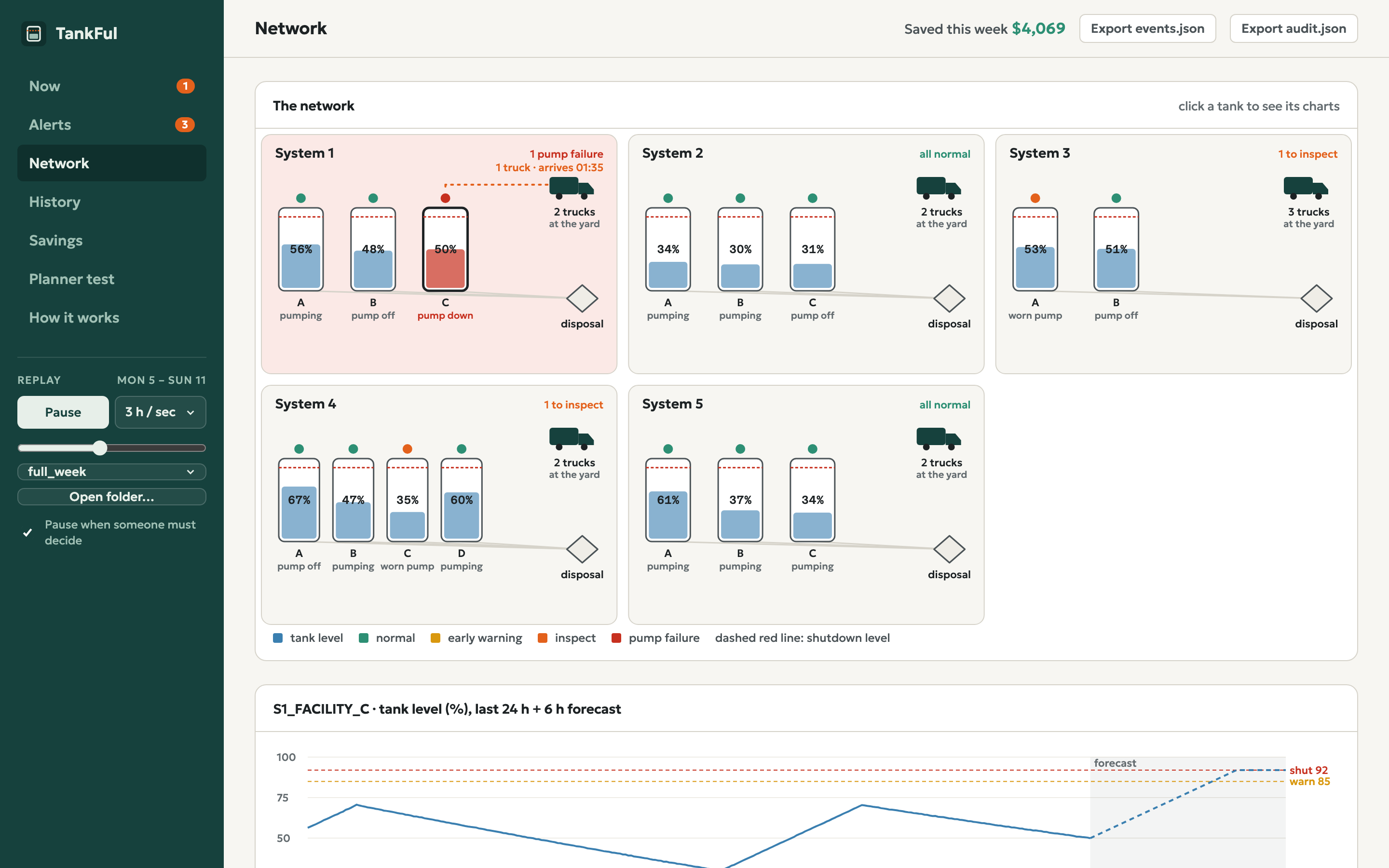
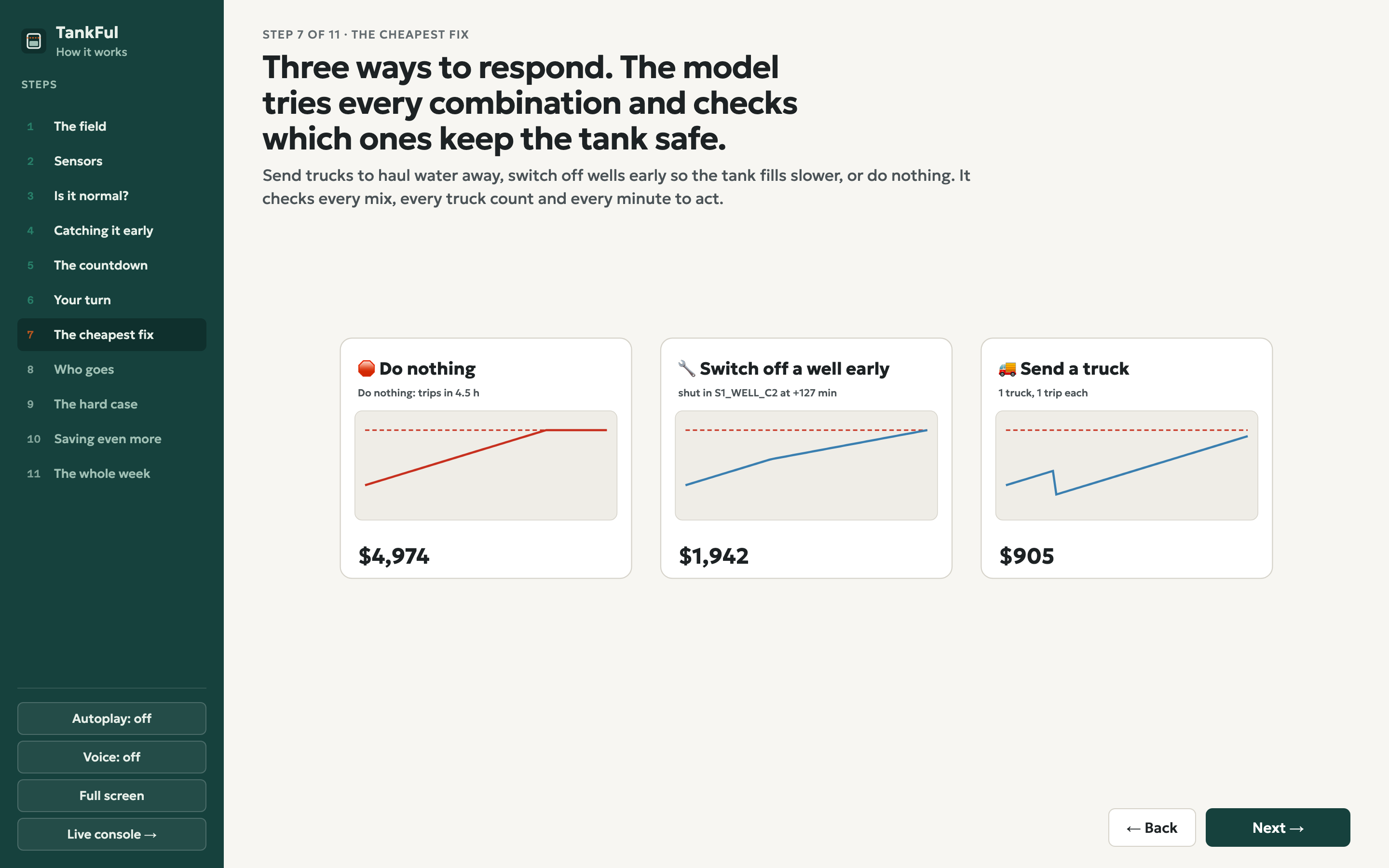
When a pump fails at a salt-water disposal site, the tank starts filling. Once it's full, every well at that facility shuts off and stops earning money. The night-shift operator has a few hours to decide: send trucks, switch off some wells, or let it shut down. Working that out by hand takes tens of minutes, and the tank keeps filling. We wanted a console that does the math instantly, shows its work, and makes sure a human acts in time.
What it does
TankFul reads 5-minute sensor data from 15 facilities and:
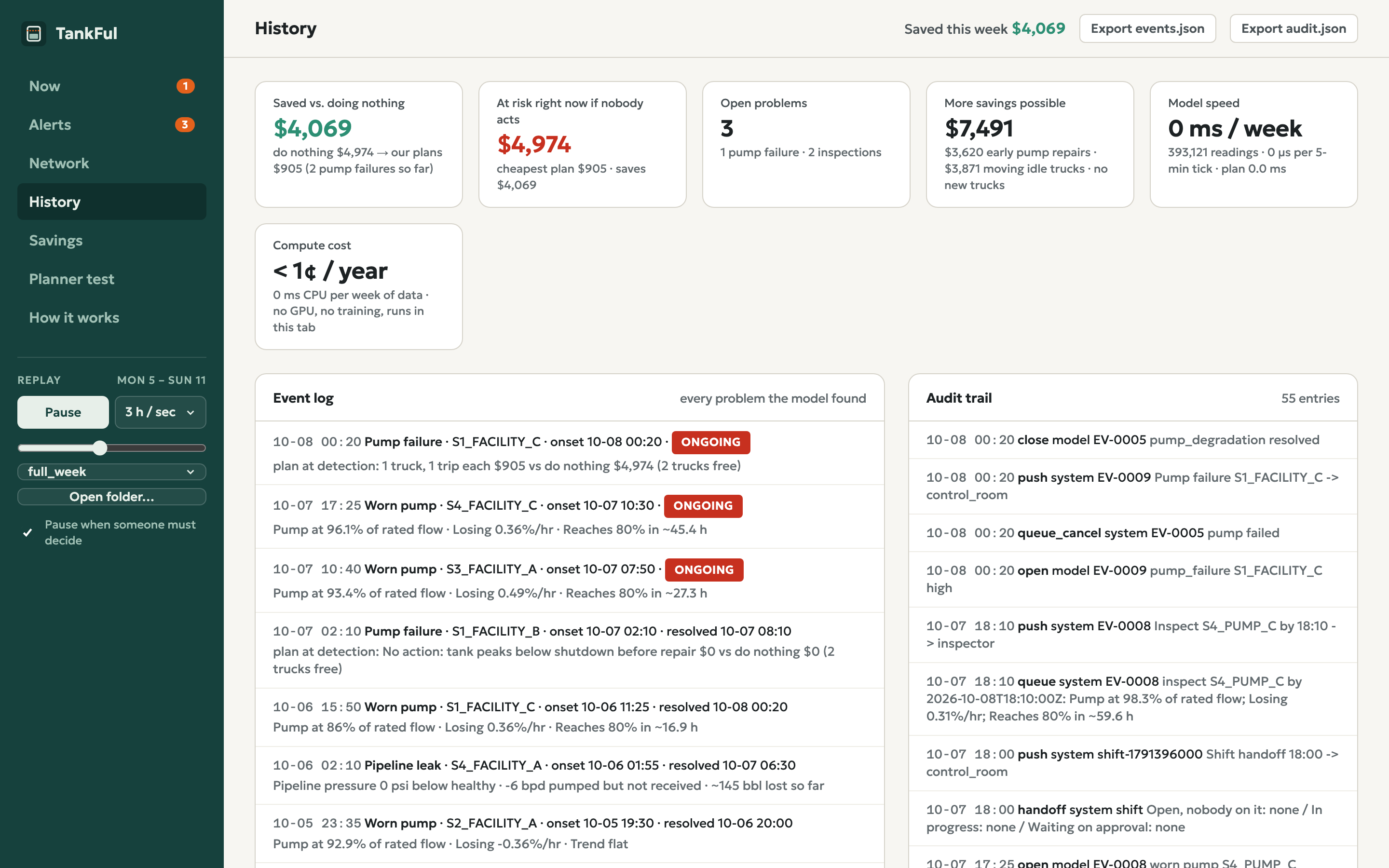
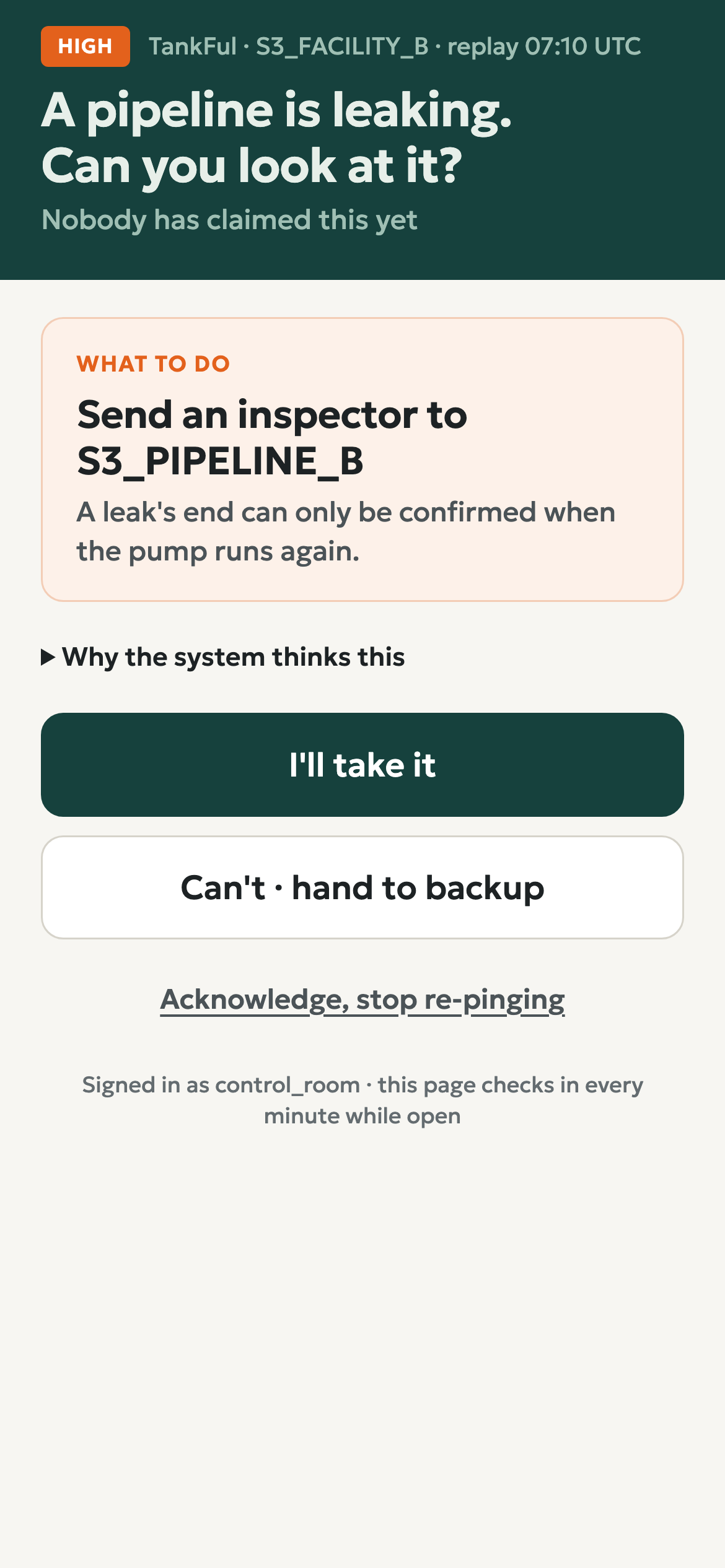
- Detects pump failures right away, leaks within 15–20 minutes, and worn pumps hours before the wear becomes obvious.
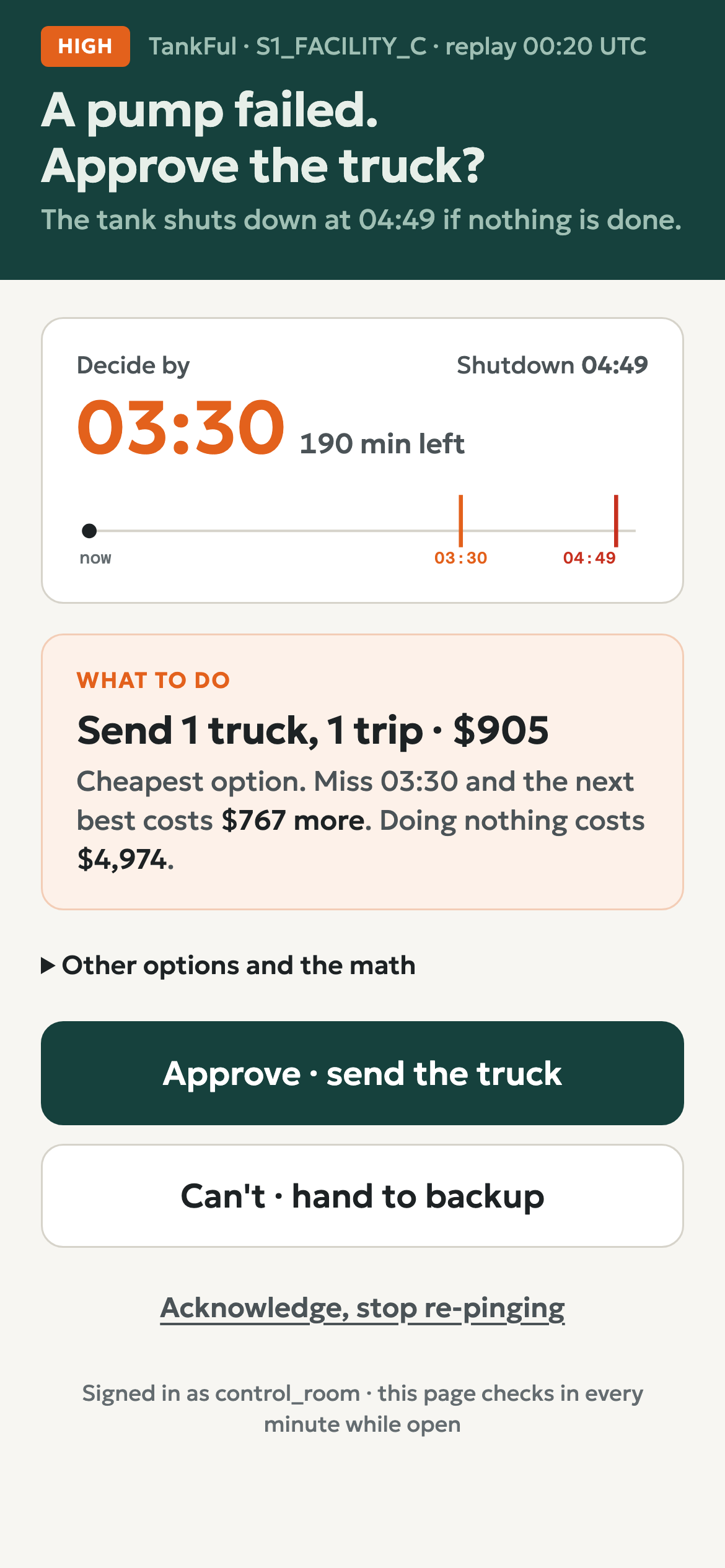
- Counts down to tank shutdown.
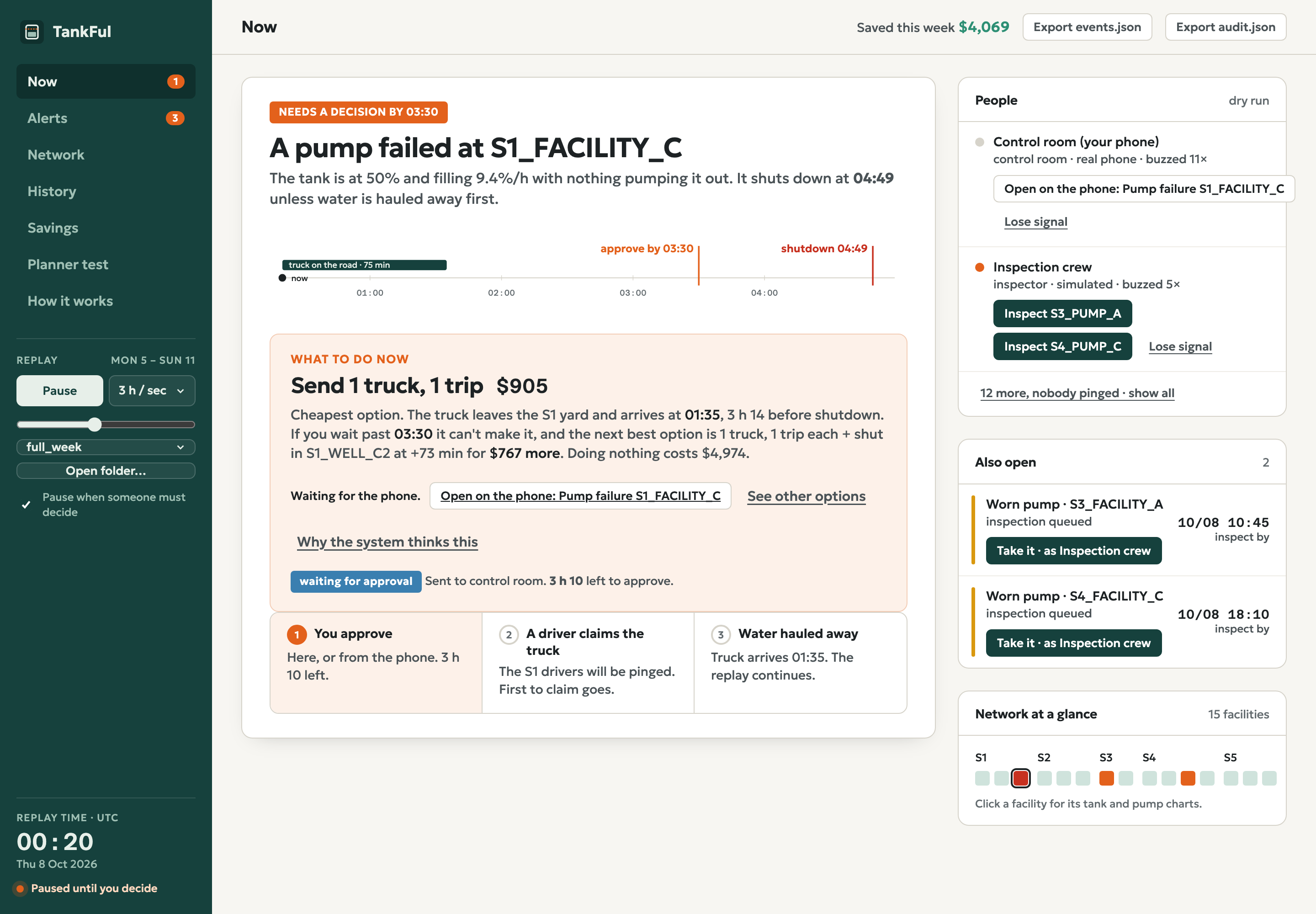
- Finds the cheapest fix across trucks, well shut-ins, and timing, then compares it with doing nothing.
- Sets an "approve-by" time: the last moment the cheapest plan still works. Trucks take 65–100 minutes to arrive, so urgency is based on this deadline, not on time to shutdown.
- Alerts the field. A push goes to the operator's phone and watch, the replay pauses until someone approves, jobs are assigned and re-planned if nobody claims them, and every decision is logged.
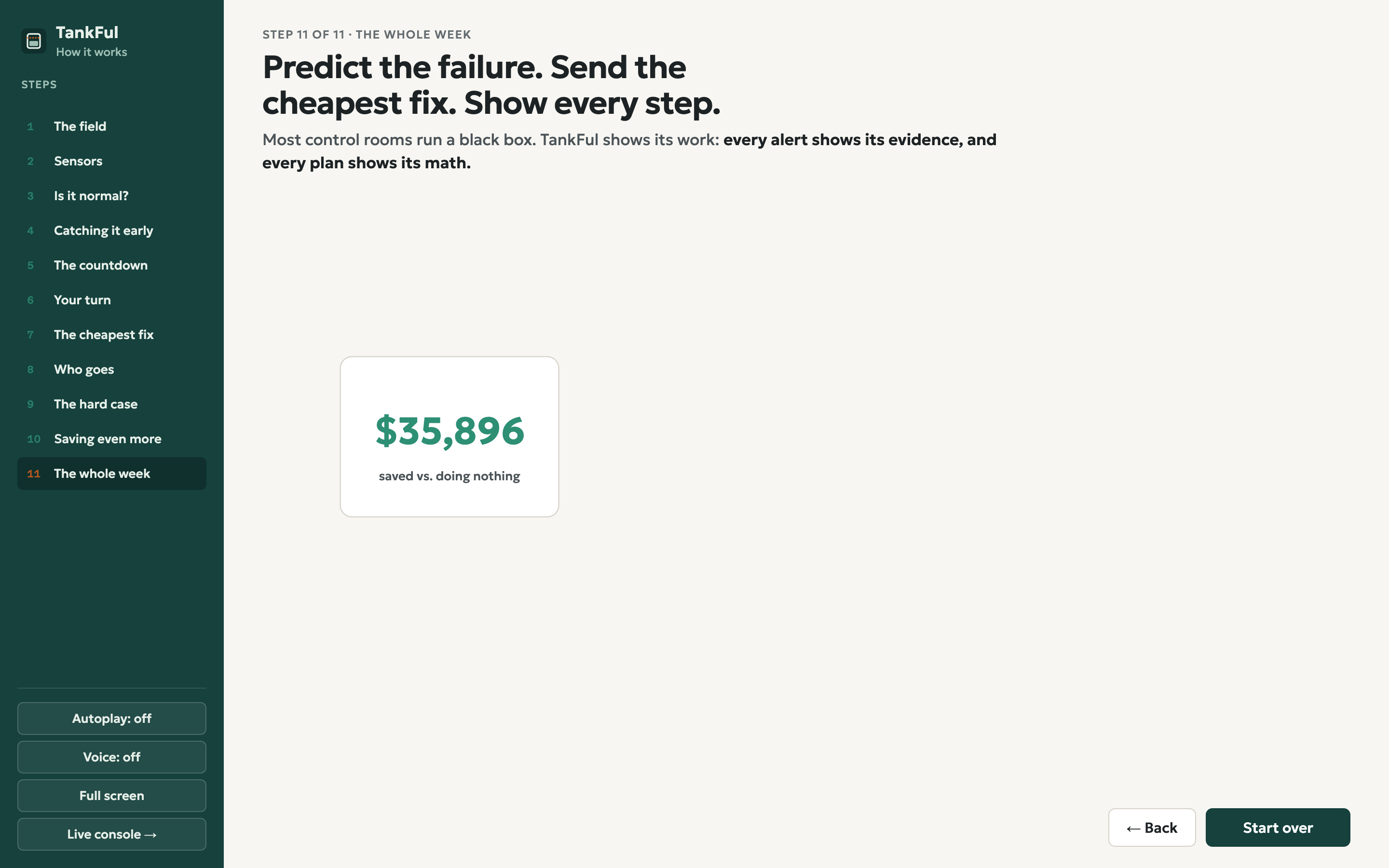
Every alert shows its evidence and every plan shows its costs.
How we built it
- Model: physics plus statistics in 18 KB of plain JavaScript. With only 23 labelled events, we used the network's own ratings as the healthy baseline and CUSUM detectors to add up small deviations over time, so it needed no training.
- Optimizer: an exact search over trucks, trips, which wells to shut in, and when, with trucks shared across a system. It takes under 1 ms.
- App: static HTML/JS, a small Node server, and ntfy push notifications to a phone claim page.
- Verification: accuracy checks against the answer keys, plus a brute-force stress test over 1,000 random emergencies.
Challenges we ran into
- Alerts fired too late. Basing urgency on time to shutdown meant trucks could no longer arrive in time. Switching to the approve-by deadline fixed it and became the core idea of the product.
- Timers in fast-forward. The replay plays hours of data per second, so we moved escalation timers onto replay time and paused the replay while a decision is pending.
- Multi-truck plans. Some fixes need several trucks shared across tanks, so alerts in the same system are approved together as one bundle.
Accomplishments that we're proud of
- 23/23 events detected, 0 false positives, even with 4× the sensor noise.
- $35,896 saved on the practice week (70%), with plans within 3% of the reference.
- 0 mismatches against brute force across 1,000 scenarios.
- A complete loop from sensor reading to costed plan to phone approval to audit log.
What we learned
With this little labelled data, a small model you can explain beat a big one you can't. Alert timing also matters as much as the prediction itself: a correct forecast is useless if it reaches the operator after the cheapest option is gone.
What's next for TankFul
- Repair worn pumps during the warning window. In our data, 3 worn pumps failed about 32 hours after we flagged them.
- Move idle trucks between systems, which would save about $3,900/week.
- A native phone and watch app with different vibration patterns by urgency.
Built With
- cloudflare-tunnel
- css
- garmin
- html5
- javascript
- node.js
- ntfy


