-
-
Banner
-
Mobile Design
🌾Inspiration
"What if a farmer could know exactly when their crops needed water before drought silently destroyed an entire harvest?"

Every year, millions of Indonesian farmers wait for the rainy season with hope. But in recent years, that hope has become increasingly uncertain. The growing intensity of El Niño has brought prolonged droughts, rising temperatures, and declining irrigation water supplies, turning once-productive farmland into dry, cracked soil. During peak dry months, particularly in August and September, crops face severe heat stress, irrigation canals begin to dry up, and the risk of crop failure (puso) rises dramatically. For smallholder farmers, losing a harvest does not simply mean producing less food link. It means losing months of income, struggling to support their families, and facing uncertainty about the next planting season.

When we visited Sinar Sari Village in Dramaga, we discovered that this challenge was not caused solely by climate change, but also by the lack of accessible decision-support technology. Farmers still determine irrigation and fertilization schedules based on experience, visual observations, or inherited farming practices. While this approach has worked for generations, today's climate is no longer predictable. A few days of delayed irrigation during an extreme drought can significantly reduce yields, while applying fertilizer at the wrong time wastes both resources and money because crops cannot absorb nutrients effectively under severe water stress link.
Many farmers still rely on experience and intuition to decide when to irrigate and when to fertilize. Without access to real-time field information, irrigation is often applied too early or too late, while fertilizers may be used when crops cannot utilize them efficiently. During droughts, these decisions become increasingly critical because every drop of water and every kilogram of fertilizer directly affect crop survival and productivity.
If water is available, how can farmers know the right time to irrigate, how much water their crops actually need, and when environmental conditions become dangerous for plant growth?
Although precision agriculture technologies already exist, most commercial solutions remain too expensive and technically complex for smallholder farmers in developing countries. Advanced nutrient sensors, proprietary software, and high installation costs limit their adoption, creating a technological gap between modern agriculture and rural farming communities. One example of these efforts is that, through the Ministry of Public Works and Public Housing and the Ministry of Agriculture, the government is building and rehabilitating irrigation networks to improve water availability link. However, these efforts do not help farmers determine when and how much water to apply in order to make their crop resistent to drought.
How can we make precision agriculture affordable enough for every smallholder farmer?
To address this challenge, we developed TaniPlus, an affordable IoT-powered precision agriculture platform designed specifically for smallholder farmers. By integrating low-cost environmental sensors and a web-based monitoring system, TaniPlus provides real-time recommendations for irrigation scheduling and heat stress mitigation. Through a collaborative B2B2C model involving farmer groups (Gapoktan), the platform makes precision farming technology more accessible while helping farmers improve water-use efficiency, optimize agricultural inputs, and strengthen resilience against climate change.
We believe that climate change cannot be prevented overnight, but its impacts can be reduced through better decisions.
By combining affordable IoT technology, real-time monitoring, and data-driven recommendations, TaniPlus empowers smallholder farmers to use water more efficiently, reduce the risk of crop failure, improve productivity, and build stronger resilience against future climate extremes.
Because when every drop of water matters, every farming decision should be backed by data—not guesswork.
🌱 What It Does
Imagine a farmer waking up early in the morning during the peak of the dry season. The weather is hotter than usual, the irrigation canal is slowly drying up, and every decision—whether to irrigate today or wait another day—could determine the success or failure of the harvest.
Instead of relying solely on experience or intuition, the farmer opens TaniPlus.

TaniPlus is an IoT-powered precision agriculture platform designed to help smallholder farmers make smarter, data-driven decisions during extreme climate conditions, particularly prolonged droughts caused by El Niño. Affordable IoT sensor boxes are installed across agricultural fields to continuously monitor environmental conditions, while farmers can access all information through a simple web-based dashboard.
Each sensor box collects essential field information, including soil moisture, air temperature, air humidity, soil pH, rainfall information, and crop age. Farmers only need to enter basic information such as the crop type and planting date, allowing the system to understand the crop's current growth stage and estimate its water requirements.
Rather than overwhelming farmers with complex sensor readings, TaniPlus transforms raw environmental data into clear, actionable recommendations. Every time new data are received, the platform analyzes field conditions using agronomic thresholds and crop water requirements to answer the questions farmers face every day:
Should I irrigate today? How much water should I apply? Is my crop experiencing heat stress? Is it the right time to fertilize?
Based on this analysis, TaniPlus provides practical recommendations, including:
- 💧 The optimal time for irrigation
- 🌾 Recommended irrigation volume based on the crop growth stage
- 🌡️ Heat stress alerts when environmental conditions become critical
- 📊 Crop monitoring reports and field history
- 📝 Historical irrigation and fertilization records for better farm management
However, we realized that technology alone is not enough. Most precision agriculture systems remain inaccessible because every farmer is expected to purchase expensive hardware individually.
To overcome this challenge, TaniPlus adopts a Business-to-Business-to-Consumer (B2B2C) implementation model by partnering with Farmer Groups (Gapoktan). Instead of approaching individual farmers one by one, sensor infrastructure is managed collectively through Gapoktan—organizations that already coordinate farming activities, technology dissemination, and government agricultural programs.
This shared approach dramatically reduces hardware costs while making deployment more efficient. During the first year, sensor procurement and installation are supported through government grants and Corporate Social Responsibility (CSR) programs, particularly from institutions such as the Directorate General of Agricultural Infrastructure and Facilities (Ministry of Agriculture), which actively promotes AI- and IoT-based precision farming.
Once the infrastructure is established, the platform transitions into a sustainable subscription model. Farmers contribute only IDR 100,000 per hectare every four months, while Gapoktan manages the subscription collectively. This recurring revenue supports cloud services, routine maintenance, software updates, sensor calibration and replacement, and continuous improvement of the recommendation system.
The entire ecosystem works as a collaborative cycle:
Developer → TaniPlus Platform → Gapoktan → IoT Sensor Boxes → Farmers → AI-Based Recommendations → Higher Productivity & Climate Resilience
Ultimately, TaniPlus is more than a monitoring platform. It serves as a digital farming assistant that transforms environmental data into practical decisions, helping farmers conserve water, optimize agricultural inputs, reduce the risk of crop failure, improve productivity, and strengthen resilience against climate change—one recommendation at a time.
📊How we built it
We start by brainstorming all available ideas with our first mentor, which was provided by Garuda Hacks, then we found a niche problem that we wanted to solve. One of our team members focused on the business side of our project, one focused on desinging the UI/UX, one was in charge of creating the hardware schematic of the IoT box, while one was the lead programmer in charge of making the platform. We did some research and below is the final financial projection of our project :
| CAPITAL EXPENDITURE | |||||
|---|---|---|---|---|---|
| NO | TYPES | Year of 0 | 2026 | 2027 | 2028 |
| 1 | Web App & AI Feature Development | Rp 42,000,000 | Rp - | Rp - | Rp - |
| 2 | Setup Domain & Infrastuktur Awal | Rp 800,000 | Rp - | Rp - | Rp - |
| 3 | Hardware & IoT prototype | Rp 32,560,000 | Rp 32,560,000 | Rp 32,560,000 | Rp 32,560,000 |
| 4 | HAKI | Rp 500,000 | Rp - | Rp - | Rp - |
| TYPES | Rp 75,860,000 | Rp 32,560,000 | Rp 32,560,000 | Rp 32,560,000 | |
| OPERATIONAL EXPENDITURE | |||||
| NO | TYPES | Year of 0 | 2026 | 2027 | 2028 |
| 1 | Cloud Hosting (Cloudflare) | Rp - | Rp 2,400,000 | Rp 2,880,000 | Rp 3,456,000 |
| 2 | Third Party AI | Rp - | Rp 1,800,000 | Rp 2,160,000 | Rp 2,592,000 |
| 3 | Manpower Wages | Rp - | Rp 48,000,000 | Rp 57,600,000 | Rp 69,120,000 |
| 4 | IoT Server and Sensor Maintenance | Rp - | Rp 1,200,000 | Rp 1,440,000 | Rp 1,728,000 |
| 5 | Partnership | Rp - | Rp 2,000,000 | Rp 2,400,000 | Rp 2,880,000 |
| 6 | Field Operation | Rp - | Rp 3,600,000 | Rp 4,320,000 | Rp 5,184,000 |
| JUMLAH | Rp - | Rp 59,000,000 | Rp 70,800,000 | Rp 84,960,000 | |
| TOTAL EXPENDITURE | Rp 75,860,000 | Rp 91,560,000 | Rp 103,360,000 | Rp 117,520,000 | |
| REVENUE | |||||
| NO | TYPES | Year of 0 | 2026 | 2027 | 2028 |
| 1 | Annual Service GAPOKTAN and Kementan | Rp - | Rp 55,000,000 | Rp 110,000,000 | Rp 165,000,000 |
| 2 | Subscription | Rp - | Rp 24,000,000 | Rp 48,000,000 | Rp 72,000,000 |
| 3 | Training | Rp - | Rp 5,000,000 | Rp 10,000,000 | Rp 15,000,000 |
| TOTAL REVENUE | Rp - | Rp 84,000,000 | Rp 168,000,000 | Rp 252,000,000 | |
| EBT | Rp (75,860,000) | Rp (7,560,000) | Rp 64,640,000 | Rp 134,480,000 | |
| TAX (22%) | Rp - | Rp - | Rp 14,220,800 | Rp 29,585,600 | |
| NET PROFIT | Rp (75,860,000) | Rp (7,560,000) | Rp 50,419,200 | Rp 104,894,400 | |
| CUMMULATIVE | Rp (75,860,000) | Rp (83,420,000) | Rp (33,000,800) | Rp 71,893,600 |
| INVESTMENT ANALYSIS | |||
|---|---|---|---|
| THE -TH YEAR | EXPENDITURES | NET CASH FLOW | CUMMULATIVE |
| 0 | Rp 75,860,000 | Rp (75,860,000) | |
| 1 | Rp (7,560,000) | Rp (83,420,000) | |
| 2 | Rp 64,640,000 | Rp (18,780,000) | |
| 3 | Rp 134,480,000 | Rp 115,700,000 | |
| PP | 2.290532178 | ||
| IRR | 40,9% | ||
| ROI | 168,98% | ||
| NPV | Rp56.097.258 |
Hardware & Firmware. The core of each sensor box is an ESP32 microcontroller, chosen for its built-in Wi-Fi connectivity, low power consumption, and affordability compared to alternatives like Raspberry Pi. Around it, we integrated a set of low-cost environmental sensors: a DHT22 for air temperature and humidity, a capacitive soil moisture sensor, and a 3-in-1 soil pH/moisture/light sensor, all housed in a weatherproof IP65 ABS enclosure to withstand field conditions. Power is supplied through a 10W solar panel paired with a LiFePO4 battery and charge controller, allowing the box to operate independently in areas without reliable electricity, which is common in rural farmland. On the firmware side, we wrote embedded C++ code (Arduino framework) that periodically samples each sensor, formats the readings into a structured JSON payload, and transmits them over HTTP to our backend using the ESP32's WiFiClient and HTTPClient libraries. Before deploying to physical hardware, we prototyped and validated the full sensor-to-cloud data flow using Velxio, an ESP32 circuit simulator, letting us iterate quickly on wiring logic and payload formatting without needing physical units on hand.
Backend & Decision Engine. Each sensor box sends its readings to a REST API endpoint, where the data is parsed, timestamped, and stored per device ID in our database, building a historical record for every field over time. On top of this raw data, we built a rule-based decision-support engine informed by agronomic research on maize (jagung) water and nutrient requirements across its growth phases (initial, crop development, mid-season, late season). The engine compares incoming sensor values, soil moisture, temperature, and pH, against phase-specific thresholds (e.g. soil moisture setpoint of 70%, temperature setpoint of 26–34°C, pH setpoint of 6.0) derived from published studies and journal data on Ultisol/Inceptisol soils. When a threshold is crossed, the system generates a concrete, actionable recommendation, such as irrigation volume in mm, optimal watering time windows, or fertilizer timing and dosage, rather than just raw numbers, so farmers with limited technical literacy can act on it directly.
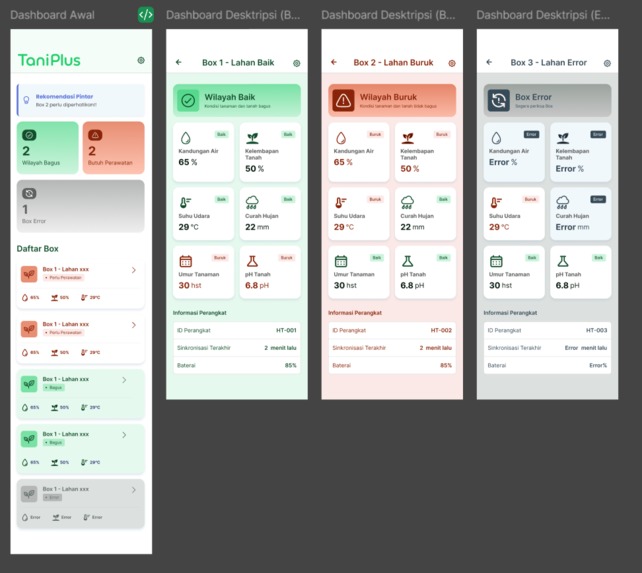
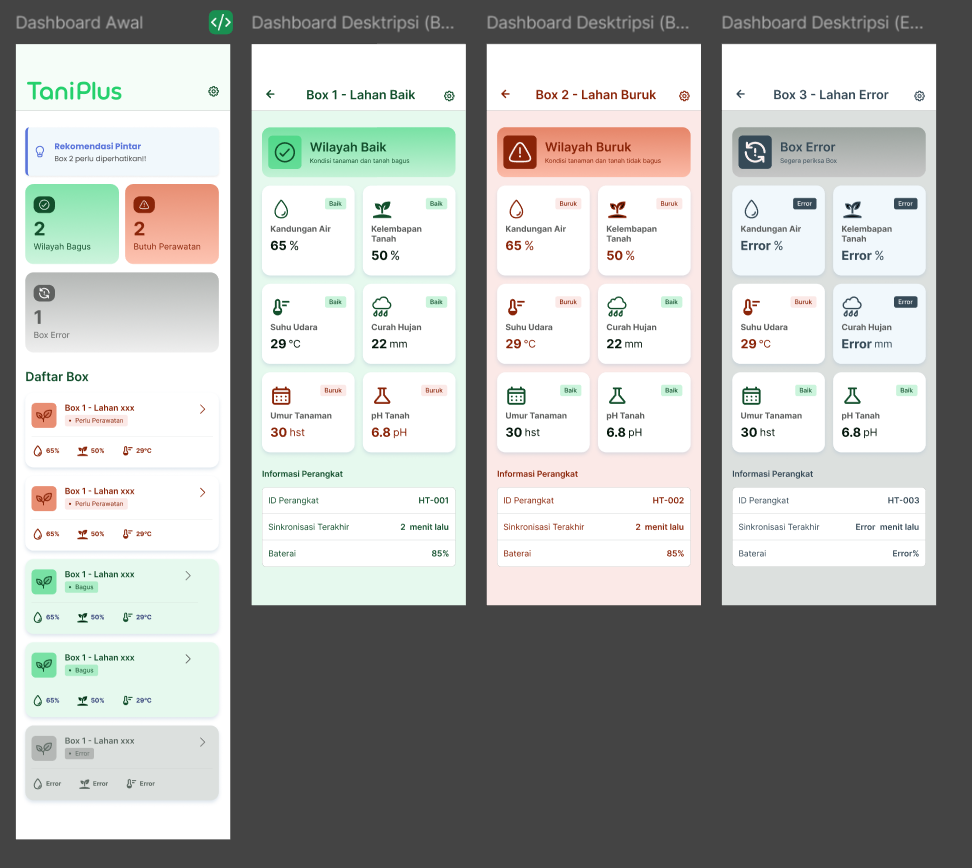
Dashboard. On the frontend, we built a web-based dashboard where farmers can log in, register their sensor box via QR code linking it to their account, select their crop type and planting date, and view real-time field conditions on an interactive map colored by soil condition status. The dashboard surfaces both the live sensor data and the corresponding AI-generated recommendations in plain, direct language, along with a historical log of irrigation and fertilization activities for each field.
Integration. We tied all three layers together end-to-end: simulated/physical ESP32 sensor readings flow into the backend via JSON over HTTP, get evaluated against our agronomic rule set, and surface as recommendations on the farmer-facing dashboard, mirroring the full Developer → Platform → Gapoktan → Sensor Box → Farmer pipeline described in our business model.
🚧 Challenges We Ran Into
Building TaniPlus was not simply about combining IoT and agriculture. It was about finding the right balance between technical performance, affordability, and real-world adoption.
One of our biggest challenges was designing a precision agriculture system that smallholder farmers could actually afford. During the early stages of development, we considered integrating professional nutrient (NPK) sensors to provide highly accurate fertilization recommendations. However, after conducting our feasibility analysis, we found that these sensors were prohibitively expensive, significantly increasing deployment costs and making the solution unrealistic for rural communities.
Instead of pursuing the most sophisticated technology, we shifted our focus toward appropriate technology. We redesigned the system to rely on affordable environmental sensors—such as soil moisture, air temperature, humidity, and soil pH—and combined them with crop growth stages and agronomic knowledge to generate irrigation and fertilization recommendations. This approach allowed us to maintain practical decision support while keeping the system economically accessible.
Another challenge was ensuring that the platform could be adopted at scale. Initially, we planned to deploy sensor boxes for every individual farmer, but we quickly realized that the upfront investment and maintenance costs would become a major barrier. To overcome this, we redesigned our implementation strategy into a Business-to-Business-to-Consumer (B2B2C) model by partnering with Farmer Groups (Gapoktan). Sharing sensor infrastructure through Gapoktan significantly reduced hardware costs while leveraging an organization that farmers already trust.
Finally, we learned that building a successful agri-tech solution is not just about developing accurate technology. Every design decision, from selecting low-cost sensors to developing a subscription-based business model, was driven by one question:
"Can this solution realistically be adopted by smallholder farmers?"
This challenge ultimately shaped TaniPlus into a platform that is not only technically feasible but also economically sustainable, scalable, and designed for real-world implementation.
Another challenge was designing a sustainable business model. We shifted from selling expensive hardware directly to farmers toward a B2B2C subscription model involving Gapoktan. It makes the solution significantly more accessible.
🏆 Accomplishments that We're Proud Of
One of our proudest accomplishments was transforming an ambitious idea into a practical solution that addresses a real challenge faced by Indonesian smallholder farmers. Throughout the development process, we continuously refined our concept to ensure that every technical and business decision aligned with the realities of rural agriculture, rather than creating another technology that would be difficult to adopt.
We successfully developed an affordable precision agriculture platform that combines IoT monitoring with an intelligent decision-support system capable of providing real-time irrigation recommendations, heat stress alerts, and fertilization guidance. Instead of relying on expensive nutrient sensors, we redesigned the platform to utilize affordable environmental sensors while maintaining reliable recommendations through agronomic thresholds and crop growth data.
Beyond the technology itself, we are proud to have designed a sustainable implementation strategy. By introducing a Business-to-Business-to-Consumer (B2B2C) model, we positioned Gapoktan as the key implementation partner to enable sensor infrastructure to be shared among farmers and dramatically lowering adoption costs. Combined with a hybrid financing model—leveraging government and CSR support during the initial deployment before transitioning to a farmer subscription model—we created a pathway that supports both accessibility and long-term financial sustainability.
Perhaps our greatest achievement is demonstrating that precision agriculture does not have to be expensive to create meaningful impact. TaniPlus brings together technological innovation, economic feasibility, and social impact into a single ecosystem that empowers smallholder farmers to make better decisions, improve water-use efficiency, strengthen resilience against El Niño, and contribute to more sustainable agricultural production in Indonesia.
We are proud not only of the platform we built, but also of proving that advanced agricultural technology can be designed for the farmers who need it most.
📚 What We Learned
Developing TaniPlus has been a journey of constant learning, iteration, and rethinking our assumptions. At the beginning, we believed that building a successful precision agriculture platform meant integrating the most advanced technologies available. However, as we explored the realities faced by smallholder farmers, we realized that innovation is only meaningful when it is practical, affordable, and accessible to the people who need it most.
One of the most important lessons we learned was that technology should adapt to farmers, not the other way around. Instead of pursuing expensive hardware with the highest technical accuracy, we focused on identifying the minimum set of environmental data that could still generate reliable recommendations. This shift allowed us to build a solution that balances performance with affordability, making precision agriculture more realistic for rural communities.
We also discovered that successful technology adoption depends just as much on people as it does on innovation. Working through Farmer Groups (Gapoktan) rather than approaching individual farmers not only reduces implementation costs but also builds on existing trust, collaboration, and local agricultural support systems. This insight fundamentally shaped our B2B2C implementation strategy and made the platform far more scalable.
Perhaps the biggest lesson from this project is that solving climate challenges requires more than engineering alone. It demands an interdisciplinary approach that combines agriculture, IoT, data-driven decision support, business sustainability, and community engagement. Every design decision—from selecting affordable sensors to developing a sustainable subscription model—was guided by a single question:
"Will this solution genuinely improve the lives of smallholder farmers?"
This experience has taught us that meaningful innovation is not defined by how sophisticated the technology is, but by how many people it can empower. That mindset will continue to guide the future development of TaniPlus.
🚀 What's Next for TaniPlus
While TaniPlus has demonstrated its potential as an affordable precision agriculture platform, we believe this is only the beginning of a much larger journey.
Our immediate priority is to bring TaniPlus out of the prototype stage and into real agricultural fields through a pilot implementation in Sinar Sari Village, Dramaga. Working closely with local Gapoktan, we aim to evaluate how the platform performs under actual farming conditions throughout a planting season. Beyond validating the accuracy of our irrigation and fertilization recommendations, we want to understand how TaniPlus influences farmers' daily decision-making, improves water-use efficiency, and contributes to higher crop productivity during drought conditions.
The insights gathered from this pilot will become the foundation for the next iteration of the platform. By listening directly to farmers, agricultural extension officers, and Gapoktan leaders, we hope to continuously refine both the technology and the user experience, ensuring that every new feature addresses real challenges faced in the field.
As the platform matures, our goal is to expand beyond a single village by partnering with Gapoktan, local governments, the Ministry of Agriculture, and Corporate Social Responsibility (CSR) programs. Through our B2B2C implementation model, we envision a growing network of shared IoT sensor infrastructure that enables more smallholder farmers to access precision agriculture without the burden of high upfront investment costs.
From a technological perspective, we plan to enhance TaniPlus with weather forecasting integration, satellite-based climate monitoring, and machine learning models capable of generating increasingly accurate and personalized recommendations. We also aim to develop a mobile application with offline functionality, allowing farmers in remote areas with limited internet connectivity to continue receiving essential farming recommendations.
Looking further ahead, we envision TaniPlus evolving into a comprehensive digital agriculture ecosystem. Beyond supporting maize cultivation, the platform will be expanded to other strategic crops, provide more advanced farm management and analytics tools for Gapoktan, and integrate with national climate adaptation initiatives. Our long-term vision is to empower smallholder farmers across Indonesia with affordable precision agriculture technology, helping them produce more with fewer resources while building resilience against climate change.
Our ultimate goal is not simply to build another agri-tech platform, but to create a future where every farming decision is guided by data, every drop of water is used wisely, and every smallholder farmer has the opportunity to thrive in a changing climate. harvest?"*
🌾 "Every field deserves the chance to thrive, and every farmer deserves the power of data."
TaniPlus is our step toward making climate-smart agriculture affordable, accessible, and sustainable for every smallholder farmer in Indonesia.
🛡️Predictive Insights, Real-time Protection📊


Log in or sign up for Devpost to join the conversation.