-
-
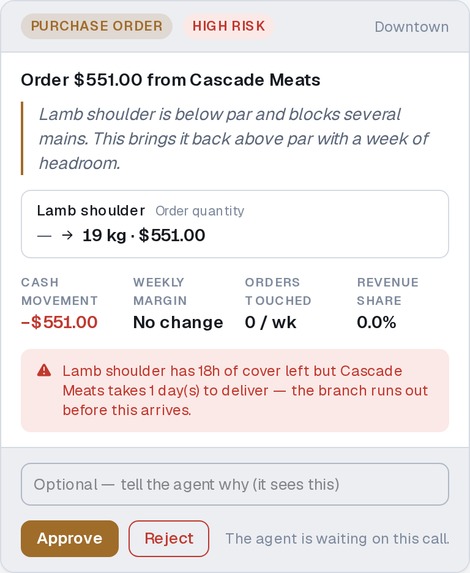
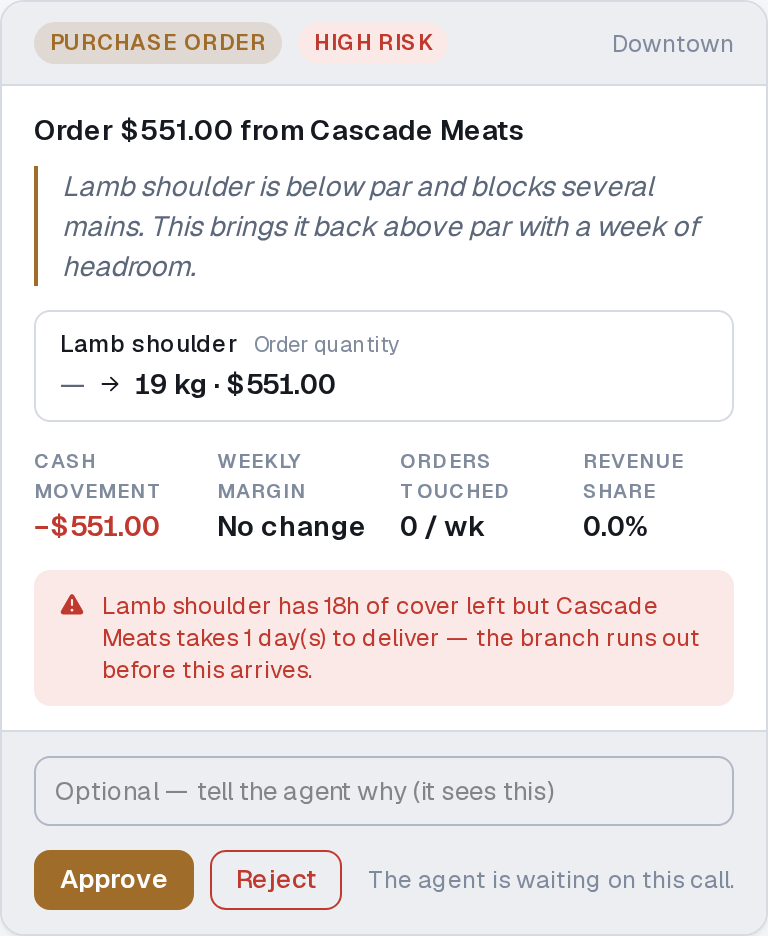
The approval card: what the agent asked for, and what the site computed it would cost.
-
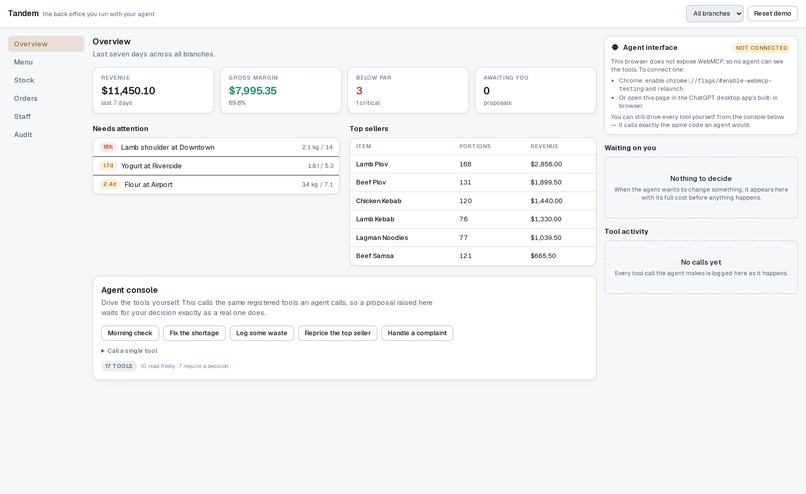
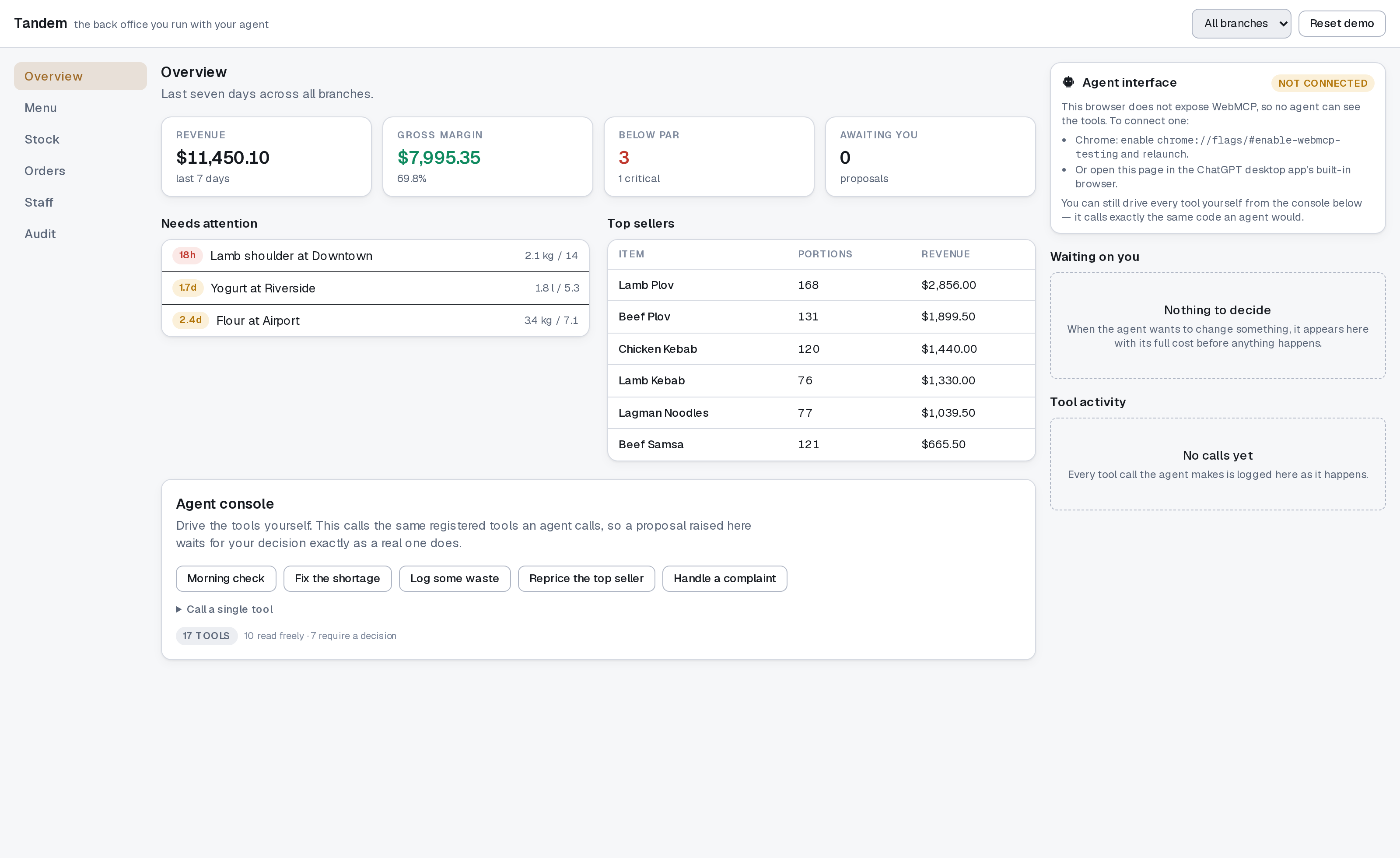
The manager's dashboard. The agent's read-only tools answer from exactly this data.
-
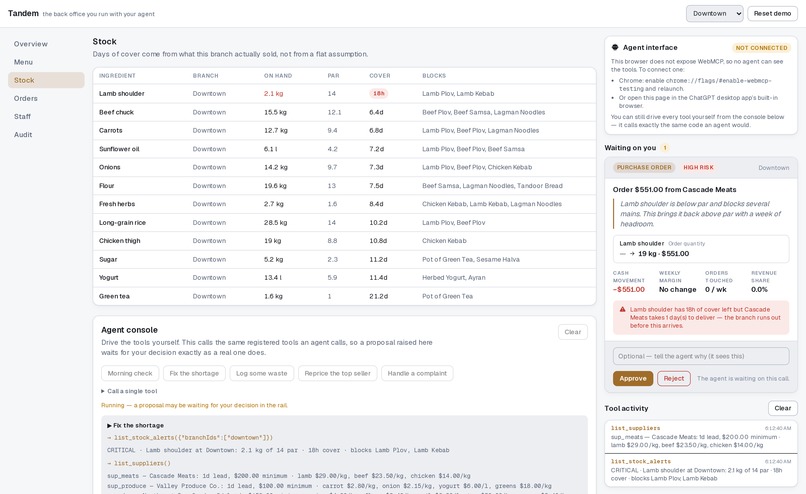
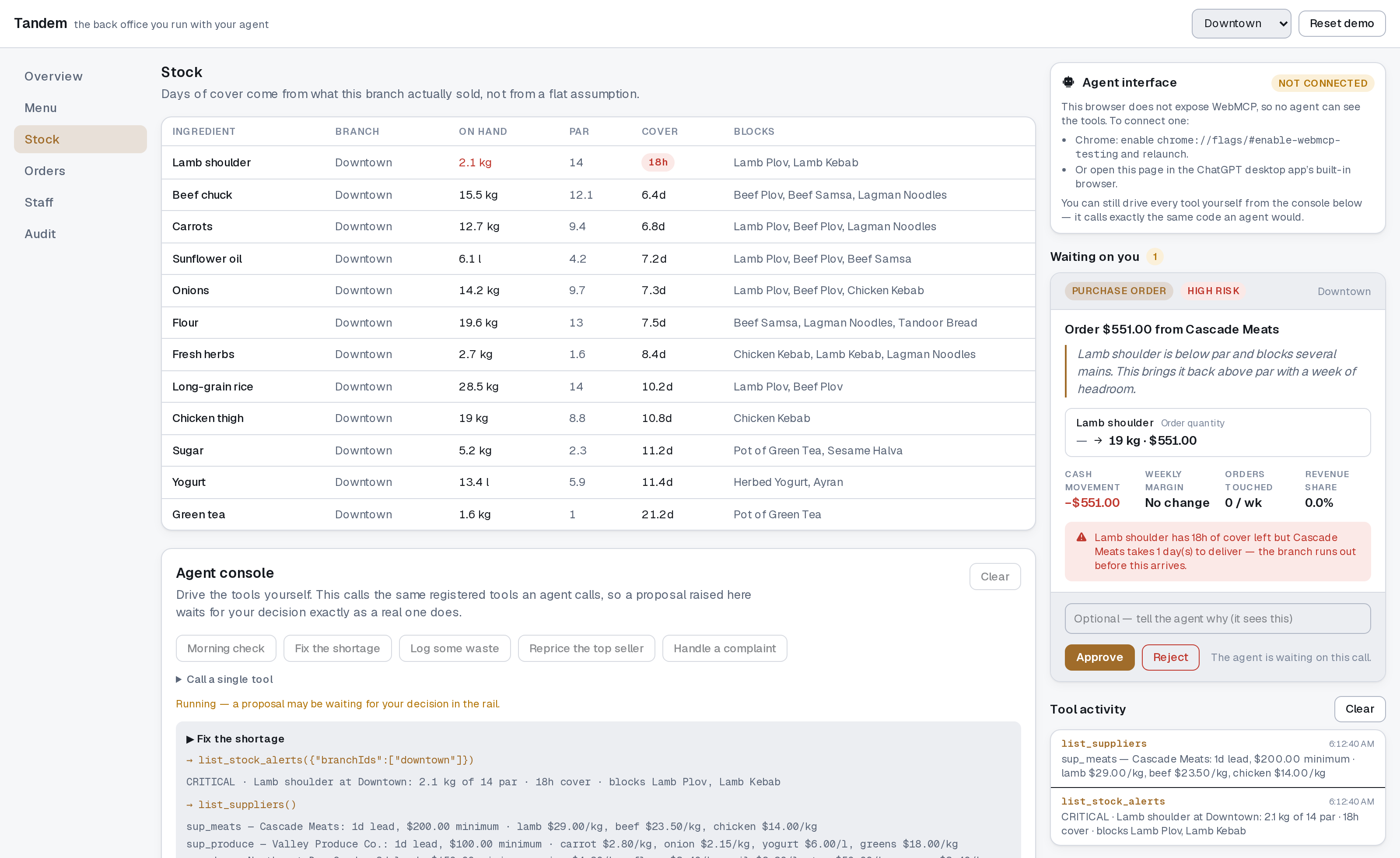
The write tool has not returned — it is blocked, waiting on the decision in the rail.
-
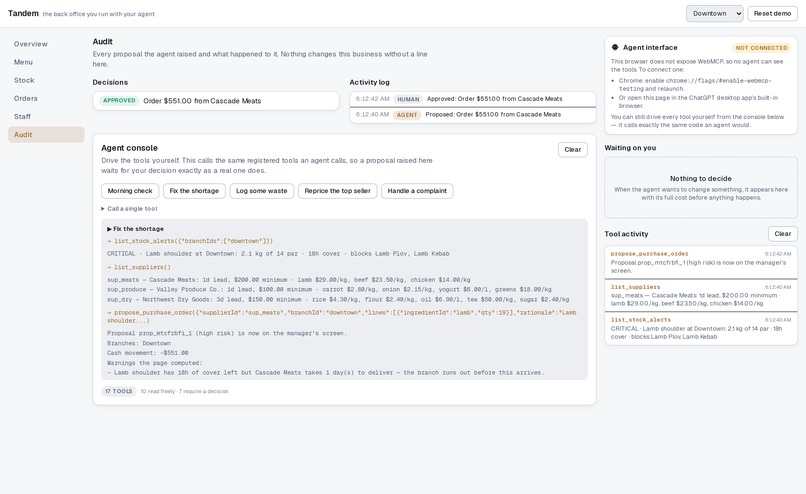
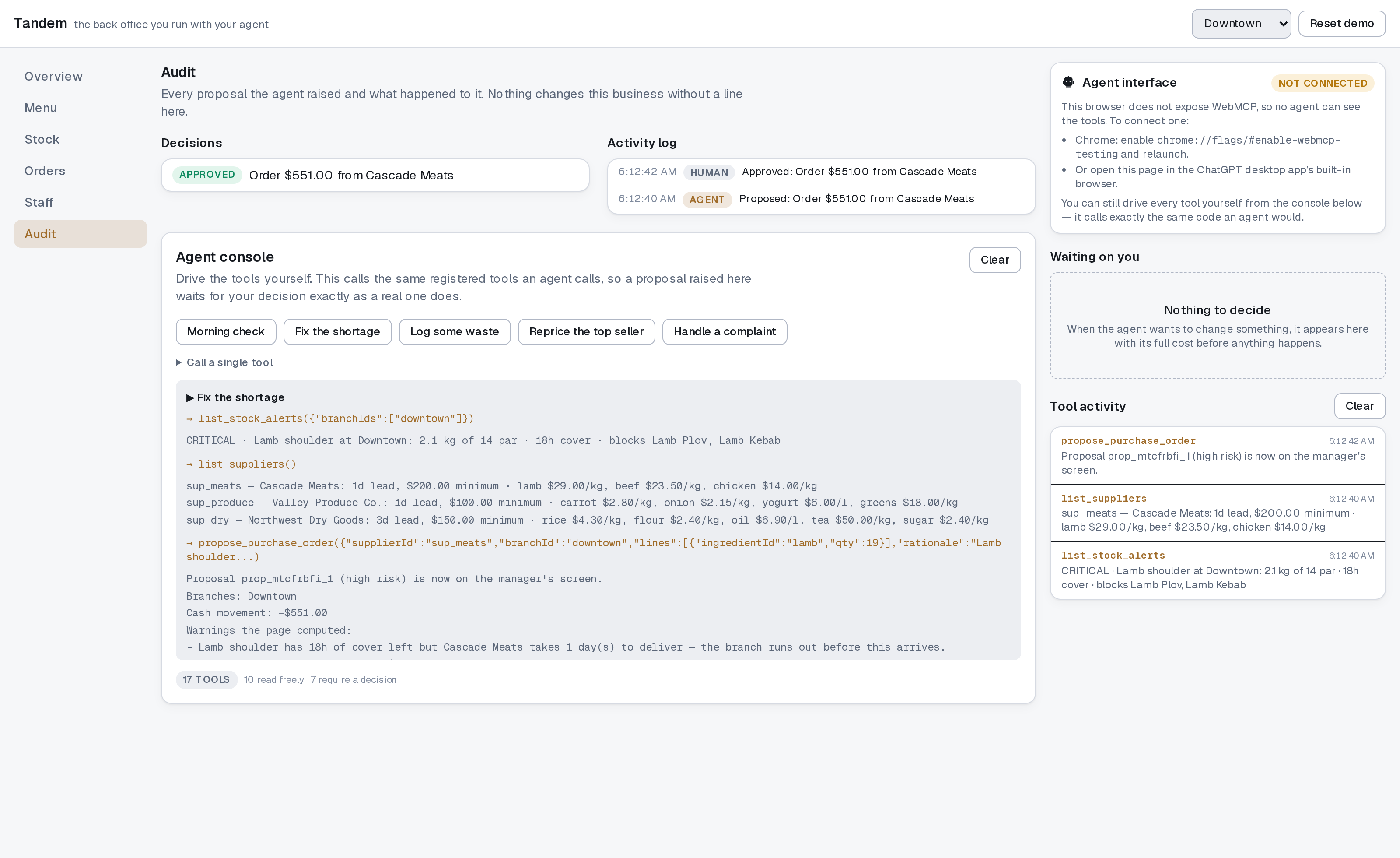
Every proposal and decision, attributed. Nothing changes without a line here.
Inspiration
Most agent integrations answer the wrong question. They ask "can the agent do this?" — and with a good enough API the answer is usually yes. The question a business actually cares about is "should it, and what does it cost?"
I have spent the last year building operations software for a real restaurant chain: three branches, live orders, real money. The thing that kept me from letting an agent touch any of it was never capability. It was that a confirmation dialog saying "Change price to $16.50? [OK]" asks a human to approve something neither party has priced.
The agent knows the dish and the number. It does not know that the dish is 31% of that branch's revenue, that a 20% rise projects out to eleven fewer covers a week, or that the branch has enough lamb for eighteen more hours.
The site knows all of that. So the site should own the confirmation.
What it does
Tandem is a back office for a three-branch restaurant chain, built so a manager and their agent can run it together.
The tool surface is split down the middle. Ten read tools, annotated readOnlyHint — the agent calls them as freely as it likes, because reading changes nothing. And six write tools that never write: each builds a fully-costed proposal, puts it on the manager's screen, and the tool call blocks. The promise stays unresolved until a human decides.
What returns to the agent is not a success code it wrote for itself. It is the manager's decision, in the manager's words:
REJECTED by the manager — "Refund $66.00 on ord_00454" was NOT applied. Nothing changed.
Their reason: Refund policy is 50% after 24h.
Do not retry the same change. Ask what they would prefer, or propose a different option.
The approval card shows what the agent could not compute: cash actually leaving the business, the weekly margin effect projected through a stated demand elasticity, orders touched last week, share of branch revenue, and warnings the page worked out for itself — "Flour has 1.9 days of cover left but Northwest Dry Goods takes 3 days to deliver, so the branch runs out before this arrives."
And because confirming every trivial action is worse than having no agent at all, the manager can grant a standing approval: narrow to one kind of change, bounded by a cash ceiling and a risk ceiling, limited to a use count, revocable at any time — and still fully audited.
How we built it
Next.js 16 and TypeScript, no backend. State lives in the browser, which means the tools and the UI are provably reading the same data rather than two views that can drift.
Tools are registered on document.modelContext — not navigator.modelContext, which was deprecated in Chromium 150 and which most tutorials still show. The imperative JavaScript API only, since the declarative HTML-form variant is not supported in ChatGPT's browser. Everything is registered from the top-level document, because tools inside an iframe are not discoverable, and a route change would tear the tool set down underneath an agent mid-conversation — so Tandem is one page that switches sections in client state.
The consequence engine is a set of pure functions over application state: portion costs from recipes, days of cover from the ingredient draw of actual sales, elasticity-adjusted margin projections, supplier lead times against run rate. Proposal construction and proposal application are deliberately separate functions sharing one payload, so what the manager approved and what actually happens cannot drift apart.
A hundred tests cover the arithmetic a human approves on, and the tool contract itself. The seed dataset is pinned too: food cost has to stay in a band a real operator would recognise, or the demo stops being believable.
Challenges we ran into
Making the block feel like a feature, not a hang. A tool call that never returns is a bug. One that returns the manager's reasoning is a conversation. That meant honouring the agent's AbortSignal, lapsing unanswered proposals after five minutes, and settling every waiting promise on unmount — a stranded card is worse than a refusal.
Registration stability. Tools close over application state, but rebuilding them on every render would make the tool list churn underneath a live agent. The tool set is built once outside React and resolves state at call time.
Demonstrability. WebMCP is behind a flag in most browsers today. Rather than ask people to take the agent half on faith, the page ships an in-page console that drives the same registered tool objects — including the blocking, so a proposal raised from the console waits for a decision exactly as a real one does.
Accomplishments that we're proud of
The block is real. A write tool's promise genuinely stays open until a person decides. This is not a modal the page shows itself — the agent's own call is suspended, and what it eventually receives is the manager's sentence.
The site says something the model cannot. "Northwest Dry Goods has a $150.00 minimum; this order is $24.00 and would be rejected." That comes from recipes, live stock, a week of orders and supplier terms. No amount of prompting gets an agent to that sentence, because the information was never in the conversation.
The tests earned their keep. A hundred of them, and they caught two things I would otherwise have shipped: a warning quoting a figure derived from the supplier's lead time rather than the branch's actual remaining cover — on the last screen before money moves — and a claim of eighteen tools where seventeen were registered.
It demonstrates anywhere. WebMCP sits behind a flag in most browsers today. Rather than ask anyone to take the agent half on faith, the page drives its own registered tool objects, blocking included.
What we learned
WebMCP's real leverage is not that it saves an agent from clicking buttons. It is that the site finally gets to participate in the decision. A REST endpoint can only say yes or no. A WebMCP tool can say "here is what that would cost — ask your human."
What's next for Tandem
Multi-party approval for changes above a threshold; learning standing-approval ceilings from the decisions a manager has already made; and replacing the demo dataset with the live chain this was designed for.
Built With
- ai-agents
- chrome
- css
- html
- javascript
- next.js
- playwright
- react
- tailwindcss
- typescript
- vercel
- vitest
- webmcp


Log in or sign up for Devpost to join the conversation.