Inspiration
In South Korea, 70% of people consume processed foods daily, leading to nutritional imbalances and chronic health problems like obesity and diabetes. Busy professionals don't have time to read complex nutrition labels or manually calculate macronutrient ratios.
We created TanDanGenie (탄수화물-단백질-지방 Genie) to solve this with AI: simply scan a food label or take a photo of your meal, and get instant carb:protein:fat ratio analysis with personalized health recommendations based on WHO guidelines.
The name "TanDanGenie" comes from Korean words:
- 탄(Tan) = Carbohydrates
- 단(Dan) = Protein
- 지(Ji) = Fat
- Genie = Your AI nutrition assistant
What it does
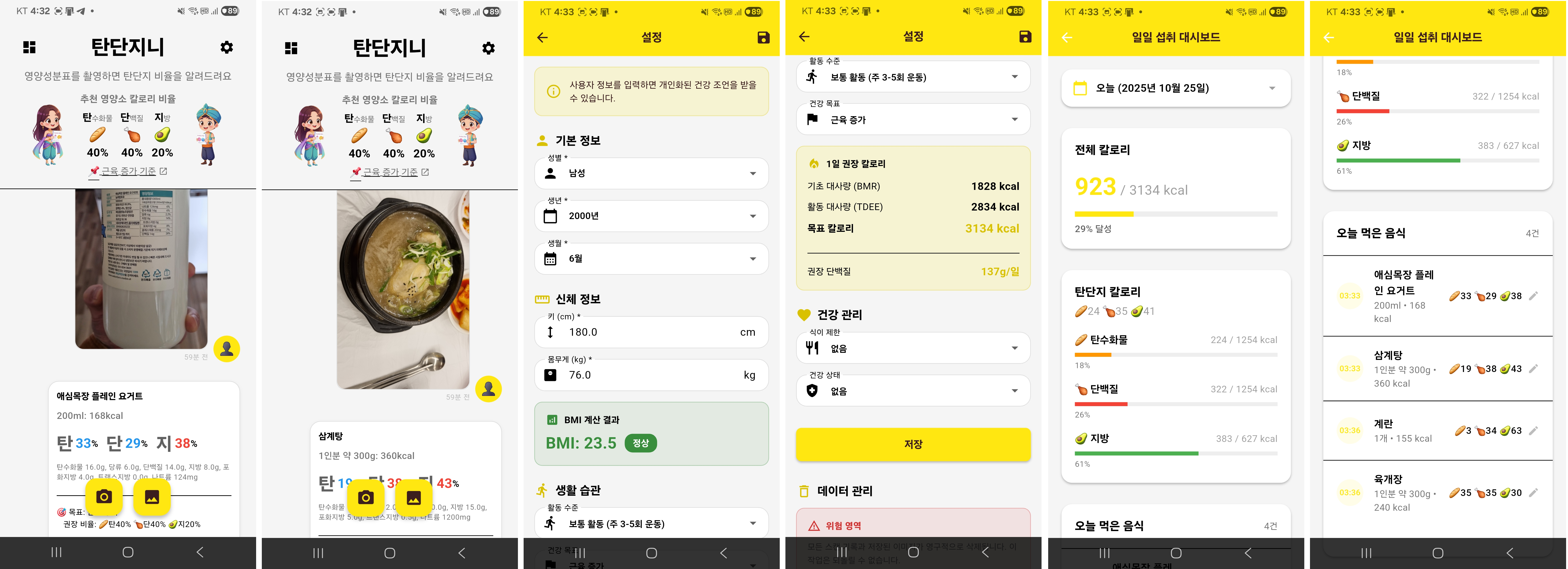
TanDanGenie is a cross-platform mobile app (Flutter) that provides instant nutrition analysis:
How we built it
Frontend Stack
- Flutter 3.9.2 (Dart) for cross-platform mobile (Android/iOS)
- Provider pattern for reactive state management
- fl_chart for nutrition data visualization
- Custom chat-style UI with emoji-based macro indicators (🥖 carbs, 🍗 protein, 🥑 fat)
AI & Backend Stack
- Google Cloud Gemini 2.0-flash API for food image recognition and OCR
- BigQuery REST API for querying USDA FoodData Central nutrition database
- Fivetran Connector SDK (Python) for automated data pipeline
- SQLite for local data storage and offline capability
Data Architecture Details
- USDA FoodData Central API provides comprehensive nutrition data (500,000+ foods)
- Custom Fivetran Connector syncs data to BigQuery automatically
- BigQuery performs WHO compliance analysis based on carb/protein/fat ratios:
- WHO Standard: 50% carbs : 30% protein : 20% fat
- Real-time query performance: <2 seconds
- Mobile App queries BigQuery REST API for personalized recommendations
- Gemini AI analyzes food images and matches against the database
Korean Food Mapping Innovation
We created a unique Korean → English food mapping system because USDA database uses English terms:
- 삼계탕 (Samgyetang) →
["chicken", "poultry", "soup"] - 김치찌개 (Kimchi stew) →
["kimchi", "soup", "stew", "fermented"] - 비빔밥 (Bibimbap) →
["rice", "mixed", "vegetable", "bowl"]
This enables accurate category-based recommendations for Korean cuisine.
Challenges we ran into
Technical Challenges
Fivetran Integration Complexity
- Learning Fivetran Connector SDK in just 6 days
- Building a production-ready data pipeline from scratch
- Handling data schema transformations between USDA API and BigQuery
OCR Accuracy for Diverse Formats
- Achieving 90%+ accuracy on nutrition labels with different layouts
- Supporting both Korean and English text recognition
- Handling low-quality images and poor lighting conditions
Cross-platform Data Synchronization
- Building a unified data pipeline for Android/iOS/Web
- Managing offline-first architecture with SQLite + BigQuery sync
- Optimizing API calls to stay within free tier limits
Korean Food Database Gap
- USDA database is primarily English/Western foods
- Created custom mappings: Korean food names → English USDA terms
- Example: "삼계탕" → searching for "chicken", "poultry", "soup" in BigQuery
Design Challenges
Simplifying Nutrition Science
- Making complex macronutrient data accessible through simple emoji indicators
- Chat-style UI makes health data feel conversational, not clinical
- Balancing detail vs. simplicity for different user expertise levels
Real-time Performance
- Optimizing BigQuery queries to respond in <2 seconds
- Implementing smart caching to reduce API calls
- Balancing image quality vs. upload speed
User Privacy
- Processing food images locally on-device (Gemini API)
- Not storing images on servers
- Minimal personal data collection (only age, gender for recommendations)
Accomplishments that we're proud of
✅ End-to-End AI Pipeline: Built a complete production pipeline (USDA → Fivetran → BigQuery → Vertex AI → App) in just 6 days
✅ High OCR Accuracy: Achieved 90%+ accuracy on food label recognition for both Korean and English labels
✅ Blazing Fast Performance: <2 second API response time from scan to result display
✅ Category-Based Intelligence: Implemented smart food alternative suggestions that actually match the analyzed food type (e.g., 삼계탕 → chicken-based alternatives, not random salads)
✅ Reusable Open-Source Connector: Created a Fivetran connector that other nutrition apps can use
✅ Real WHO Compliance: Integrated actual WHO nutrition guidelines (50:30:20 ratio) for evidence-based recommendations, not arbitrary standards
✅ Korean-English Bridge: Successfully mapped 20+ Korean foods to USDA English database terms
What we learned
Technical Learnings
Fivetran SDK is a Game-Changer
- What would take weeks to build manually (ETL pipeline) can be done in days with Fivetran
- The SDK handles edge cases (rate limiting, retries, incremental sync) automatically
- Connector code is reusable across different data sources
Gemini 2.0-flash is Incredibly Versatile
- Single API call handles both OCR (text extraction) AND vision (food identification)
- Multimodal capability reduces complexity vs. using separate OCR + vision APIs
- Structured output with JSON makes parsing reliable
BigQuery Scales Effortlessly
- Handles 500,000+ food records with sub-second query performance
- SQL-based querying is more intuitive than NoSQL for nutrition analysis
- Built-in analytics functions (e.g.,
PERCENTILE_CONT) simplify WHO compliance calculations
Spec-Driven Development Accelerates AI Coding
- Writing specifications before code helps AI coding assistants (Claude Code) generate better code
- Clear specs reduce back-and-forth debugging iterations
- Living documentation stays in sync with implementation
Design Learnings
Simplicity Wins Over Sophistication
- Users prefer simple emoji indicators (🥖🍗🥑) over complex pie charts
- Chat UI feels more approachable than clinical dashboards
- Progressive disclosure: show simple ratio first, detailed breakdown on scroll
Chat UI for Health Data Works
- Conversational interface makes health data less intimidating
- Feels like talking to a friend vs. reading a medical report
- KakaoTalk-style bubbles are familiar to Korean users
Context Matters for Recommendations
- Generic "eat more vegetables" advice doesn't work
- Users want alternatives similar to their food type
- Example: For 삼계탕 (chicken soup), suggest grilled chicken, not tofu (even if WHO-compliant)
Business Learnings
Massive Untapped Market
- 70% processed food consumption in Korea = huge addressable market
- Global obesity crisis makes this problem universal, not Korea-specific
- Nutrition apps exist, but none combine AI vision + real-time data pipeline
Data Moat is Real
- USDA FoodData Central (public) + WHO guidelines (public) = no moat alone
- BUT: Korean food mapping + Fivetran pipeline + Gemini prompts = defensible advantage
- Our Korean → English food mapping is unique IP
Open Source as Distribution
- Releasing Fivetran connector as open source attracts developers
- Other nutrition apps can use our connector → builds ecosystem
- MIT license encourages adoption without legal friction
What's next for TanDanGenie: AI-Powered Nutrition Analyzer
Short-term (Next 3 months)
- 🚀 Public Launch: Deploy to Google Play Store and Apple App Store
- 🌐 Internationalization: Add Japanese, Chinese, Spanish label support
- 🤝 User Testing: Beta testing with 1,000+ real users to gather feedback
- 🔧 Feature Refinement: Improve OCR accuracy based on user-reported failures
Medium-term (Next 6-12 months)
- 🍽️ AI Meal Planning: Generate personalized meal plans based on nutrition goals
- 🛒 Grocery Store Integration: Scan entire supermarket aisles, get real-time healthier swaps
- 📈 Advanced Health Insights: Long-term trend analysis, predictive health recommendations
- 💪 Fitness App Integration: Connect with Apple Health, Google Fit, Samsung Health
- 🏥 Clinical Validation: Partner with nutritionists to validate AI recommendations
Long-term Vision (1-3 years)
- 🌍 Global Expansion: Target 1M users across Asia-Pacific, then US/Europe markets
- 🏥 Healthcare Partnerships: Collaborate with hospitals for diabetes/obesity management programs
- 🔬 Research Contribution: Open-source anonymized nutrition data for academic research
- 🏭 B2B White-Label Platform: License our tech to food manufacturers for product transparency
- 🤖 Advanced AI: Move from reactive (scan food) to proactive (predict nutrition needs)
Open Source Commitment
- 📖 Full Codebase Release: MIT License on GitHub
- 🔌 Fivetran Connector Publication: Share connector for community use
- 📝 Prompt Engineering Guide: Document our Gemini prompts and best practices
- 🎓 Educational Content: Tutorials on building nutrition AI apps
Built With
- android
- bigquery
- computer-vision
- dart
- data-pipeline
- firebase
- fivetran
- flutter
- gemini-ai
- google-cloud
- healthcare
- ios
- machine-learning
- material-design
- nutrition
- ocr
- provider
- python
- rest-api
- sql
- sqlite
- usda-api
- vertex-ai

Log in or sign up for Devpost to join the conversation.