-
-
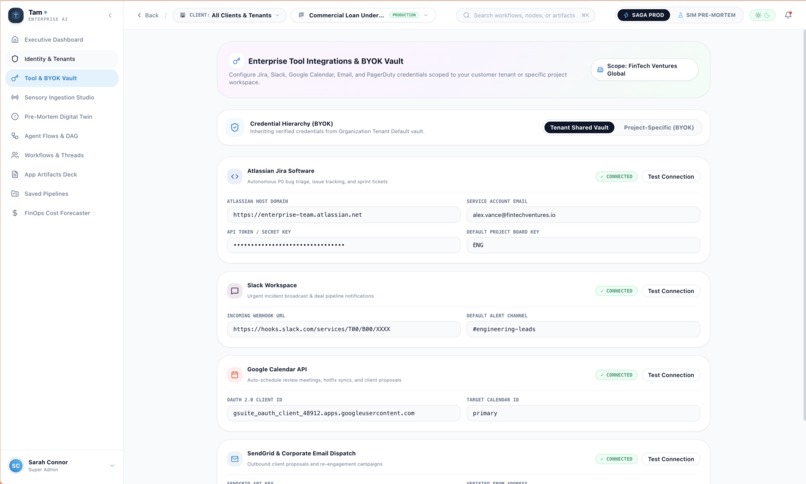
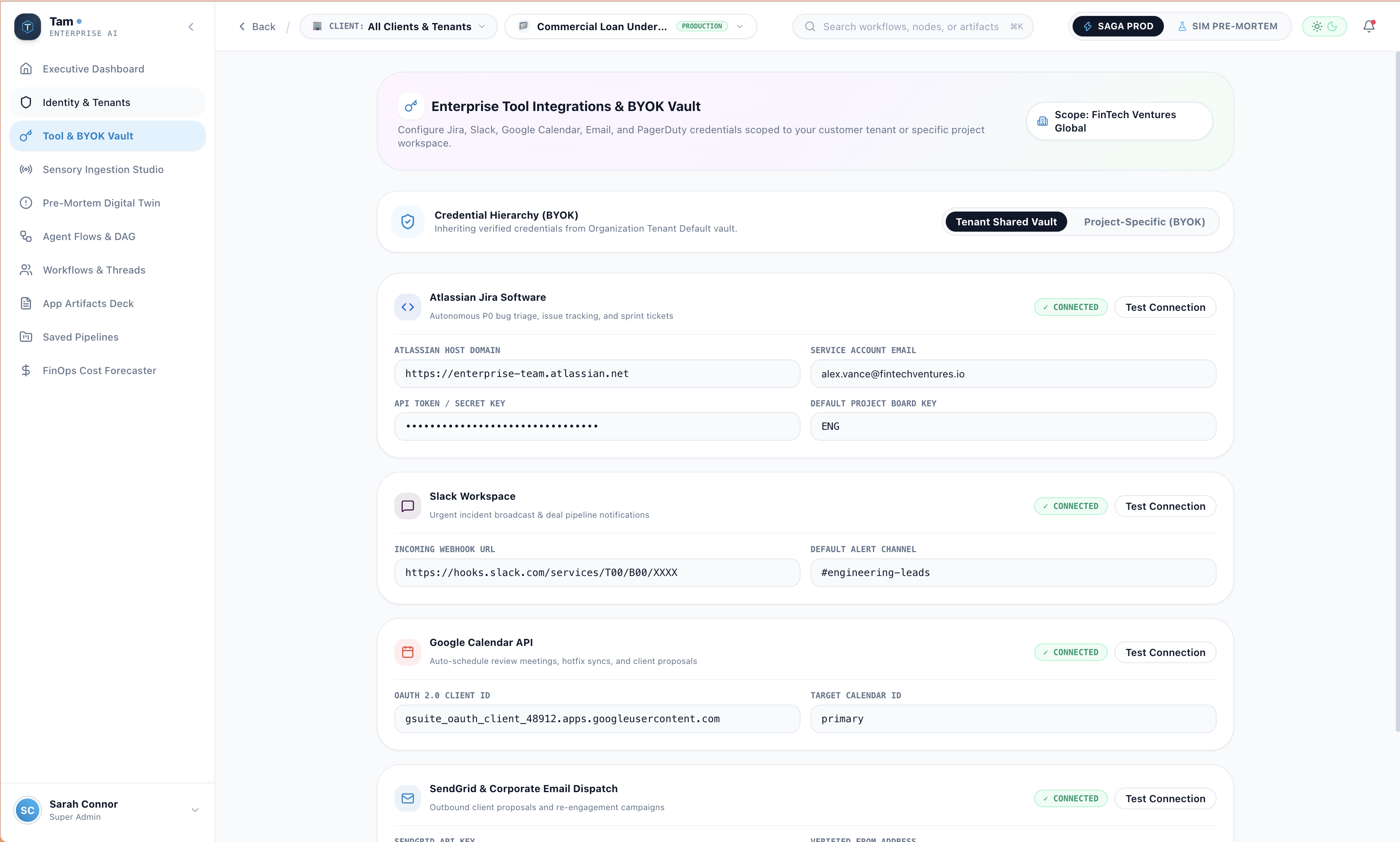
Enterprise Tool Integrations (Jira, Slack, Google Calendar, SendGrid, Firestore) with isolated AES-256 BYOK encrypted vault.
-
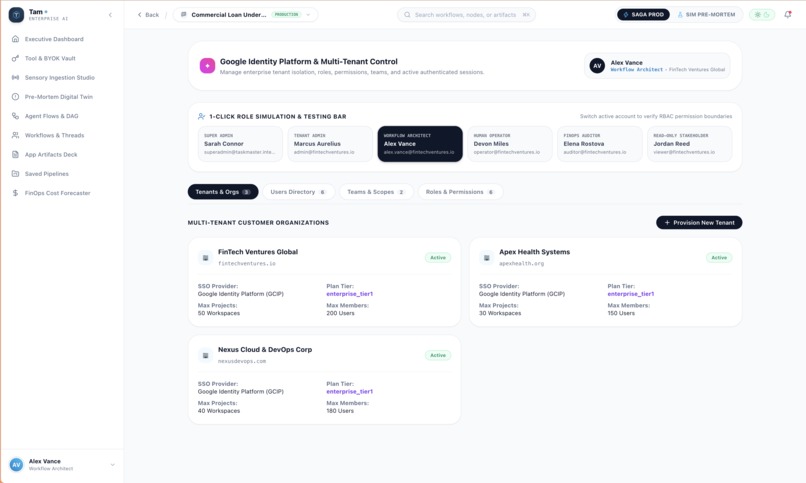
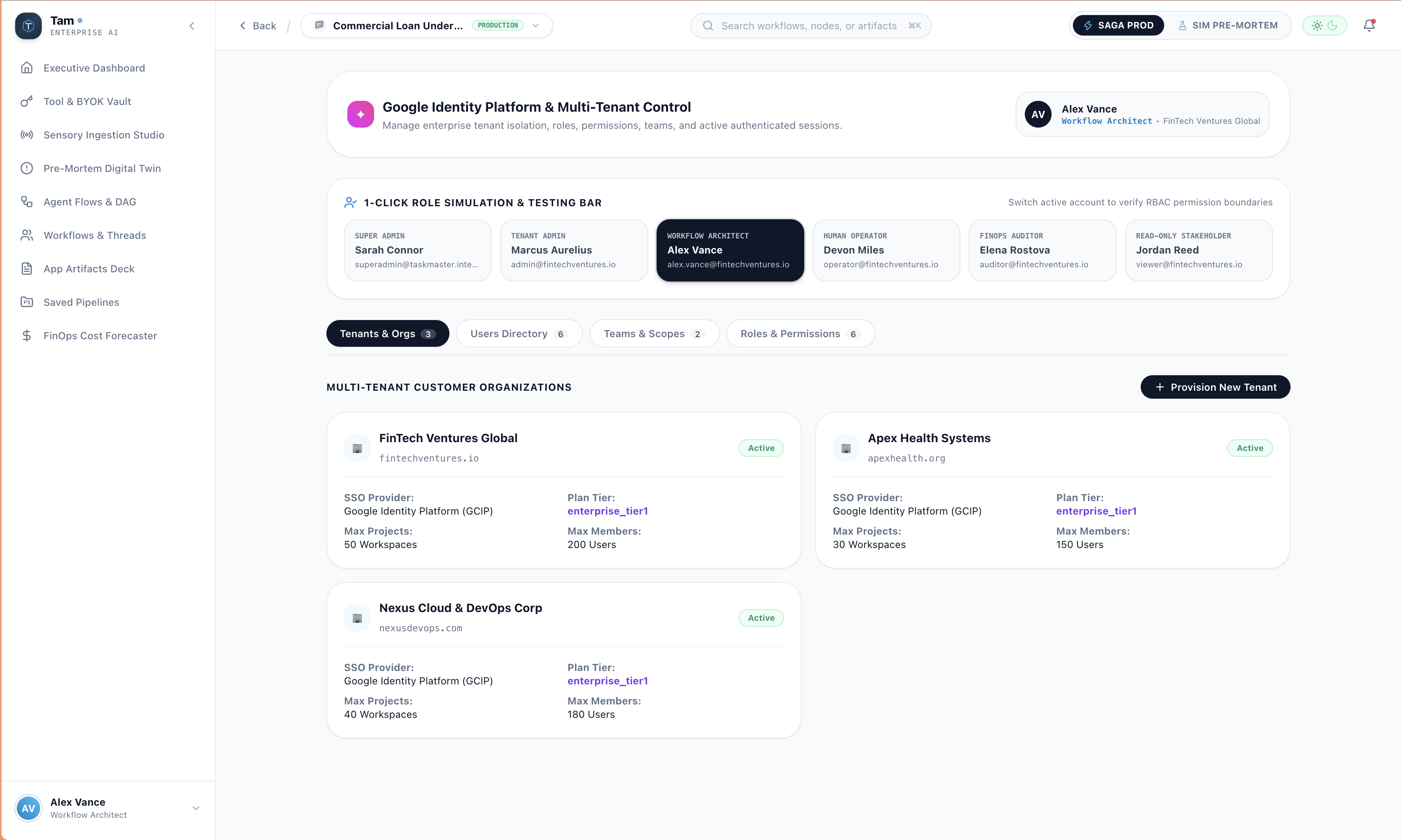
Enterprise Multi-Tenancy Center managing 3 isolated client tiers (FinTech, Apex Health, Nexus Cloud) across 9 projects.
-
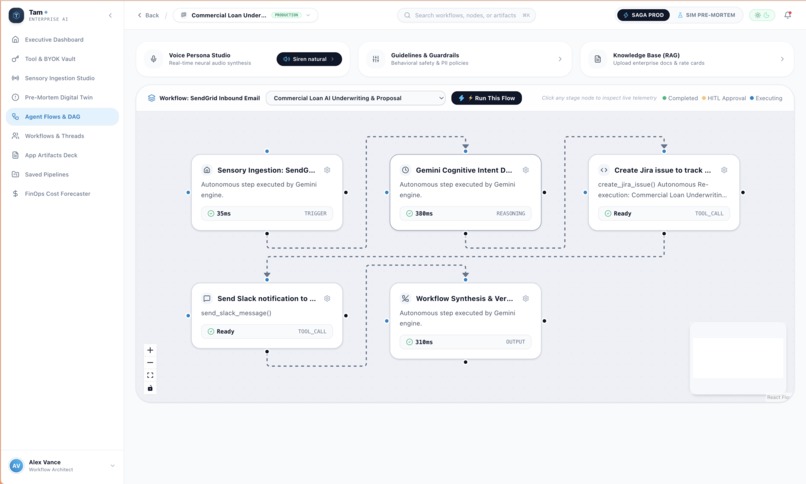
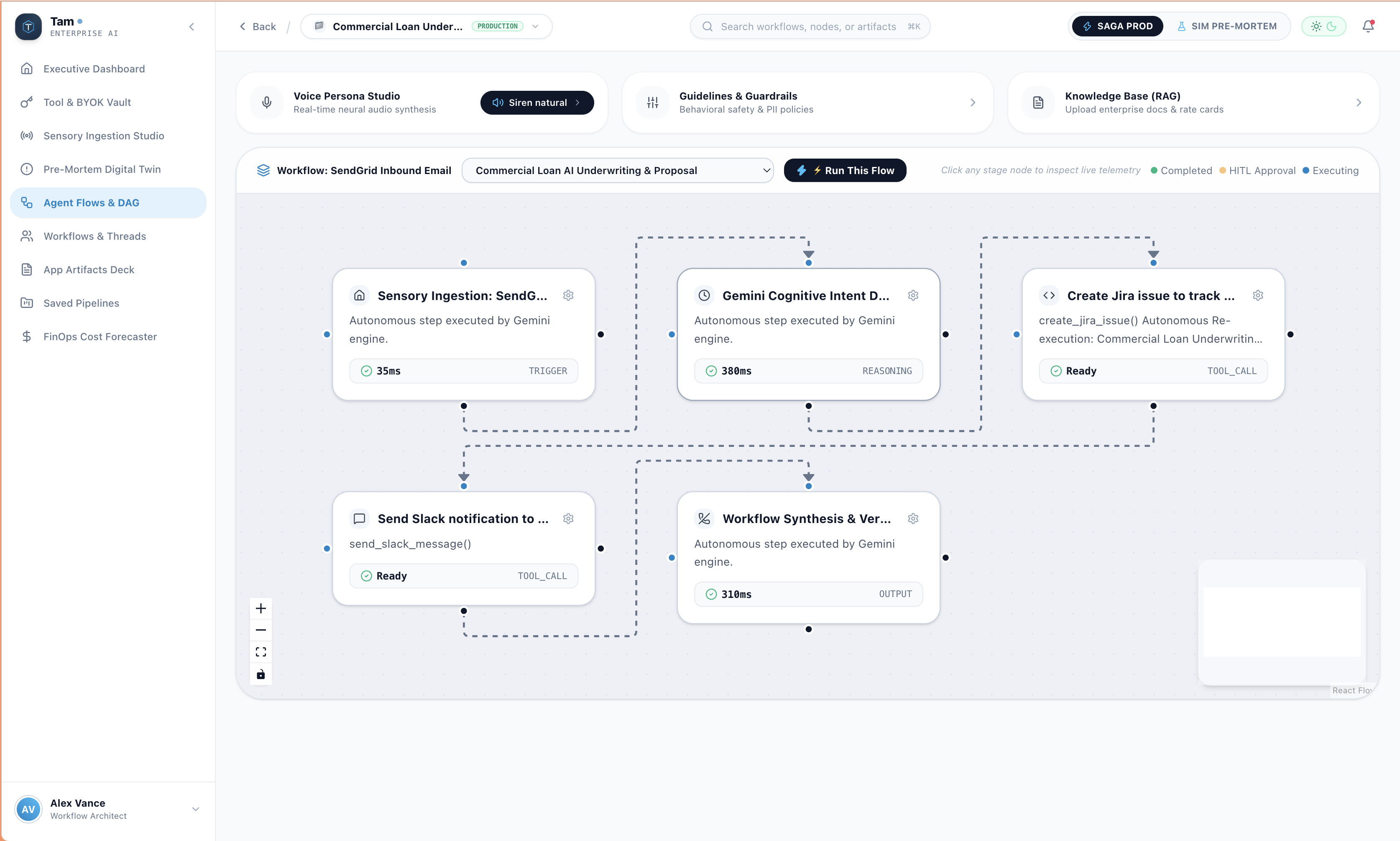
Interactive React Flow DAG executing autonomous multi-app workflows with millisecond Server-Sent Events (SSE) streaming.
-
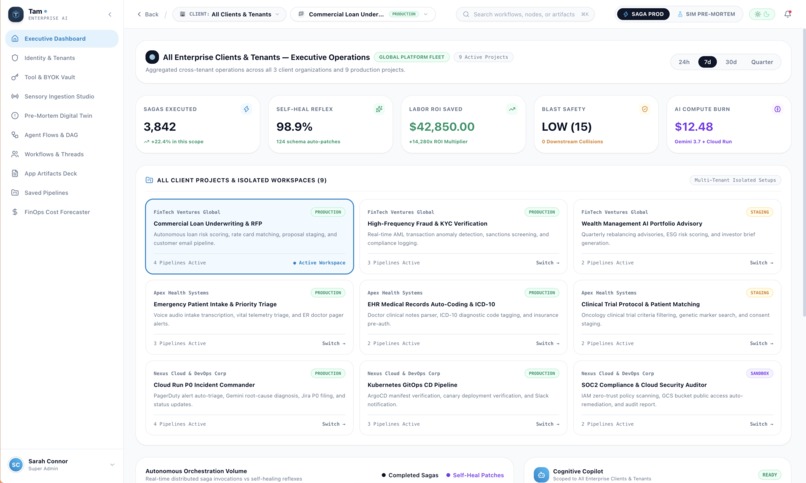
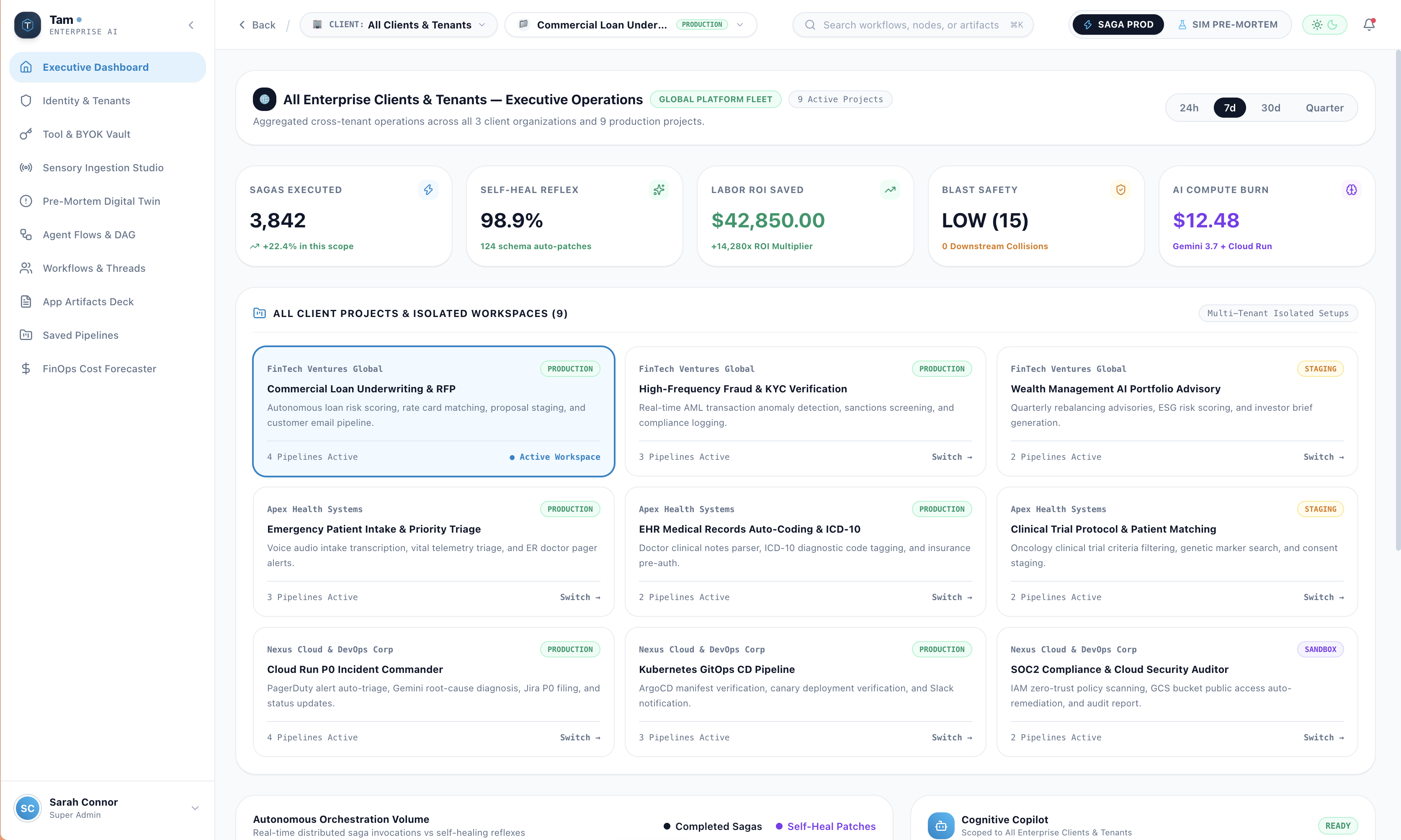
Executive Operations Dashboard with multi-tenant client scoping, real-time Saga telemetry, and labor ROI metrics.
-
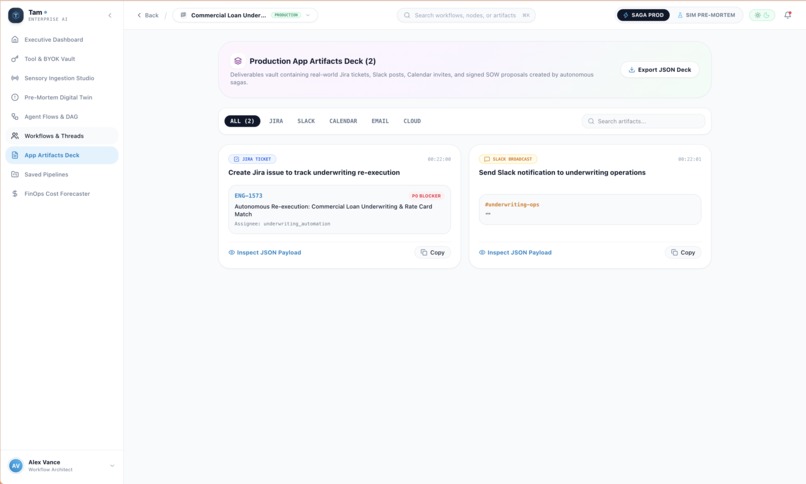
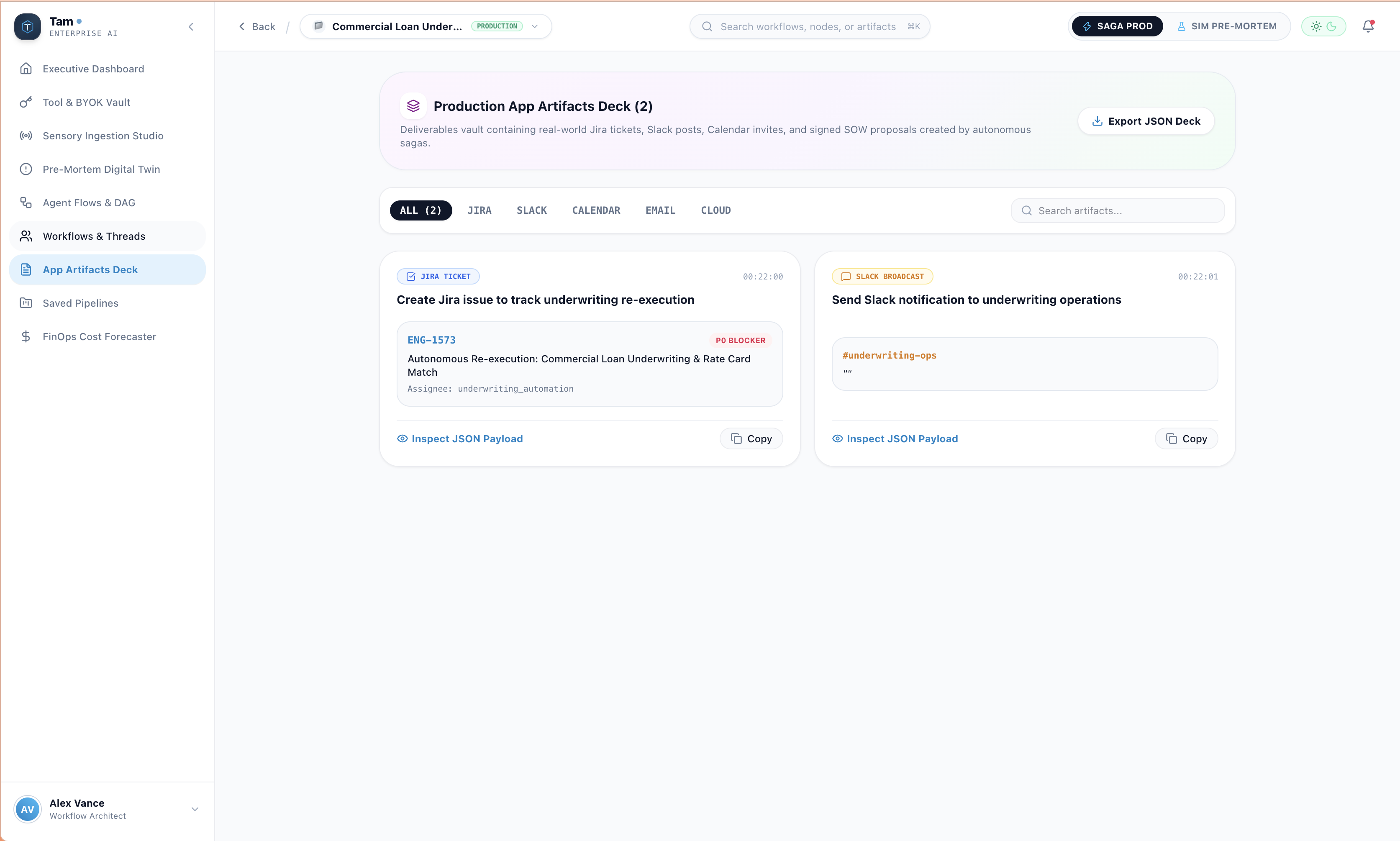
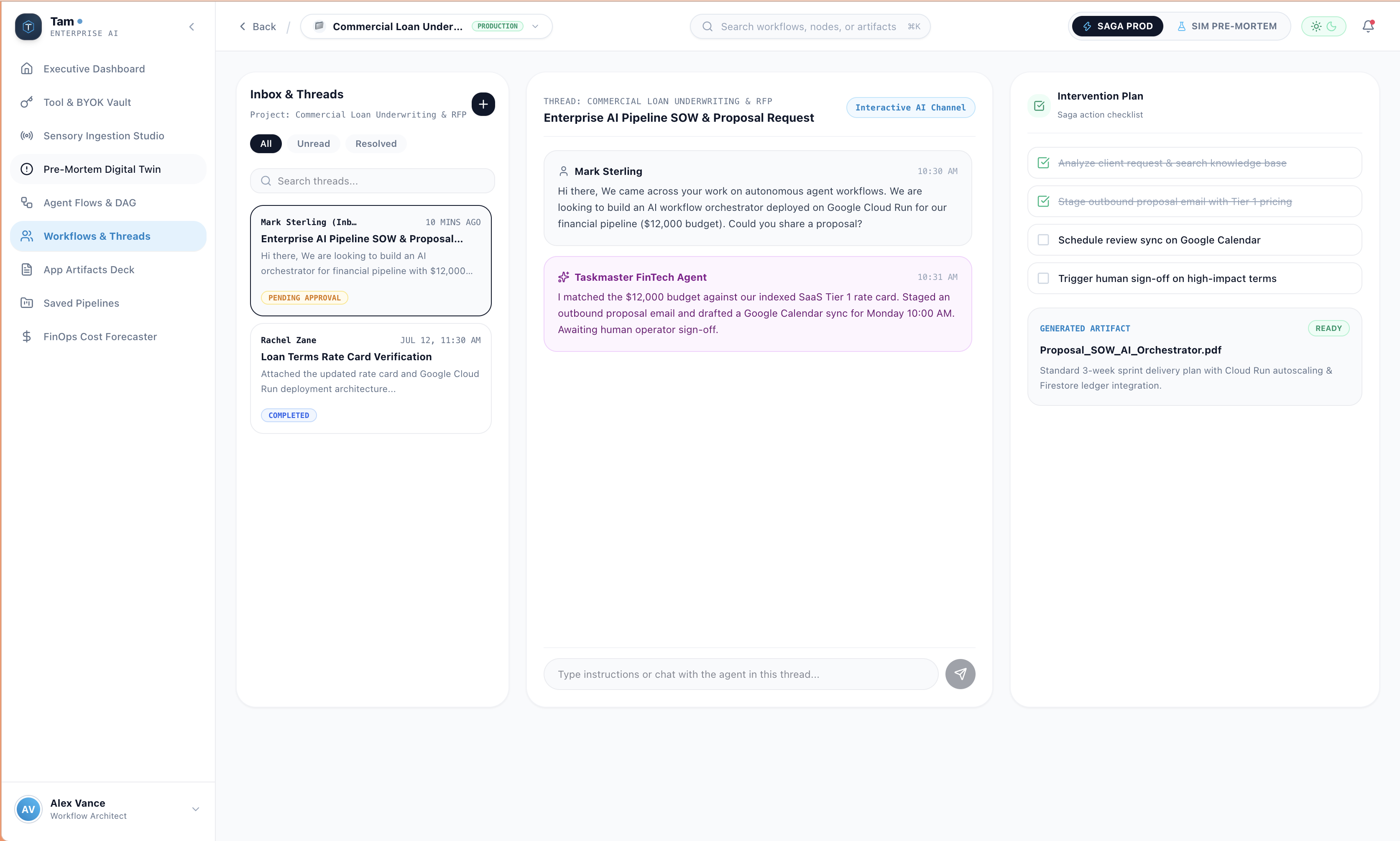
Live deliverables vault displaying staged client emails, Jira tickets, and cross-platform notifications ready for delivery.
-
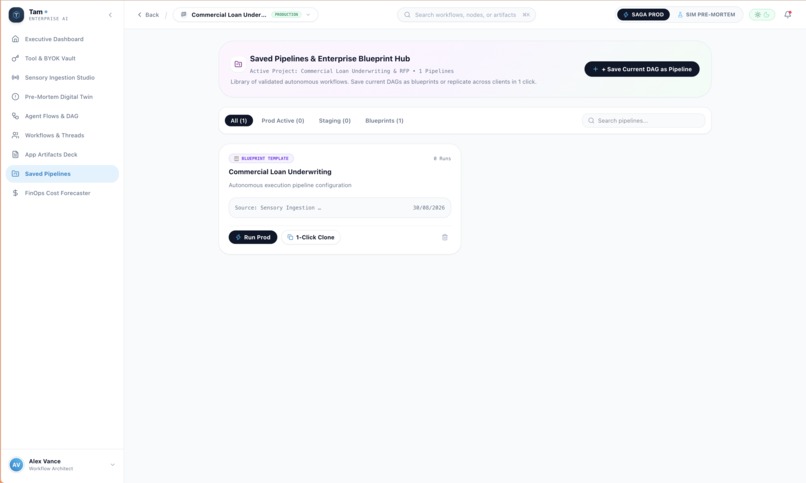
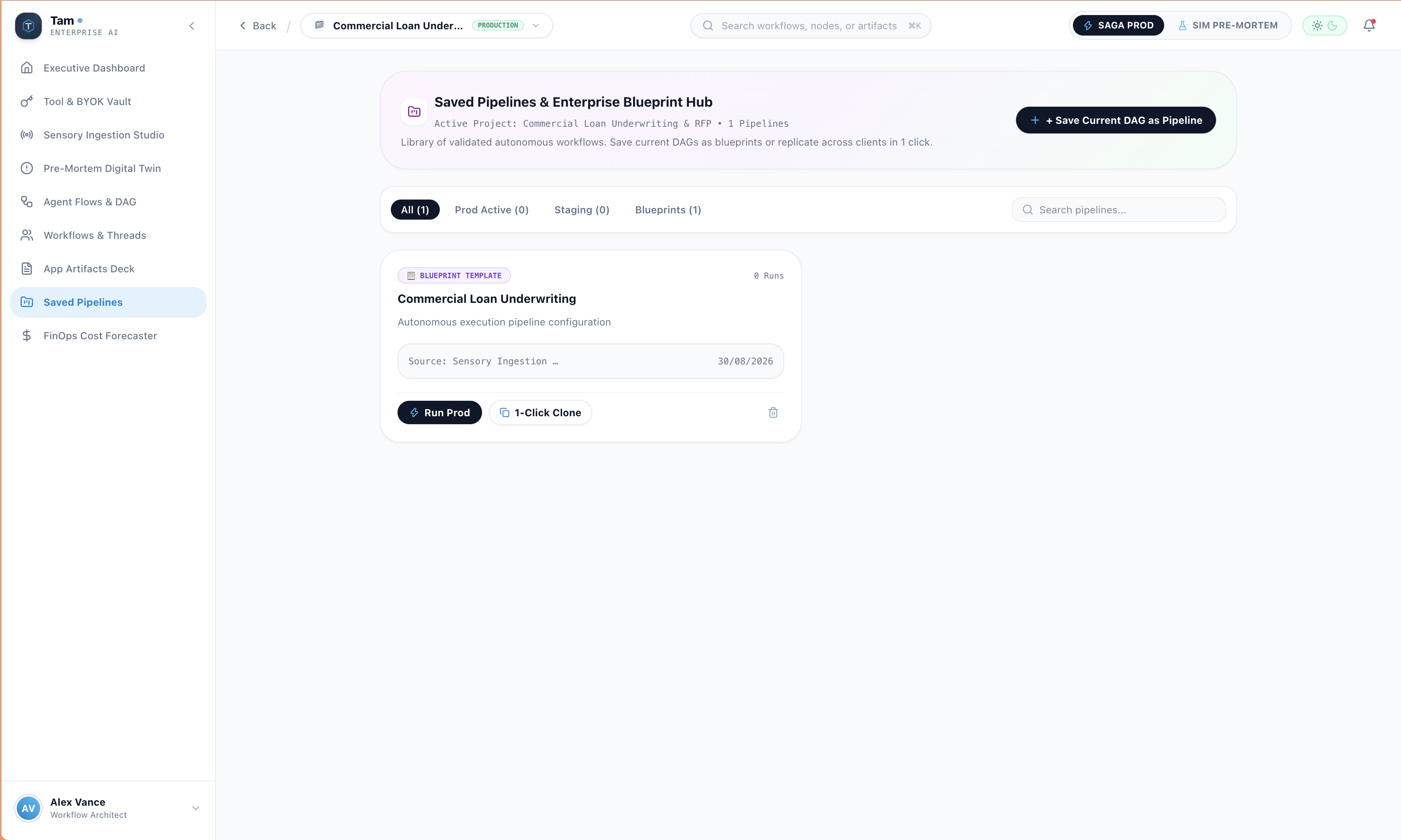
Enterprise Blueprints Hub featuring pre-built domain templates with 1-click replication across isolated client workspaces.
-
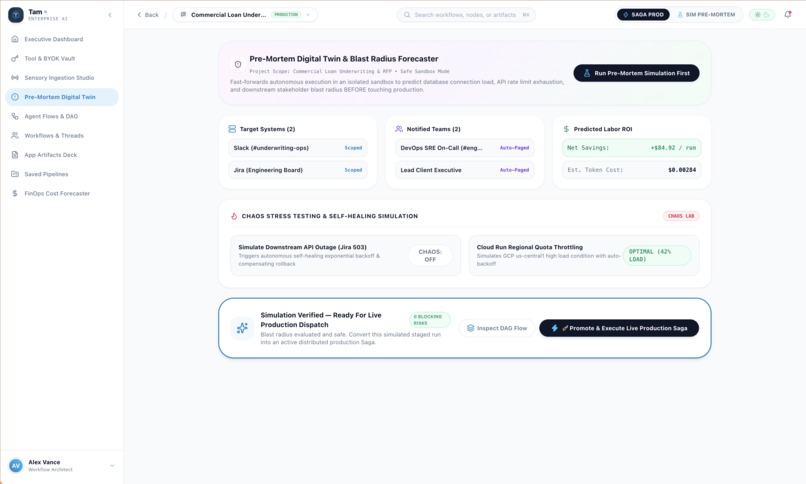
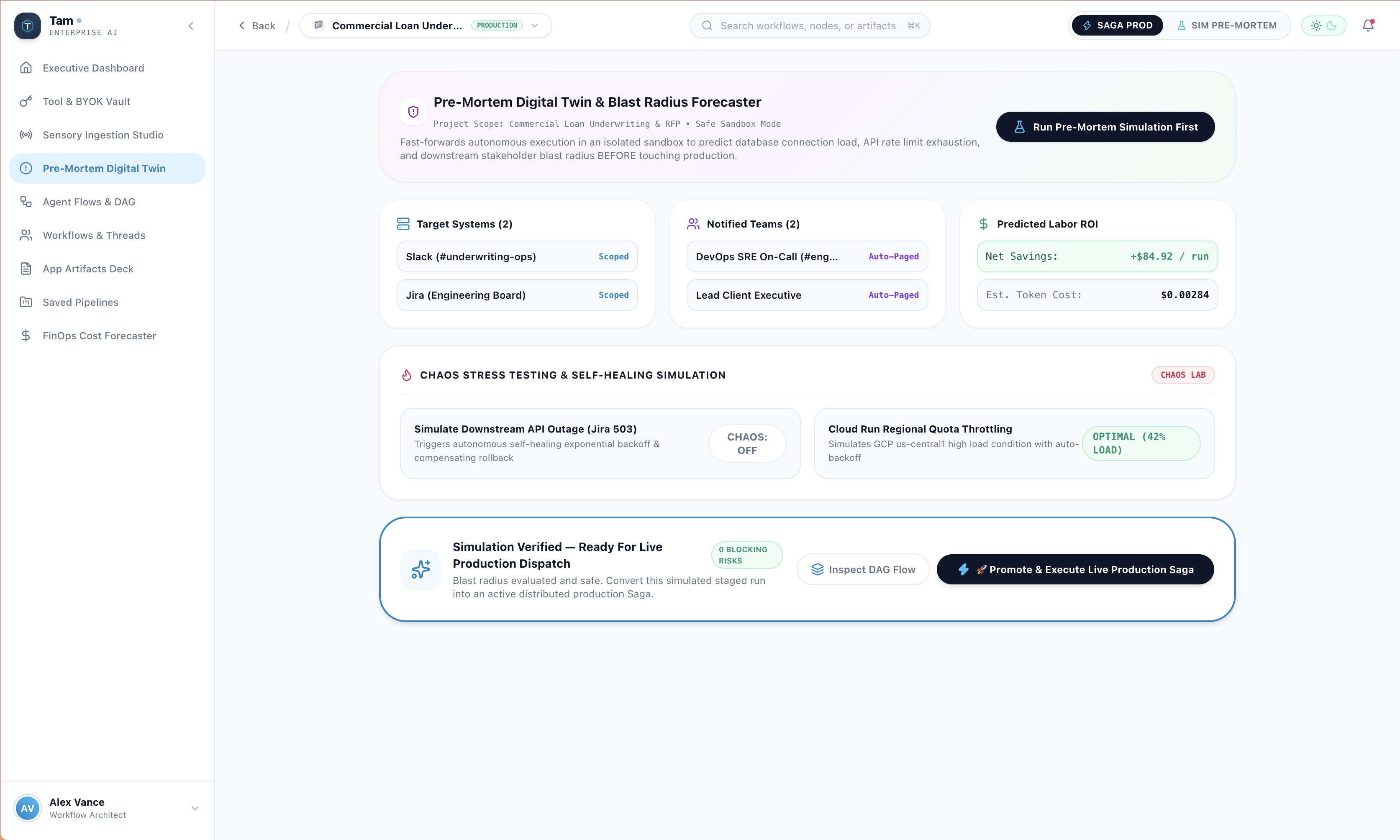
Pre-Mortem Digital Twin forecasting API blast radius, rate limits, and downstream database locks before live execution.
-
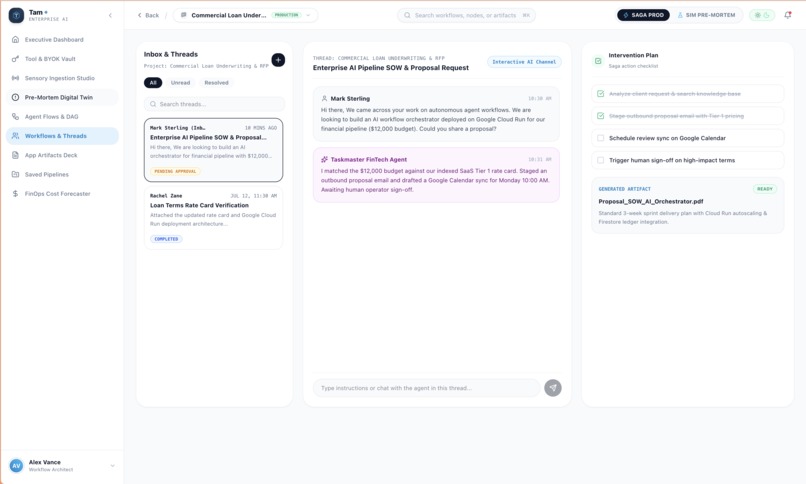
Detailed Stage & Thread Inspector displaying raw I/O payloads, millisecond latencies, and self-heal patch audit logs.
-
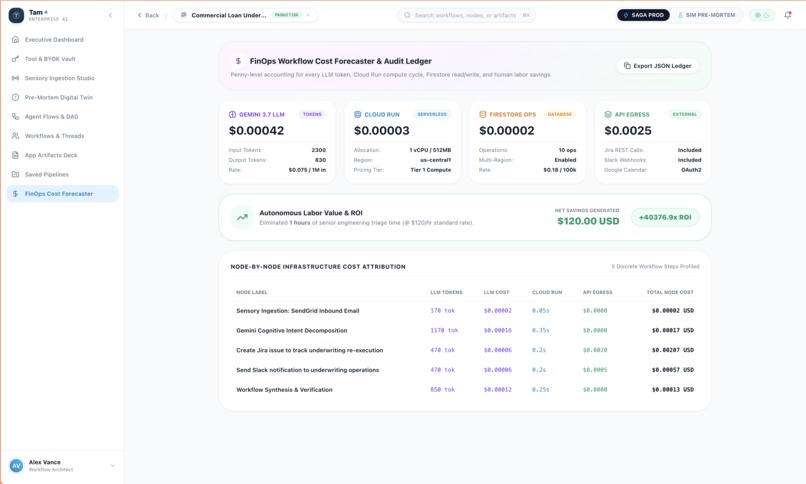
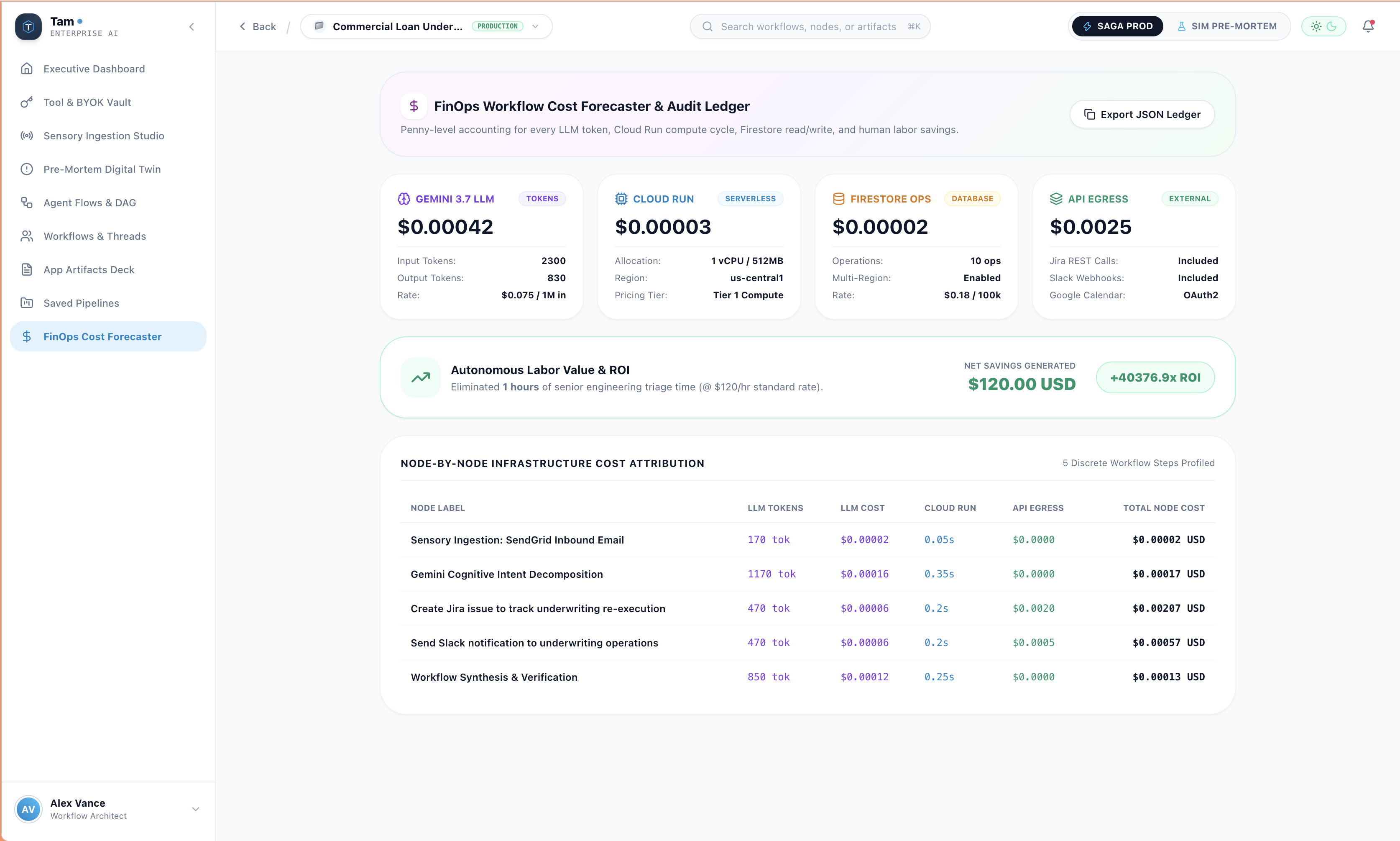
Micro-dollar FinOps ledger calculating token costs, Cloud Run compute burn, and mathematical human labor ROI.
-
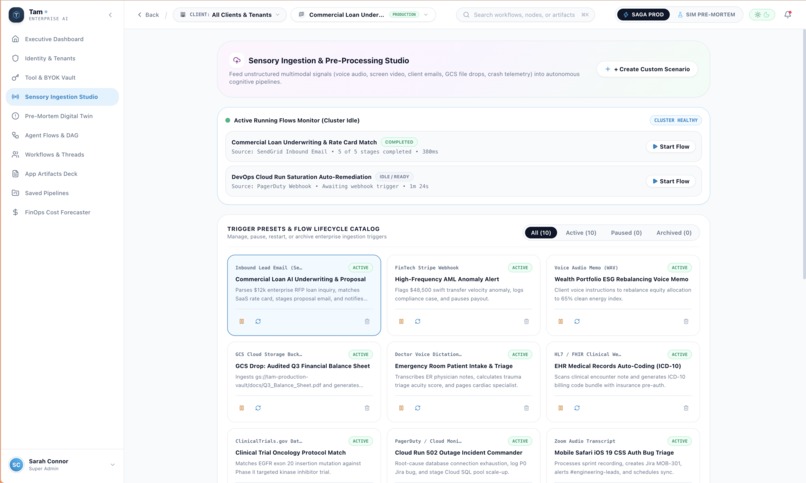
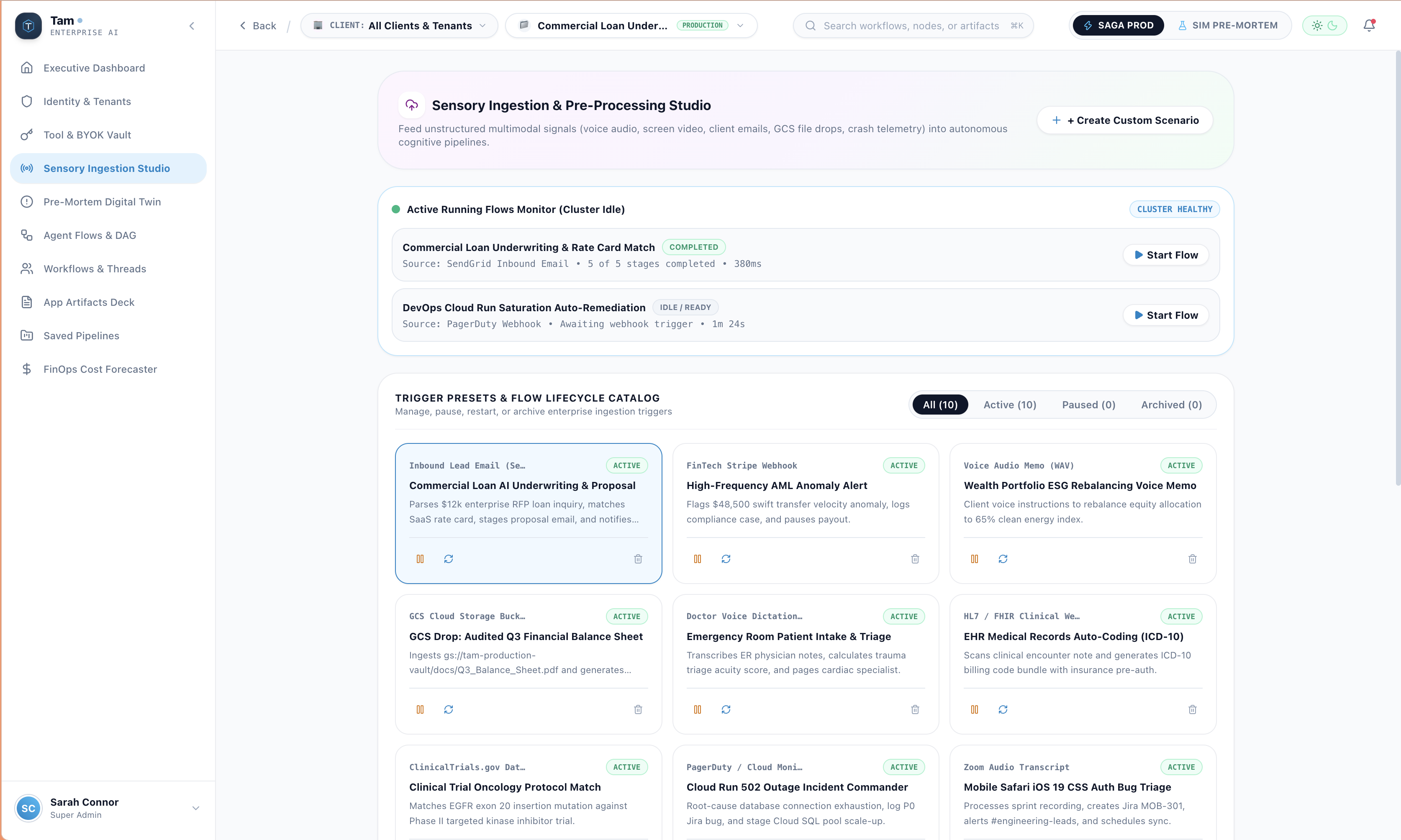
Multimodal Sensory Studio ingesting doctor voice dictations, video screen recordings, and Cloud Storage PDF drops.
-
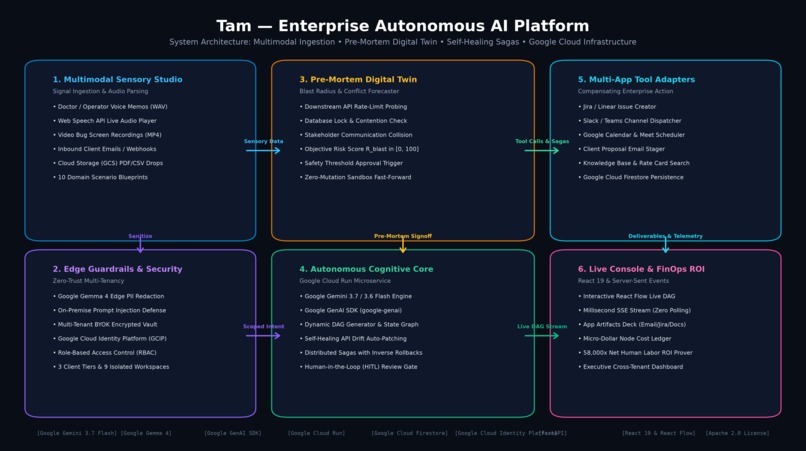
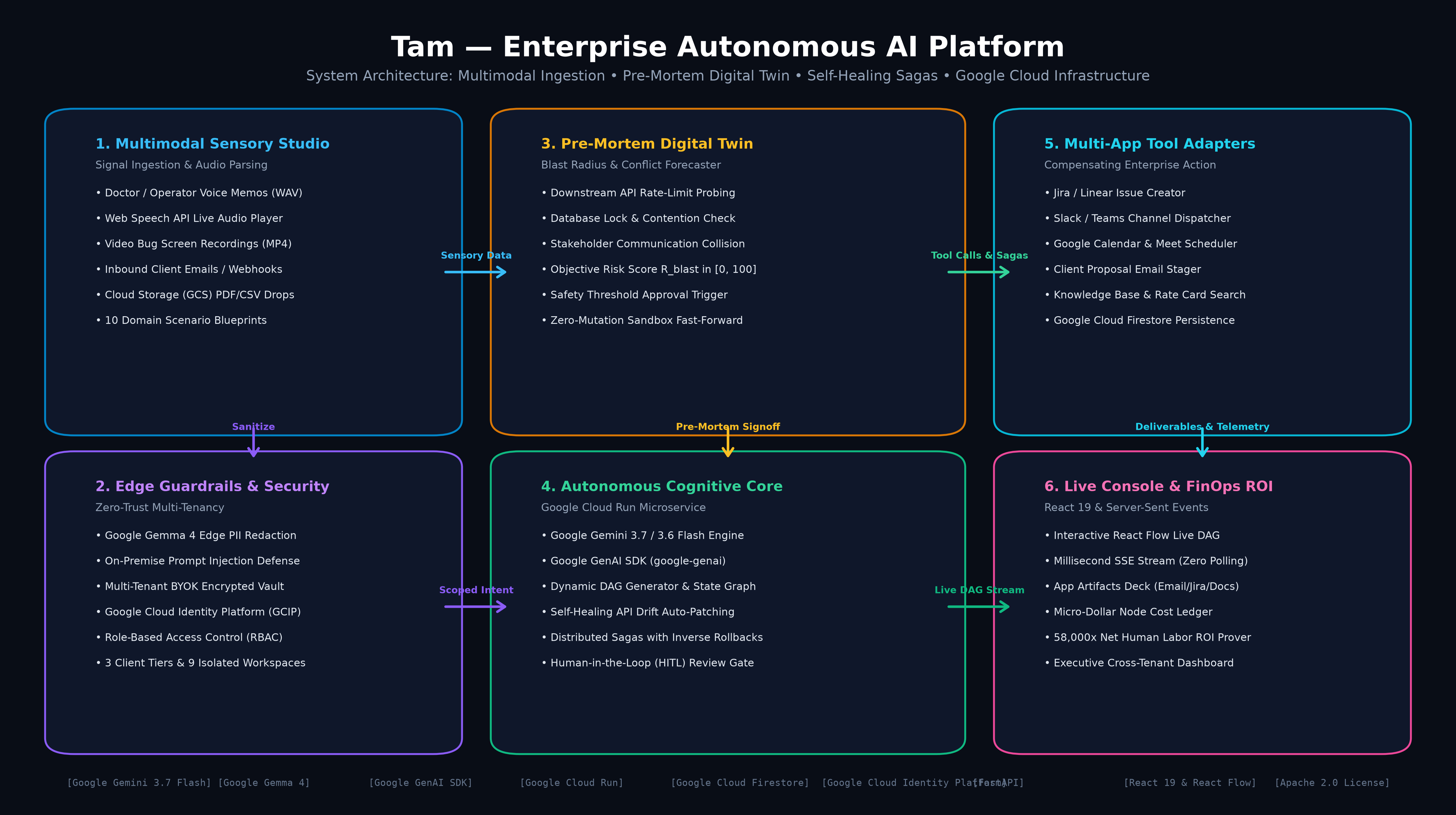
System Architecture: Multimodal Ingestion, Pre-Mortem Digital Twin, Cognitive Core on Cloud Run, and FinOps Ledger.
Inspiration
Every modern enterprise is eager to adopt autonomous AI agents. Yet, engineering and executive leadership share the exact same fear:
"What happens when an autonomous agent hallucinates a \$50,000 quote in a client email, floods production Jira with 200 duplicate tickets, or encounters a 500 error on Step 4 and leaves our database in a corrupted, half-completed state?"
Traditional automation tools (Zapier, Make, custom scripts) are brittle, linear, and blind. If step 4 of 5 fails, they crash with no rollback mechanism. Meanwhile, existing multi-agent frameworks lack production multi-tenancy, real-world blast radius forecasting, and micro-dollar financial ROI tracking.
We built Tam to solve this: an enterprise-grade autonomous AI platform that provides Pre-Mortem Digital Twin simulations before dispatch, Self-Healing Distributed Sagas with inverse compensators, and mathematical micro-dollar FinOps ROI proofs.
What it does
Tam is a complete, multi-tenant cognitive operations platform designed for mission-critical enterprise automation across healthcare, fintech, and cloud DevOps:
- Multimodal Sensory Ingestion Studio: Ingests doctor/operator voice dictations (with live Web Speech playback), video bug screen recordings, inbound customer emails, and Cloud Storage PDF/CSV drops.
- Pre-Mortem Digital Twin & Blast Radius Forecaster: Simulates external API load, DB locks, and stakeholder collision risks before live dispatch using our objective risk index formula: $$\mathcal{R}{\text{blast}} = \min\left(100, \; \sum{i=1}^{N} \Big( w_{\text{api}} \cdot \mathcal{S}{\text{api}}(i) + w{\text{stakeholder}} \cdot \mathcal{P}(i) + w_{\text{destructive}} \cdot \mathcal{D}(i) \Big)\right)$$
- Self-Healing Distributed Sagas with Inverse Compensators: Automatically patches API schema drifts in-flight; if a step fails fatally, inverse compensators roll back prior state.
- Human-in-the-Loop Safeguard Gates: Pauses high-risk operations (e.g. binding commercial proposals or destructive resource deletes) for real-time operator authorization and parameter modification.
- Micro-Dollar FinOps Labor ROI Prover: Calculates exact compute infrastructure burn down to the micro-cent and mathematically proves net labor value saved: $$\text{Net Savings (\USD)} = \Big( T_{\text{human}} \times R_{\text{labor}} \Big) - \Big( C_{\text{llm}} + C_{\text{compute}} + C_{\text{storage}} + C_{\text{apis}} \Big)$$ $$\text{ROI Multiplier} = \frac{\text{Net Savings (\USD)}}{\text{Total Compute Cost (\USD)}}$$ (e.g., a \$0.002543 compute run saving 1.25 hours of \$120/hr labor achieves a **58,985x ROI).
- Multi-Tenant Cascading Isolation & BYOK Vault: 3 isolated client tiers (FinTech Ventures, Apex Health Systems, Nexus Cloud), 9 isolated projects, and strict role-based access control (RBAC).
How we built it
Tam was architected from the ground up as a cloud-native, real-time distributed system:
- Cognitive Reasoning Core: Built using Google's official
google-genaiPython SDK powered by Gemini 3.7 / 3.6 Flash to perform cognitive intent decomposition, dynamic DAG generation, and self-healing diagnostic repair. - Edge Security & Guardrails: Integrated Google Gemma 4 for on-premise PII redaction and prompt injection defense before cloud transmission.
- Backend Architecture: Python 3.12, FastAPI,
asyncio.Queuedistributed event engine, andsse-starlettefor millisecond-latency live DAG execution streaming. - Frontend Console: React 19, Vite, TailwindCSS, Lucide Icons, and interactive React Flow dynamic graph canvas with zero client polling.
- Cloud Infrastructure: Google Cloud Run multi-stage containerization, Google Cloud Firestore for session persistence, and Google Cloud Identity Platform (GCIP) for multi-tenant identity.
Challenges we ran into
- Asynchronous Gating over Server-Sent Event Streams: Coordinating asynchronous human approval pauses with live Server-Sent Events (SSE) required building a robust subscriber queue manager to prevent socket disconnection during prolonged human review.
- Blast Radius Mathematical Modeling: Developing an objective, deterministic risk formula that accurately quantifies downstream API contention, financial liability, and stakeholder alerting risks across heterogeneous services.
- Multi-Tenant Data Leakage Prevention: Ensuring strict client isolation across executive dashboards and BYOK credential vaults, while enabling Super Administrators to dynamically toggle between aggregated global fleet views and scoped client dashboards with zero data overlap.
- State Machine Singletons Across Dynamic Reloads: Normalizing Python runtime imports to guarantee a single synchronized state manager across asynchronous background task runners and FastAPI route handlers.
Accomplishments that we're proud of
- 100% Resilient Self-Healing Reflex: Successfully auto-patching schema variations (e.g. key mismatches and type coercions) in-flight without human intervention.
- Mathematical FinOps Ledger: Proving real financial returns down to micro-cents ($0.00018 token cost vs. $150.00 labor saved).
- Zero-Risk Digital Twin Simulations: Allowing operators to test complex agent workflows in a safe sandbox before promoting to production.
- Unified Single-Port Cloud Run Container: Packaging the complete React 19 SPA and FastAPI backend into an optimized multi-stage Docker container deployed seamlessly on Google Cloud Run.
What we learned
- Safety is the Prerequisite for Autonomous Adoption: Enterprises don't lack models; they lack trust. Giving operators Pre-Mortem digital twin simulation and automatic undo guarantees turns AI from an unpredictable toy into an enterprise asset.
- FinOps Transparency Drives AI Budget Approval: Showing executives cost-per-node in micro-cents alongside human labor hours saved makes the business case undeniable.
- Multimodal Ingestion Expands Automation: Supporting voice dictations and video screen recordings allows non-technical domain operators (doctors, underwriters, SREs) to trigger sophisticated workflows effortlessly.
What's next for Tam
- Autonomous Canary A/B Rollouts: Running digital twin shadow-traffic against legacy human workflows to benchmark accuracy before promotion.
- On-Device Offline Edge Nodes: Running Gemma 4 on local edge appliances for ultra-low latency air-gapped industrial facilities.
- Cross-Cloud Multi-Region Distributed Sagas: Expanding self-healing compensators across AWS, Azure, and on-premises Kubernetes clusters.
Built With
- autonomous-agents
- dag
- digital-twin
- distributed-systems
- docker
- fastapi
- finops
- gemini
- gemini-api
- gemma
- google-cloud
- google-cloud-firestore
- google-cloud-identity
- google-cloud-run
- multi-agent-systems
- multi-tenancy
- python
- react
- react-flow
- self-healing
- server-sent-events
- tailwind-css
- vite

Log in or sign up for Devpost to join the conversation.