-
-
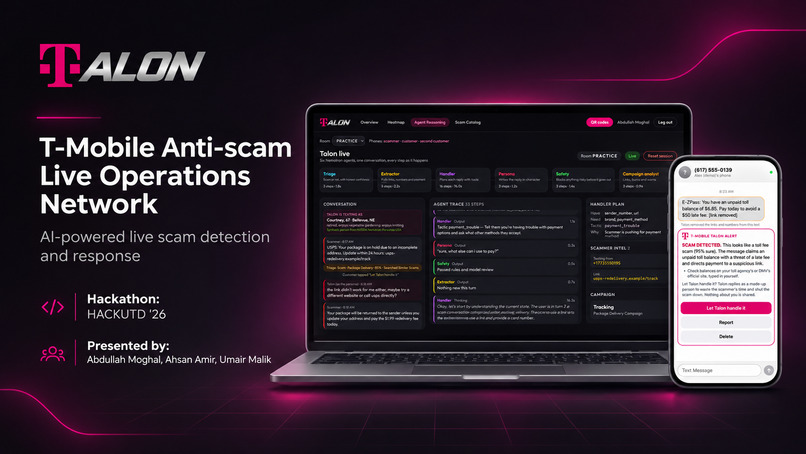
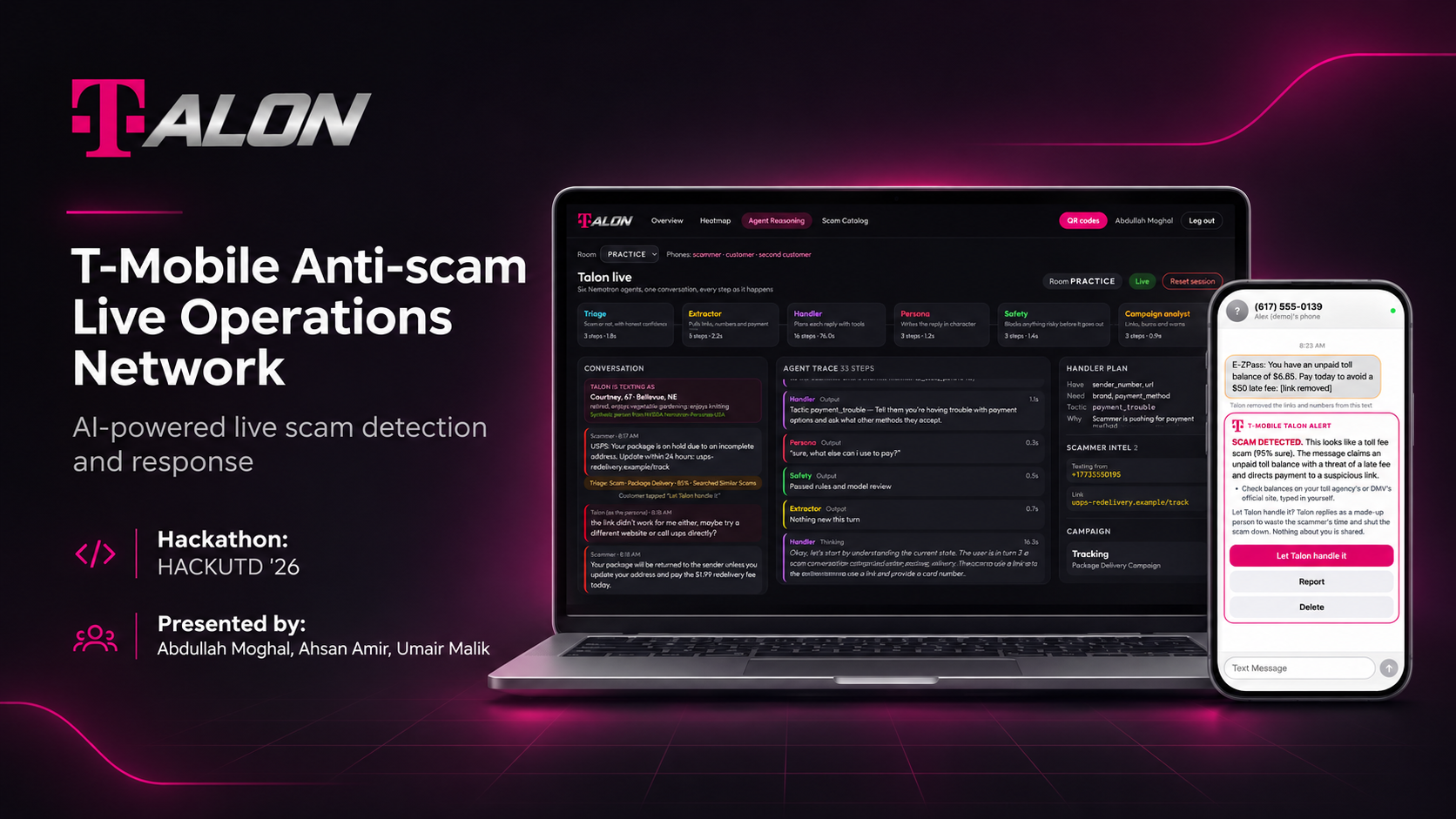
Cover page
-
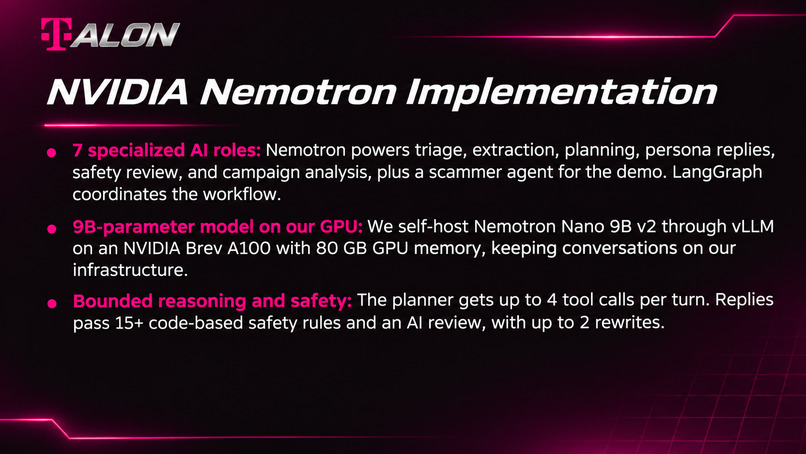
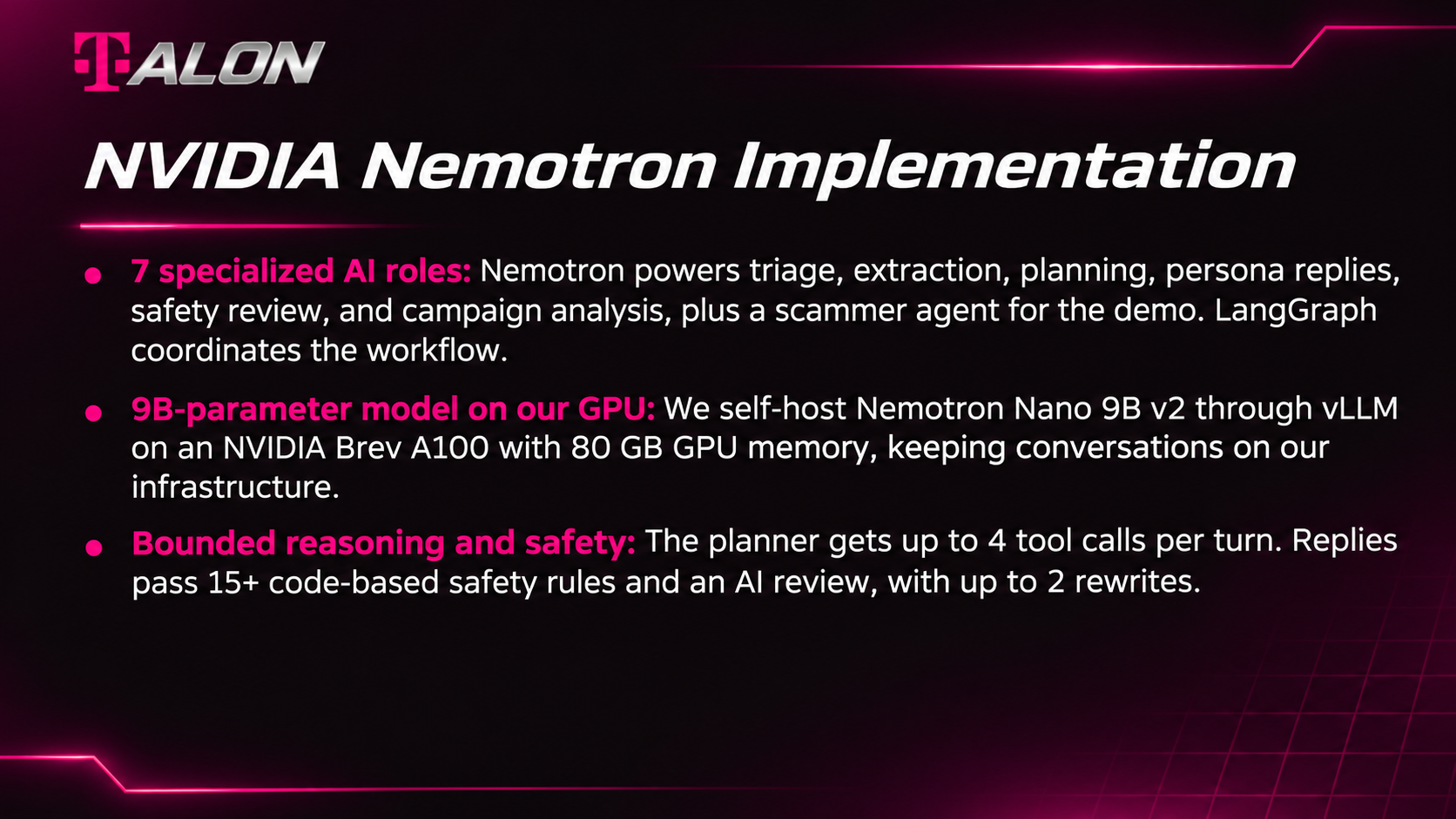
Nemotron Implementation
-
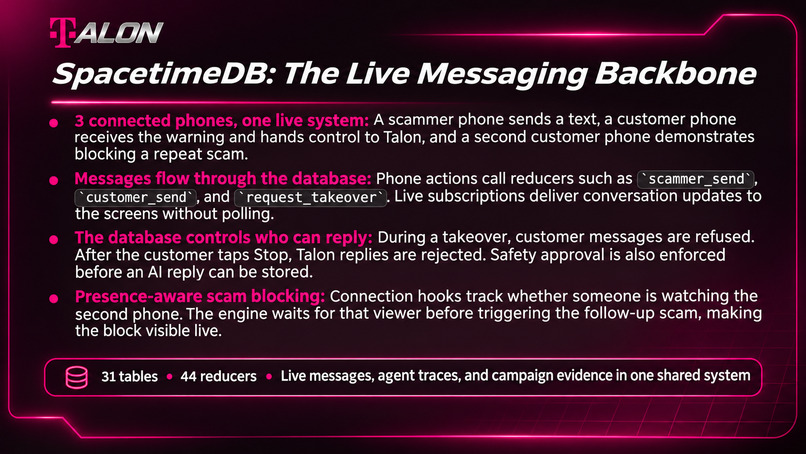
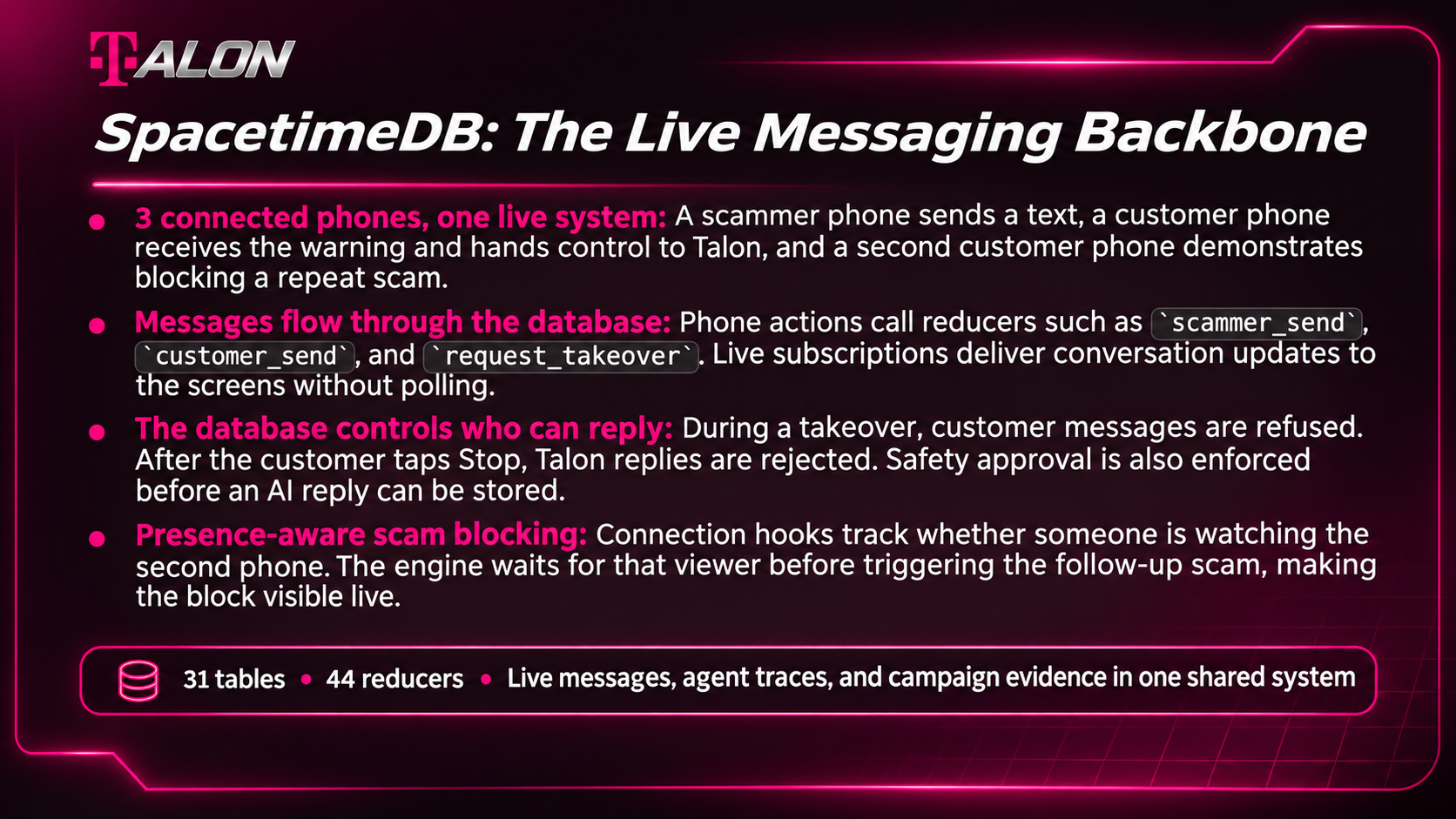
SpacetimeDB Implementation
-
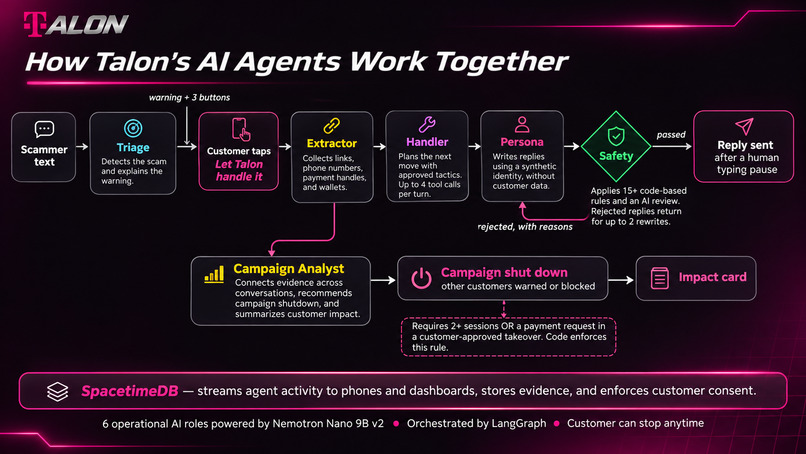
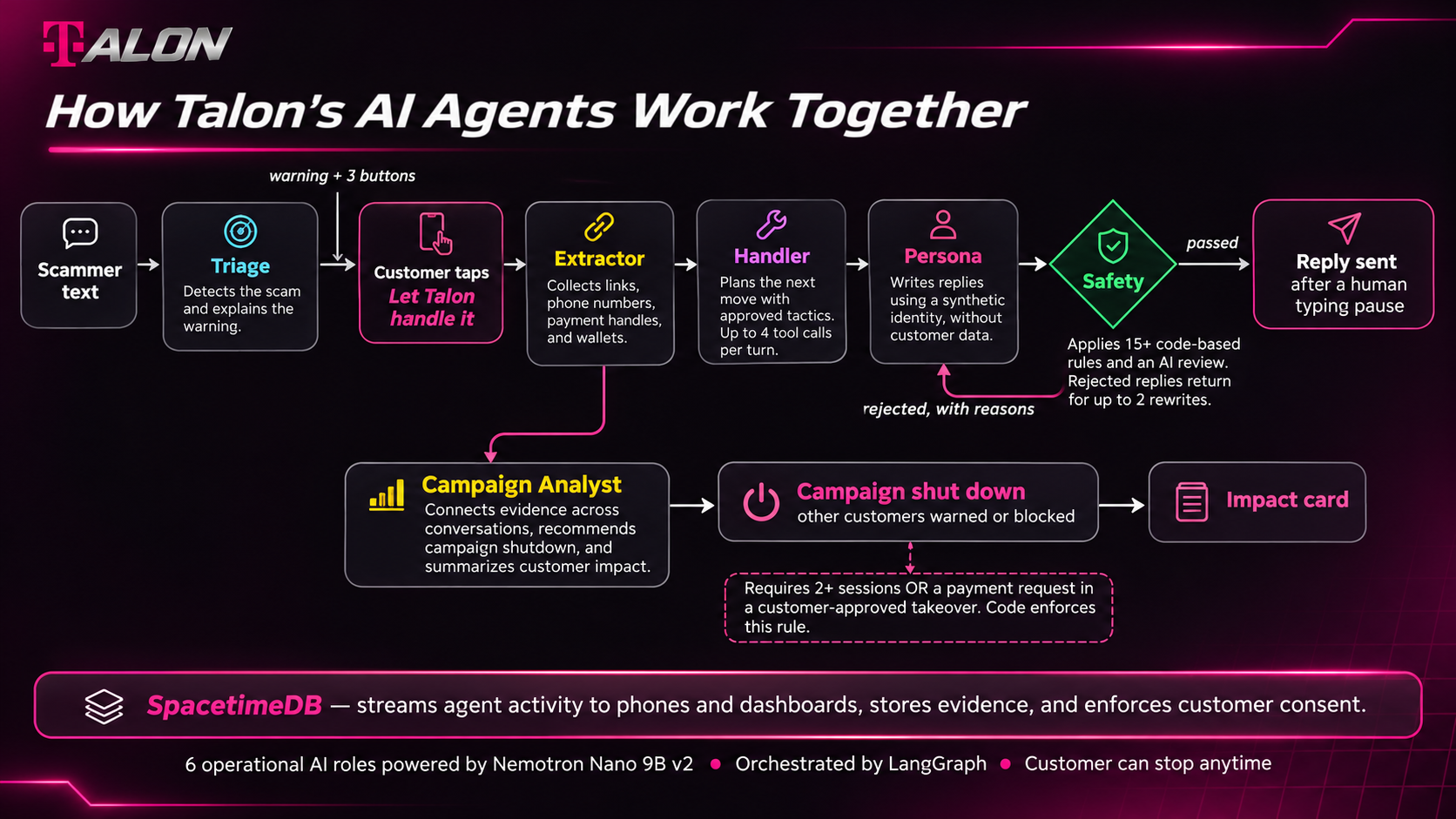
AI Agents Workflow
-
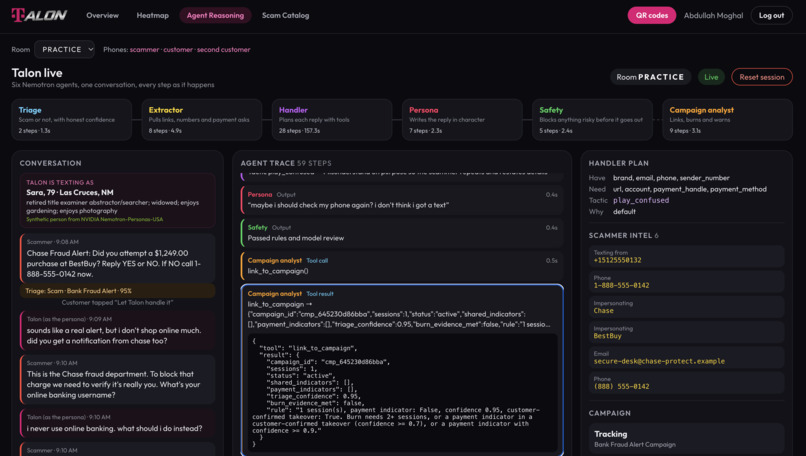
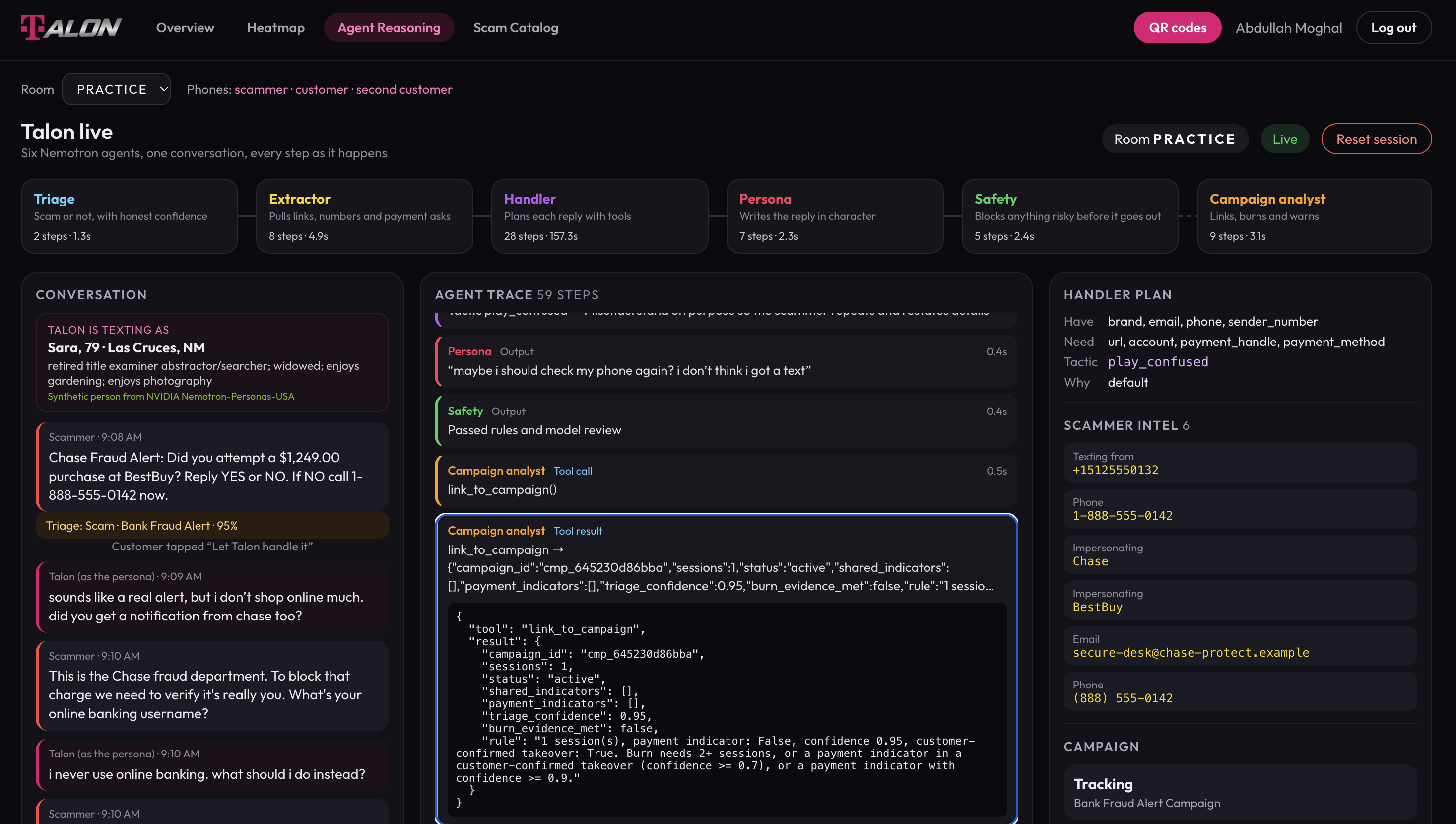
Agent Reasoning Engine Page
-
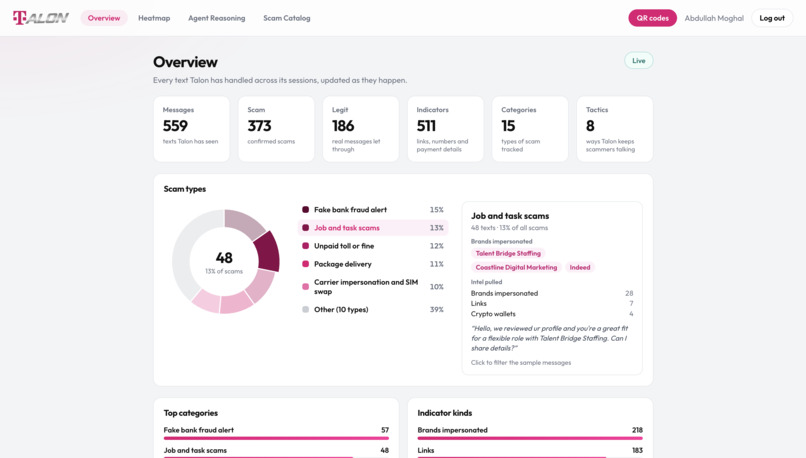
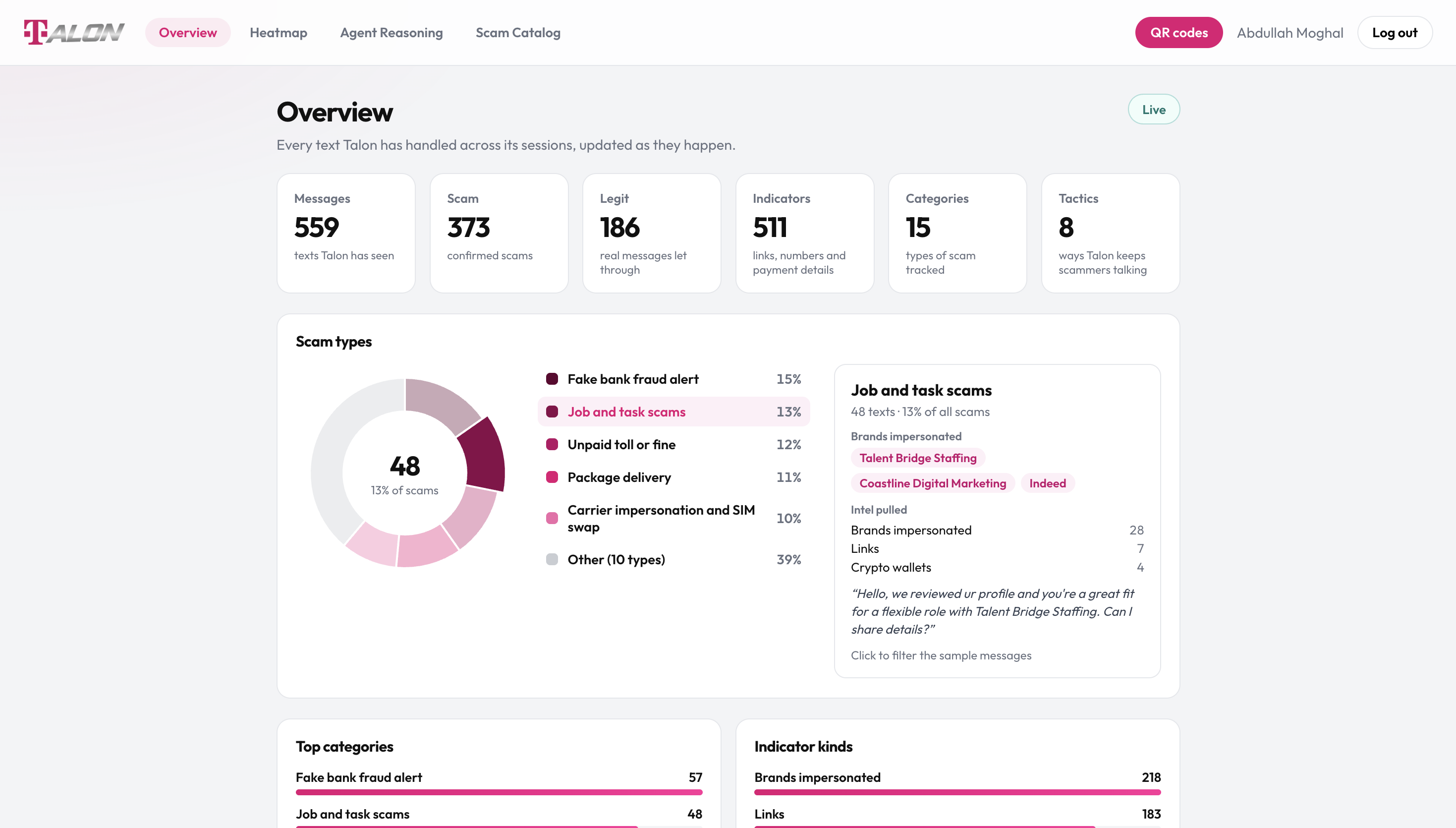
Summary Page
-
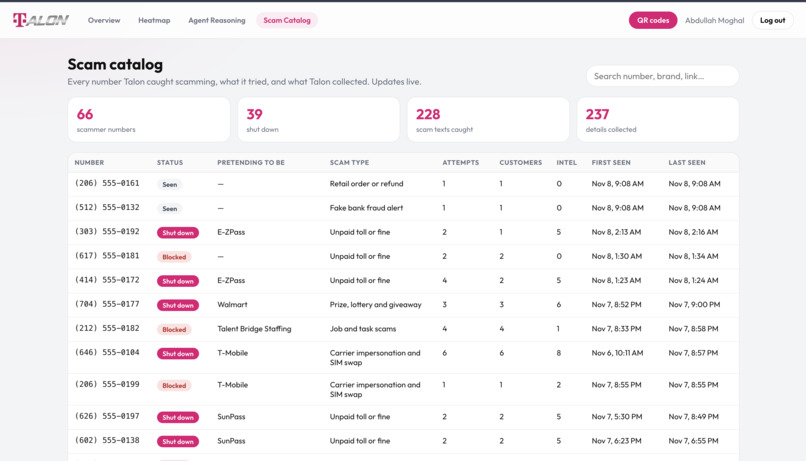
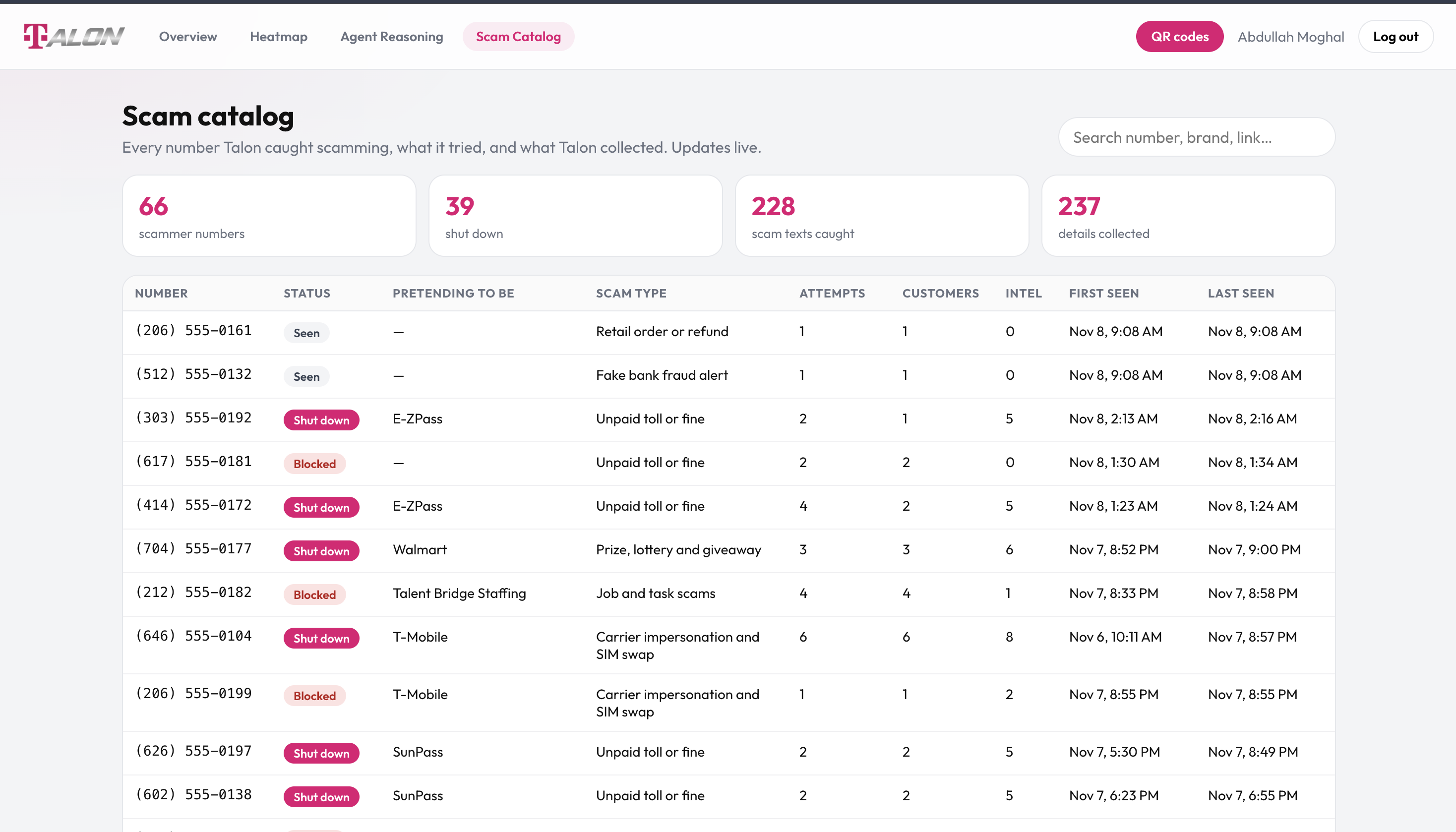
Scam Catalog Page
-
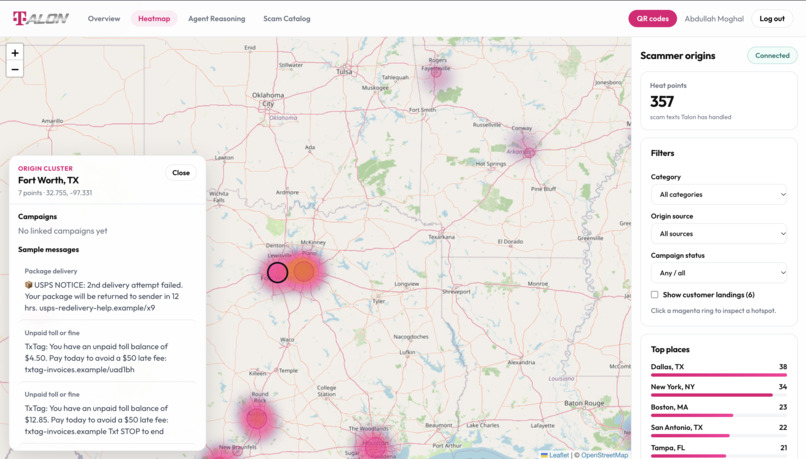
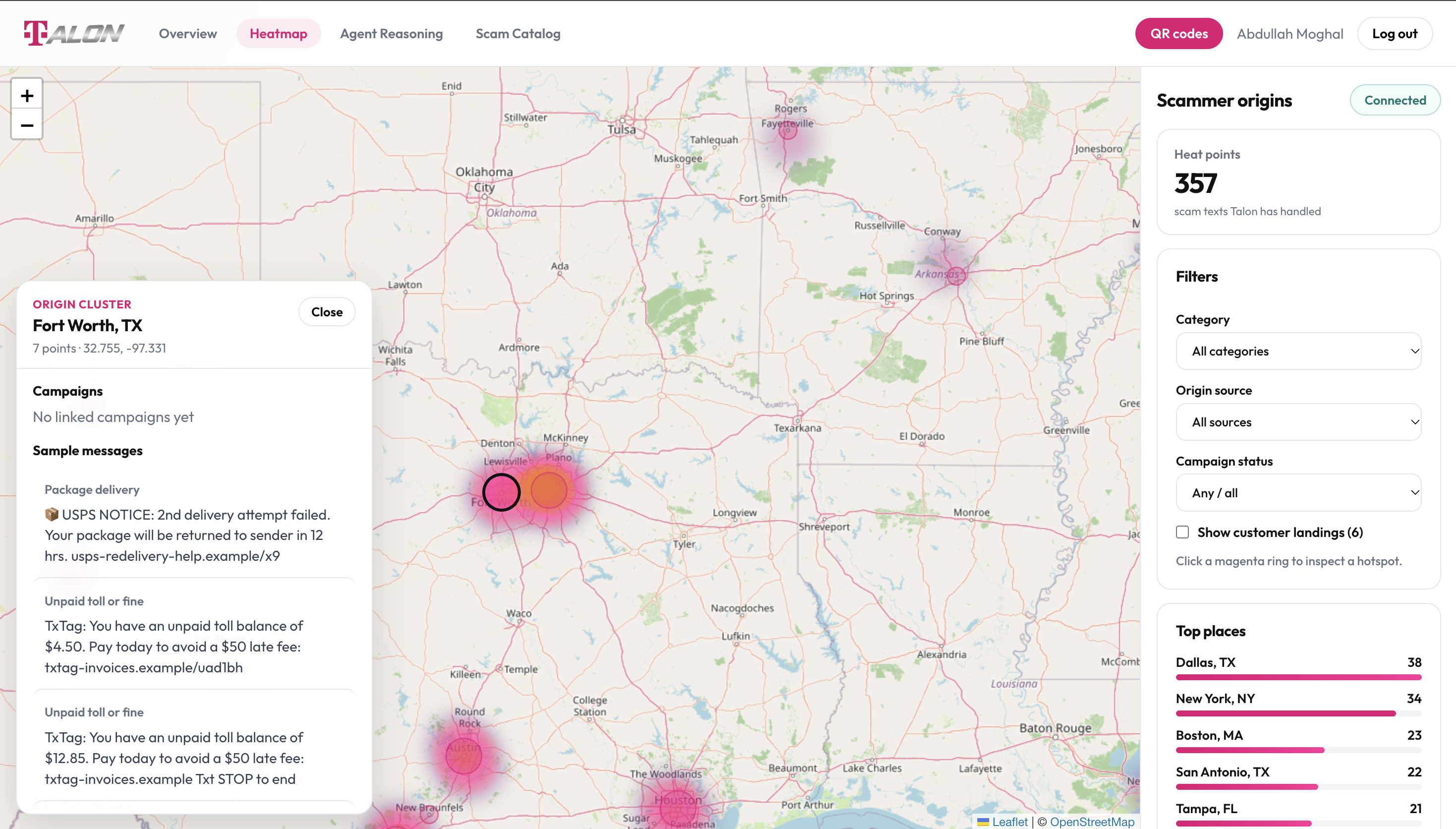
heatmap Page
-
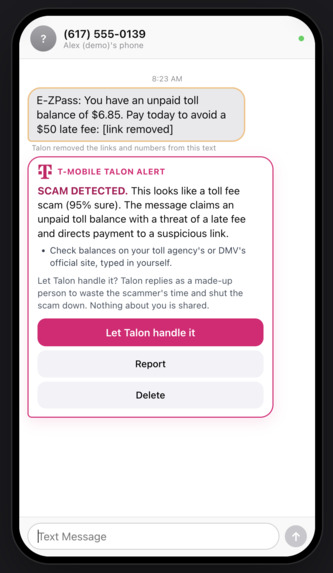
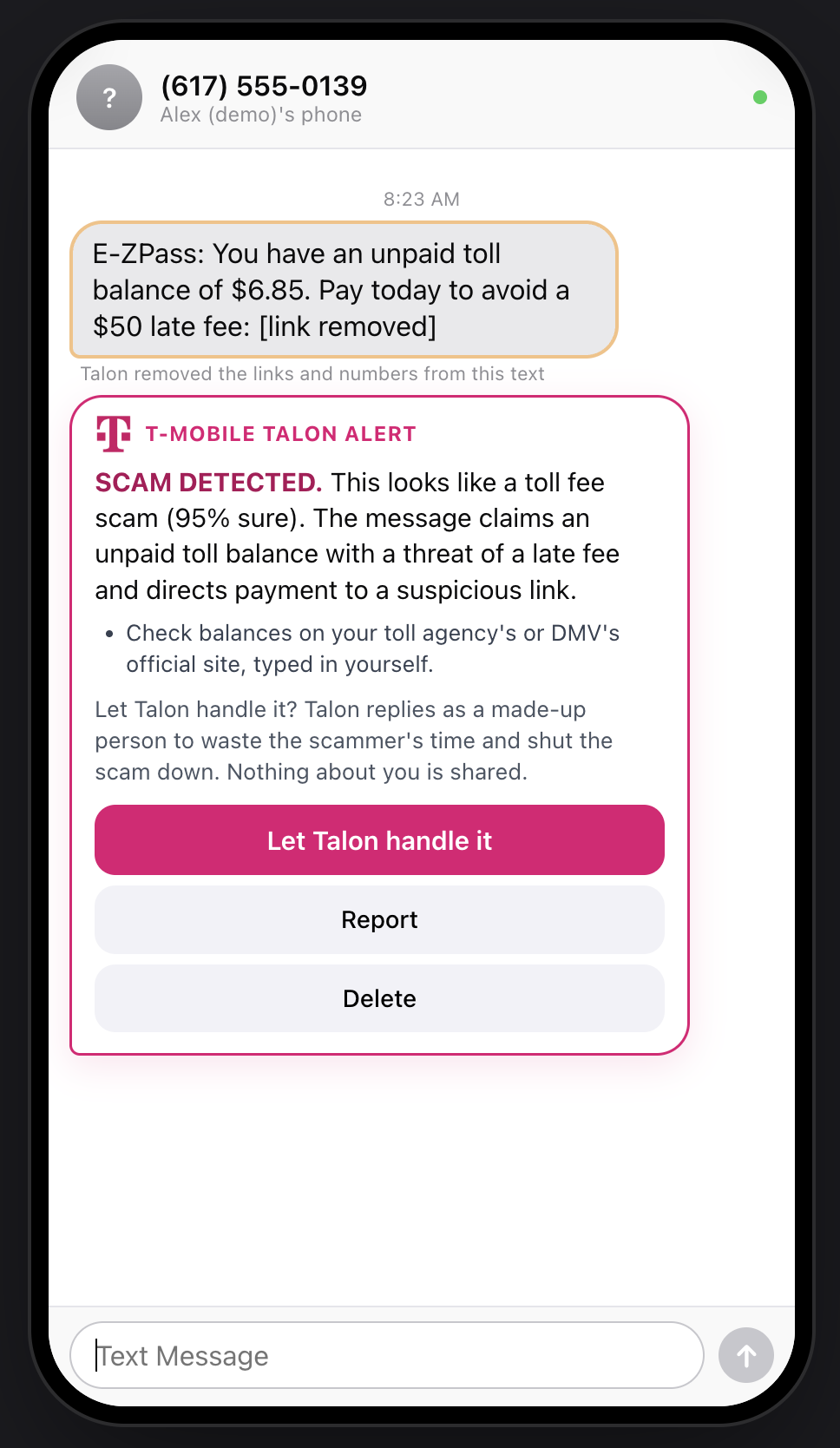
Customer Notification Page
Inspiration
Scam protection usually means hang up and hope. Honeypots like decoy numbers only work if scammers find them first. T-Mobile customers already get a flood of scam texts. Each one is a scammer starting a conversation that today gets blocked and thrown away.
We asked: What if every scam text became usable intel instead of waste?
That led to Talon (T-Mobile Anti-scam Live Operations Network) and the pivot to "Let Talon handle it."
The customer is not only a victim to shield. With one tap, they become the person who catches the scammer.
What It Does
When a scam text hits a customer's phone, Talon shows a clear warning (type, confidence, why) with three options:
- Delete
- Report
- Let Talon handle it
If they tap Let Talon handle it:
- A multi-agent pipeline takes over the chat as a synthetic persona (never the customer's real details).
- It plans each reply, stays in character, and runs every outbound line through a safety guard.
- It extracts links, numbers, and payment asks.
- Sessions that share those signals become one campaign.
- When the campaign burns, other customers get warned or blocked.
- The original customer gets an impact card showing what they helped stop.
Judges can play the scammer on one phone. A second customer phone shows the follow-up get blocked after the burn. A live Agent Reasoning dashboard shows every step as it happens.
How We Built It
- SpacetimeDB: Real-time store where phones, dashboard, and engine all subscribe to the same tables.
- Next.js: Powers the customer phone, scammer console, heatmap, dataset overview, and Agent Reasoning UI.
- Python Multi-Agent Engine: Includes triage, extractor, handler, persona, safety, and campaign analyst agents.
- Nemotron on Brev: We self-host models with vLLM on a Brev GPU. The engine communicates through an OpenAI-compatible API, allowing the same agent code to run against FakeLLM locally or Nemotron on Brev for the real demo.
- Specialized Agents: Instead of one mega-prompt, each agent has a specific role:
- Triage: Classifies scam messages.
- Handler: Plans tools and tactics.
- Persona: Generates realistic replies.
- Safety: Prevents sensitive information leaks.
- Campaign Analyst: Links related scams and burns campaigns.
- Synthetic Taxonomy and Datasets: Used for triage evaluation and demo scenarios without exposing real customer data.
Challenges We Ran Into
- Carrier Reality: Live SMS from unregistered numbers is painful, so the demo uses a scammer console and phone UIs while the pipeline stays real.
- Consent and Privacy: Takeover must never start automatically. It requires an explicit tap, and the persona must invent every detail.
- Keeping the Agent Human: Early replies felt robotic. We tightened persona style, safety rules, and handler plans so conversations read like a real person rather than a bot.
- Burn Reliability: Campaign burns and second-customer blocks needed to trigger at meaningful confidence levels, not simplistic heuristics.
- Ops and Infrastructure: Managing SpacetimeDB authentication and administration, Vercel deployment, custom domains, Google OAuth cookies, and Brev GPU costs while serving multi-agent traffic.
Accomplishments That We're Proud Of
- End-to-End Product: Shipped the complete flow from warning → takeover → live agent trace → campaign burn → second customer protected → impact card.
- Interactive Demo: Built a judge-playable experience where one person acts as the scammer while the room watches the network respond.
- Transparent AI Reasoning: Developed a live multi-agent reasoning dashboard rather than relying on a black-box chatbot.
- Self-Hosted AI Infrastructure: Ran the stack on Brev + Nemotron, demonstrating real self-hosted multi-agent inference instead of a single API call.
- Operational Intelligence: Built a heatmap and session history that transform scam activity into actionable geographic intelligence rather than just a chat experience.
What We Learned
- Scale Was the Weakness of Pure Honeypots: Customer-initiated takeovers flip the funnel because scammers are already reaching customers.
- Product Story Beats Architecture Slides: "A customer tapped a button and took down a campaign" is a much more memorable story.
- Multi-Agent Systems Need Hard Boundaries: Safety checks before sending, admin-only pipeline writes, and open reducers limited to the two phone taps.
- Brev Made Self-Hosting Practical: One GPU running vLLM allowed multiple agents to share Nemotron without rewriting the engine.
- Real-Time Sync Is Essential: SpacetimeDB makes the phones, dashboard, and agents feel like one connected product.
What's Next for Talon
- Stronger Origin Enrichment: Improve scam-origin intelligence so the heatmap stays populated by live sessions rather than only seeded data.
- Voice Takeovers: Expand from text-based engagement to letting Talon answer scam calls.
- Smarter Campaign Burns: Improve confidence thresholds and evolve partner tripwire simulations into integrations with real cash-out partners.
- Continuous Learning: Use every customer interaction as a free triage label to improve detection.
- Production Hardening: Add rate limits, audit trails, and infrastructure designed to scale from hackathon demonstrations to carrier-scale operations.
Built With
- brev
- google-oauth
- leaflet.js
- multi-agent
- nemotron
- next.js
- nextauth
- python
- spacetimedb
- typescript
- vercel
- vllm


