-
-
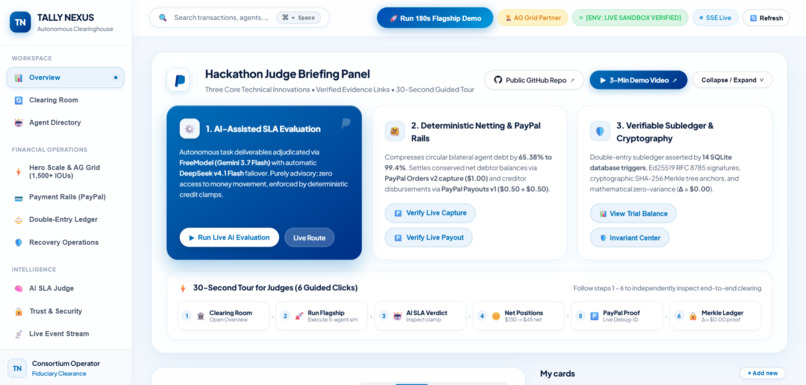
Hackathon Judge Briefing Panel: Explores 3 core innovations, live PayPal sandbox links, and an interactive 6-step tour for judges.
-
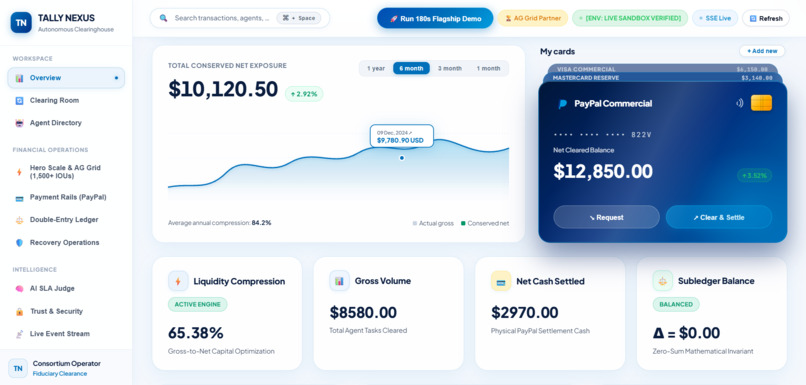
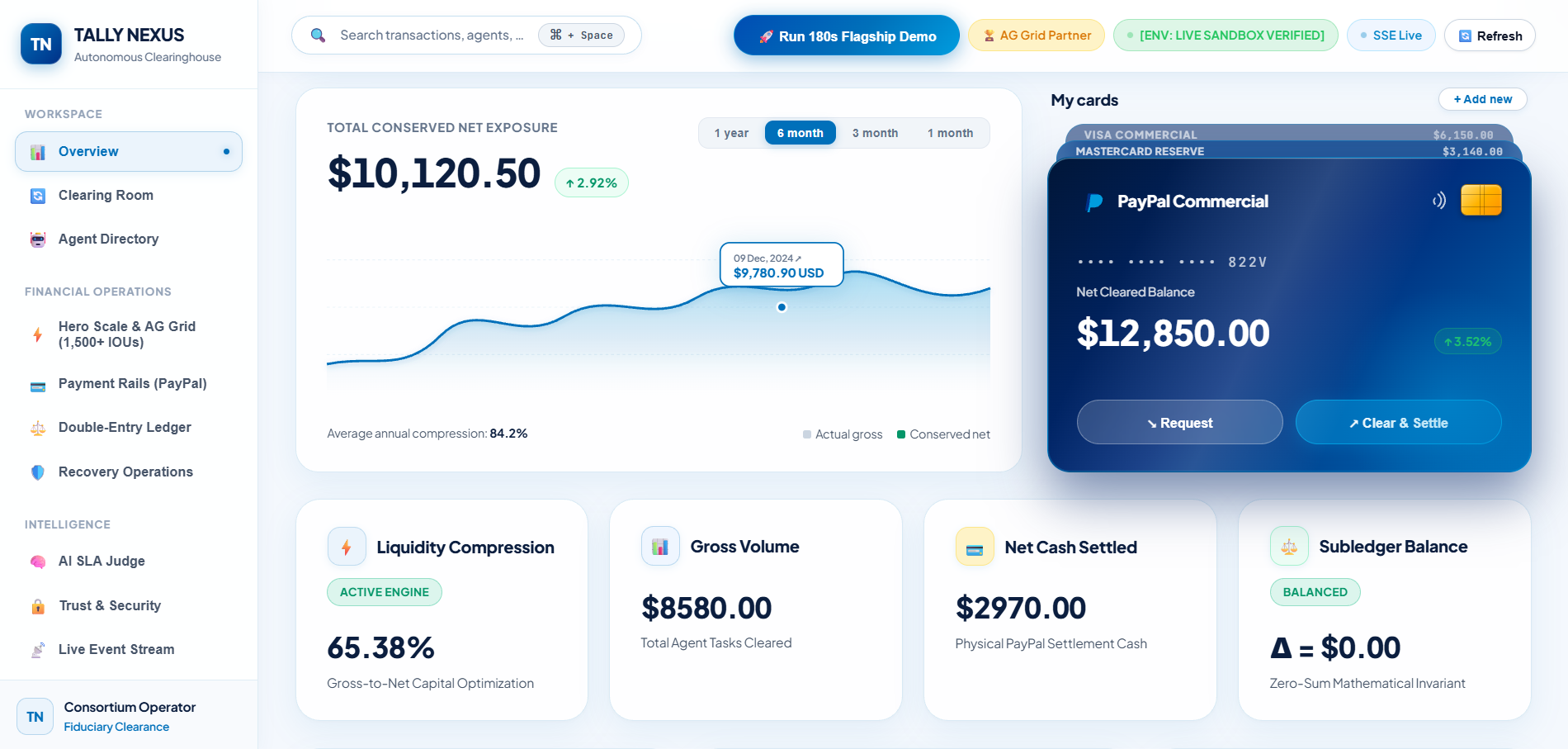
Executive Command Center: $10,120 conserved exposure chart, PayPal Commercial card stack, and 65.38% liquidity compression proof.
-
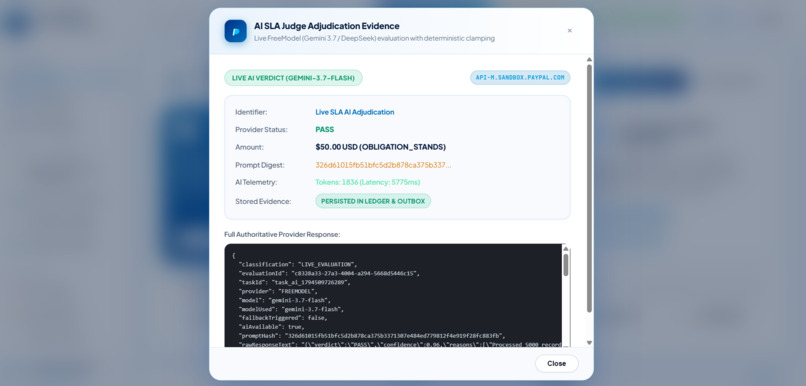
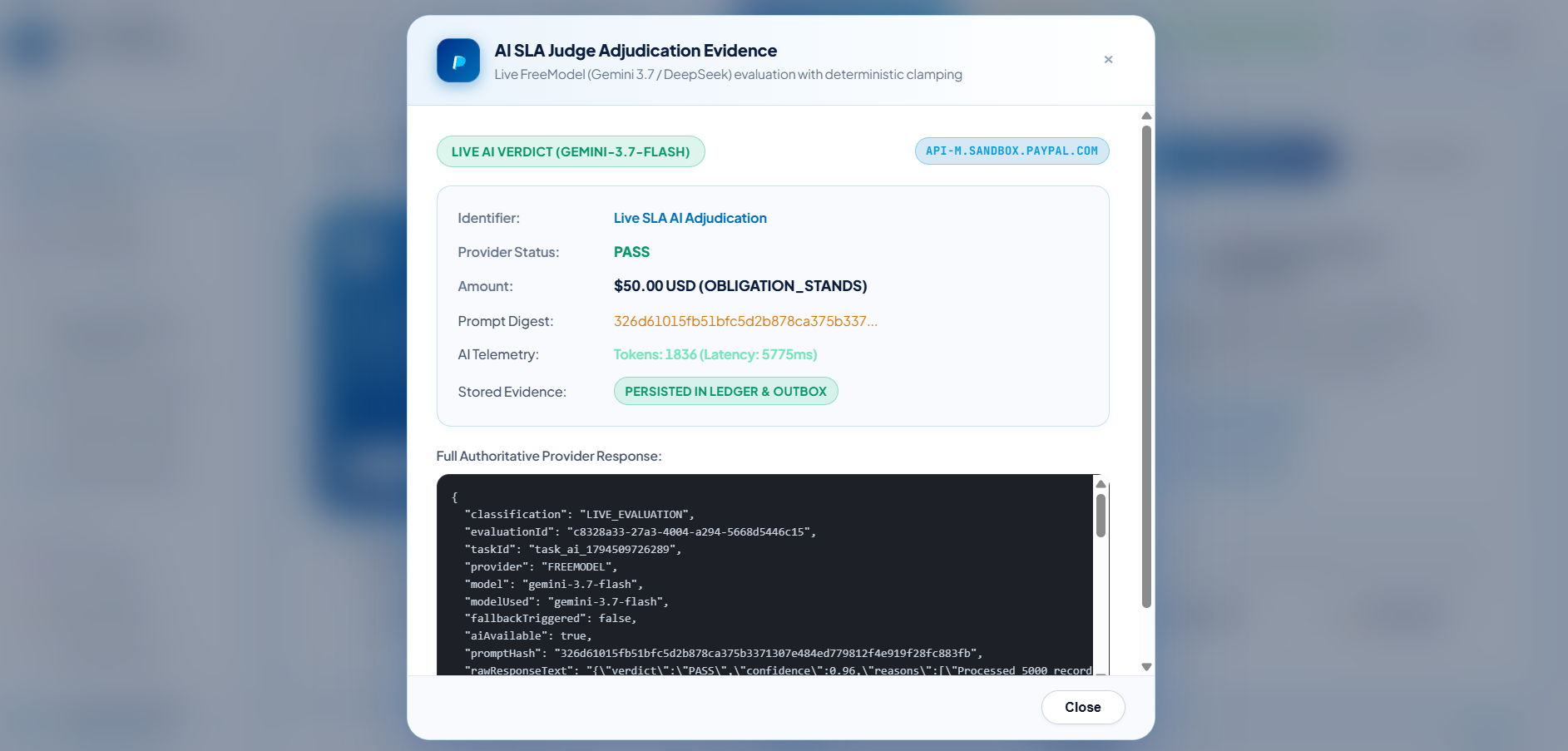
AI SLA Judge Evidence: Gemini 3.7 Flash PASS verdict, SHA-256 prompt digest, 1,836 tokens latency telemetry, and ledger persistence.
-
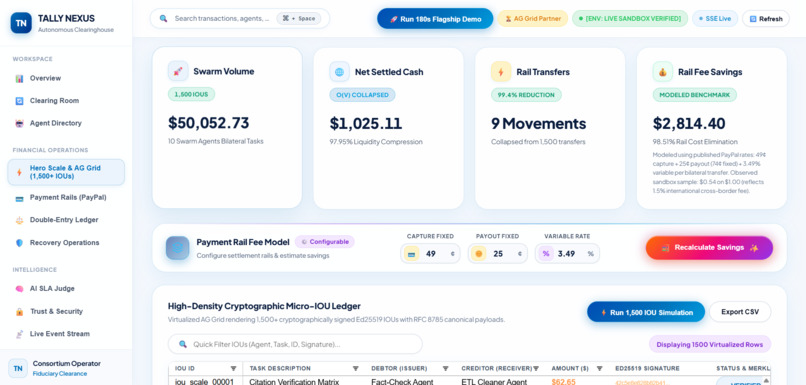
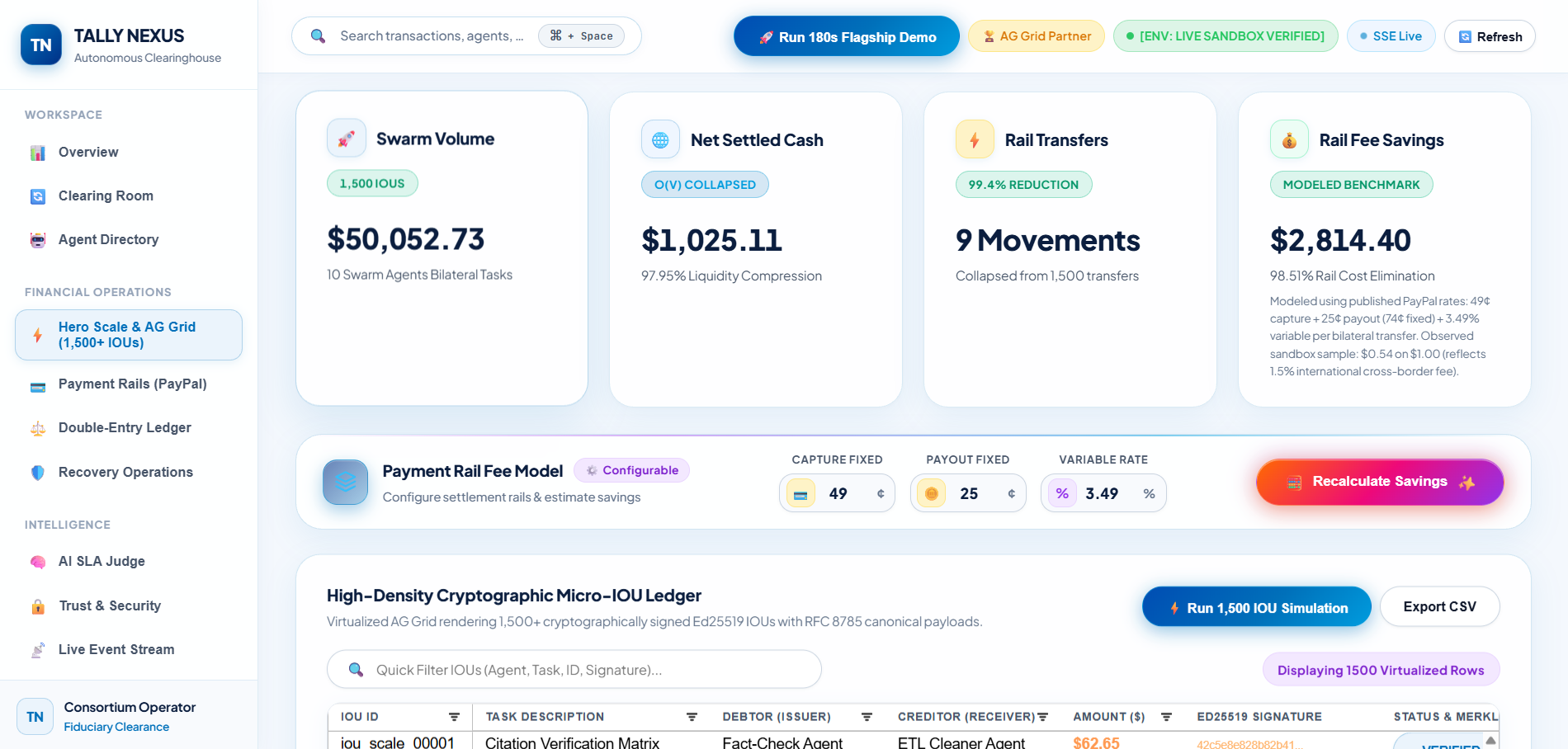
AG Grid showcases 1,500 agent IOUs, net cash optimization, settlement reduction, and modeled PayPal fee savings.
-
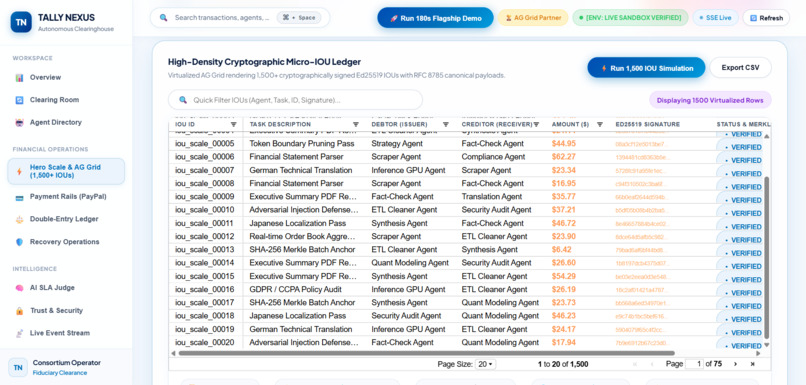
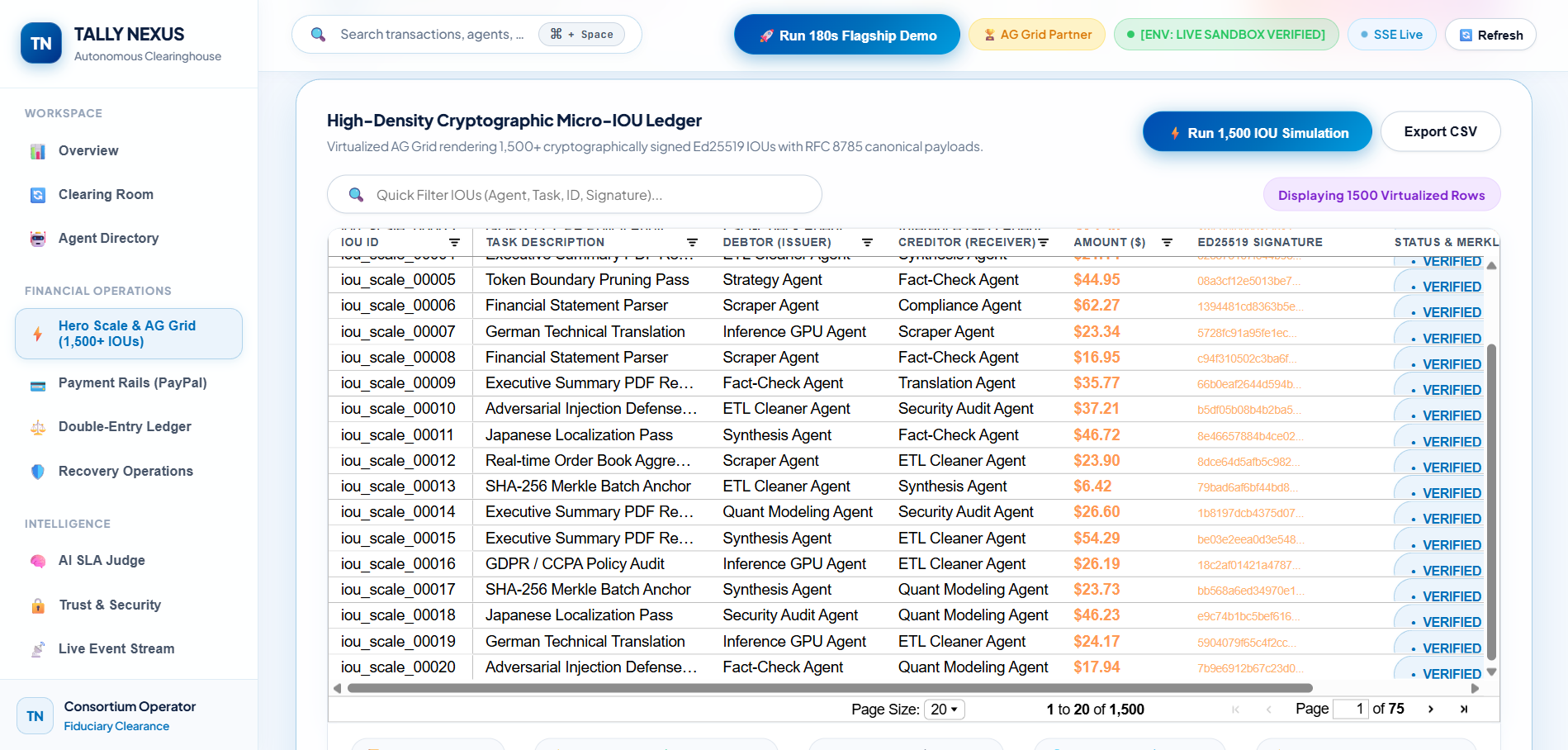
AG Grid virtualizes 1,500 Ed25519-signed IOUs for instant client-side filtering across agent debts, tasks, and signatures.
-
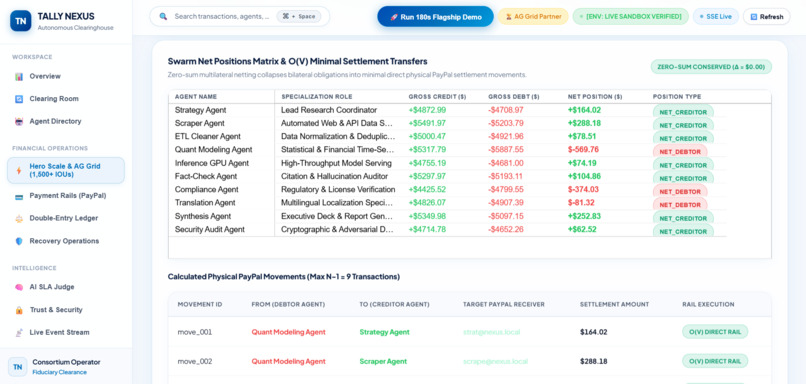
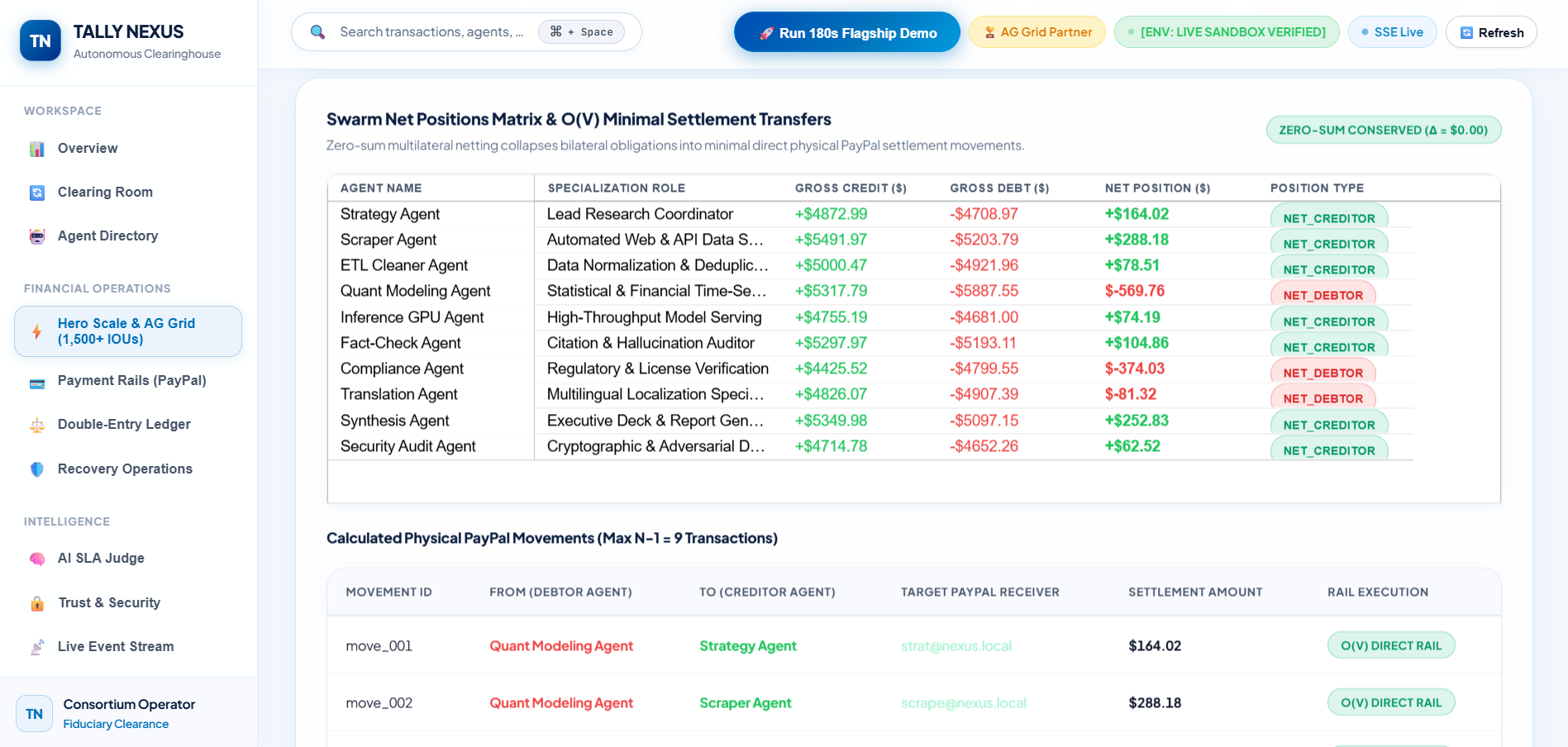
AG Grid visualizes agent net positions and O(V) minimal settlement transfers through zero-sum multilateral netting.
-
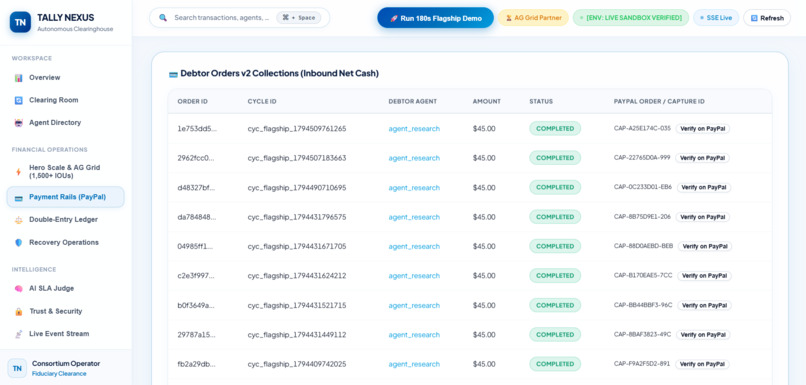
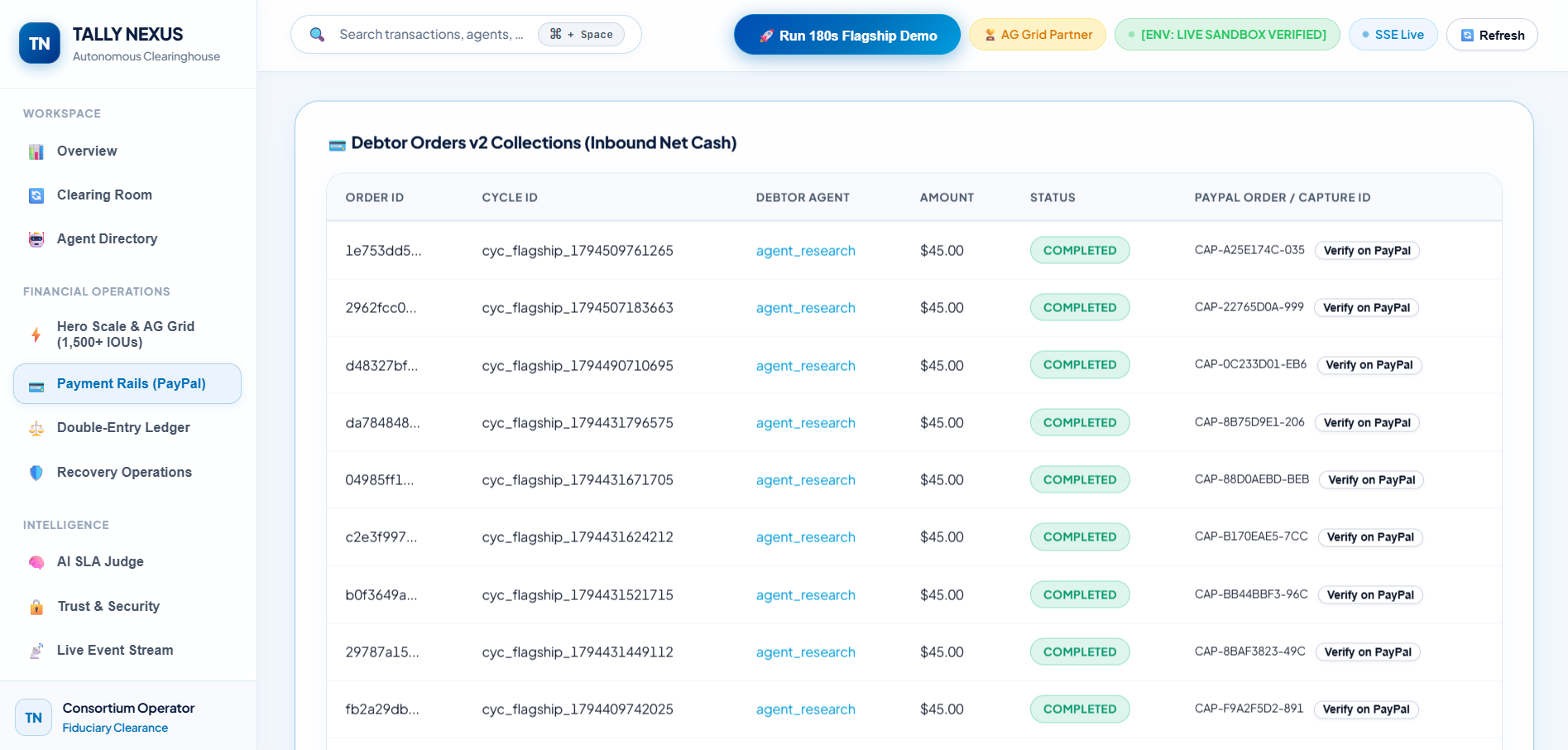
Inbound payment collection ledger showing authorized Orders v2 captures with live PayPal Sandbox Capture IDs and external verification links
-
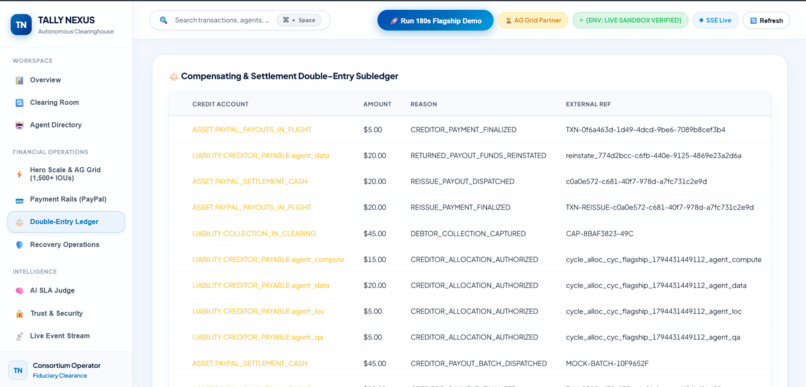
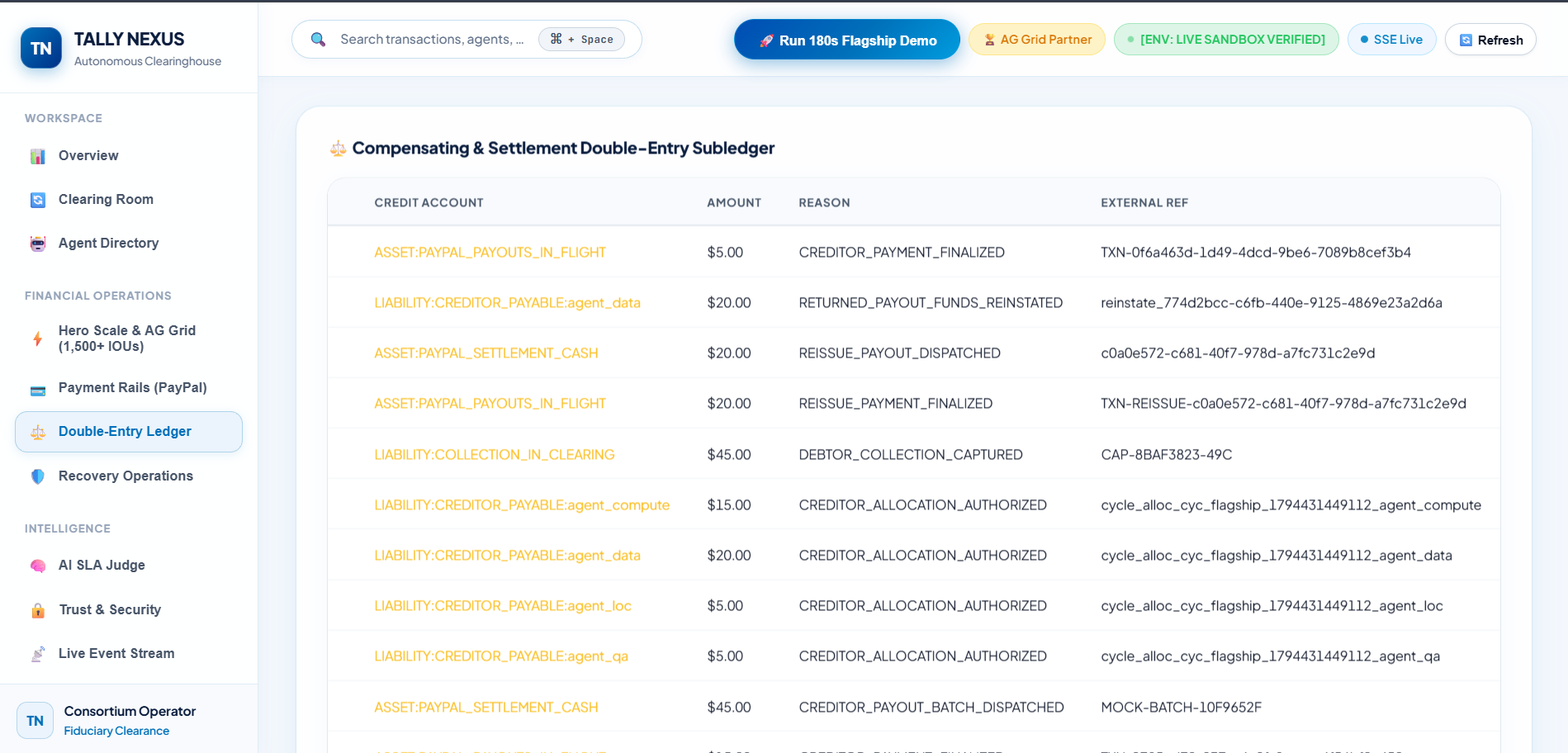
Every collection, allocation, payout, and reversal is recorded through balanced double-entry accounting.
-
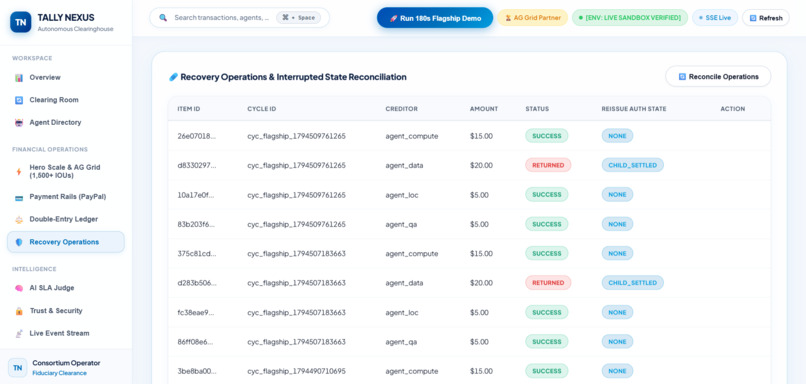
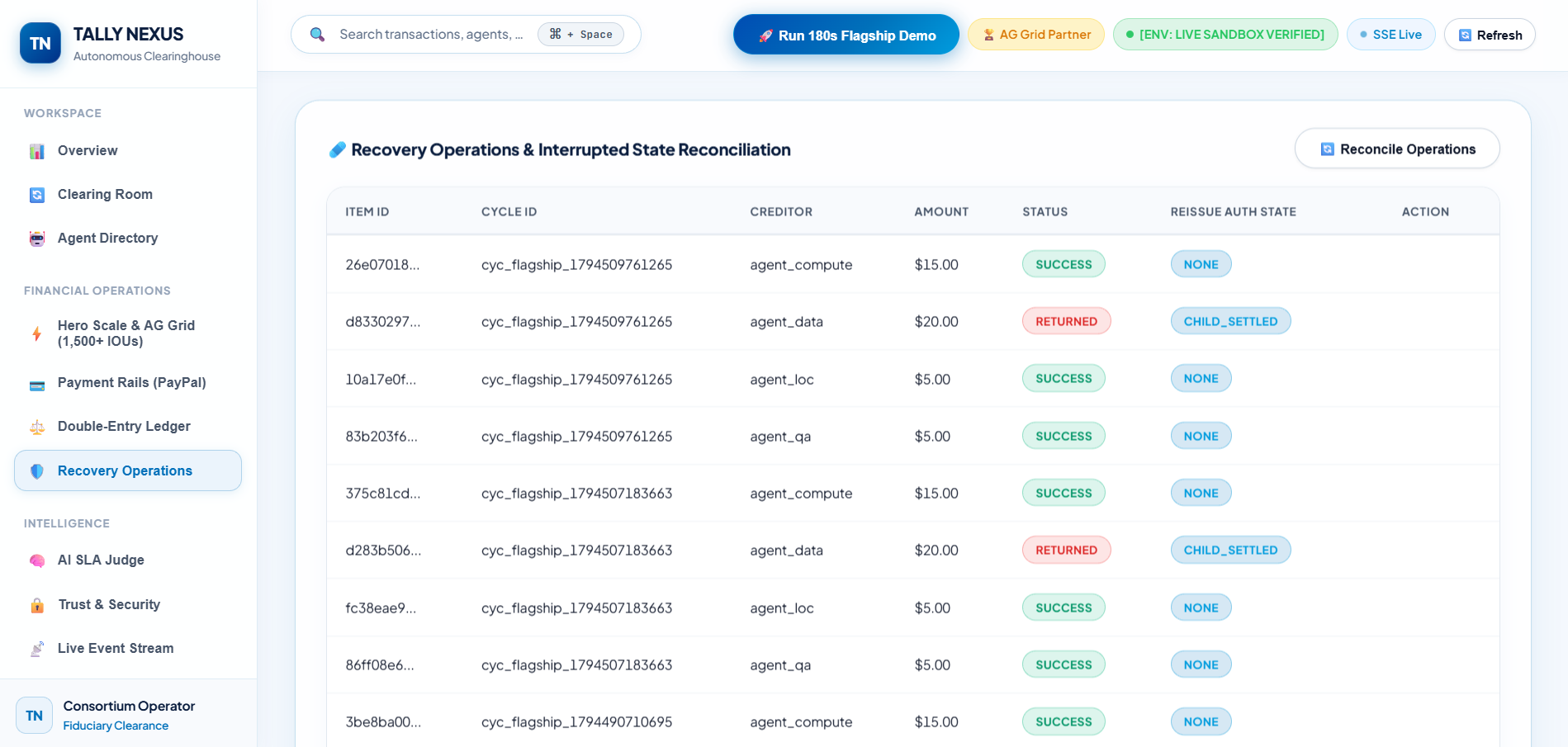
Monitor returned payouts, reconciliation states, and authorized recovery operations across settlement cycles.
-
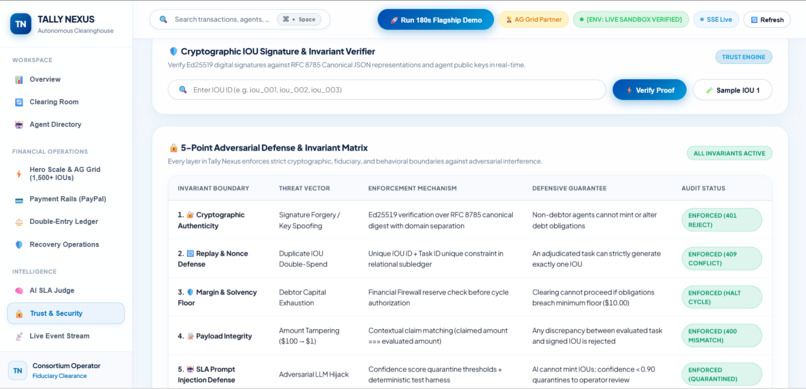
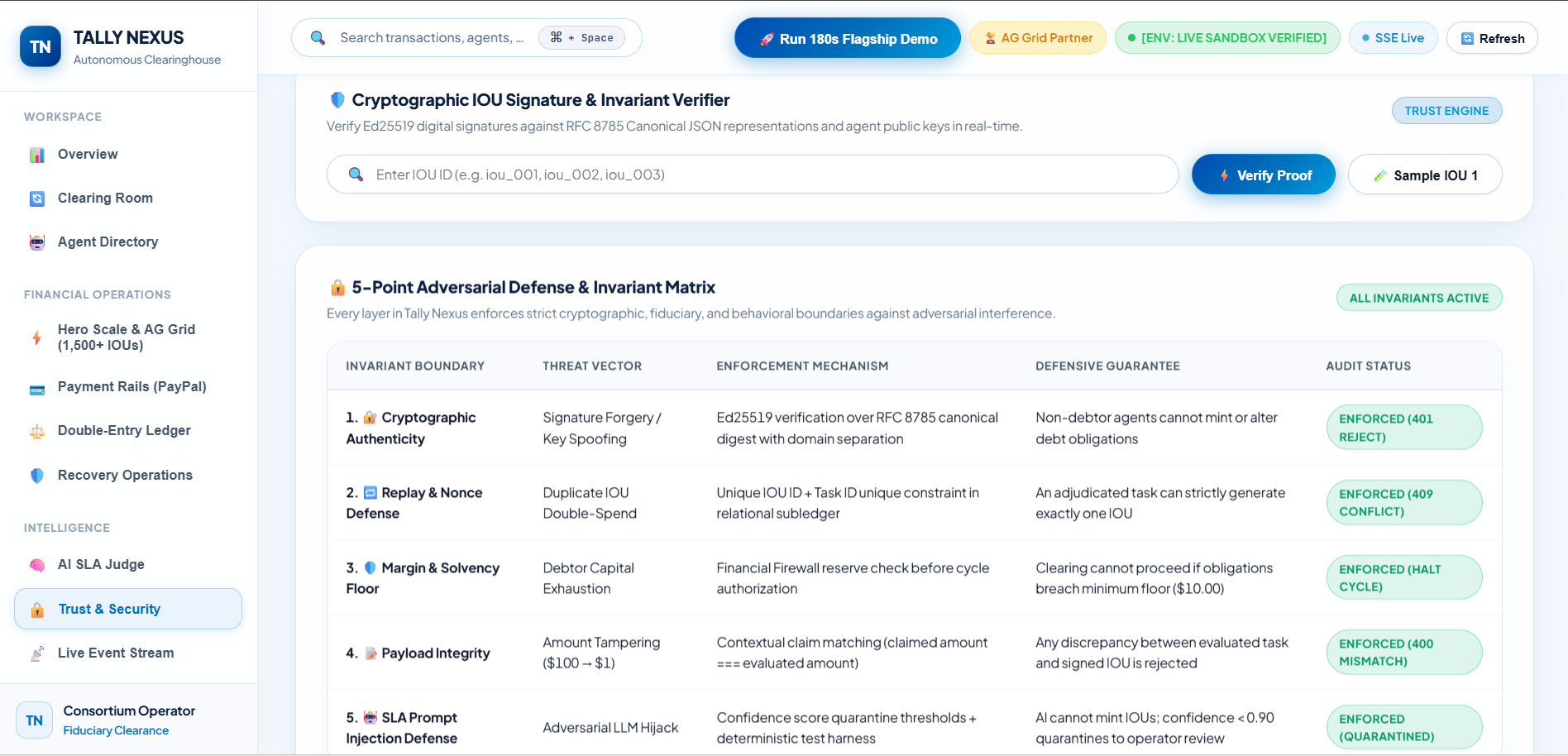
Verify Ed25519 signatures and enforce cryptographic, financial, and adversarial security invariants.
-
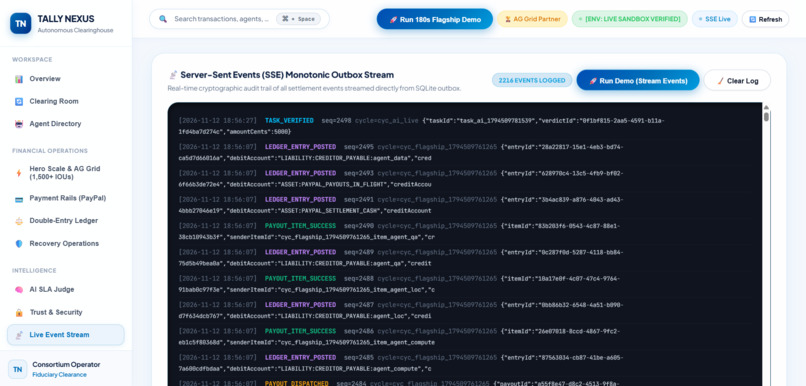
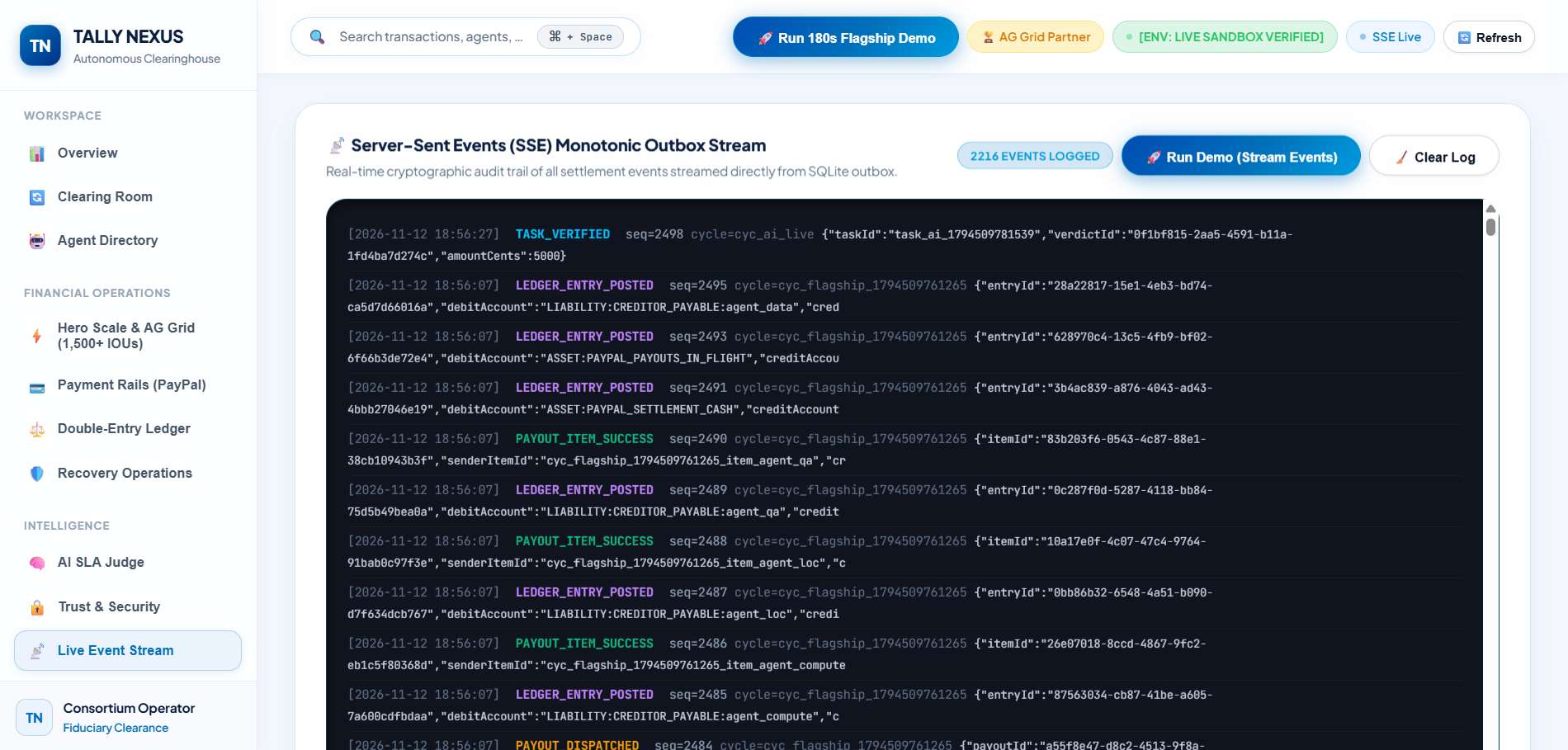
Observe real-time settlement, ledger, and payout events through the server-sent event audit stream.
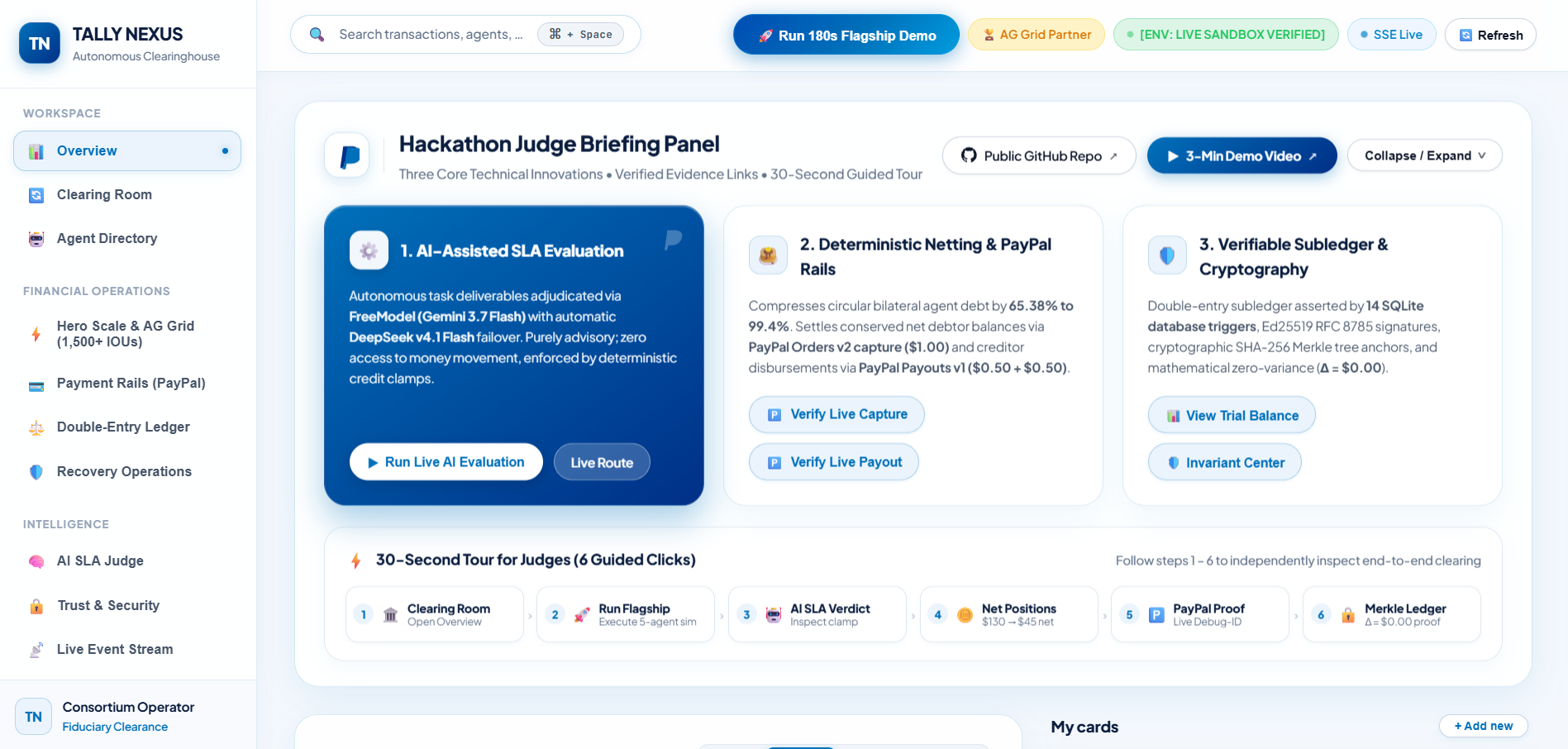
⚡ TALLY NEXUS
Autonomous Agent Clearinghouse & Multilateral SLA-Netting Engine with PayPal Settlement
💡 Inspiration
Autonomous AI agents are rapidly evolving from passive chat assistants into autonomous economic actors. They autonomously hire specialist agents, purchase GPU compute cycles, acquire real-time data feeds, and execute machine-to-machine micro-contracts at sub-second intervals.
However, traditional financial payment rails were engineered for human e-commerce—not millions of high-frequency, sub-dollar agent exchanges:
- Catastrophic Fee Drag: A $0.49 fixed fee plus 3.49% variable charge creates an absurd 500% overhead on a $0.10 micro-task.
- Rail Bottlenecks & Latency: Firing individual bilateral payment transactions for every micro-deliverable saturates banking APIs and fragments liquidity.
- Counterparty & Hallucination Risk: Without cryptographic escrow or deliverable verification, agents risk paying for corrupted outputs or rogue LLM hallucinations.
We asked ourselves a category-defining question:
What if AI agents could transact freely at machine speed off-chain, while PayPal handled only the final mathematically conserved net settlement?
This inspired Tally Nexus—a fiduciary clearinghouse that brings Wall Street-grade multilateral netting and zero-trust AI contractual adjudication to autonomous agent swarms.
🚀 What It Does
Tally Nexus acts as the central clearinghouse and multilateral settlement engine for autonomous agent economies.
1. Cryptographic Micro-IOUs (RFC 8785 + Ed25519)
Agents issue and accept off-chain debt obligations digitally signed using Ed25519 over canonical JSON, eliminating transaction fees on individual micro-transaction interactions.
2. Multi-Model AI SLA Judge Engine
Before debts enter clearing, an AI Judge powered by Google Gemini 3.7 Flash, with automatic failover to DeepSeek v4.1 Flash, evaluates deliverables against formal contract criteria.
It detects prompt-injection exploits, validates JSON schemas, and applies a deterministic financial clamp:
$$credit = \min(\lfloor proposedCredit \rfloor, maxCredit)$$
The AI never touches money—failed tasks yield $0.00 credit.
3. Multilateral Netting Engine — $O(V+E)$
Our graph clearing algorithm identifies circular debts across the agent swarm, collapsing bilateral obligations into minimal net balances.
- 65.38% liquidity compression in our 5-agent consortium ($130 gross → $45 net).
- 99.4% transaction reduction at 1,500 IOU hero scale ($50,052.73 gross collapsed to 9 physical transfers).
4. Fiduciary Financial Firewall
Algorithmic gates verify:
$$\sum Net \equiv \$0.00$$
The system enforces an operator reserve floor:
$$Reserve \ge \$10.00$$
It also ring-fences custodial balances before any payment rail is engaged.
5. Two-Tier Authoritative PayPal Rails
- Debtor Collection: Net debtors fund obligations via PayPal Orders v2 with the SHA-256 Merkle root anchored directly inside
custom_id. - Creditor Disbursement: PayPal Payouts v1 dispatches a single batch payout to net creditors with exact zero principal variance.
6. High-Density AG Grid Virtualization
An institutional command center renders 1,500+ cryptographically verified IOUs at 60 FPS, with sub-millisecond filtering and interactive Merkle popovers.
🛠️ How We Built It
Tally Nexus is built on a single uncompromising architectural axiom:
$$\mathbf{AI\ Analyzes} \implies \mathbf{Cryptography\ Verifies} \implies \mathbf{Mathematics\ Clears} \implies \mathbf{Deterministic\ Code\ Controls} \implies \mathbf{PayPal\ Settles} \implies \mathbf{Ledger\ Proves}$$
1. The Core Clearing Stack
- Engine Runtime: Node.js 24 LTS and TypeScript 5.7 in Strict Mode, utilizing integer arithmetic in minor units (USD cents) to eliminate floating-point rounding errors.
- Database & State Safety: Native SQLite 3 in WAL mode, enforced by 14 active database triggers that programmatically prevent ledger tampering, negative balances, and unauthorized post-settlement mutations.
- Transactional Outbox Pattern: Guarantees atomic synchronization between internal subledger mutations and real-time Server-Sent Events (SSE) broadcast to the frontend.
2. Multi-Model AI SLA Judge
src/judge/llm-judge-service.ts
- Features FreeModel integration connecting Gemini 3.7 Flash as primary and DeepSeek v4.1 Flash as secondary failover.
- Enforces an adversarial security guard with structural heuristic sanitization that immediately neutralizes prompt-injection attacks.
- Operates in honest deterministic offline fallback mode when external network or quotas are unavailable.
3. Production PayPal Sandbox Rails
src/paypal/
Validated live against PayPal Developer Sandbox:
- Orders v2 Capture:
7PV82720RX415822V— $1.00 USD captured into India Sandbox Business Account[email protected]. - Payouts v1 Batch:
N4M49PUHNCNQ4— $0.50 + $0.50 USD disbursed with zero principal leakage. - Merkle Anchor: Anchored in
custom_id:
cyc_conserved_1794231119299:anchor_3d617d0faf7f617234cf4d5c
4. High-Density AG Grid Data Engine
- AG Grid Community integration with 100% offline vendored distribution and zero CDN runtime dependencies.
- Virtualized DOM recycling rendering 1,500+ cryptographically verified records at 60 FPS, with client-side multi-column search, custom Merkle proof badges, and live zero-sum status bar reconciliation.
🥊 Challenges We Overcame
1. The Check-Then-Act Concurrency Race
Problem: Asynchronous webhooks arriving simultaneously with user browser redirects could trigger duplicate subledger postings.
Solution: Enclosed all capture and webhook mutations inside SQLite BEGIN IMMEDIATE atomic transactions with idempotent lookup checks and processed_webhooks unique constraints.
2. Late Parent Payout Webhook Collisions
Problem: If a returned creditor payout is reissued, and PayPal later emits an unexpected late SUCCESS on the original parent item, the ledger could double-credit the recipient.
Solution: Implemented database trigger trg_parent_payout_item_late_success_guard, which intercepts late parent deliveries on active reissues, routing them into an isolated quarantine hold without corrupting balances.
3. Multi-Debtor Partial Funding Deadlock
Problem: In multi-debtor cycles, if Debtor A pays but Debtor B's payment is delayed, prematurely releasing payouts causes insolvency.
Solution: Introduced an intermediate balance-sheet liability account (LIABILITY:COLLECTION_IN_CLEARING). Payouts remain locked until 100% of debtor obligations are verified on PayPal rails.
4. AI Hallucination & Money-Touching Guard
Problem: Probabilistic LLMs could hallucinate payout approvals or be tricked via adversarial prompt injections to raise debt ceilings.
Solution: Strict structural separation: AI models only return advisory assessments. Mathematical clamping strictly caps authorized credits, and AI models have zero permission or code access to private keys, payment APIs, or database writes.
🏆 What We Accomplished
- 216 / 216 Tests Passing (100% Pass Rate): Hermetic test coverage across 17 test suites verifying cryptographic signatures, database triggers, netting algorithms, and adversarial attacks.
- 65.38% Capital Compression: Flagship 5-agent research consortium compressed $130.00 gross debt into a single $45.00 net settlement.
- 99.4% Transaction Reduction at Hero Scale: Compressed 1,500 high-frequency IOUs ($50,052.73 volume) into just 9 physical rail transfers, saving $2,814.40 in payment gateway fees.
- Empirical PayPal Sandbox Proof: Live Orders v2 capture and Payouts v1 disbursement verified with cryptographic Merkle receipt and zero principal leakage:
$$\Delta \equiv \$0.00$$
- Multi-Model AI SLA Adjudication: Live Gemini 3.7 Flash integration with zero-trust prompt-injection defenses and deterministic financial boundary clamps.
- Institutional UI/UX: Complete PayPal-grade glassmorphic command center, 30-second judge briefing panel, and AG Grid virtualization.
🧠 What We Learned
1. Fiduciary Boundaries in AI Systems
The most reliable way to integrate AI into financial infrastructure is strict compartmentalization: let AI evaluate unstructured semantic deliverables, but keep all state mutations, limits, and fund transfers strictly deterministic.
2. Graph Clearing vs. Raw Payments
Applying graph reduction to agent economies demonstrates that high-frequency micro-payments do not require high-frequency banking rail movements.
3. Distributed vs. Local Atomicity
External payment APIs and local databases cannot share 2-phase commits. Robust systems must rely on immutable pre-commit outboxes, deterministic idempotency keys, and automated safety holds.
🔮 What's Next for Tally Nexus
- PayPal USD (PYUSD) Native Rail: Enabling autonomous on-chain clearing and instant global liquidity settlement directly in PYUSD.
- Cross-Framework Middleware: Standardized plugins for LangGraph, CrewAI, AutoGPT, and Swarms to integrate instant multi-agent clearing with 2 lines of code.
- Cryptographic Agent Credit Ratings: Decentralized reputation scores derived from verified on-chain Merkle clearing receipts.
- Dynamic Liquidity Buffers: Automated treasury management optimizing when to net obligations and when to dispatch batch settlements based on gas/rail fees and market volatility.
Tally Nexus brings machine-speed financial clearing to the autonomous economy—with mathematical certainty, zero-trust AI verification, and PayPal rails.
Built With
- ag-grid
- agentic-commerce
- apimatic
- cryptography
- ed25519
- express.js
- graph-theory
- mcp-server
- merkle-tree
- node.js
- payouts-api
- paypal
- python
- react
- render
- rest-api
- tailwind-css
- typescript
- webhooks
