Inspiration
Traditional coding interviews were built for a world where engineers wrote every line of code themselves. Modern-day engineers work alongside AI. The skills that matter most are problem decomposition, communication, system design, and the ability to guide and validate AI-generated code.
Yet the technical assessment industry, dominated by platforms such as HackerRank and CodeSignal, remains largely unchanged. These assessments continue to emphasize data structures and algorithm exercises that can often be optimized through extensive practice, memorization, and pattern recognition.
As a result, these evaluations capture only a narrow slice of the skills that drive success in modern software engineering. This limitation becomes especially problematic for hiring teams reviewing thousands of applicants per role. A single numerical score or pass/fail threshold reveals little about a candidate's ability to collaborate, navigate unfamiliar codebases, communicate technical decisions, or solve the kinds of open-ended problems they will encounter on the job.
What We Built
We built Talkode - the voice-first online assessment for software engineering roles. Talkode gives hiring teams a holistic view of how candidates think, communicate, and solve real engineering problems, as they would at the job.
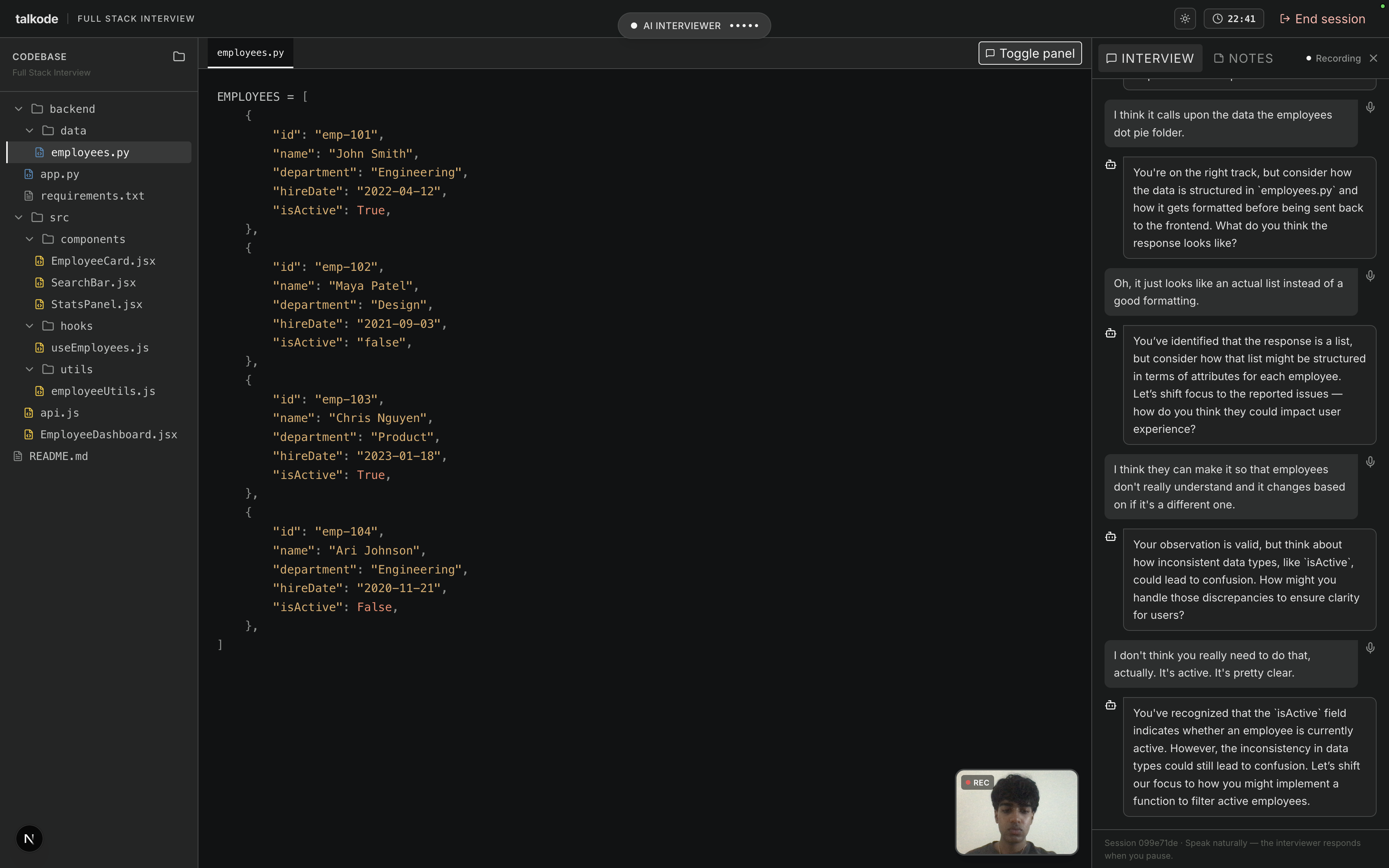
Instead of answering isolated algorithm questions, candidates work through realistic technical scenarios while speaking naturally with an AI agent. The platform generates custom codebases and role-specific challenges tailored to a company's tech stack and hiring requirements.
Throughout the assessment, Talkode evaluates the following, for example:
- Problem decomposition and reasoning
- Technical communication and collaboration
- System design decision-making
- Codebase navigation and debugging
- Code quality, validation, and tradeoff analysis
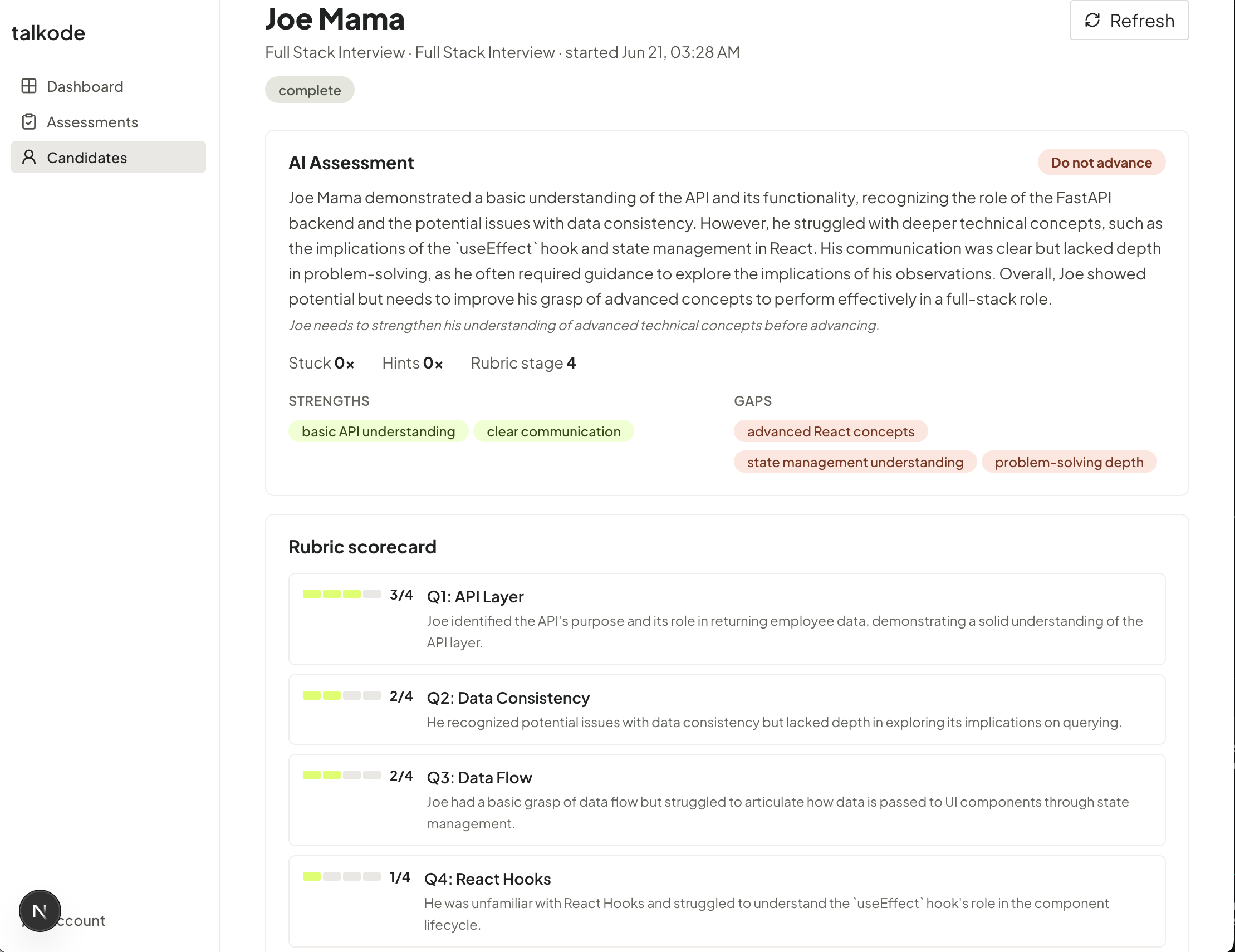
The result is a rich candidate profile that goes far beyond a single score of passed test cases, helping hiring teams identify engineers who can succeed in modern, AI-assisted development environments.
Key Features
Voice-First AI Technical Assessment
- Candidates engage in natural, conversational technical interviews rather than typing answers into a coding assessment. Talkode evaluates how candidates communicate ideas, explain tradeoffs, and reason through complex engineering problems in real time.
Custom AI-Generated Codebases
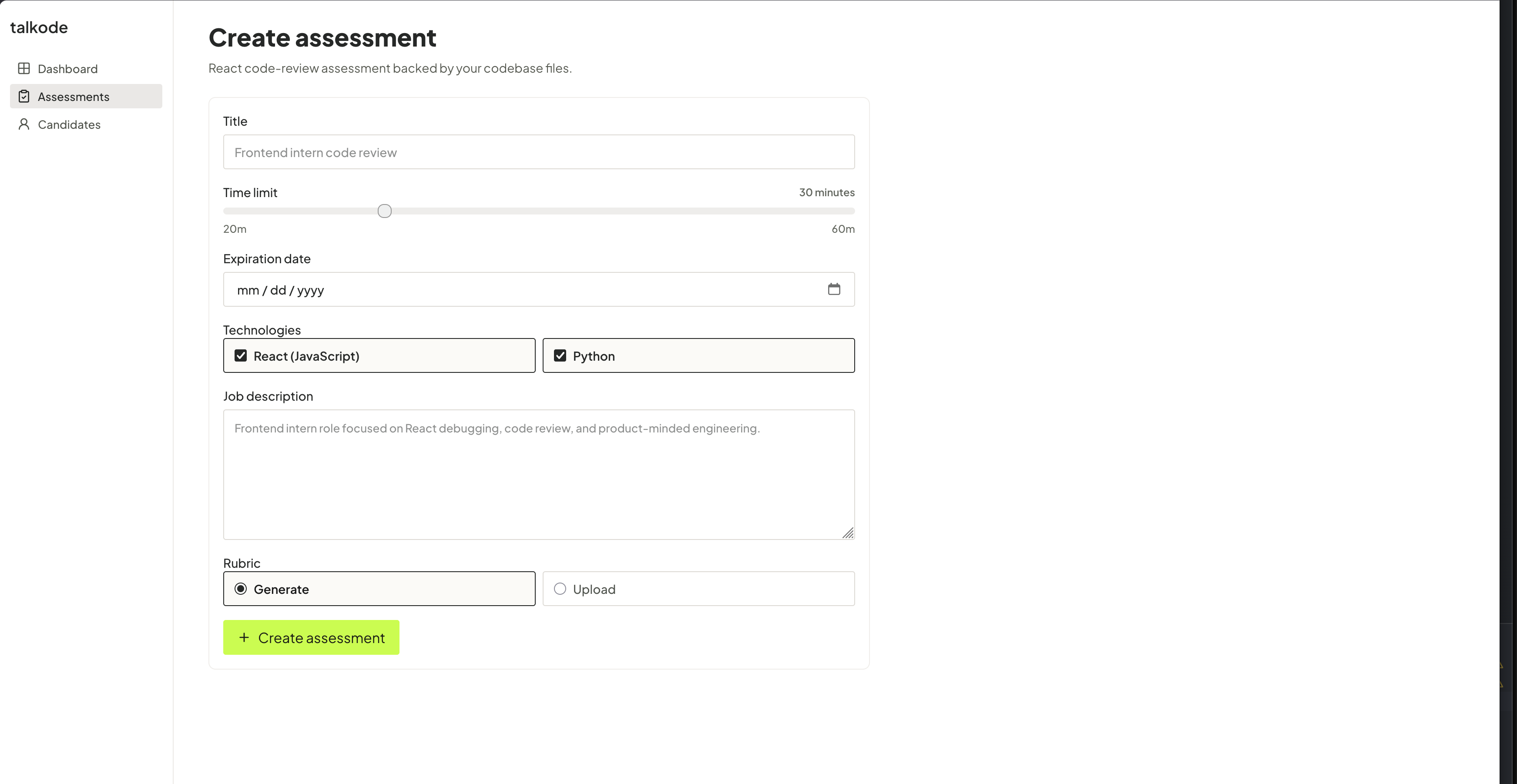
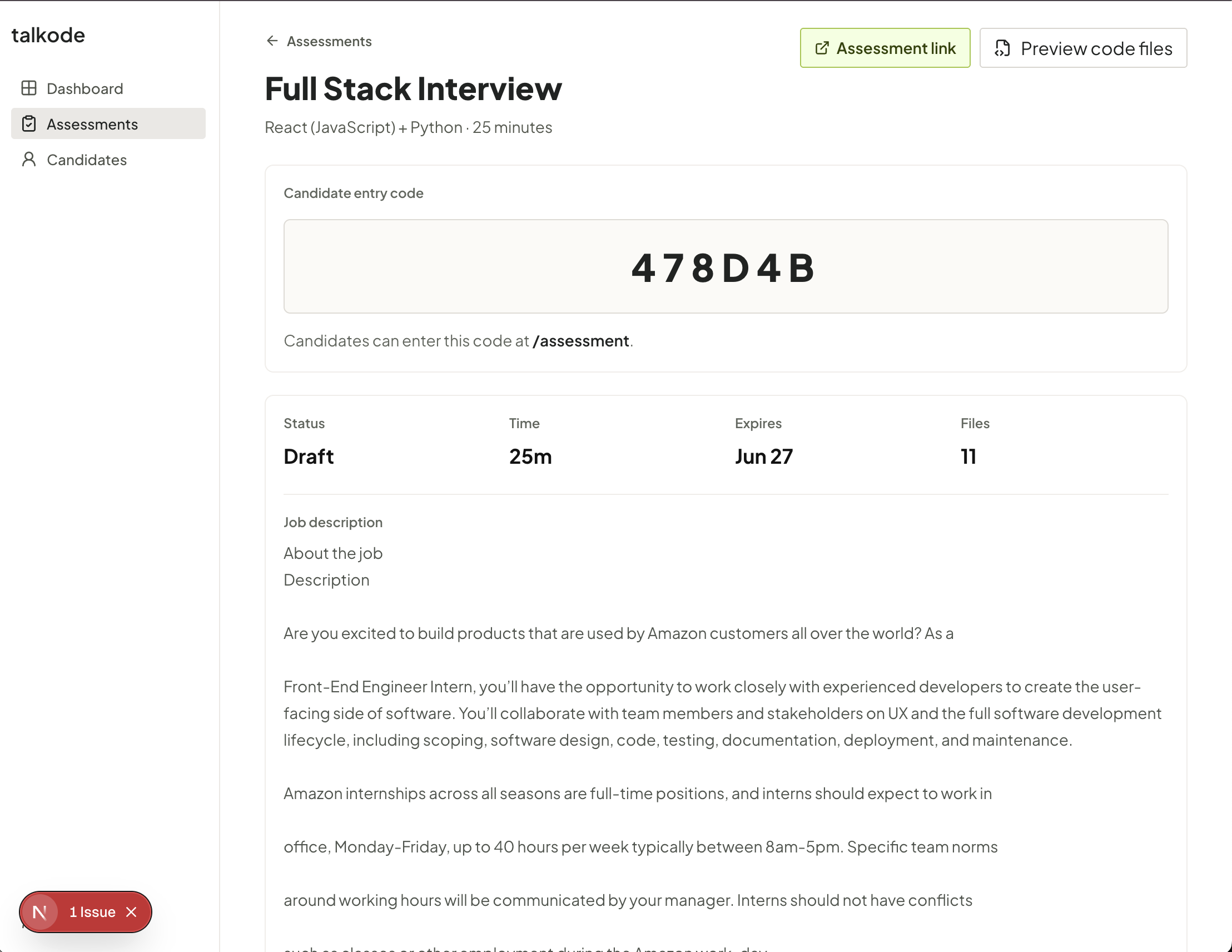
- Hiring teams can upload job descriptions, technical requirements, and company context. Talkode automatically generates realistic codebases and project scenarios tailored to the role being hired for.
Rich Assessment Reports for Hiring Team
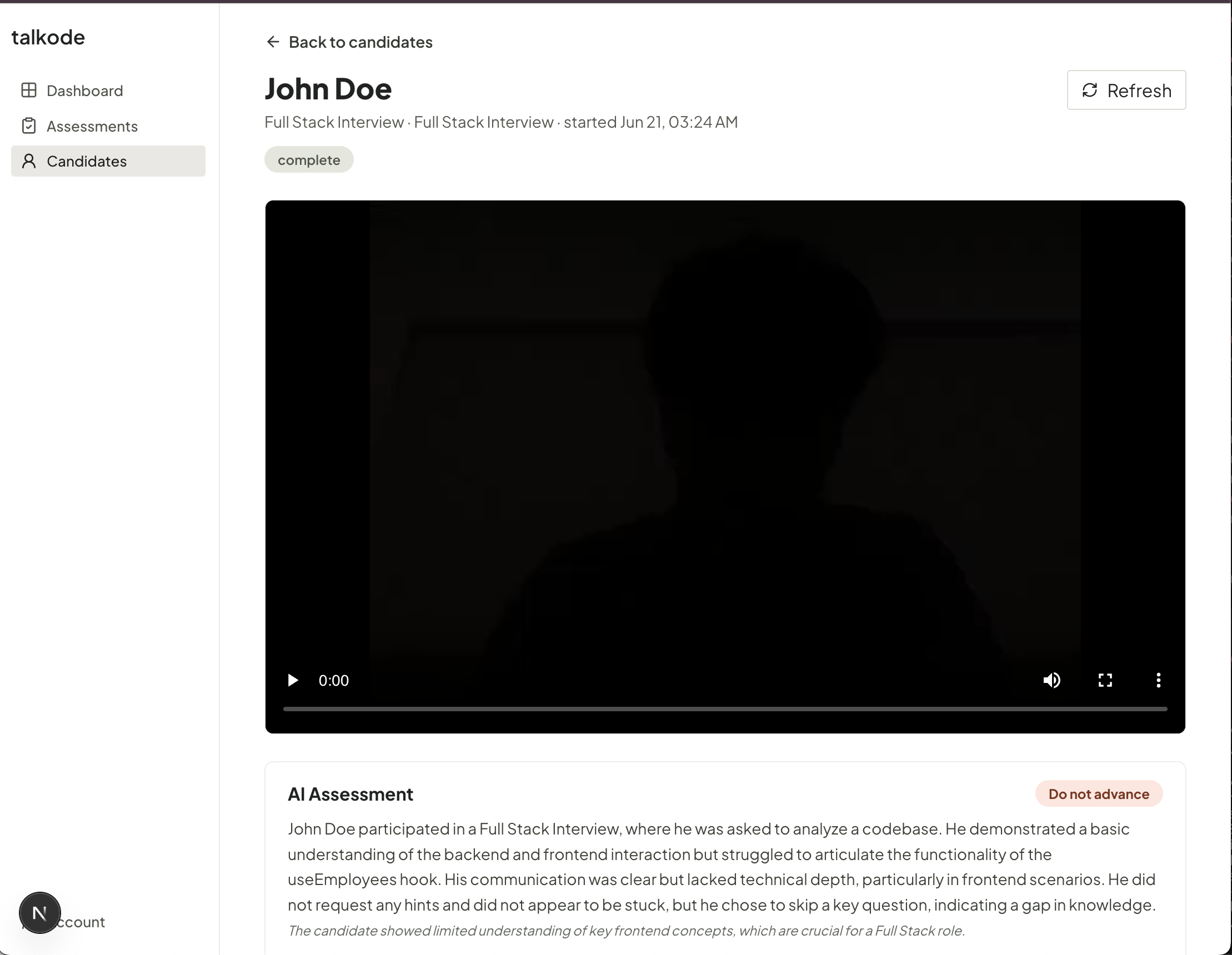
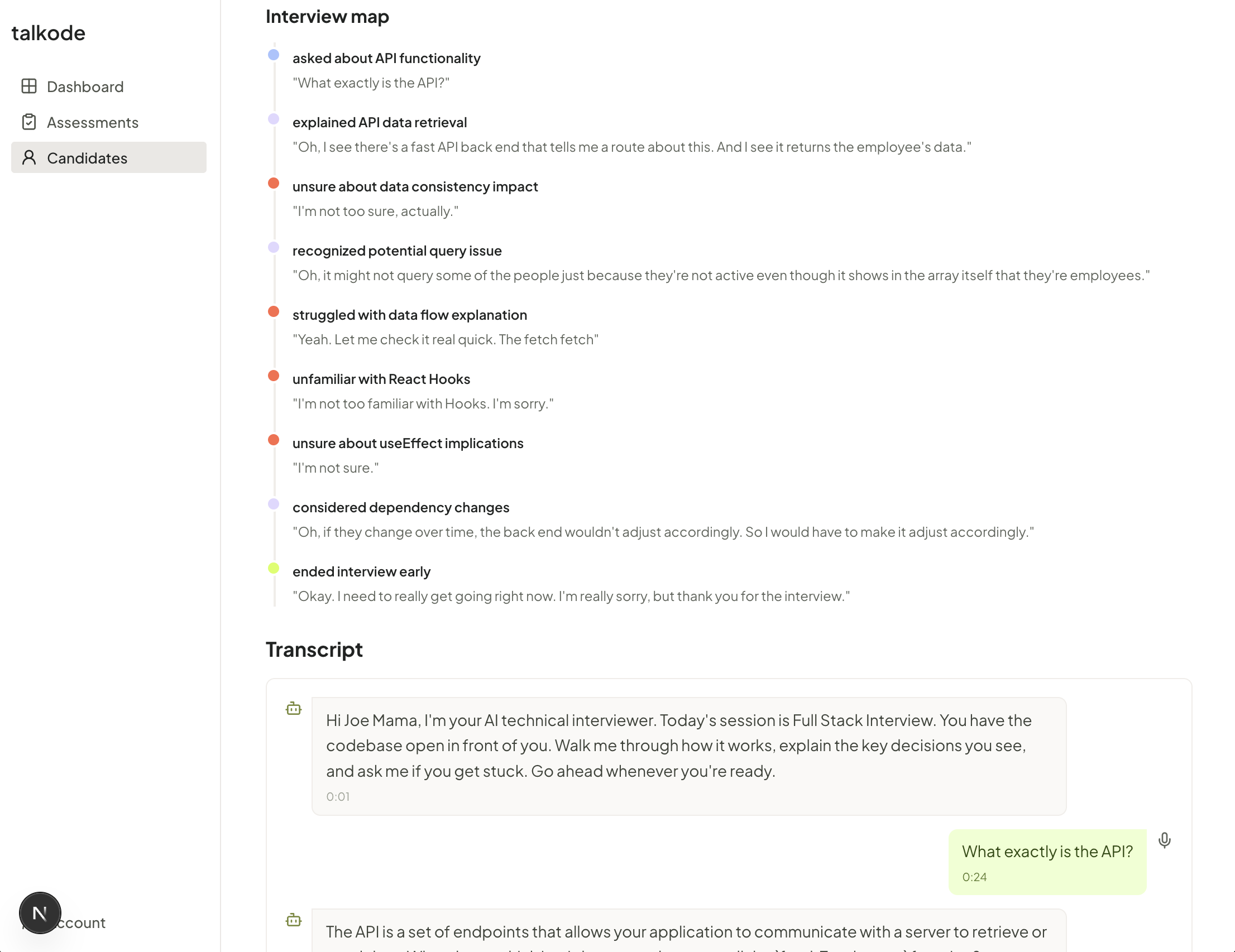
- Hiring teams receive detailed candidate profiles containing interview transcripts, reasoning summaries, technical strengths and weaknesses, solution approaches, and AI-generated evaluation insights.
How We Built It
Our team used React/Next.js for the Frontend, Python FastAPI for the Backend, and Supabase as the database to store and fetch relevant information.
We used three main Sponsor Technologies: Deepgram, The Token Company, and Redis.
Deepgram powered our main voice agent, which is the heart of the project. We used Deepgram's text-to-speech and speech-to-text technologies to give voice to Talkode's AI voice agent and understand candidate speech, respectively. Deepgram was used extensively to conduct full 30-minute assessments as dry runs, resulting in low latency throughout.
The Token Company's token compression tool was a key technology that helped compress the thousands of tokens that had to be continuously fed as context over long time periods, ranging from 20-60 minutes. The technology helped us extract the key thinking from the candidates, making it fair for candidates who have trouble using many filler words.
Redis served as an AI memory layer to maintain short-term context during interviews, storing recent transcript chunks, candidate responses, and tool outputs for fast retrieval. This allowed the AI interviewer to "remember" what had just been said without repeatedly querying slower persistent storage or rebuilding context from scratch. By keeping this working memory in Redis with TTL-based expiration, each session stayed both coherent and cost-efficient while scaling to many concurrent interviews. The result was a more fluid, human-like conversation where the AI could reference prior moments in real time without losing state.
Challenges
The biggest challenge we faced was making the interview flow feel natural and smooth, especially in a voice-first, AI-driven environment where latency and context transitions can easily break the sense of conversation. We had to carefully design how the AI maintained memory, structured follow-ups, and transitioned between questions to preserve conversational continuity while still evaluating structured technical skills.
Beyond the technical side, the harder problem was trust and credibility. How do you convince a hiring manager that a candidate coming out of the platform is actually strong? It's easy to list traits like problem decomposition, systems thinking, or tradeoff reasoning, but much harder to ground those in something concrete and auditable, like actual moments in a transcript that justify a score. We ended up rewriting the evaluation rubric multiple times, working with mentors and engineers we met along the way, to build a baseline that is explainable by default and can still be customized by each company.
What we are proud of
- Built a working voice-first technical interview system end-to-end in a short time frame
- Designed an interview flow that feels natural and conversational, even under real-time AI constraints
- Successfully reduced awkward pauses and context loss, making interactions feel much more human
- Developed an evaluation approach that ties scores back to actual transcript evidence, improving transparency and trust
- Iterated on the rubric with input from mentors and engineers to make it more grounded and explainable
- Turned an initial concept into a usable product experience that hiring teams can actually explore and test
What's next?
Anti-cheating + interview integrity layer
- Our next biggest step is building robust anti-cheating systems to ensure interview authenticity. Since this was a hackathon project, we didn’t have time to fully implement safeguards like behavioral anomaly detection, environment monitoring, or AI-assisted answer validation. However, we want to continue working on this project and hope to implement anti-cheat measures in the near future.
Richer codebase generation Expand support for more languages, frameworks, and real-world engineering environments so companies can simulate the exact tech stack they hire for (e.g., React + Node, distributed systems, data pipelines, etc.).
Deeper assessment customization
- Allow companies to fully customize the interview experience, including the AI interviewer’s personality, tone, difficulty level, and evaluation focus areas.
Enterprise readiness + integrations
- Integrate with ATS platforms (like Greenhouse or Ashby) and support enterprise-grade compliance, analytics, and candidate tracking.
Built With
- css
- deepgram
- fastapi
- gpt-4o-mini
- httpx
- lucide-react
- marked
- next.js
- openai
- prism.js
- python
- react
- redis
- supabase
- tailwind
- thetokencompany
- typescript
- uvicorn
- websockets


Log in or sign up for Devpost to join the conversation.