-
-
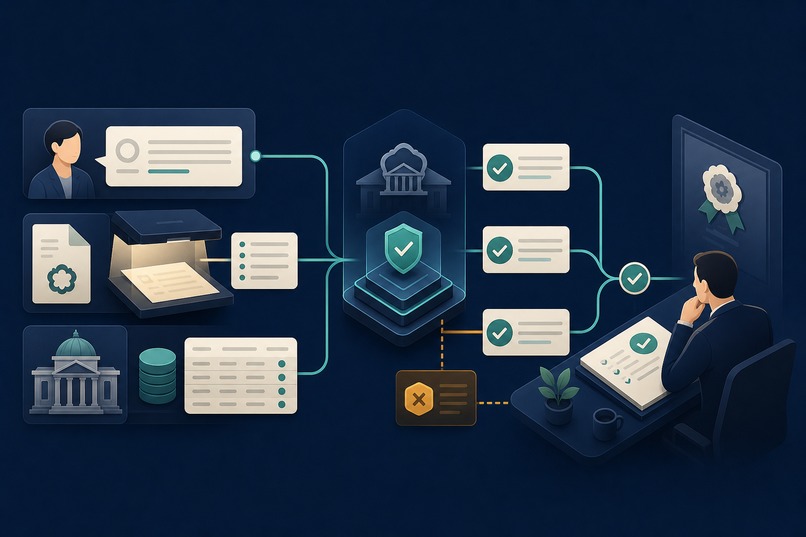
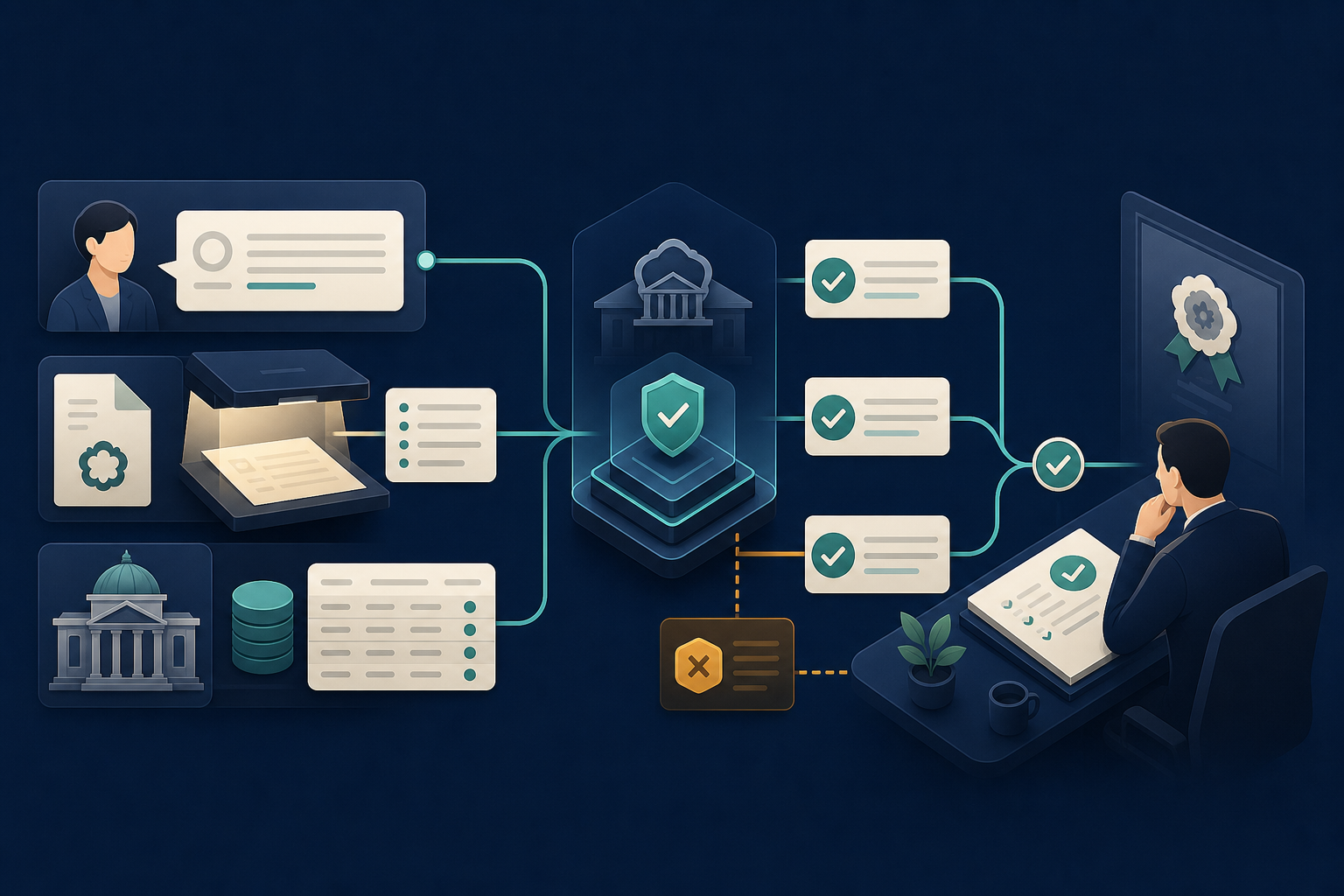
Source-aware evidence reconciliation: AI reads, official data verifies, a human confirms.
Inspiration
Small finance and operations teams often verify a new Korean vendor by copying details between a chat, a business registration certificate, a government lookup, and an invoice system. The painful part is not finding one field; it is knowing which source proved which fact and noticing when two almost-identical values disagree. Generic AI can make this faster, but it can also collapse an extracted value and an official fact into one confident sentence.
We built TalkCheck around a stricter idea: AI should read and converse, official data should verify, and a person should decide before a financial action.
What it does
- Accepts a Korean business number, user-provided identity details, or registration-certificate fields read by the GPT‑5.6 host.
- Checks number format/checksum and current NTS business status and tax type.
- Validates a certificate bundle when business number, opening date, and representative are available.
- Reconciles every field as claimed, extracted, officially verified, consistent, conflicting, missing, or unavailable.
- Returns the exact unresolved values and a single clarification question instead of a risk score.
- Prepares a 30-minute opaque tax-invoice confirmation handoff only after the workflow is resolved.
- Shows a privacy receipt and always states that the invoice has not been issued.
How we built it
The product has two intentionally separate layers:
- GPT‑5.6 in Codex/ChatGPT understands the user's Korean request, reads visible certificate fields, maps them into MCP arguments, and manages the clarification turn.
- TalkCheck MCP performs deterministic reconciliation, calls NTS status/certificate providers, preserves provenance, and prepares a non-issuing handoff.
The backend uses Python, FastMCP, Starlette, httpx, Pillow, and optional Tesseract OCR. The mobile confirmation experience uses React and Vite. The Codex plugin includes a manifest, remote MCP configuration, and a workflow skill with explicit evidence and issuance boundaries.
No OpenAI API key is required: GPT‑5.6 runs in the user's subscription host. Official NTS access is handled by the configured government-data provider or deployed registry service.
How we used Codex
Codex audited the existing repository and helped identify the strongest Build Week extension: turning raw verification utilities into an evidence-aware agent rather than adding a decorative AI call. In the primary build task, Codex:
- traced the NTS provider contract and caught that status lookup cannot verify a name or representative independently;
- designed and implemented the deterministic evidence state model and fourth MCP tool;
- created the plugin and orchestration skill;
- added unit tests and updated PlayMCP compatibility checks;
- extended the mobile experience with matched/conflict scenarios and a blocked-handoff state;
- ran the UI in a real browser, inspected both flows, fixed the only console error, and validated the plugin/skill manifests;
- prepared the existing-project disclosure, demo script, and submission checklist.
The dated Build Week branch and /feedback Session ID provide the development evidence.
Challenges
The hardest product decision was deciding what “verified” means. NTS status lookup returns status and tax type, not a public name/representative lookup. We avoided the tempting but incorrect UX of painting every extracted field green. Identity fields become officially verified only when the submitted certificate bundle passes validation; otherwise they remain clearly labelled extraction or user confirmation.
The second challenge was keeping the product useful while preserving a human boundary. The agent can do the repetitive work and prepare a draft, but unresolved evidence blocks the handoff and the handoff itself never issues an invoice.
Accomplishments
- A working four-tool MCP server and installable Codex plugin.
- Deterministic, tested provenance and conflict handling rather than model-generated confidence.
- A coherent mobile flow that demonstrates both success and a safe stop condition.
- No additional OpenAI API billing or key management for users with Codex/ChatGPT access.
- Explicit privacy and issuance boundaries visible in both tool output and product UI.
What we learned
Agent reliability improves when the model is not asked to be the database. GPT‑5.6 is most useful here as the flexible interface between messy human input and a narrow deterministic tool. Keeping source attribution in the data model—not only in the prompt—made the UI, tests, and guardrails much clearer.
What's next
- Measure extraction accuracy on a consented, redacted certificate test set.
- Add PDF input through the host attachment pipeline.
- Connect a licensed Korean e-tax-invoice ASP sandbox after the confirmation handoff.
- Add durable encrypted workflow storage and organization-level audit policies.
- Localize the plugin's judge/demo experience fully into English.
Built With
- codex
- docker
- fastapi
- github
- javascript
- mcp
- python
- react
- vite


Log in or sign up for Devpost to join the conversation.