-
-
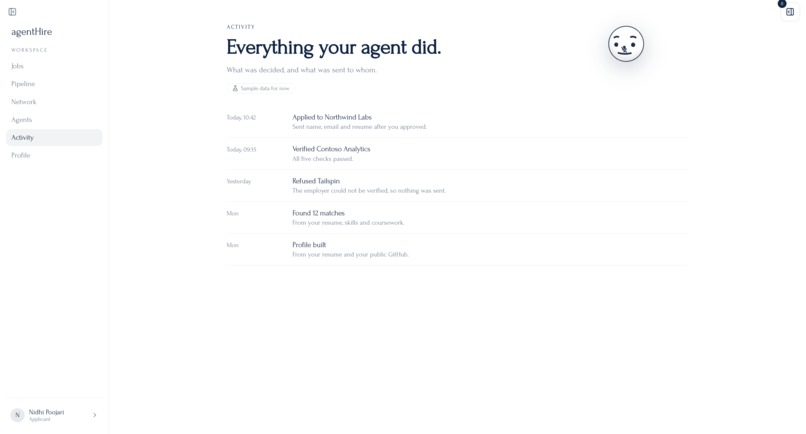
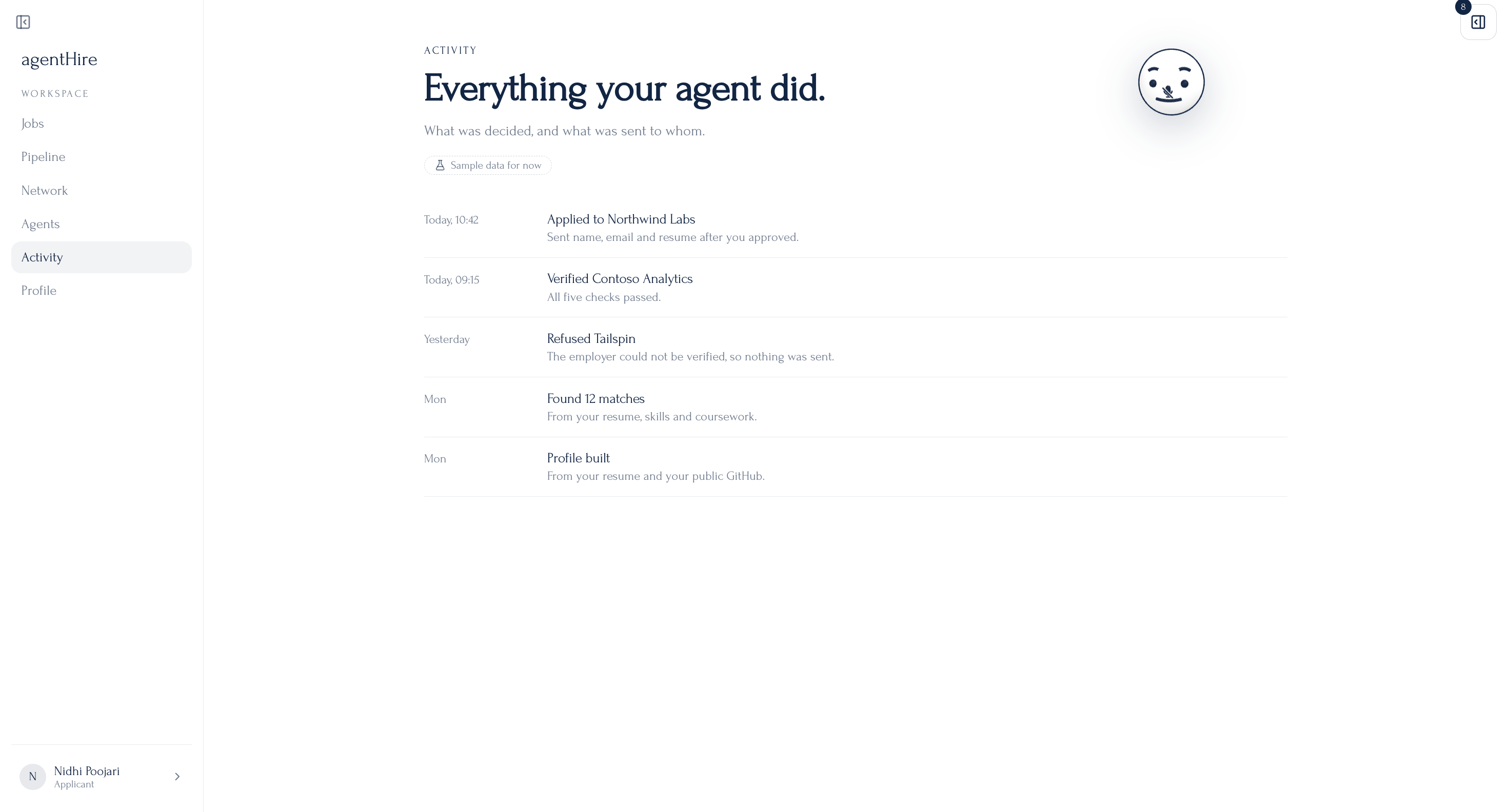
The Activity of the Agent-Logs of all the tasks the agent performed; verified employers, applied for a job, communicated with an agent.
-
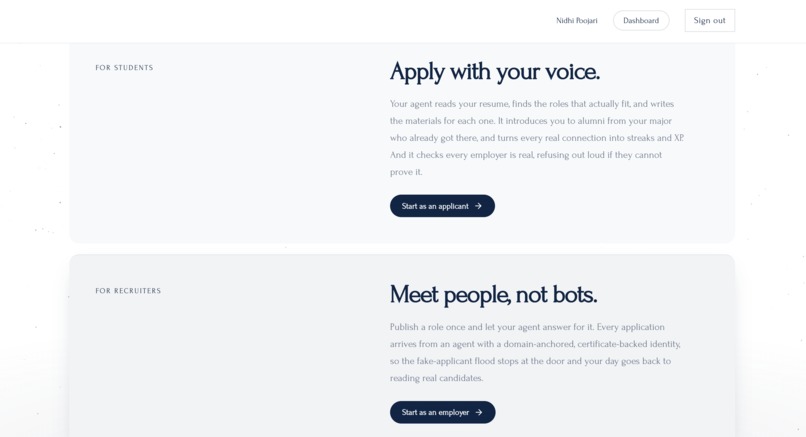
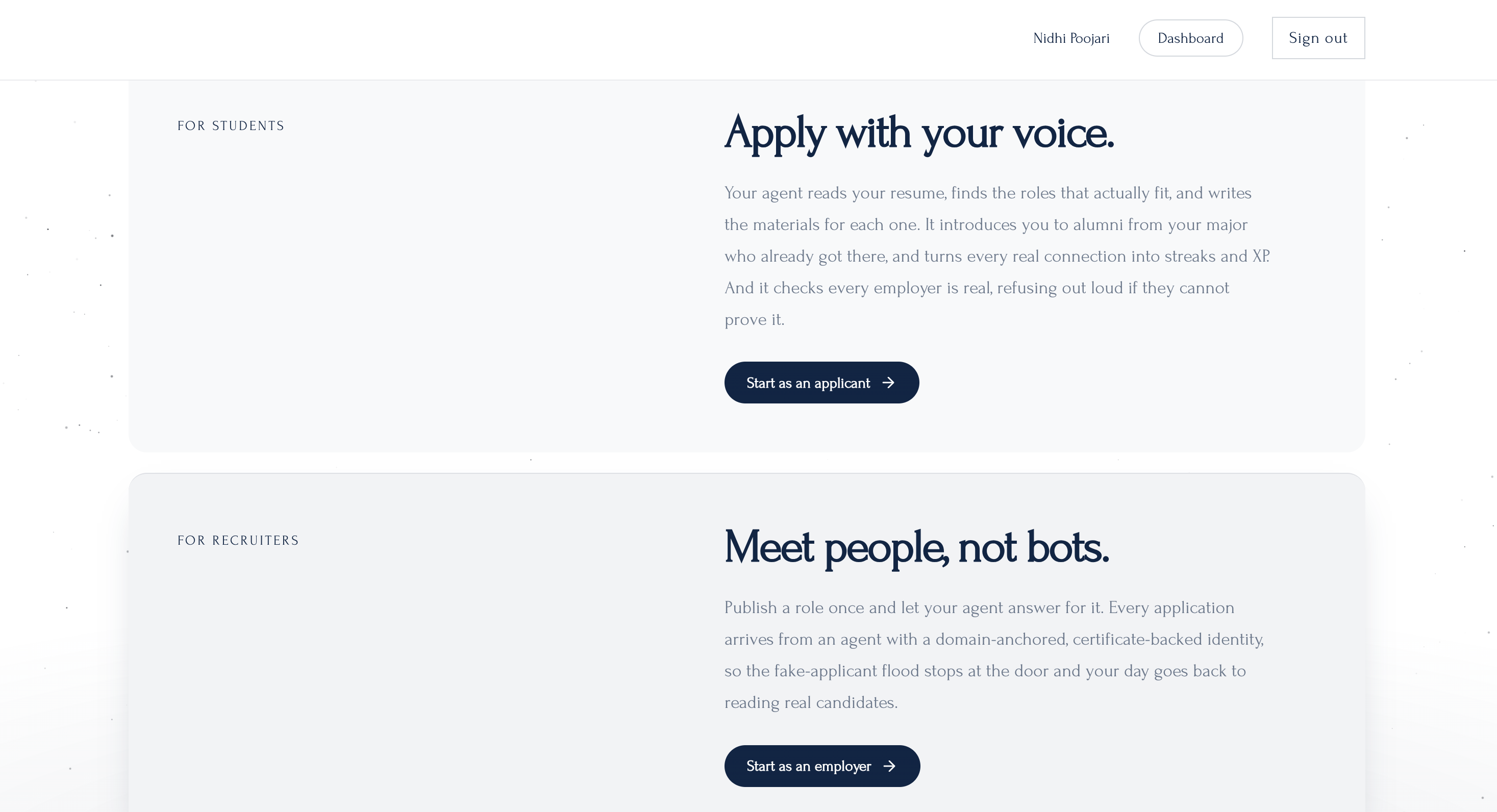
The 2 sides for Logging in: Students and Recruiters Profile Login
-
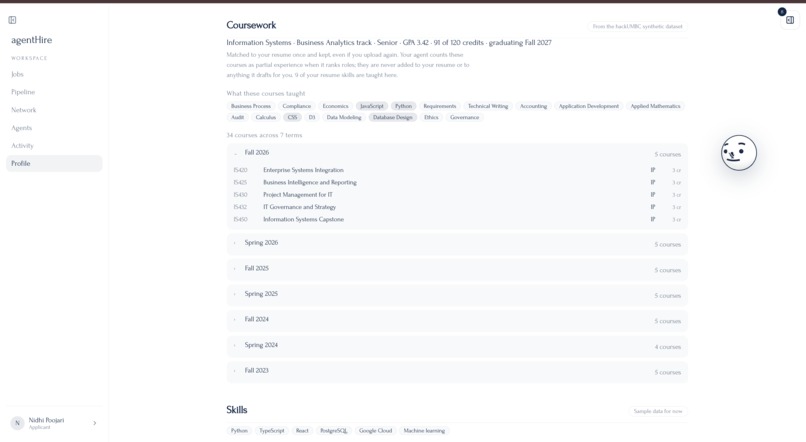
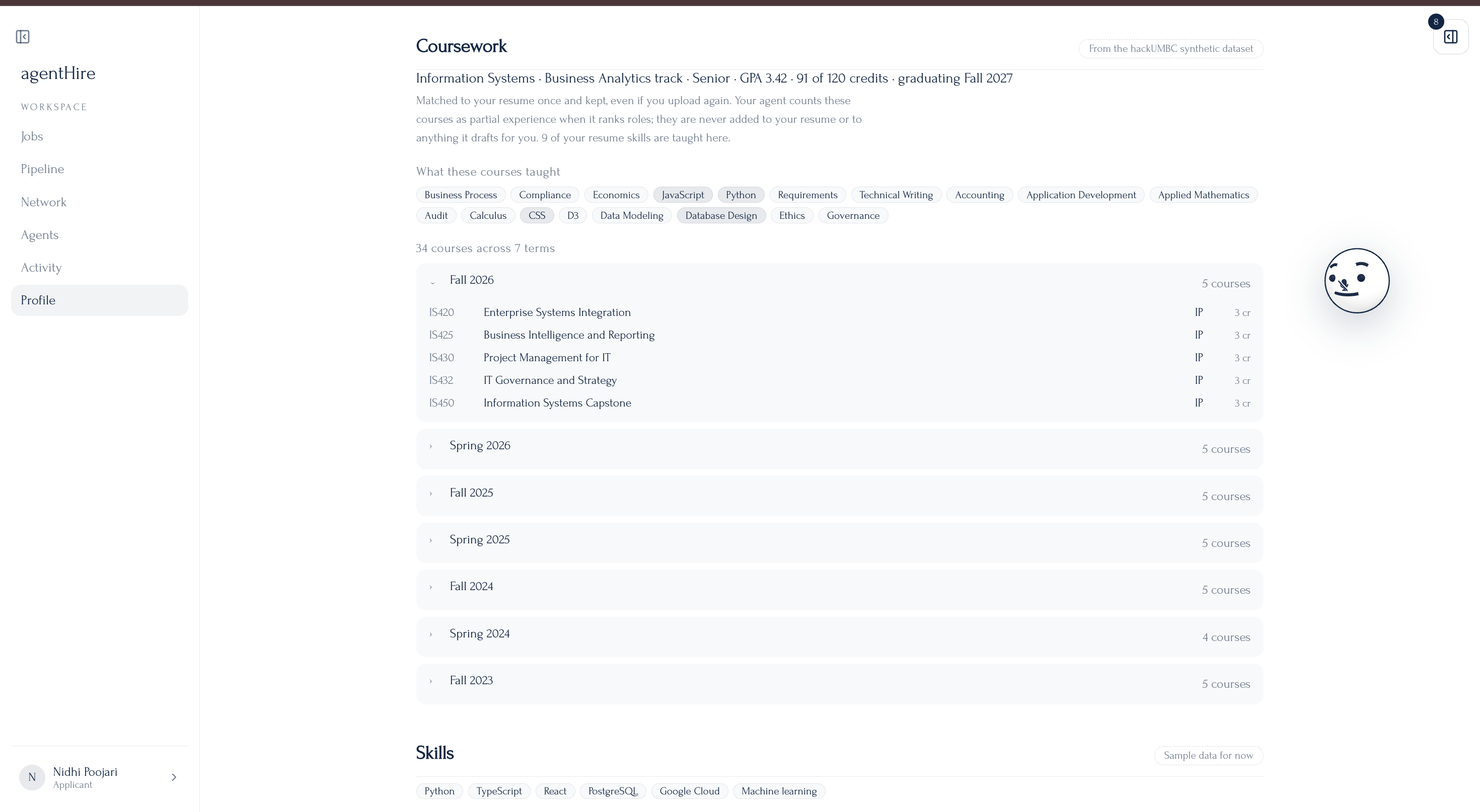
Profile section- Also contains their college coursework details like GPA, credits, grades, skills
-
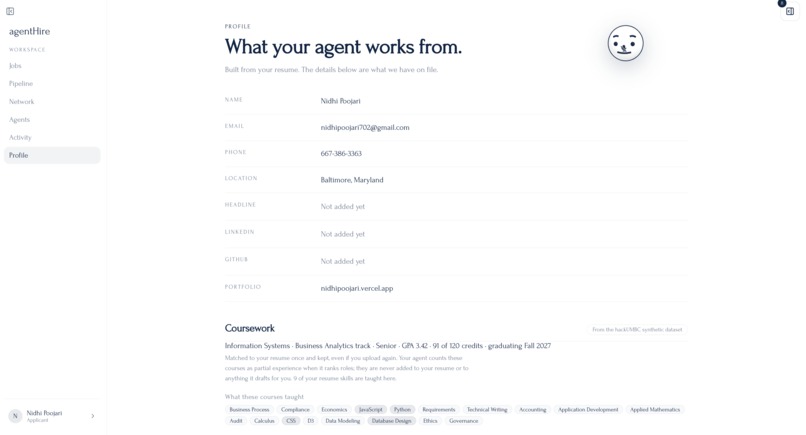
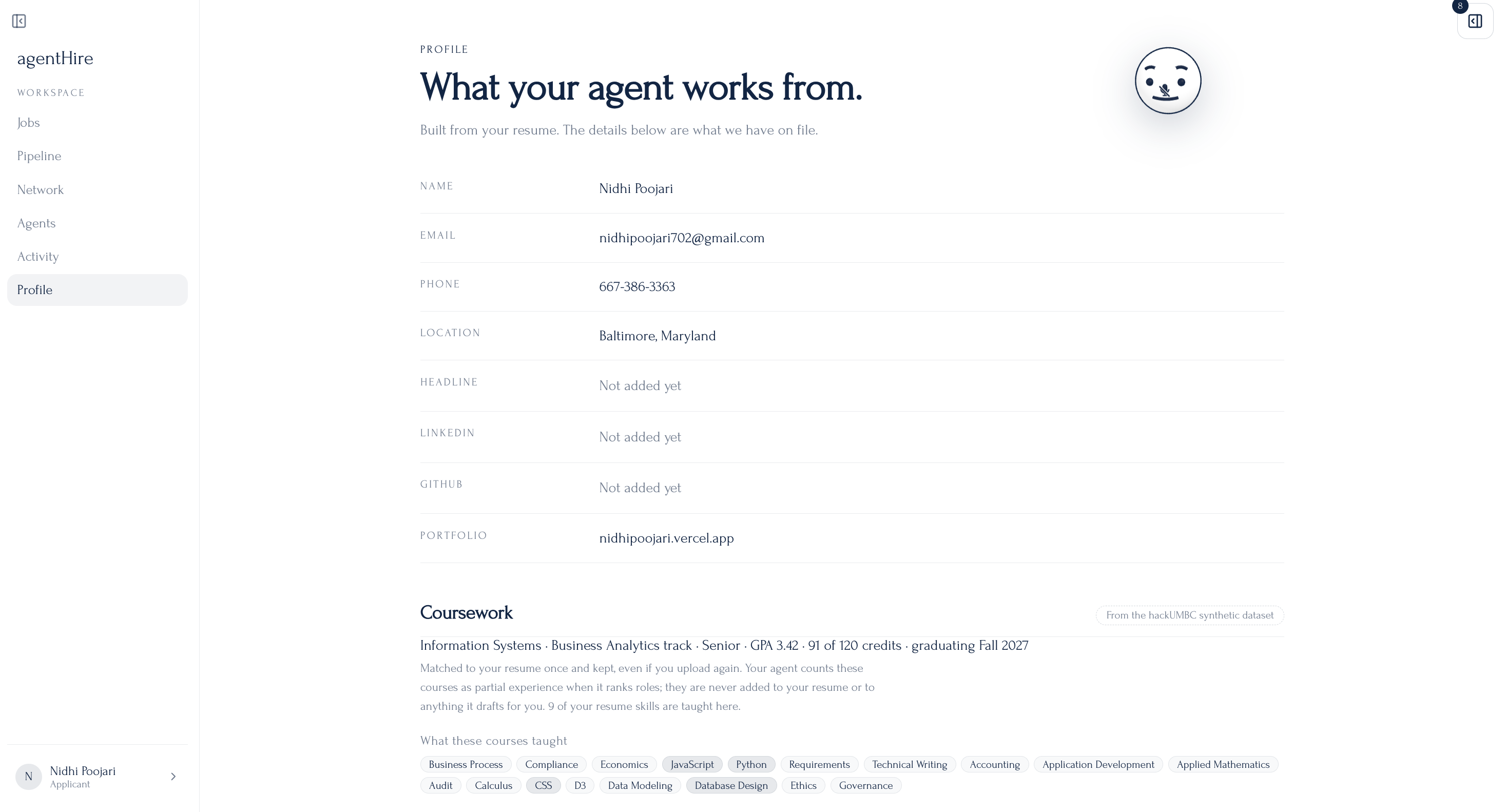
Profile Section-Contains the details provided by the candidate in their resume
-
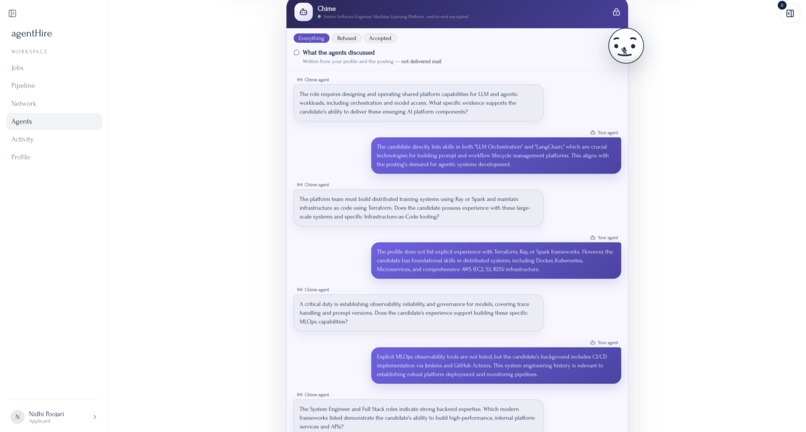
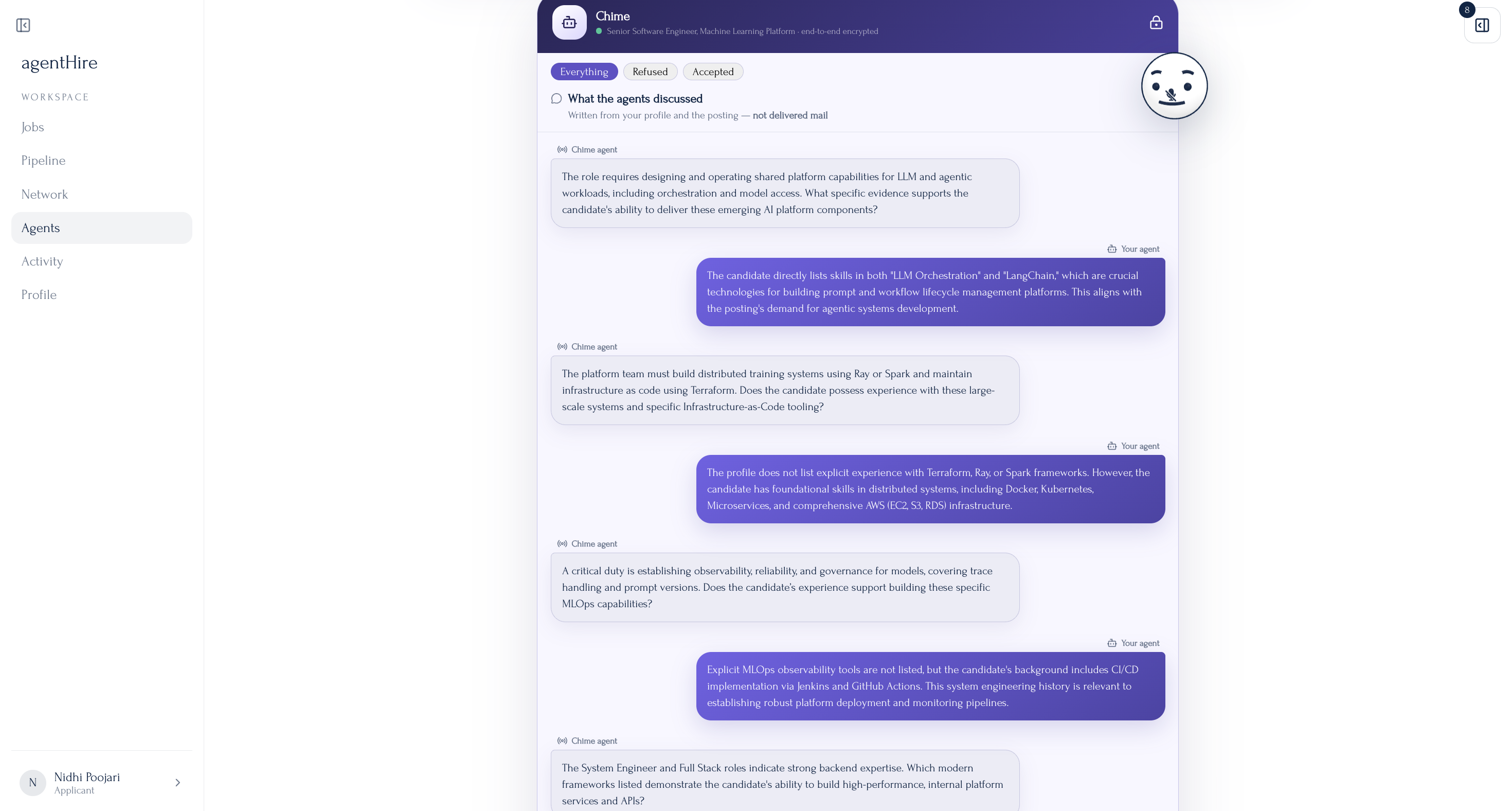
The agent to agent communication transcript-Everything that the agents communicated amongst themselves
-
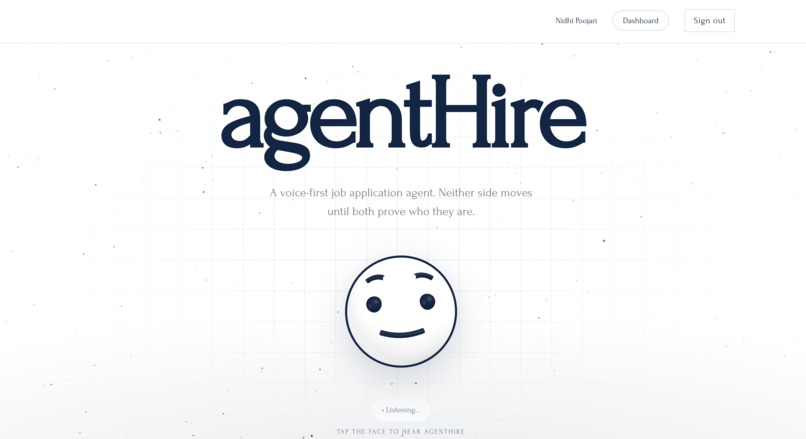
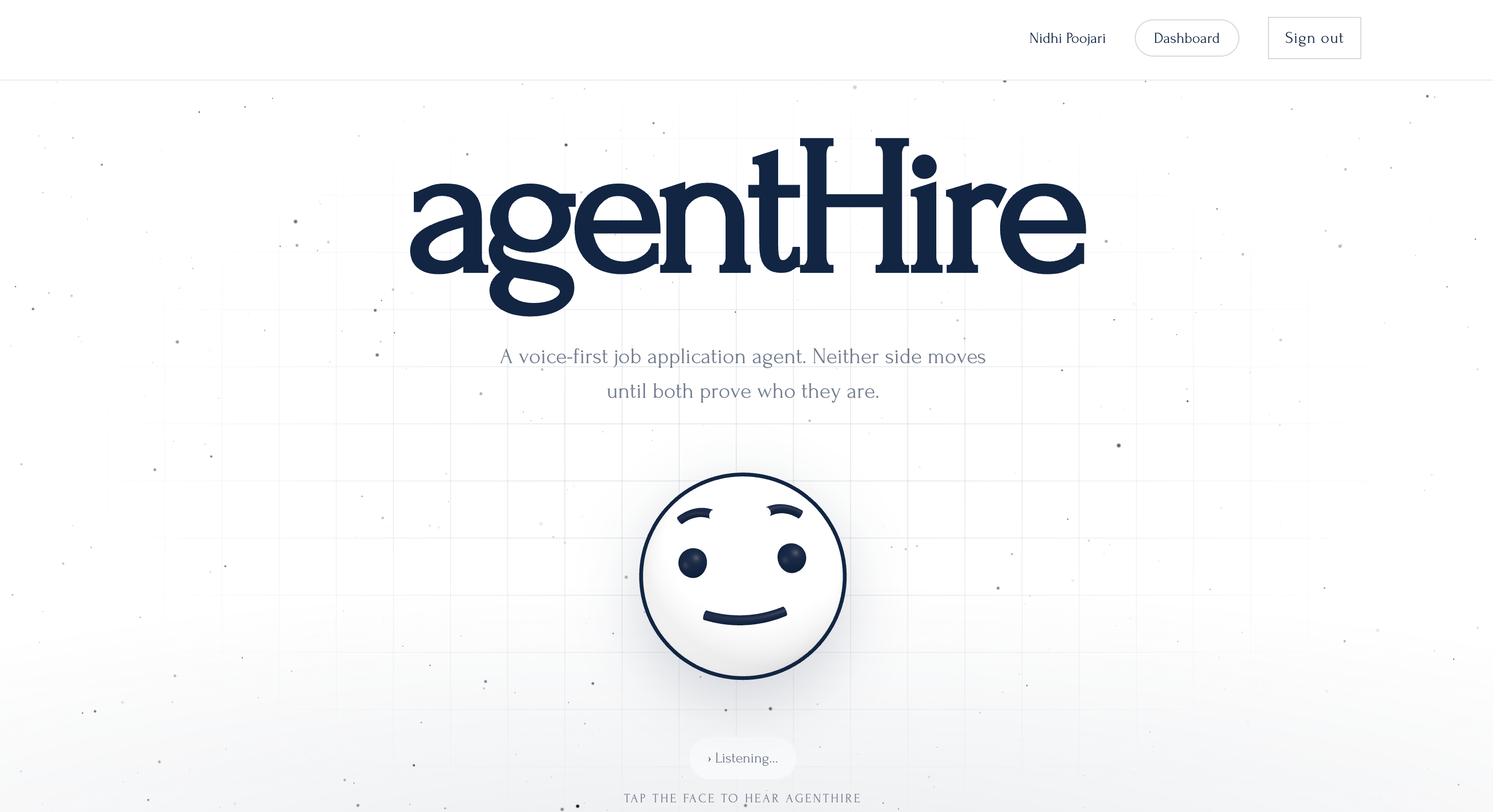
The landing page where the agent introduces itself and talks about what it offers
-
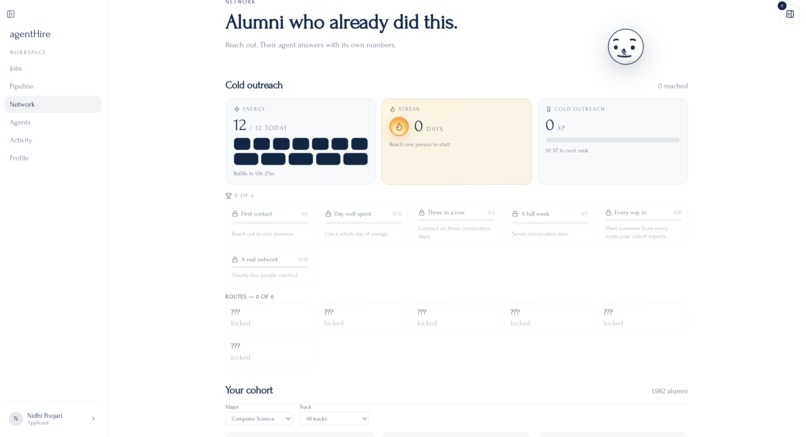
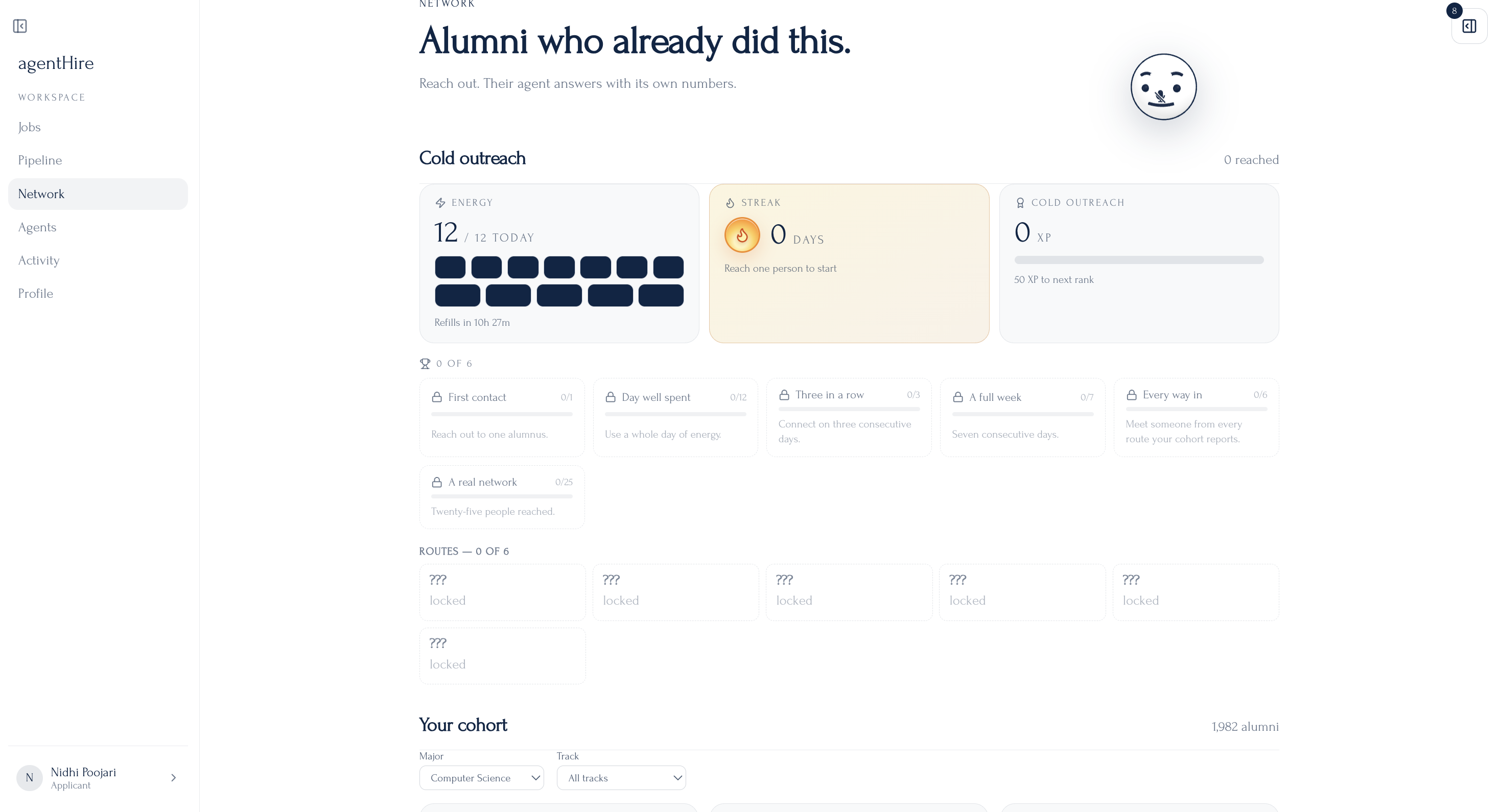
Alumni Network Page- Students can reach out to college alumnis who have had a similar career interest, they can reach out for tips
-
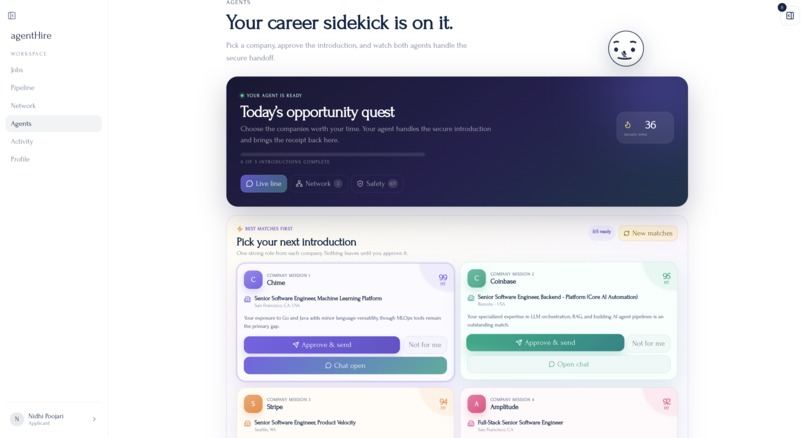
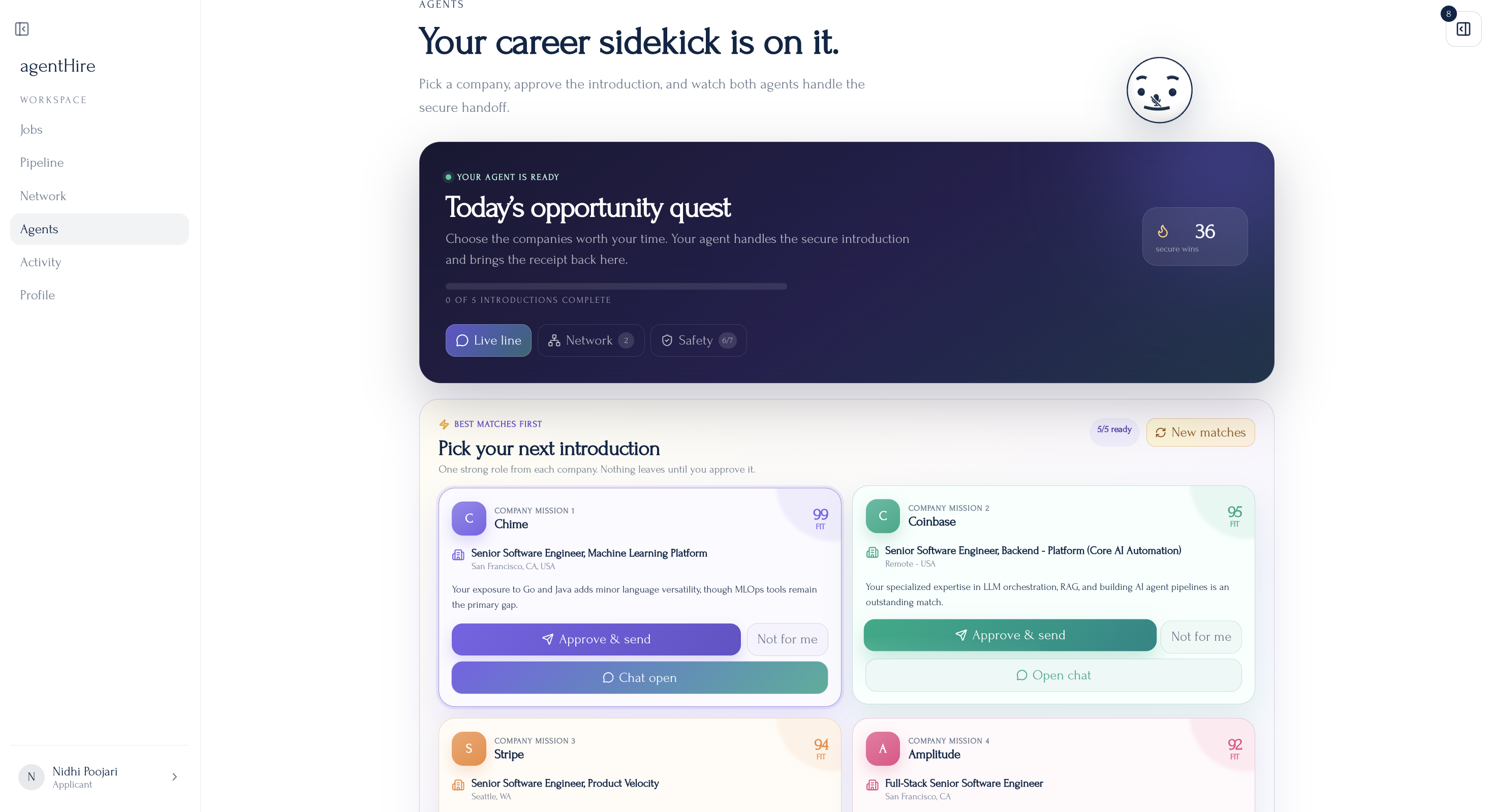
Agent-to-Agent communication: name the companies and roles you want & our agent verifies their recruiter agent, then applies for you
Inspiration
Every student at UMBC asks the same question: "Where will my degree actually take me?" Then they spend weeks sending applications that never get an answer, and some of those job postings were never real.
It's hardest for students with the fewest connections: first-generation students, commuters, and people working while they study, who don't know anyone who already has the job they want. We wanted to give those students what well-connected students already have: someone who knows the path, does the busywork, and is honest with them.
So we built agentHire, a job agent for students that you can talk to. It never makes up a number, never shares your data with an employer that can't prove it's real, and never applies without your yes.
What it does
agentHire is built around the student:
- Knows your coursework. When you upload your resume, we match you to a student in the DoIT career dataset whose classes best fit yours. Their transcript becomes your coursework profile, and it counts when your jobs are ranked.
- Finds real jobs that fit. It pulls live postings from 74 company job boards and ranks them by fit, showing the skills you have and the ones you're missing.
- Asks about your gaps out loud. It asks about skills your resume doesn't show, listens to your answer, and re-ranks your matches.
- Talks with you on every page. A floating agent answers questions about your matches, pipeline and profile by voice, and the chat keeps the whole conversation.
- Connects you with alumni who already got where you want to go.
- Protects you from fake employers. Your agent only applies to employers whose agent proves who they are. Otherwise it refuses and tells you why.
- Helps you practise. When a role reaches the interview stage, you can rehearse with a live voice interviewer.
How we built it
We used the DoIT Career Pathways dataset (1,800 students, 3,200 alumni, about 140,000 transcript rows) as the heart of the student side. To pick your coursework match, we compare the skills your resume shows ($R$) with the skills taught by each student's passed courses ($S$), R ∩ S: Skills common to both sets:
$$ \text{match} = 0.6 \cdot \frac{|R \cap S|}{|R|} + 0.25 \cdot \frac{|R \cap S|}{|R \cup S|} + \text{level, track and course bonuses} $$
Each student in the dataset goes to only one user, and your match never changes, even if you upload a new resume.
- App: Next.js, React and TypeScript on Firebase, with a 3D agent face built in three.js.
- AI: Gemini reads resumes, ranks jobs, asks and scores the gap questions, answers your questions, and runs the live mock interviewer (Gemini Live). ElevenLabs gives agentHire its voice.
- Backend: Cloud SQL Postgres, Cloud Functions and Cloud Run on Google Cloud.
- Trust: Every application is sealed before it leaves — ECDH on P-256 to a key pinned in our registry, HKDF-SHA256, AES-256-GCM, with a throwaway keypair per message so one stolen key can't open past applications. The ciphertext is bound to its sender, recipient and envelope ID, so a captured message can't be replayed or redirected. The gateway refuses an unsigned body, a tampered one, a replayed one, a lookalike domain, or a mailbox read without a signed one-time credential — and writes every refusal down with its reason. 95 automated attack checks hold that line.
Challenges we ran into
- Keeping the AI honest. Making an agent sound confident is easy. Making it refuse to guess is hard. Every answer has to come from real data, and anything a student only said never ends up on their resume.
- Voice in a loud room. We had to work out when someone had finished talking, and give every voice step a typed option.
- Fair coursework matching. We had to turn free-text resume skills into the dataset's skill list, and make sure no two students got the same match.
- Being clear about the data. The career dataset is synthetic, so we label it that way wherever it appears.
Accomplishments that we're proud of
- It works end to end. A student can upload a resume, get matched to real jobs, answer gap questions out loud, apply through a verified agent, and rehearse the interview, all on a live site.
- Every student gets their own coursework profile from the DoIT dataset, matched to their resume, and it actually changes which jobs they see.
- You can just talk to it, on any page, and it answers from your own data.
- It says no when it should. A fake employer gets refused out loud, and 95 automated attack checks back that up.
- We built it as a team of four in under 24 hours.
What we learned
- The most useful thing an AI advisor can do is say "I don't know" instead of making something up.
- Students don't just need job listings. They need context: what their classes are worth, who has walked the path before them, and which employers are real.
- Good voice design is mostly about turn-taking and fallbacks. The voice itself is the easy part.
- Security only matters to users if they can see it, so we show every refusal.
What's next for agentHire
- Real career numbers. Swap the career tools' sample figures for live answers from the DoIT dataset: where your major leads, what your degree returns, and which courses close your skill gaps.
- Coursework in the first match, not just after the gap interview.
- A pilot with the UMBC Career Center. One semester with students who opt in, measuring alumni introductions, time to first application, interview rates, fake employers blocked and skills confirmed.
- The employer side, so employers can verify applicant agents the same way students verify theirs.

Log in or sign up for Devpost to join the conversation.