-
-
TalentCircuit-human-Centered recruiting Reimagined Power by Alibaba Cloud
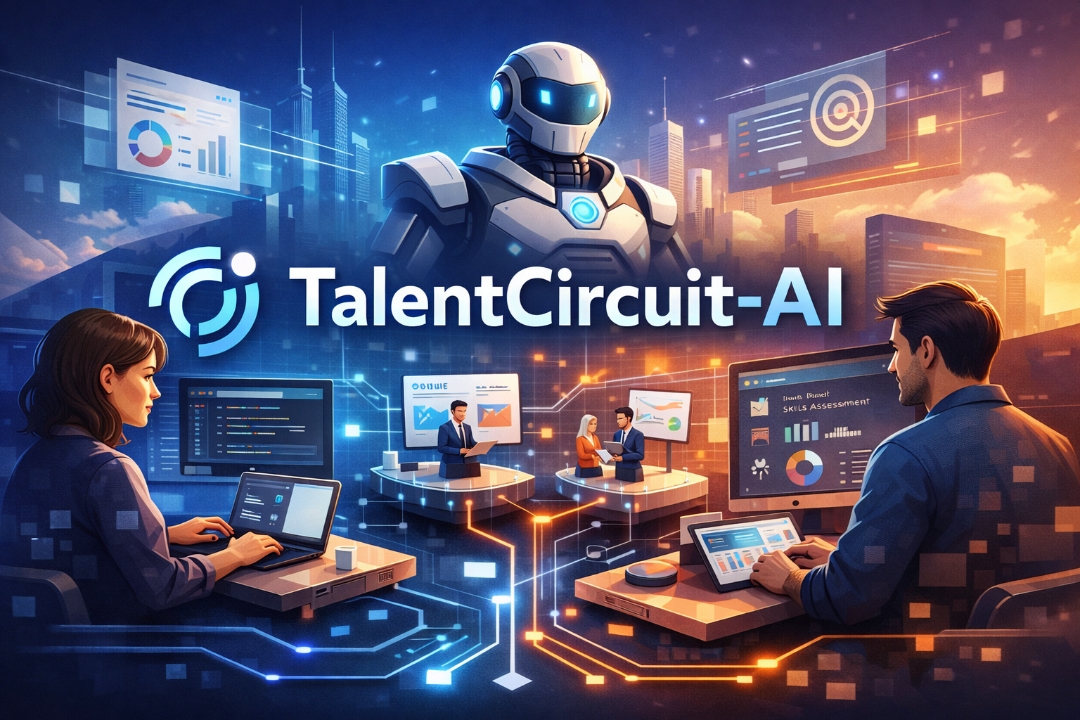
Inspiration TalentCircuit AI was inspired by a simple but urgent truth: recruiting is broken for both candidates and hiring teams. Endless applications, shallow screening, biased processes, and fragmented tools create friction at every step. I wanted to design a human-centered, AI-powered system that treats talent acquisition like a dynamic electrical circuit—where energy (skills and passion) flows seamlessly to where it is needed most, without the friction of traditional recruitment middlemen.
What it does TalentCircuit AI is an agentic recruiting intelligence system that transforms hiring into an interactive, skill-based circuit. * Intelligent Circuit Matching: Instead of basic keyword search, the AI acts as a router, analyzing project requirements and recommending optimized "talent circuits"—curated, highly compatible micro-teams designed for rapid execution.
At its core, it:
- Generates dynamic skill circuits tailored to each role
- Evaluates candidates with AI agents using scenario-based challenges
- Builds candidate capability profiles instead of keyword résumés
- Automates recruiter workflows from screening to shortlisting
- Provides transparent feedback to candidates and hiring teams
The result: faster, fairer, more human recruiting.
How we built it We built TalentCircuit AI as a modular agent stack designed for hackathon-grade performance and real-world deployment.
Key components:
- Next.js agent dashboard for recruiter and candidate interfaces
- Agent orchestration layer coordinating evaluation, scoring, and feedback
- Judge-ready challenge engine generating role-specific tasks
- Capability graph builder mapping strengths, gaps, and potential
- AI & Semantics: Powered by Qwen Max model for intelligent profile parsing and semantic synthesis. We utilized vector embeddings to map skill alignments mathematically.
Challenges we ran into Building an agentic recruiting system meant navigating several real constraints:
- Bias mitigation — ensuring fairness across agent evaluations
- Scenario generation consistency — keeping challenges realistic and role-aligned
- ATS interoperability — connecting legacy systems with modern agent workflows
- Real-time scoring — balancing speed with depth of evaluation
- User experience clarity — making agentic recruiting intuitive for candidates
Balancing Automation with Human Agency: We didn't want this to feel like a cold, automated HR screening tool
Accomplishments that we're proud of End-to-End Functional Prototype: Successfully built a working pipeline that ingests raw developer data, processes it via AI, and generates an interactive, visual "talent circuit" matching score. - Capability-first candidate profiles that outperform traditional résumés
- Human-centered UX that reduces candidate anxiety
- Modular architecture enabling rapid hackathon iteration
We’re especially proud that TalentCircuit AI makes recruiting feel fair, transparent, and empowering.
What we learned The Power of Agentic Workflows: We realized that AI shouldn't just match profiles; it can act as an autonomous coordinator, suggesting optimal project timelines based on the team's collective skill velocity.
- Agentic systems need guardrails to ensure fairness and reliability
- Recruiting benefits from scenario-based evaluation far more than keyword matching
- Human + AI collaboration is the future of talent evaluation.
What's next for TalentCircuit-AI Predictive Team-Building Algorithms: Training the AI to predict team synergy and project success rates based on historical collaboration data.
Built With
- alibaba
- bash
- docker
- python
- typescript


Log in or sign up for Devpost to join the conversation.