Inspiration
The inspiration behind TalentAI came from observing the challenges faced by both job seekers and recruiters during the hiring process. Recruiters often receive a large number of resumes and have to spend significant time manually screening, comparing, and shortlisting candidates. At the same time, students and job seekers often apply for jobs without knowing whether their resumes are actually suitable for the role, why they may be rejected, or which skills they need to improve.
This created an important question: What if AI could make the hiring process smarter for recruiters while also helping candidates understand and improve themselves?
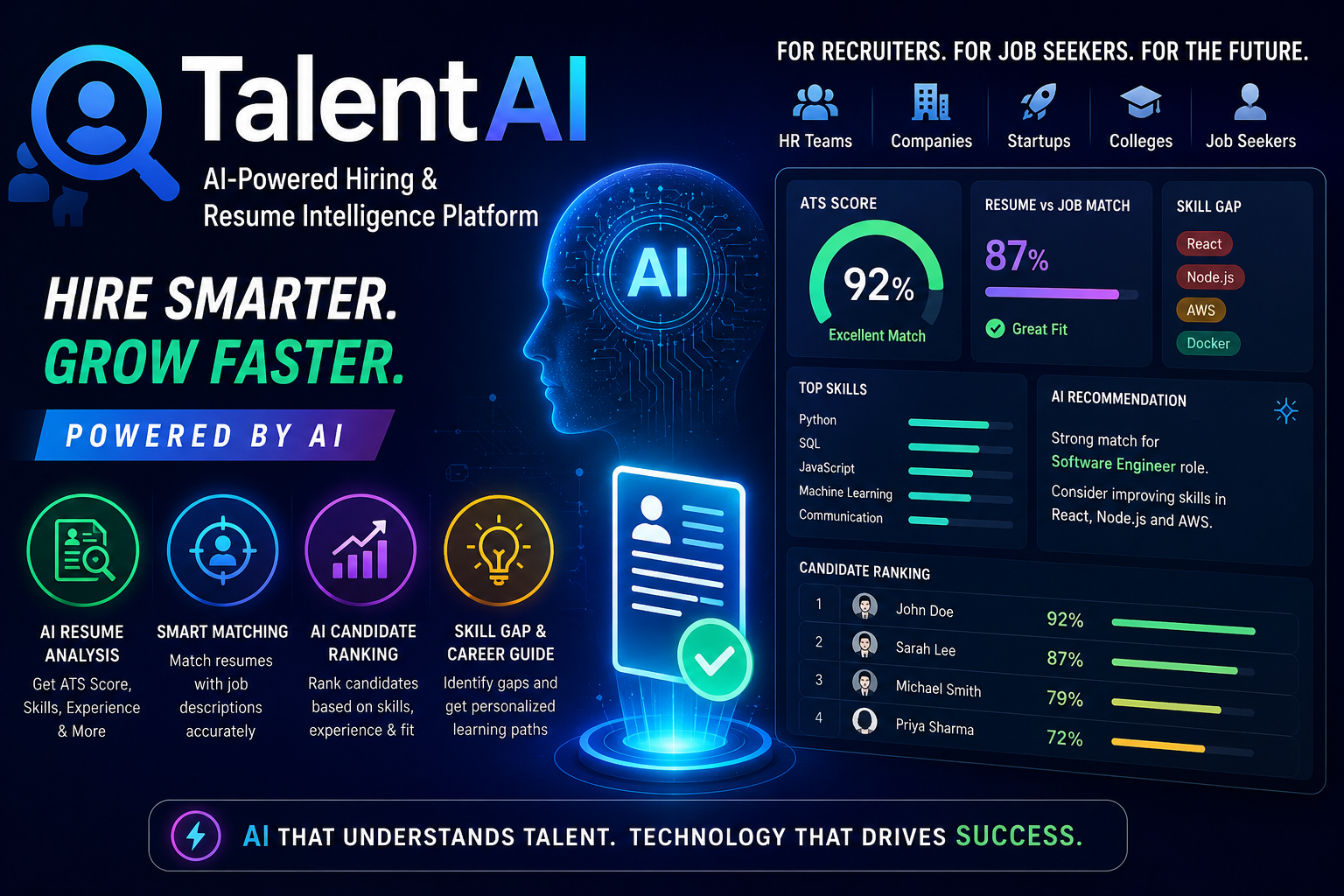
That question became the foundation of TalentAI. We wanted to create more than just a resume checker. Our inspiration was to build a platform that could understand resumes, compare them with job requirements, identify missing skills and keywords, provide actionable improvement suggestions, and help recruiters find relevant candidates more efficiently.
The idea is also inspired by the need for better career guidance for students and young job seekers. Instead of leaving candidates with no feedback after an unsuccessful application, TalentAI aims to turn their resume and job requirements into useful insights that can guide their next steps.
Our vision is to use AI not simply to automate recruitment, but to create a more intelligent connection between people, skills, resumes, and opportunities. This led us to combine resume intelligence, job matching, skill-gap analysis, candidate ranking, career guidance, and interview preparation into one platform.
TalentAI is ultimately inspired by a simple belief: the hiring process should work better for both sides—companies should be able to discover the right talent faster, and candidates should understand how to become the right talent for the opportunities they want.
What it does
📄 Analyzes resumes — extracts skills, education, experience, certifications, and projects. 📊 Calculates ATS & resume scores — helps candidates understand how well their resume performs. 🎯 Matches resumes with jobs — compares a candidate's resume with a specific job description. 🔍 Finds skill gaps — identifies missing skills and keywords required for a target role. ✍️ Improves resumes — suggests ways to make resumes stronger. 🧭 Provides career guidance — recommends learning paths and relevant skills. 🤖 Prepares candidates for interviews — generates questions and provides readiness feedback. 👨💼 Ranks candidates for recruiters — analyzes multiple resumes and helps recruiters filter, compare, and shortlist applicants. 📈 Provides hiring analytics and reports — gives recruiters insights into applications, rankings, hiring funnels, and shortlisting.
How we built it
How We Built It
We built TalentAI as a full-stack AI-powered hiring and resume intelligence platform by combining a modern web application with AI, natural language processing, resume-processing technologies, and a structured database.
The frontend was designed using React 19, TypeScript, Vite, Tailwind CSS, and shadcn/ui to create a responsive and user-friendly interface. React Router was used for navigation, Axios for communication with the backend, Framer Motion for interactive animations, and Recharts for displaying analytics and hiring data.
For the backend, we used Python with FastAPI to build the application's APIs and core server-side functionality. Uvicorn is used as the application server, while Pydantic handles data validation. SQLAlchemy and Alembic are included for database interaction and database migration management.
For data storage, we use PostgreSQL with Supabase. Supabase also provides storage for uploaded files. This allows the platform to manage candidate profiles, resumes, job information, applications, and other platform data in a structured way.
The AI layer is built using the Google Gemini API, along with spaCy, Sentence Transformers, RapidFuzz, and scikit-learn. These technologies support resume understanding, natural language processing, semantic matching, similarity analysis, skill extraction, and intelligent comparison between resumes and job descriptions.
For resume processing, we use PyMuPDF to process PDF resumes and python-docx to process DOCX resumes. The extracted information can then be analyzed by the AI modules to identify skills, education, experience, certifications, projects, keywords, and other relevant information.
We designed the AI functionality using specialized modules and agents. These include a Resume Parser Agent, ATS Scoring Agent, Job Matching Agent, Skill Gap Agent, Candidate Ranking Agent, Resume Improvement Agent, Interview Agent, and Recruiter Assistant Agent. A broader AI architecture also includes career, analytics, search, reporting, notification, and other specialized agents coordinated through an AI Orchestrator.
The platform also includes authentication and security features such as JWT authentication, Google OAuth, role-based access, secure file storage, password hashing, and audit logs. Different roles such as candidates, recruiters, and administrators can access functionality according to their requirements.
For analytics and reporting, we use Recharts for visual dashboards and ReportLab and openpyxl for generating PDF and Excel reports. PostgreSQL Full-Text Search and sentence embeddings support search and semantic-search functionality.
Finally, the application is designed for deployment using Vercel for the frontend, Render for the backend, and Supabase for the database and storage. Git and GitHub are used for version control, while tools such as VS Code, Postman, and Figma support development, API testing, and design.
Overall, we built TalentAI by combining frontend development, backend APIs, AI/NLP technologies, resume processing, database management, authentication, analytics, and deployment into one integrated platform. The result is a system designed to analyze resumes, match candidates with jobs, identify skill gaps, support career development, and assist recruiters in making faster and more informed hiring decisions.
Challenges we ran into
Challenges We Ran Through
While developing the TalentAI concept, we faced several challenges in designing a platform that could support both job seekers and recruiters.
One of the biggest challenges was handling different resume formats and unstructured information. Resumes can contain different layouts, sections, formats, and ways of describing skills and experience. Extracting useful information such as education, skills, certifications, projects, and work experience therefore requires careful resume processing.
Another challenge was creating accurate resume-to-job matching. A simple keyword comparison is not always enough because candidates and job descriptions may describe the same skill using different words. We therefore designed the platform around NLP, semantic matching, sentence embeddings, fuzzy matching, and machine-learning technologies to support more meaningful comparisons.
We also had to consider how to provide useful ATS scoring and skill-gap analysis without making the system overly dependent on a single score. A candidate's suitability cannot always be represented by one number, so the platform is designed to provide additional information such as matching skills, missing keywords, skill gaps, and job suitability.
Another challenge was designing the system for two different types of users. Candidates need resume analysis, career guidance, learning recommendations, and interview preparation, while recruiters need candidate ranking, filtering, comparison, shortlisting, and hiring analytics. Building these different workflows into one platform required a structured architecture.
The AI architecture was another challenge. Instead of relying on one AI function, we designed specialized agents for resume parsing, ATS scoring, job matching, skill-gap analysis, candidate ranking, resume improvement, interviews, and recruiter assistance. Coordinating these functions through an AI-oriented architecture adds complexity but makes the system more modular.
We also considered security and user access because the platform handles resumes and recruitment information. The proposed system therefore includes authentication, role-based access, secure file storage, password hashing, and audit logs.
Finally, we had to design the project so that it could grow beyond the initial version. The architecture needs to support future features such as an AI job portal, campus placement system, learning recommendations, employee referrals, and workforce analytics.
These challenges helped shape TalentAI into a broader platform rather than a simple resume analyzer. Our approach was to break complex recruitment and career tasks into specialized modules and use AI to provide structured, actionable insights for both candidates and recruiters.
Accomplishments that we're proud of
Accomplishments That We’re Proud Of
One of our biggest accomplishments is that we developed the concept of TalentAI into a complete AI-powered hiring and resume intelligence platform rather than limiting it to a basic resume analyzer.
We are proud of bringing both sides of the recruitment process into one platform. TalentAI is designed to support job seekers with resume analysis, ATS scoring, job matching, skill-gap identification, resume improvement, career guidance, and interview preparation, while also supporting recruiters with candidate analysis, ranking, filtering, comparison, shortlisting, and hiring insights.
Another accomplishment we are proud of is the design of our AI-driven architecture. Instead of depending on a single AI feature, we structured the system around specialized agents such as the Resume Parser Agent, ATS Scoring Agent, Job Matching Agent, Skill Gap Agent, Candidate Ranking Agent, Resume Improvement Agent, Interview Agent, and Recruiter Assistant Agent. This gives each major task a specific purpose within the overall system.
We are also proud of designing a complete technical stack for the platform. The project combines React and TypeScript on the frontend, Python and FastAPI on the backend, PostgreSQL and Supabase for data management, and AI/NLP technologies including the Google Gemini API, spaCy, Sentence Transformers, RapidFuzz, and scikit-learn.
Another important accomplishment is the integration of resume-processing capabilities for both PDF and DOCX documents. The platform is designed to extract meaningful information from resumes and use that information for ATS analysis, job matching, skill-gap detection, and candidate evaluation.
We are proud that the project addresses real problems rather than focusing only on technology. It aims to reduce repetitive recruitment work for HR teams while giving candidates actionable information about their resumes, skills, career direction, and interview readiness.
We also designed analytics and reporting capabilities for candidates, recruiters, and administrators. These include candidate progress, job-match history, hiring funnels, candidate rankings, skill distributions, screening information, and different types of recruitment and resume reports.
Finally, we are proud of the scalability of the idea. TalentAI has been designed with future possibilities such as an AI job portal, campus placement system, employee referral platform, learning recommendation platform, internal hiring portal, and workforce analytics dashboard.
Overall, our biggest accomplishment is transforming a simple idea—using AI to improve recruitment—into a complete platform concept that connects resumes, jobs, skills, candidates, recruiters, career development, interviews, and analytics within one intelligent ecosystem.
What we learned
What We Learned
Working on TalentAI helped us understand how a real-world problem can be transformed into a technology-driven solution. We learned that building an AI platform is not only about integrating an AI model, but also about understanding the problem, designing the right workflow, organizing data, and creating a system that is useful for real users.
One of our major learnings was understanding how AI can be applied to recruitment and career development. We learned how resume information can be analyzed and compared with job requirements to generate useful insights such as ATS scores, job-match percentages, missing keywords, and skill gaps.
We also learned about the importance of Natural Language Processing (NLP) when working with resumes and job descriptions. Resumes are not always structured in the same way, and the same skill can be described using different words. This made us understand why technologies such as spaCy, Sentence Transformers, RapidFuzz, and machine-learning techniques can be useful for extracting information and improving matching.
Another important lesson was understanding AI-agent architecture. We learned that a complex application can be divided into specialized AI agents, with each agent responsible for a particular task. In TalentAI, different agents are planned for resume parsing, ATS scoring, job matching, skill-gap analysis, candidate ranking, resume improvement, interviews, and recruiter assistance. This taught us how modular AI systems can be organized around specific responsibilities.
We also learned the importance of full-stack development. Building TalentAI requires more than AI. We had to consider the frontend, backend, database, authentication, file storage, APIs, analytics, reporting, testing, and deployment. This helped us understand how different technologies work together to create a complete application.
Another major learning was user-centered design. Candidates and recruiters have completely different requirements. Candidates need feedback, career guidance, skill recommendations, and interview preparation, while recruiters need candidate ranking, filtering, comparison, shortlisting, and hiring analytics. Designing one platform for both users taught us the importance of understanding different user needs before designing features.
We also learned that AI should assist human decision-making rather than blindly replace it. In recruitment, a score alone cannot determine whether someone should be hired. TalentAI is designed to provide recruiters with structured information and recommendations while keeping the final decision with the human recruiter.
Security was another important area of learning. Since resumes and recruitment information can contain sensitive personal and professional data, we learned the importance of authentication, role-based access, secure file storage, password protection, and audit logs.
Finally, this project taught us how to think about scalability and future development. Instead of building a system that solves only one problem, we designed TalentAI so it can potentially expand into a job portal, campus placement system, learning recommendation platform, employee referral system, and workforce analytics platform.
Overall, TalentAI taught us how to combine AI, NLP, full-stack development, databases, user experience, security, analytics, and problem-solving to design a practical technology solution. More importantly, we learned that successful technology should not simply demonstrate what AI can do—it should solve a genuine problem and create measurable value for its users.
What's next for TalentAI – AI-Powered Hiring & Resume Intelligence Platform
What's Next for TalentAI
The next step for TalentAI is to move from an AI-powered hiring and resume intelligence platform into a broader career and talent ecosystem. Our goal is to continuously improve the platform so that it can support users throughout the complete journey from building skills and improving a resume to finding opportunities, preparing for interviews, and getting hired.
We plan to expand TalentAI into an AI Job Portal where candidates can discover relevant opportunities based on their skills, experience, career interests, and job-match results. Instead of searching through unrelated job listings, users can receive more relevant opportunities based on their profiles.
Another major direction is a Campus Placement System. TalentAI can help colleges and placement cells analyze student resumes, identify skill gaps, track placement readiness, and understand which skills students need to develop for available industry opportunities.
We also plan to develop a Learning Recommendation Platform connected to the skill-gap analysis system. When TalentAI identifies missing skills for a target role, it can guide candidates toward relevant learning resources and create personalized learning roadmaps.
The platform can further expand into an Employee Referral Platform and an Internal Hiring Portal, allowing organizations to manage talent and opportunities within their own ecosystem.
Another future direction is Workforce Analytics. Organizations could use TalentAI to understand recruitment patterns, skill distributions, hiring funnels, and workforce-related insights through analytics dashboards and reports.
We also plan to continue improving the AI-agent architecture. Specialized agents can become more capable at resume understanding, job matching, career guidance, interview preparation, candidate ranking, analytics, reporting, search, and other recruitment tasks.
As the platform grows, security, scalability, reliability, and responsible AI usage will remain important priorities. The objective is to ensure that AI provides useful recommendations and insights while human recruiters continue to make the final hiring decisions.
Ultimately, the future vision of TalentAI is to become more than a resume analyzer or recruitment tool. We want it to become an intelligent ecosystem connecting candidates, skills, learning, jobs, recruiters, interviews, and organizations in one platform.
Our long-term vision is simple: help people become better prepared for the opportunities they want while helping organizations discover and manage talent more efficiently.
TalentAI's journey doesn't end with getting a job—it aims to support continuous career growth and smarter talent management.
Built With
- talentai

Log in or sign up for Devpost to join the conversation.