Inspiration
The hiring process is fundamentally broken. Recruiters spend countless hours manually reviewing formatting-heavy PDFs, trying to match candidate skills to job requirements, and creating relevant technical questions. I wanted to build a system that doesn't just "track" applicants, but actively assists recruiters using next-generation AI.
What it does
TalentAI is a fully automated, AI-driven Applicant Tracking System (ATS).
For Admins: I built a feature where job posts can be generated instantly just by typing a title (powered by Llama 3). When candidates apply, they are automatically scored and ranked in a drag-and-drop Kanban pipeline.
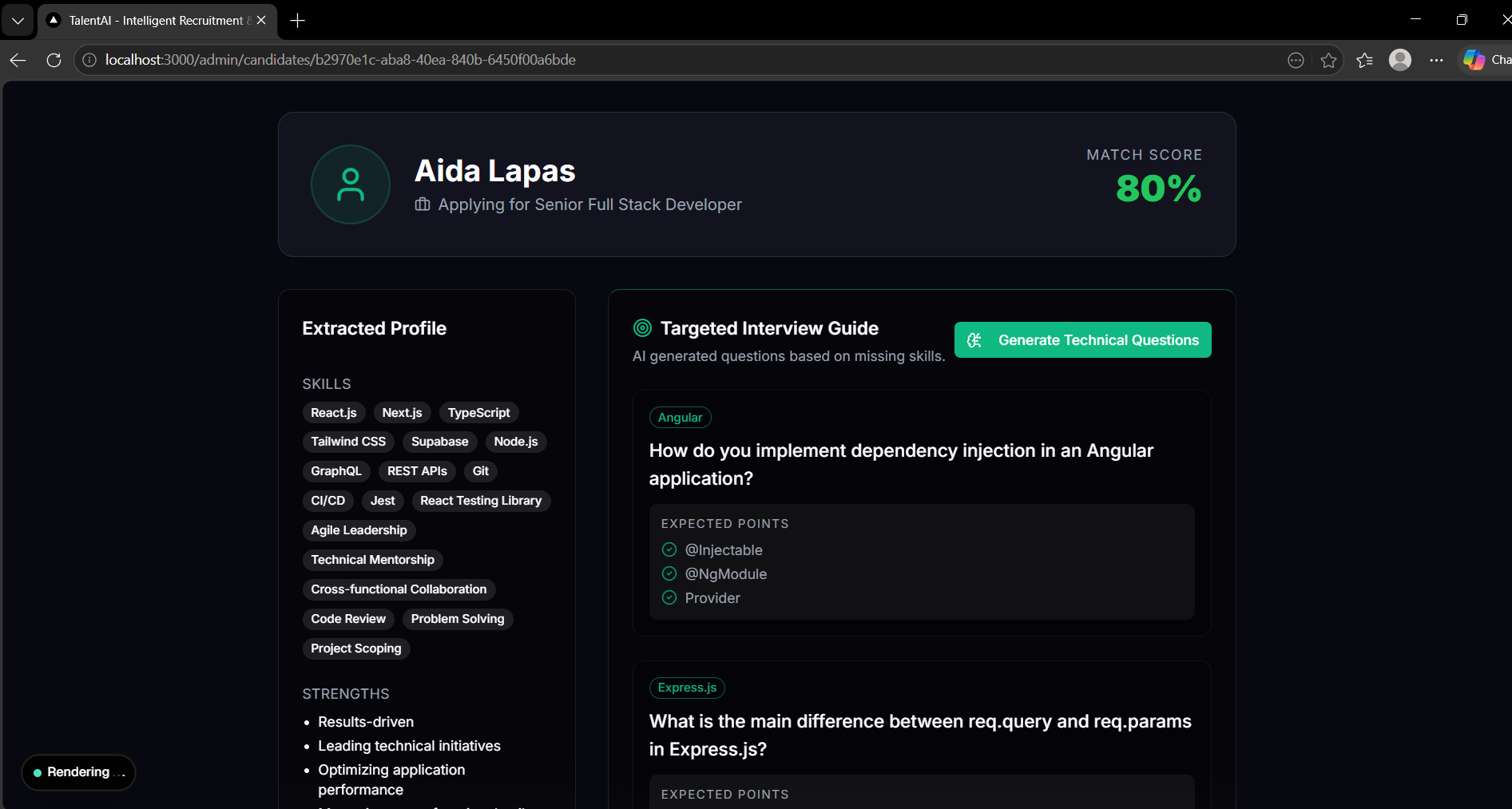
For Candidates: They simply upload their CV as a PDF. The AI parses the document, extracts skills and experience, and compares them against open roles to calculate a Match Score.
The Magic: For any candidate, the system automatically detects missing skills compared to job requirements and generates a Targeted Interview Guide with custom technical questions designed to test weak points.
Unique Feature – AI Upskill Coach: Instead of rejecting candidates outright, I designed a feature that provides a personalized “How to Get This Job Next Time” roadmap. If a candidate is missing key skills, the AI generates:
- A custom learning path
- Suggested projects to build
- Specific concepts to study
This transforms rejection into opportunity and adds a human-centered approach to hiring.
Architecting The TalentAI Platform
TalentAI is designed with scalability, modularity, and performance in mind. I structured the system using a modern full-stack architecture where the frontend, backend, and AI services are cleanly decoupled.
The Next.js App Router handles both UI rendering and server-side logic, ensuring fast performance and seamless routing. Supabase serves as the backend, managing the PostgreSQL database, authentication, and security through Row Level Security (RLS).
The AI layer is powered by Hugging Face Serverless APIs, which process CV data and return structured outputs. I engineered the AI pipeline with strong prompt design and fallback parsing to ensure consistent and reliable JSON responses.
Real-time updates and smooth interactions, such as the Kanban pipeline, are handled with modern state management and optimistic UI updates. The result is a system that feels fast, intelligent, and production-ready.
How I built it
I built the platform using a modern, highly scalable stack:
- Frontend: Next.js 16 (App Router) with React, styled using Tailwind CSS and enhanced with Framer Motion for smooth micro-animations
- Backend & Auth: Supabase for PostgreSQL database management, authentication, and Row Level Security (RLS)
- AI Engine: Hugging Face Serverless API (
@huggingface/inference) using the Meta-Llama-3-8B-Instruct model to parse CVs and generate structured JSON - State Management:
@dnd-kitfor responsive Kanban board interactions
Challenges I ran into
Integrating the AI to consistently output perfectly structured JSON from raw PDF text was challenging. I had to carefully engineer system prompts and build custom RegEx fallback parsers to ensure the database always received clean MatchScore and Skills arrays.
Additionally, configuring Next.js Turbopack to correctly bundle server-side PDF web workers required deep configuration of external packages.
Accomplishments that I'm proud of
I am especially proud of the One-Click Job Generator and the Targeted Interview Guide. Seeing a raw PDF transform into an accurate Match Score and customized interview questions within seconds feels like a real breakthrough.
The interface also delivers a smooth and premium user experience.
What's next for TalentAI
In the future, I plan to implement pgvector for deep semantic search across candidate resumes. I also aim to introduce an AI-powered chatbot where candidates can perform mock technical screenings directly on the platform before engaging with recruiters.
Built With
- framer-motion
- huggingface
- llama-3
- next.js
- postgresql
- react
- supabase
- tailwind-css
- typescript

Log in or sign up for Devpost to join the conversation.