Inspiration
Talaria started from a personal experience with the power of opportunities.
One of us experienced firsthand how discovering opportunities that people around us did not even know existed could completely change someone's direction. Volunteering, niche programs, communities, and other opportunities opened doors to education, new experiences, meaningful connections, and a clearer sense of what was possible.
But finding those opportunities was difficult. They were scattered across different websites, communities, social media pages, and networks. Often, discovering the right opportunity depended less on your potential and more on whether you happened to know where to look.
That made us ask: How many people are missing opportunities simply because they never hear about them?
We created Talaria because we believe people should not need the perfect network or spend hours searching across the internet just to discover opportunities that fit them.
What it does
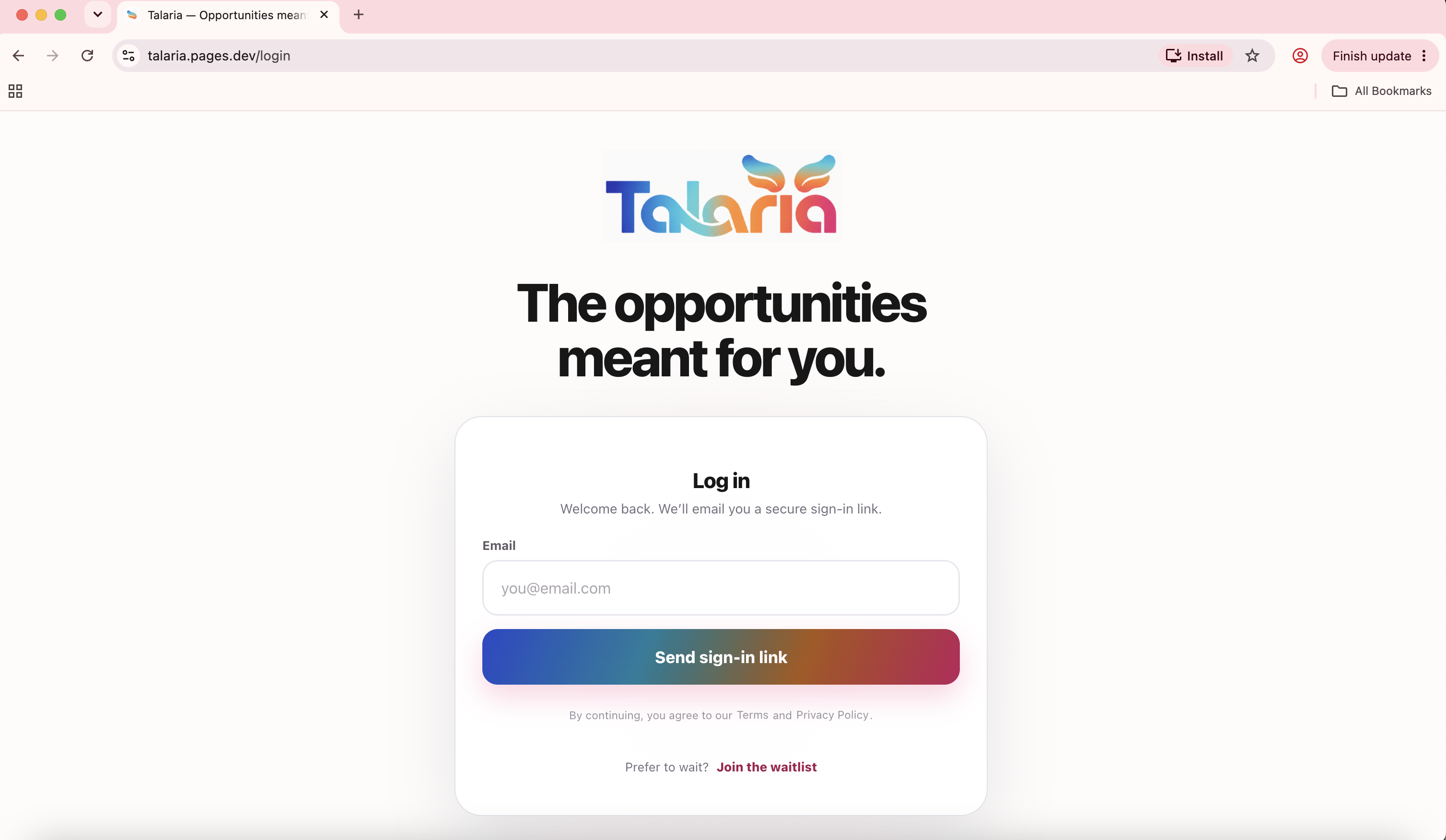
Talaria is a personalized platform that helps people discover and pursue opportunities that match who they are and what they want to achieve.
Users build a profile around their background, interests, goals, current projects, skills, and constraints. Talaria uses this context to surface opportunities that are actually relevant to them. Users can also describe what they are looking for in their own words and use Talaria's AI-powered research to find opportunities that match their needs.
These can include internships, accelerators, grants, scholarships, fellowships, hackathons, educational programs, volunteering, communities, events, and other experiences.
Instead of giving users another long list of links, Talaria helps identify which opportunities are worth investigating and why. Users can explore, filter, and save opportunities in one place, as well as ask questions about eligibility, deadlines, next steps, and applications.
Ultimately, we want to shorten the journey from "I want to do something" to "I found something I can actually apply for."
How we built it
We started by thinking about what we would actually need to know about someone to recommend an opportunity that is useful to them. We built Talaria around a personalized user profile containing their goals, interests, skills, projects, background, and constraints. We then connected this context with AI-powered opportunity research and recommendations, allowing users to search in natural language and discover opportunities based on more than just keywords. We also built tools for filtering, saving, and asking questions about opportunities so the experience does not end once an opportunity is found.
Challenges we ran into
One of our biggest challenges was figuring out what makes an opportunity a genuinely good match. Someone might technically be eligible for something, but that does not necessarily mean it fits their goals. We also had to work with opportunity information that can change, such as deadlines, eligibility requirements, and application links. Another challenge was keeping the experience simple: we wanted AI to do the complicated work in the background without making users feel like they had another complicated platform to learn.
Accomplishments that we're proud of
We are proud that we were able to turn a problem we personally cared about into a working product. Talaria can understand what a user is looking for, use their profile to personalize recommendations, conduct deeper research for specific requests, and give them a place to explore and save what they find. Seeing these different parts come together into an experience that someone can actually use was one of our biggest accomplishments.
What we learned
One of the biggest things we learned is that opportunity discovery is not simply a search problem. People cannot search for something they do not know exists. That changed the way we thought about Talaria: instead of only helping people search faster, we wanted to help them discover possibilities they may never have thought to search for. We also learned how important personalization and trust are when using AI for recommendations — users should understand why something fits them and have enough information to decide whether it is worth pursuing.
What's next for Talaria
Our next step is to put the platform in front of more real users, gather feedback, and understand which features genuinely help people discover and pursue opportunities. As our user base grows, we want to continuously improve Talaria based on how people actually use it.
We plan to improve personalization, expand the range of opportunities available, introduce multilingual support, and develop features that help users track applications, deadlines, and next steps.
In the longer term, we see the potential to turn Talaria into a real startup and sustainable business. Before getting there, we want to validate the idea with a larger group of users, learn from their experiences, and continue building around their needs.
Our goal is for Talaria to grow beyond a hackathon project into a platform that people genuinely rely on to discover opportunities that can move their lives, careers, and ideas forward.
The opportunities are already out there. We want to make sure the right people can find them.
Built With
- cloudflare-pages
- cloudflare-workers
- gemini
- gemini-api
- google-cloud-build
- google-cloud-run
- google-cloud-scheduler
- google-genai
- hono
- openai-responses-api
- playwright
- postgresql
- pwa
- python
- react
- resend
- sql
- supabase
- supabase-auth
- supabase-storage
- tanstack-query
- typescript
- vite
- vitest
- zustand


Log in or sign up for Devpost to join the conversation.