-
-
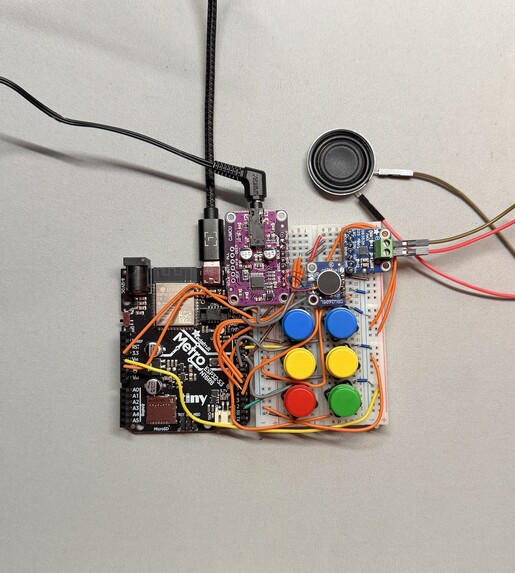
Taktile hardware wallet
-
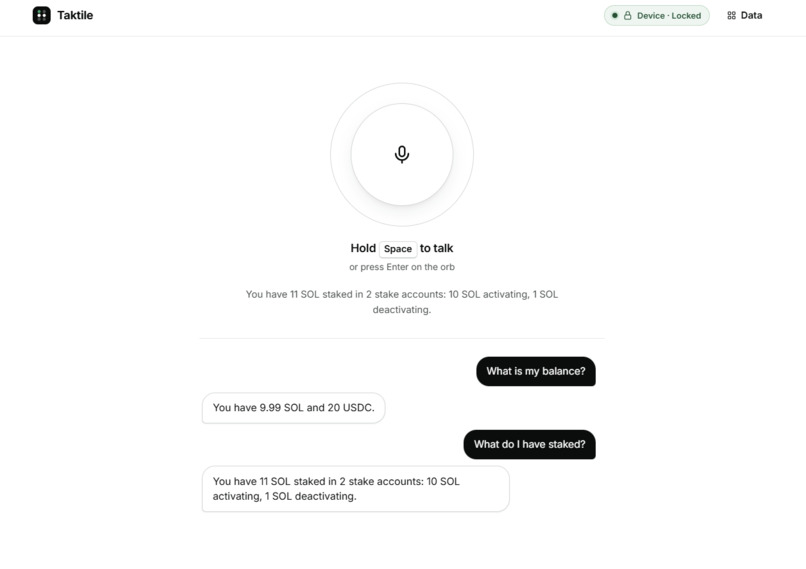
Taktile web app
Taktile: send, request, stake on Solana without batting an eye (literally)
Inspiration
A normal hardware wallet has one job: make sure what you sign is what you meant to sign. It does that with a tiny screen showing the real amount and recipient, the one thing malware on your computer can't fake.
If you're blind or low-vision, that screen method isn't viable. Your options are to trust a screen reader running on the same laptop the malware lives on, or to ask someone else to read your transactions for you. Neither is security, and neither is independence.
We asked: what if the hardware wallet talked instead? And what if it was designed so that even a fully compromised laptop couldn't change a single word it said?
What it does
Taktile is a screenless Solana hardware wallet, built on an ESP32-S3 with a voice-first web app. Every security decision happens on the device, not the laptop.
- You speak, it listens. Hold Space and say "send 5 USDC to Max." The app transcribes it with ElevenLabs Speech to Text and builds the Solana transaction.
- The device checks everything itself.
- It parses the raw transaction bytes on its own chip and works out the real amount, token and destination.
- It looks up the destination in its own contact book, and speaks the result into a private earpiece: "send one USDC to H-E-N-R-Y."
- If the address isn't a contact, it buzzes three times and says "unknown recipient, do not sign."
- You approve by touch.
- A 6-digit PIN is entered with a "rotary" scheme: each digit starts at a random number spoken only in your ear, so someone watching your hands learns nothing.
- Then you press a physical CONFIRM button. Presses during the announcement are ignored, so you can't approve something you haven't heard.
- Two voices, one checksum. The laptop speaks three checksum words computed from the bytes it built. The device speaks three words from the bytes it received. If they match, nothing tampered with the transaction in between.
- Send, request and stake:
- Send SOL and USDC to verified contacts.
- Request payments: each request is served as a standard Solana Action (Blink). The payer's page checks the transaction and hands it to Solflare to approve.
- Stake SOL natively with one pinned validator. The device refuses any stake unless it is both staker and withdrawer with no lockup, so a hacked laptop can't quietly make itself the owner.
- Voice commands for everything else:
- "what is my address" and "who are my contacts": answered by the device.
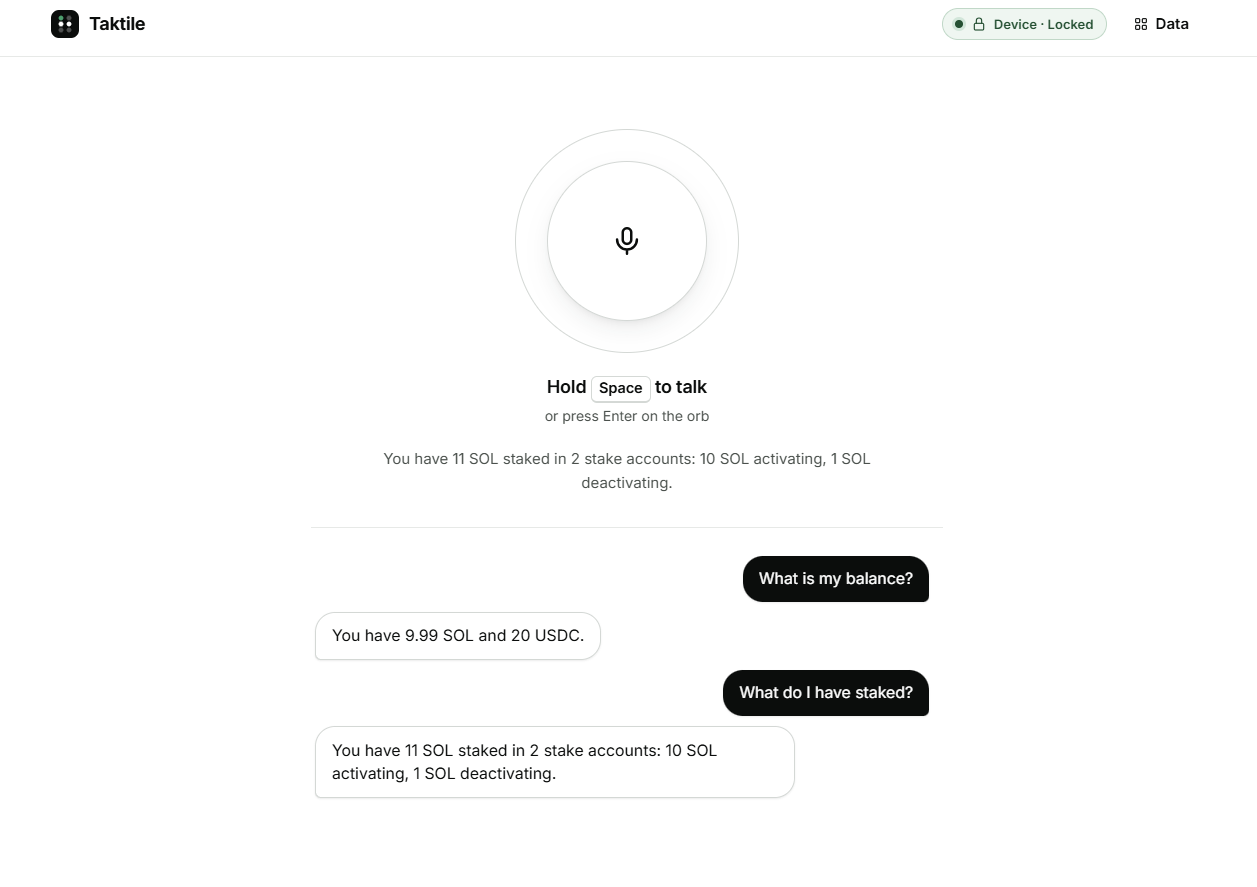
- "what's my balance", "how much do I have staked", "recent activity" and "did Max pay me": answered by the laptop, and clearly marked as information only.
- "lock", "repeat" and "cancel".
- Contacts you can trust. Adding a contact makes the device read out an 8-word address phrase. You call your friend, they read their phrase from their own screen, and if the words match the address is really theirs.
- Ambiguity handled by voice. If you say "send to Jack" and you know two Jacks, an ElevenLabs agent asks "Jack Miller or Jack Chen?". The agent can only ever pick one of those names, never an amount or an address.
In our demo, simulated malware rewrites the recipient after the app has built and announced the honest payment. The laptop happily says "Sending 1 USDC to Henry." The device says "unknown recipient, do not sign." Nothing is sent.
How we built it
The device (trusted)
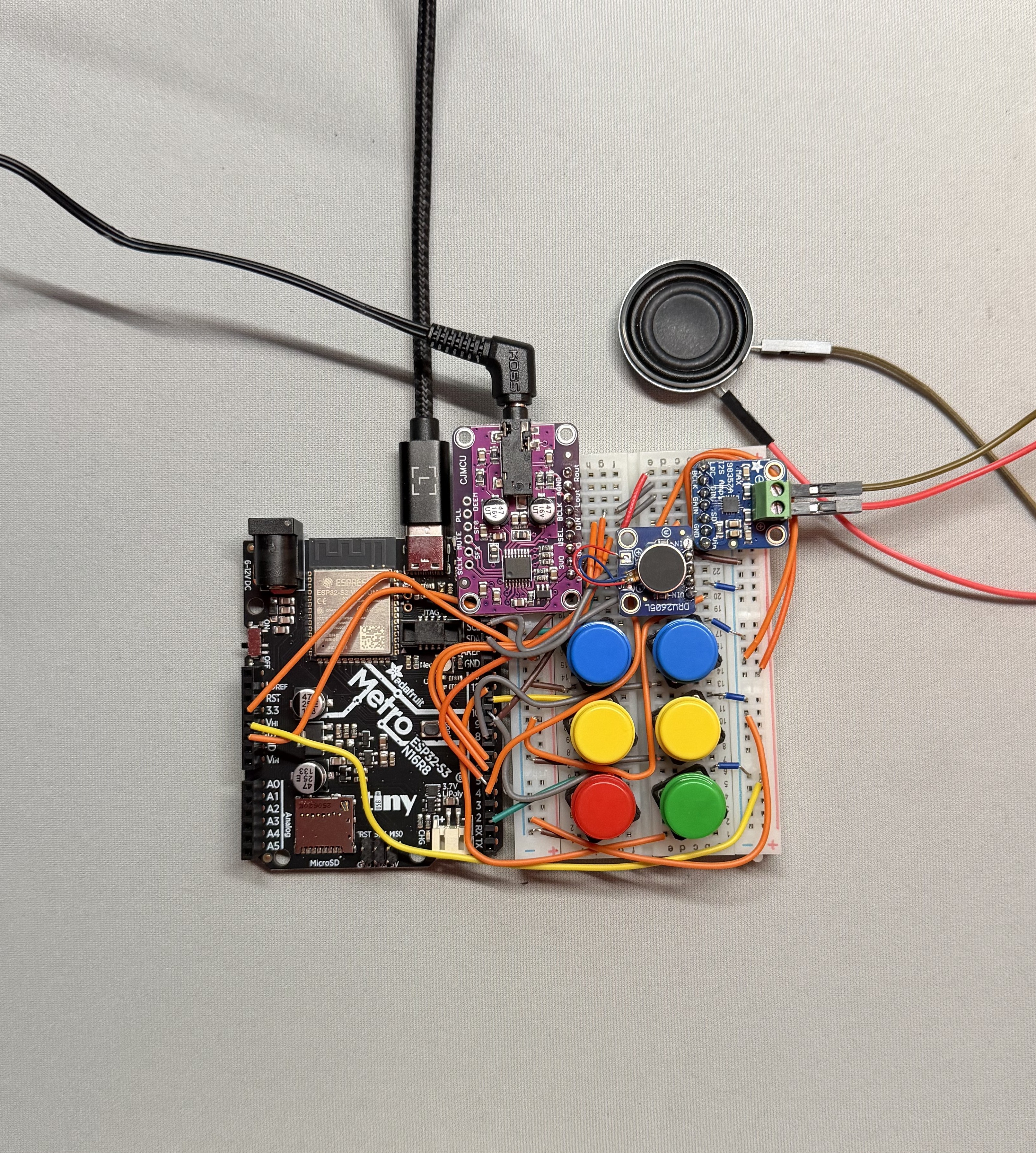
- Hardware: an Adafruit Metro ESP32-S3 with:
- a UDA1334A I2S DAC and earbuds (the private earpiece);
- a MAX98357A amp and speaker for a demo-only speaker mode;
- a DRV2605L haptic motor driver;
- six tactile buttons.
Wi-Fi and Bluetooth are never initialized.
- Security core: all security logic lives in a portable C11 library (
core/) that compiles for both the chip and a laptop simulator.- The Solana legacy-message parser accepts only four transaction shapes (SOL transfer, USDC
TransferChecked, stake, unstake) and rejects everything else. - Associated token accounts are derived on the device, including the ed25519 curve check.
- The core also holds the contact book, the checksum phrases, the serial protocol and every on-device flow.
- The Solana legacy-message parser accepts only four transaction shapes (SOL transfer, USDC
- Keys:
- A BIP39 24-word phrase is generated on the device from the hardware RNG (entropy source on, health-checked) and spelled into the earpiece letter by letter.
- The signing key is derived with SLIP-10 at
m/44'/501'/0'/0', the same path as Phantom and Solflare. - The key is encrypted under the PIN with PBKDF2-HMAC-SHA256, using trezor-crypto.
- Ten wrong PINs wipe it, and each attempt is counted before it's checked.
- Firmware: a thin ESP-IDF layer provides USB serial, I2S audio, debounced buttons, haptics and NVS storage.
- Audio: every word the device can say (369 clips: prompts, numbers, letters and 256 checksum words) was generated once with ElevenLabs Text to Speech. The clips are normalized and flashed as a CRC-checked clip pack, so the device speaks with no network at all.
The laptop (untrusted)
- App: a Vite + React + TypeScript web app that talks to the device over Web Serial. It's keyboard- and screen-reader-first: ARIA live regions, push-to-talk on Space, and an Enter toggle for screen-reader users.
- Commands: a deterministic intent parser (no LLM in the money path) turns speech into exact integer amounts.
- Transactions:
@solana/web3.jsbuilds them on devnet. The app verifies the device's Ed25519 signature before broadcasting. - Server: a tiny Node server keeps the ElevenLabs key off the browser. It proxies Speech to Text (
scribe_v2, with contact names as keyterms), Text to Speech (a separate app voice,eleven_flash_v2_5) and ElevenLabs Agents tokens. It also serves payment requests as Solana Actions and detects payment through areferencekey.
Testing
- The C core runs under AddressSanitizer + UndefinedBehaviorSanitizer.
- Three libFuzzer targets cover every decoder of untrusted bytes: the transaction parser, the serial frames and the clip pack.
- Test vectors are generated with web3.js, so the app's transactions are byte-for-byte what the device's parser was tested on.
- The same core test suite also runs on the ESP32-S3 itself.
Challenges we ran into
- The blockhash kept expiring. A Solana blockhash lives about 60 seconds. Our first real devnet send took 50 seconds from request to signature (announcement, six PIN digits, the key derivation) and arrived too late. We added an
UNLOCKstep to the protocol: PIN first, then the app fetches a fresh blockhash and builds the transaction. - Text to speech can't say the alphabet. Alone, "A" came back as "ah" and "B" as "buh", and some letters came out sounding Spanish. We regenerated letters from their spoken names, generated multiple candidates, and picked them by ear. Recovery words are spelled letter by letter, because 2,048 word clips wouldn't fit in flash.
- Secret audio leaked to the speaker. During bring-up, a missing wire on the amp's shutdown pin meant clips that should only reach the earpiece played out loud. Now firmware forces the amp off before the first sample of every secret clip, and a bring-up test checks that a loud tone is silent.
- "Press-ahead" attacks. If CONFIRM pressed during the announcement counted, the announcement would be decoration. The button driver tags every press with a clip "epoch" and drops anything that started while audio was playing.
- One board, no do-overs. Flash encryption and secure boot burn one-time eFuses, and we had a single board. We chose to leave them off and to document the limitation honestly. That also shaped the PIN key derivation: 100,000 PBKDF2 iterations would have taken 13 seconds per unlock, so we measured on-device and settled on 2.6 seconds.
- Staking is a trap if you're careless. A stake transaction can name someone else as the withdrawer or lockup custodian, and they could take the SOL later. The parser checks every field of all three instructions and recomputes the stake account itself.
- Matching Solana exactly. On-device ATA derivation must agree with the on-chain curve check (curve25519-dalek), which differs slightly from web3.js in two edge cases. We pinned both in tests.
- Two voices talking over each other. The app's voice now waits whenever the device is speaking, and only says what matters: the checksum, the result and errors.
Accomplishments that we're proud of
- The malware demo works, live, on real hardware. The laptop lies, and the device says "unknown recipient, do not sign."
- Real transactions on Solana devnet, signed by a device we built: sends, payment requests, and native staking.
- A PIN you can type in public, and contacts verified over a phone call. Both are security features designed around audio, not adapted from a screen.
- A security core in C we're not afraid of: sanitizers, three fuzzers, generated cross-checked test vectors, and the same tests passing on the chip.
- ElevenLabs used in three ways: baked into firmware as the device's voice, live in the app, and an agent that is deliberately boxed in to one safe action.
What we learned
- Accessibility changes the threat model, not just the UI. Once audio is the only output, who is speaking matters as much as what is said. The laptop's voice and the device's voice need different levels of trust, and the product has to make that obvious.
- Designing for the ear is its own craft:
- spell names instead of trusting pronunciation;
- keep each prompt a separate clip;
- let the user repeat anything;
- never let two voices overlap;
- make every warning both a sound and a vibration.
- Solana's transaction format, byte by byte: compact-u16s, account ordering, PDAs,
createWithSeed, and the stake program's instructions. - "Reject by default" is liberating. Allowing exactly four shapes made the parser small enough to reason about and fuzz properly.
What's next for Taktile
- An enclosure with tactile markings: a raised dot on OK, and CONFIRM and REJECT on opposite ends with different shapes.
- More languages, starting with Spanish. The device's language would change only after a confirmation spoken in both languages.
- NFC tap-to-add contacts, replacing the phone-call check when you're in the same room.
- Withdrawing unstaked SOL, Token-2022, versioned transactions, and creating a recipient's token account in-transaction.
- Mainnet, after a third-party security audit.
Built With
- c
- elevenlabs
- esp-idf
- esp32
- freertos
- libfuzzer
- node.js
- python
- react
- solana
- solana-actions
- trezor-crypto
- typescript
- vite
- web3.js

