-
-
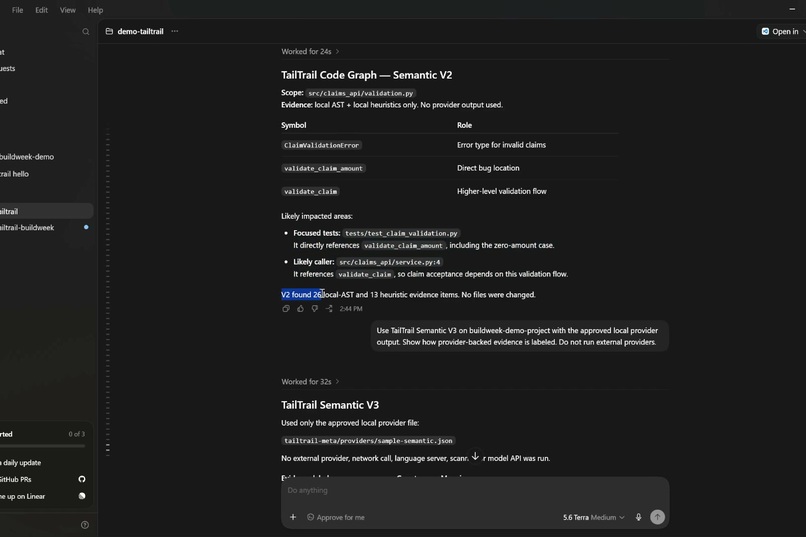
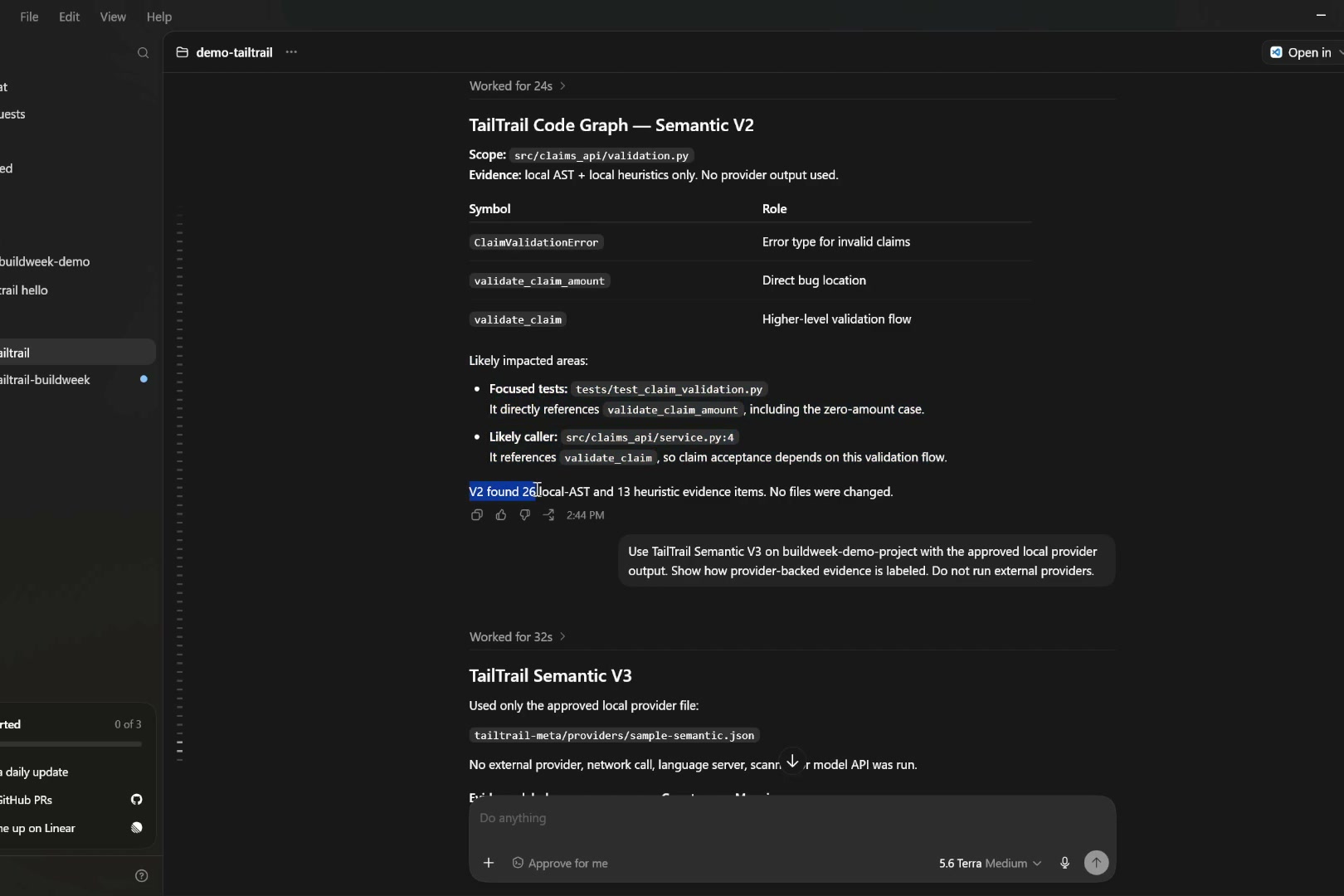
Code semanatic V3 depth
-
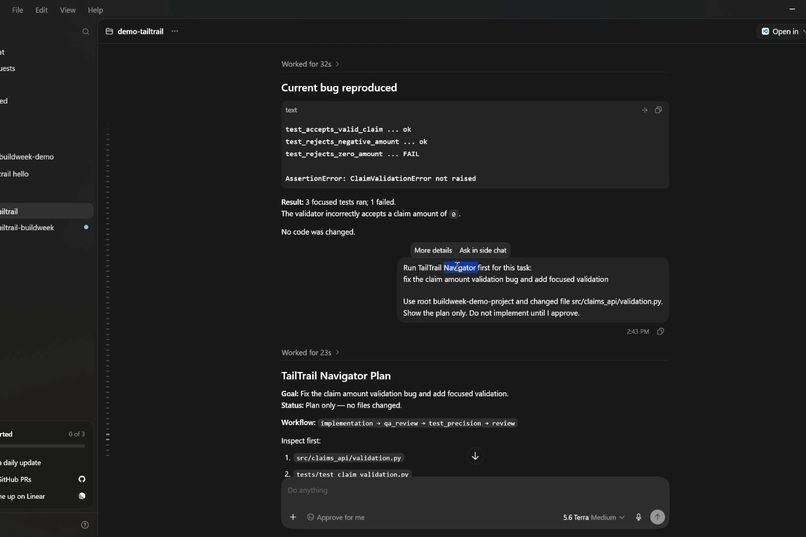
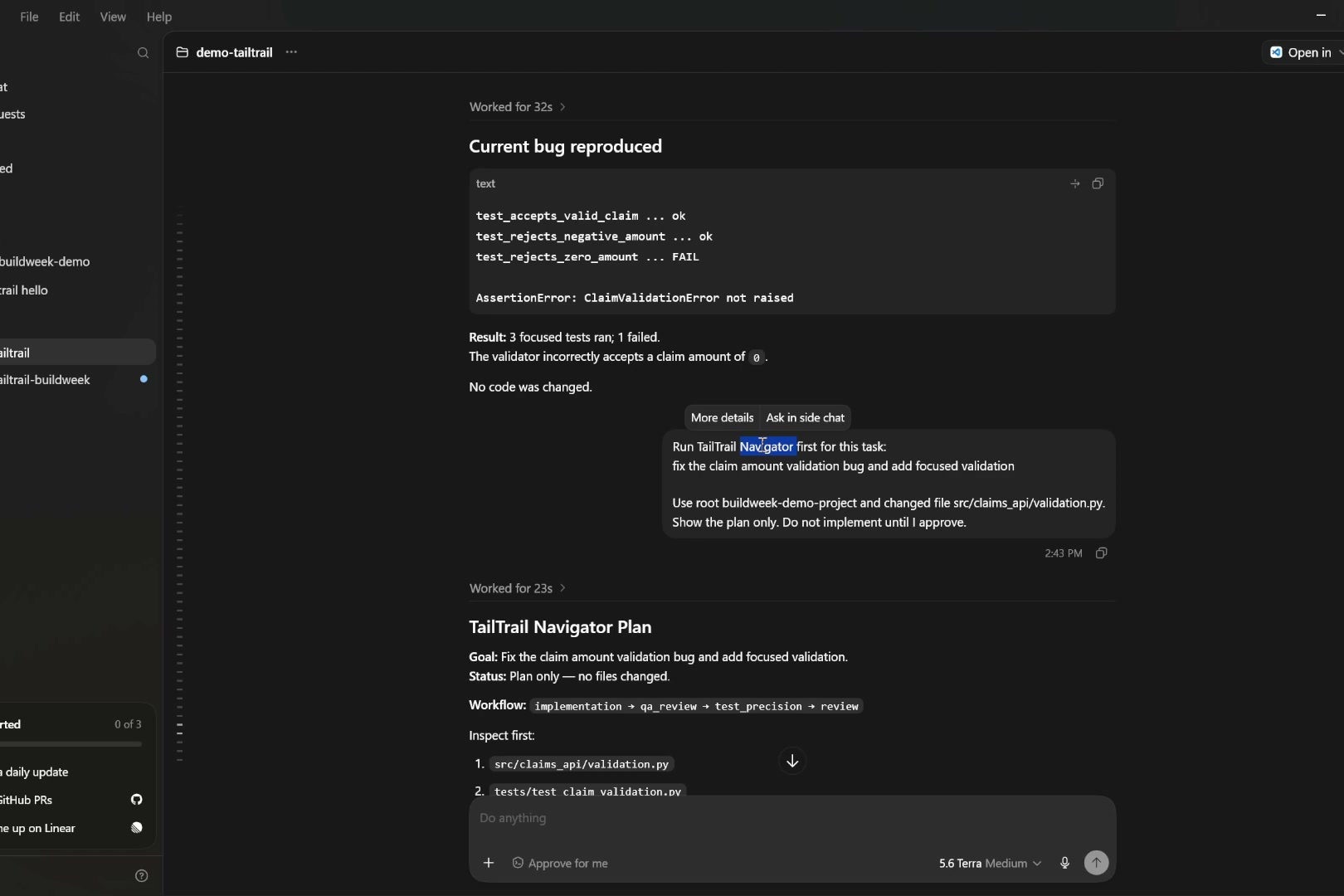
Navigator plan- generates automated workflow
-
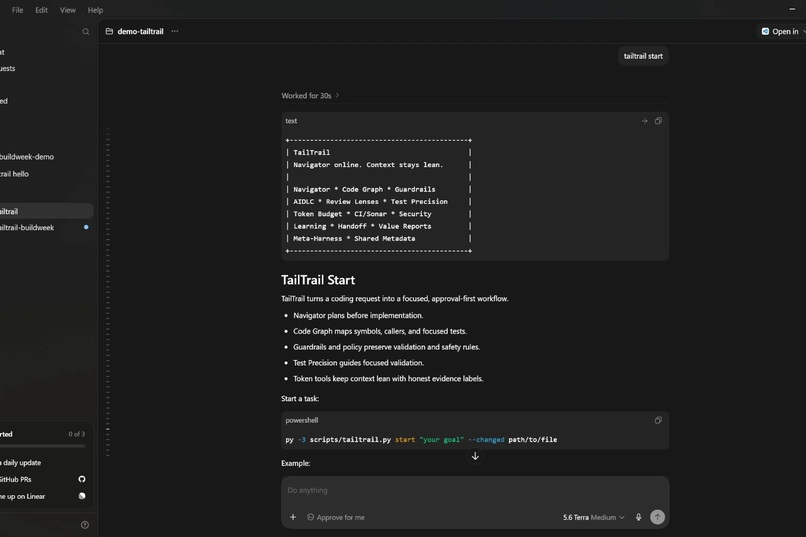
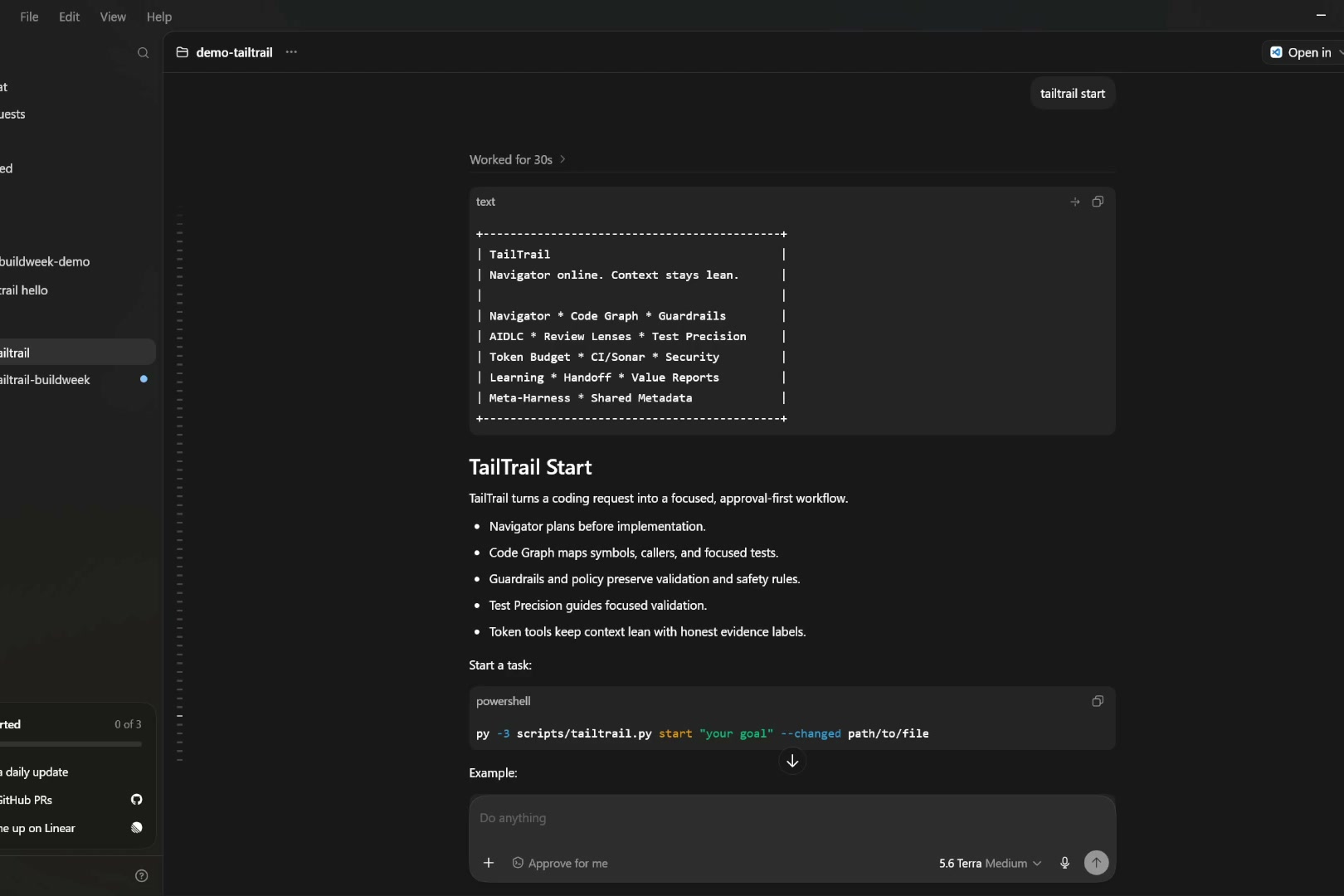
TailTrail start- give comprehensive view of TailTrail
-
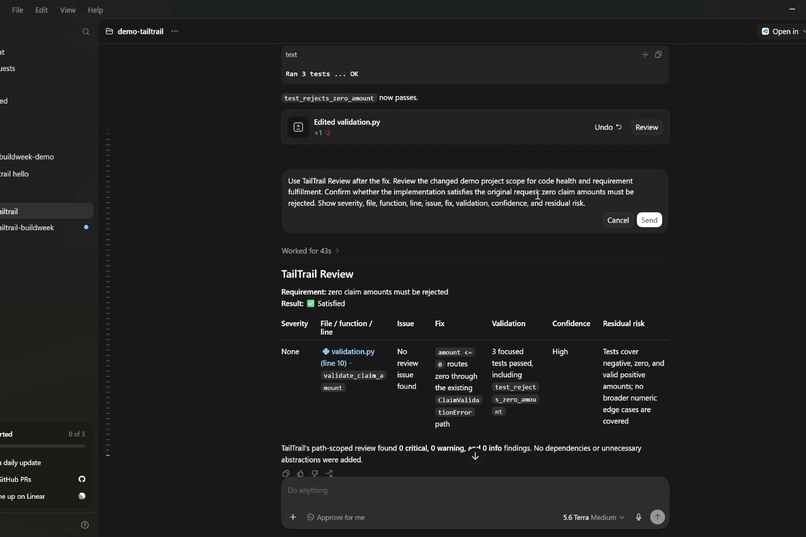
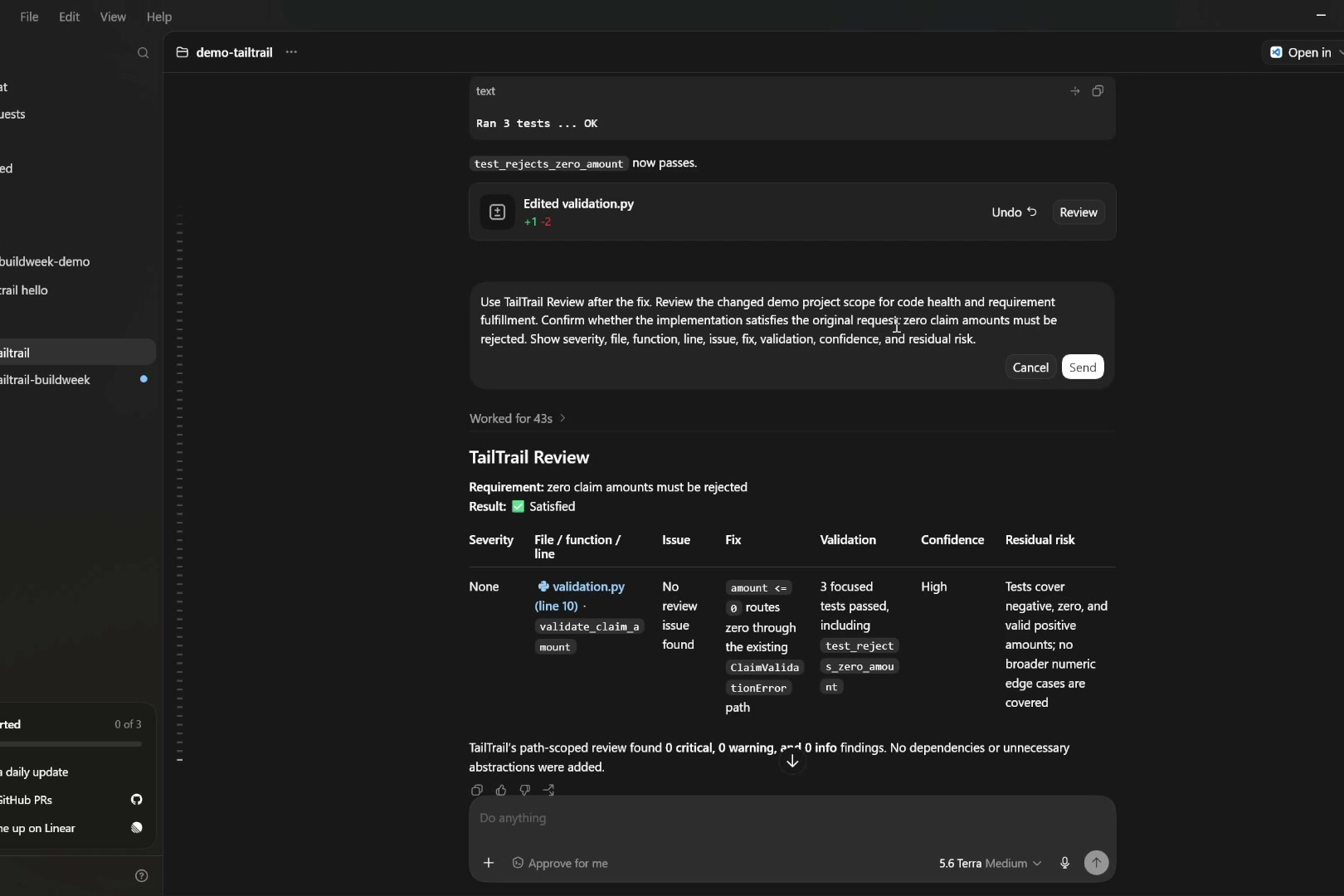
Review notes- confidence high
-
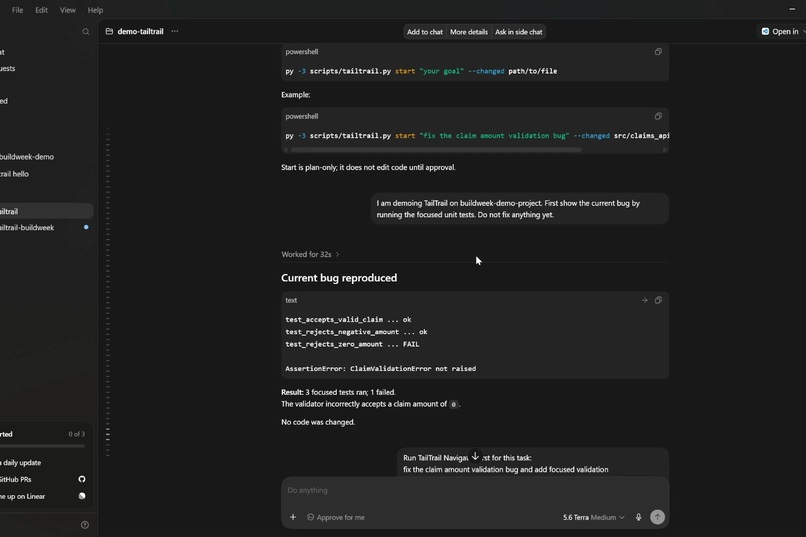
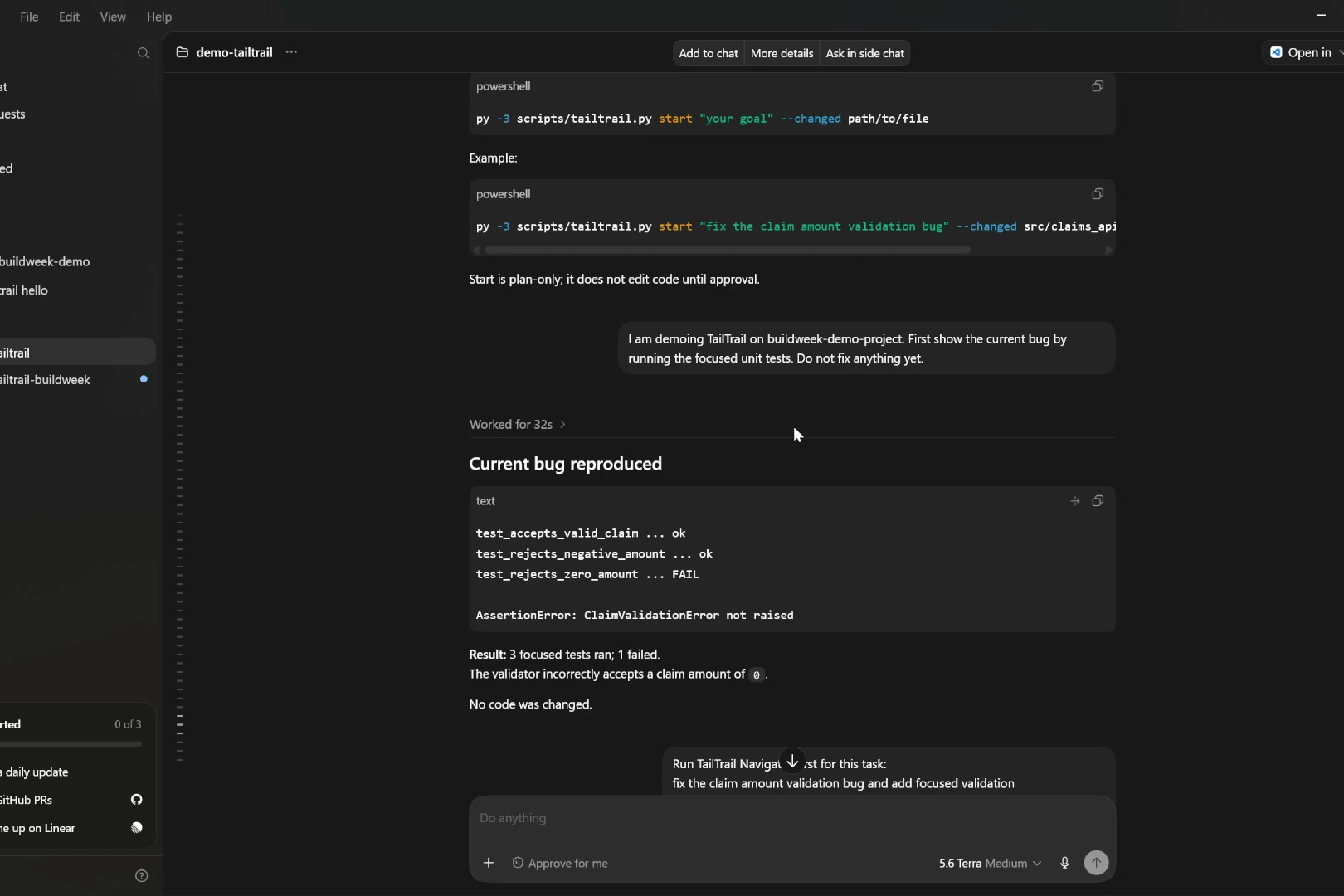
Bug found via TailTrail
Inspiration
- AI-assisted coding is powerful, but small tasks can still go sideways.
- A simple validation fix can turn into a broad refactor. Long prompts can bury the real requirement. The agent may read too much, create unnecessary helpers, or claim success without enough evidence.
TailTrail started from a simple idea: give Codex a clearer way into a codebase. Instead of jumping straight to implementation, TailTrail helps the workflow begin with a plan, narrow the relevant context, preserve local safeguards, validate the actual change, and leave behind evidence that a developer or reviewer can understand.
TailTrail is my answer to that. It’s not about forcing the AI to be perfect—it’s about giving it a clean, structured way in:
- start with a navigator-first plan,
- keep the scope tight,
- limit the prompt to the real change,
- use code graphing to find the right files,
- and keep token posture honest.
That’s the story behind this demo.
What it does
TailTrail is a local, approval-first development control layer for Codex. It helps developers move through a focused workflow:
Task -> Navigator plan -> focused context -> approval -> change -> test -> review -> evidence
Key capabilities include:
- Navigator-first planning so Codex starts by understanding the task instead of editing immediately.
- Code Graph mapping to identify relevant symbols, callers, and likely tests before changing code.
- Focused context to keep small changes small and avoid broad repository reads.
- Guardrails and local policy to preserve validation, dependency discipline, safety checks, and project conventions.
- Focused validation so the workflow proves the requested behavior before claiming success.
- Requirement-aware review that checks whether the implementation actually solves the original problem.
- Evidence labels that distinguish estimates, local evidence, and measured telemetry.
- Evaluation Harness scenarios that make the Build Week demo repeatable through local saved-artifact proof.
For this demo, TailTrail guides Codex through a small claims-service bug: zero-dollar claims are incorrectly accepted even though claim amounts must be positive. The workflow finds the relevant validation function and regression test, waits for approval, makes the smallest fix, validates it, and reviews the result.
How we built it
We built TailTrail with Codex and GPT-5.6 around one core principle: AI-assisted development should be structured without becoming heavy.
We started with Navigator-first planning, then added local code-graph helpers to identify the right files and likely tests before editing. We added guardrails, policy guidance, focused test planning, post-change review, and evidence labels so the workflow stays grounded in real source code and validation.
As the project grew, the roadmap became an important part of the product story. It shows how TailTrail evolved from small workflow guidance into a broader local toolchain for planning, graphing, validation, review, reporting, evaluation, and safer AI-assisted development.
We also added a Codex-friendly installation path and plugin profile so TailTrail can be used as part of a real Codex workflow rather than only as documentation.
THIS IS JUST A TIP- have a full ROADMAP file thats shows how it started and small featured turned into a critical feature in TailTrail
Challenges we ran into
The hardest part was finding the right balance between guidance and automation.
- We wanted Codex to stay focused on the smallest useful change without blocking useful work.
- We needed enough context for accurate reasoning, but not so much that the important requirement gets lost.
- We had to keep token-related messaging honest: reducing noisy context is useful, but exact token-savings claims need real telemetry.
- We needed validation and review to be evidence-based, not just polished summaries.
- We also had to make installation practical for Codex users, not just describe an ideal workflow.
Accomplishments that we're proud of
- Built a complete, understandable Build Week demo around a real regression workflow.
- Created a Navigator-first process that keeps planning separate from implementation approval.
- Added local AST-based code graphing to narrow code context before edits.
- Added focused validation and requirement-aware review.
- Kept privacy and safety boundaries explicit: local-first, approval-first, and no hidden telemetry.
- Created a deterministic buildweek-validation Evaluation Harness scenario so judges can replay the workflow story.
- Built the submission around honest claims rather than unsupported productivity or token-savings promises.
What we learned
We learned that the best AI coding workflow is not necessarily the one with the most automation.
Developers still need control over when code changes, what context is used, which tests run, and what claims are made about the result. A small amount of structure before and after implementation can make Codex much more reliable without making the developer experience feel slow or bureaucratic.
We also learned that evidence matters. A demo is stronger when it can be replayed, inspected, and explained clearly.
What's next for TailTrail
Next, we want to make TailTrail easier to install and use across more real repositories while keeping the workflow lightweight.
Planned directions include:
- improving the Codex managed-pack installation experience
- making the single-command start flow even clearer
- expanding language-aware code graphing
- improving focused test recommendations
- adding more repeatable evaluation scenarios across task types
- supporting measured telemetry when users explicitly provide it
- continuing to improve local-first governance, review, and evidence workflows
- TailTrail’s next step is to evolve from a guided workflow into an approval-first harness for coding agents.
TailTrail is not trying to replace Codex, tests, CI, scanners, or human review. It is built to make AI-assisted coding more focused, more reviewable, and easier to trust.
Built With
- agents
- ai
- ai-agents
- analysis
- ast
- automation
- cli
- code
- code-review
- codex
- developer
- developer-tools
- devops
- evaluation
- gpt-5.6
- local-first
- productivity
- python
- review
- static
- testing
- tools

Log in or sign up for Devpost to join the conversation.