-
-
TaiChi@Meta-Dojo: Routine Mode
Inspiration
It is widely recognized that TaiChi can improve cardiovascular health, enhance balance and lower-body strength, and help reduce stress and anxiety, which makes it an ideal wellness practice for all ages. Yet TaiChi’s intricate movements can be challenging to learn. Traditionally, TaiChi is taught primarily through in-person instruction. Outside of class, learners must rely on memory or practice by following videos, which often results in slow progress and limited effectiveness. As a result, many students give up halfway and miss out on the full benefits of learning TaiChi.
What it does
TaiChi@Meta-Dojo leverages the spatial computing capabilities of Meta Quest 3 to create a metaverse training arena for mastering TaiChi. By combining cutting-edge XR technology with virtual TaiChi coaches, the system lowers the barriers to learning and enables users to practice anytime, anywhere, and at their own pace.
How we built it
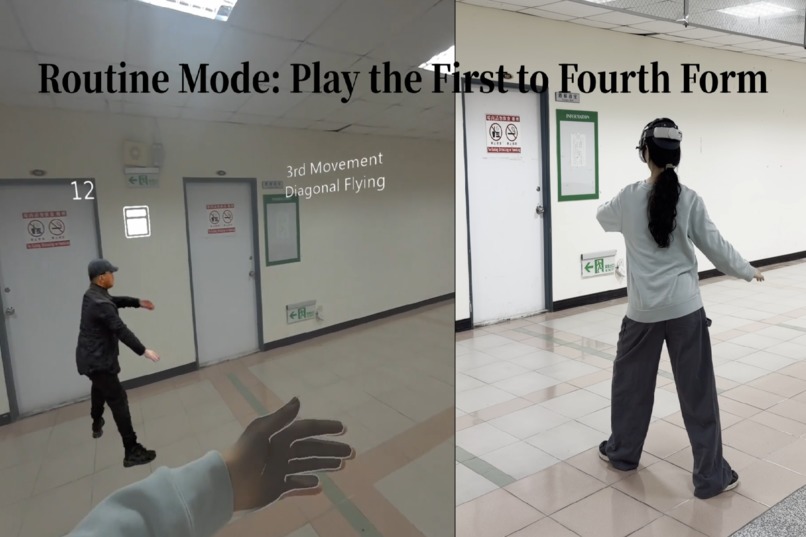
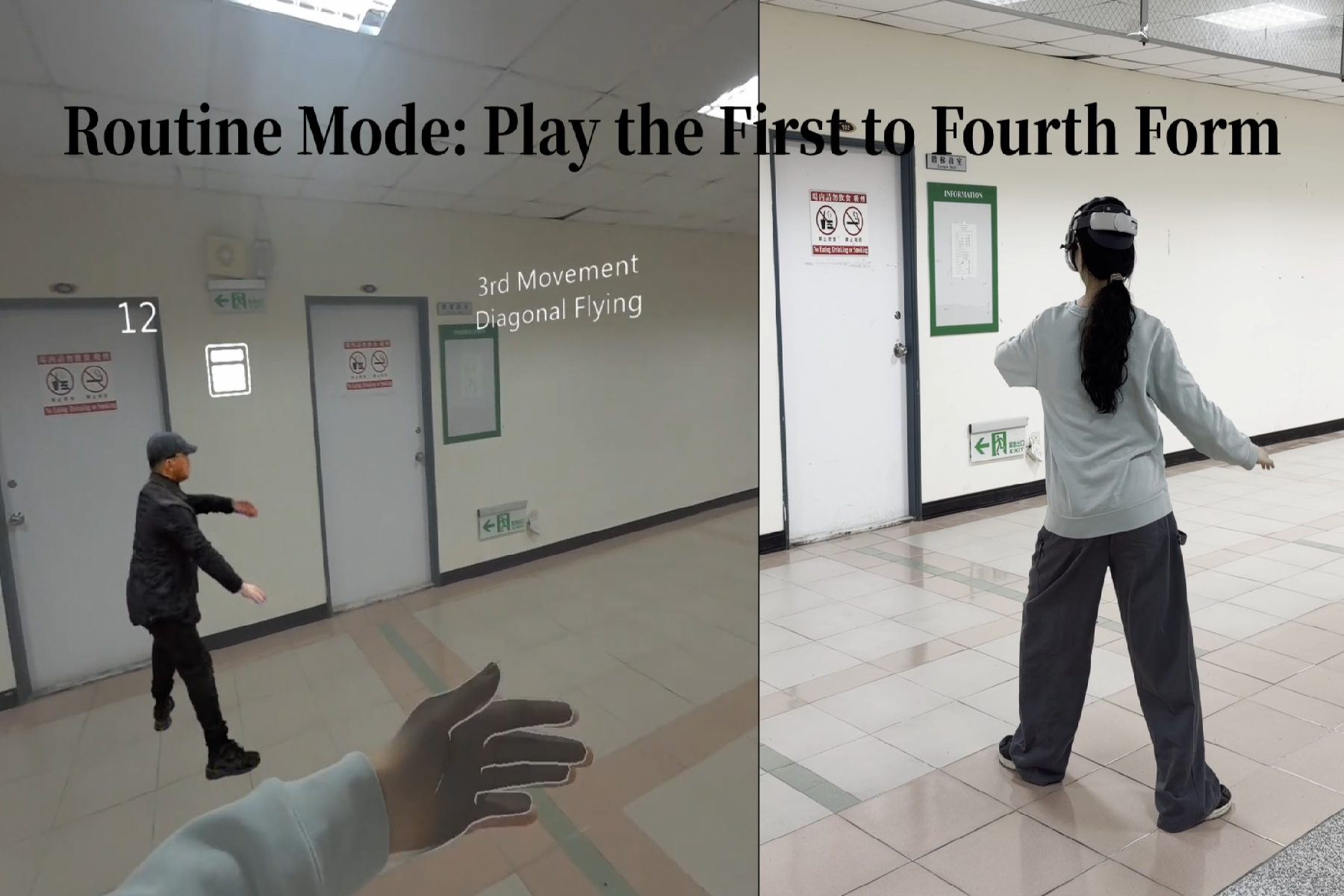
Developed in Unity using the OVR Package, this work supports intuitive hand-gesture interaction for menu selection and offers two modes: Single-Move Mode, for mastering the detailed posture of one movement, and Routine Mode, for practicing the flow of TaiChi sequences. With Passthrough MR, multiple virtual coaches can appear around the user, providing real-time demonstrations from any direction.
Guided by micro-progressive learning, we break down complex movements into small, achievable steps that build confidence through continuous micro-successes. In Single-Move Mode, the virtual coach demonstrates highly detailed movements that users can repeat as many times as needed until they reach proficiency. Once several moves are mastered, learners can transition to Routine Mode, where the virtual coach guides them through the flow and continuity of the TaiChi sequence—helping to eliminate the common frustration of forgetting what comes next. In Routine Mode, we employ 4D Gaussian Splatting to deliver smooth, photorealistic demonstrations whose lifelike presence enhances immersion and provides a clearer, more intuitive learning experience.
Challenges
Key challenges included transforming raw motion-capture data into clear visual guidance and compressing large Gaussian Splatting datasets to run efficiently on the standalone Quest 3.
Accomplishments
Through state-of-the-art Gaussian Splatting, we successfully deployed lifelike, high-fidelity instructor performances on Quest 3—achieving an immersive and intuitive training experience previously considered technically impossible on a standalone device.
What we learned
The metaverse era is rapidly approaching, and innovations like Meta-Dojo show how immersive technology can redefine movement learning and digital wellness.
What’s next
Currently, the system includes movements from the Yang-style 108 Form (Forms 1–16 in Single-Move Mode and 1–4 in Routine Mode). We will progressively complete the full 108 Form and expand to additional Yang, Chen, Wu, Sun, Cheng Man-Ching, and international competition forms. A multi-user Group Practice Mode will soon allow practitioners worldwide to gather in the metaverse and recreate the iconic ambiance of morning park TaiChi practice.
Looking ahead, Meta-Dojo will evolve into a broader XR wellness ecosystem, adding yoga, dance, rehabilitation training, and other mind–body practices—transforming it into a next-generation platform for holistic movement learning and immersive health experiences.


Log in or sign up for Devpost to join the conversation.