-
-
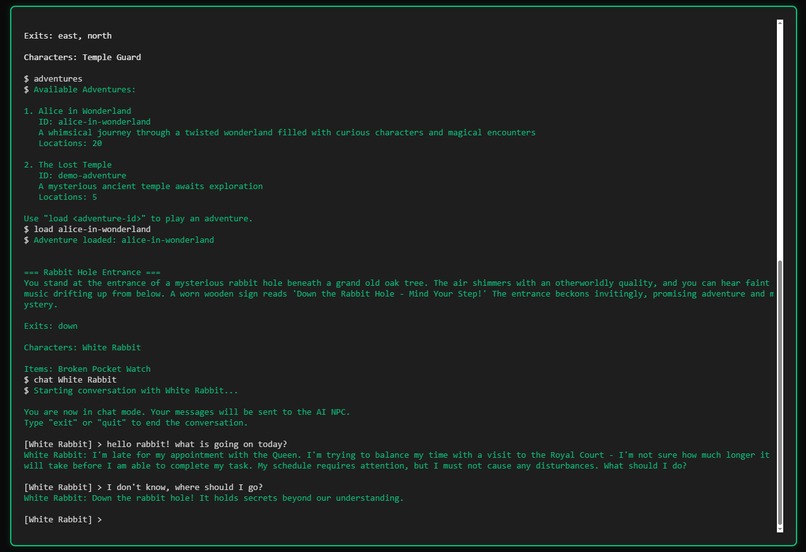
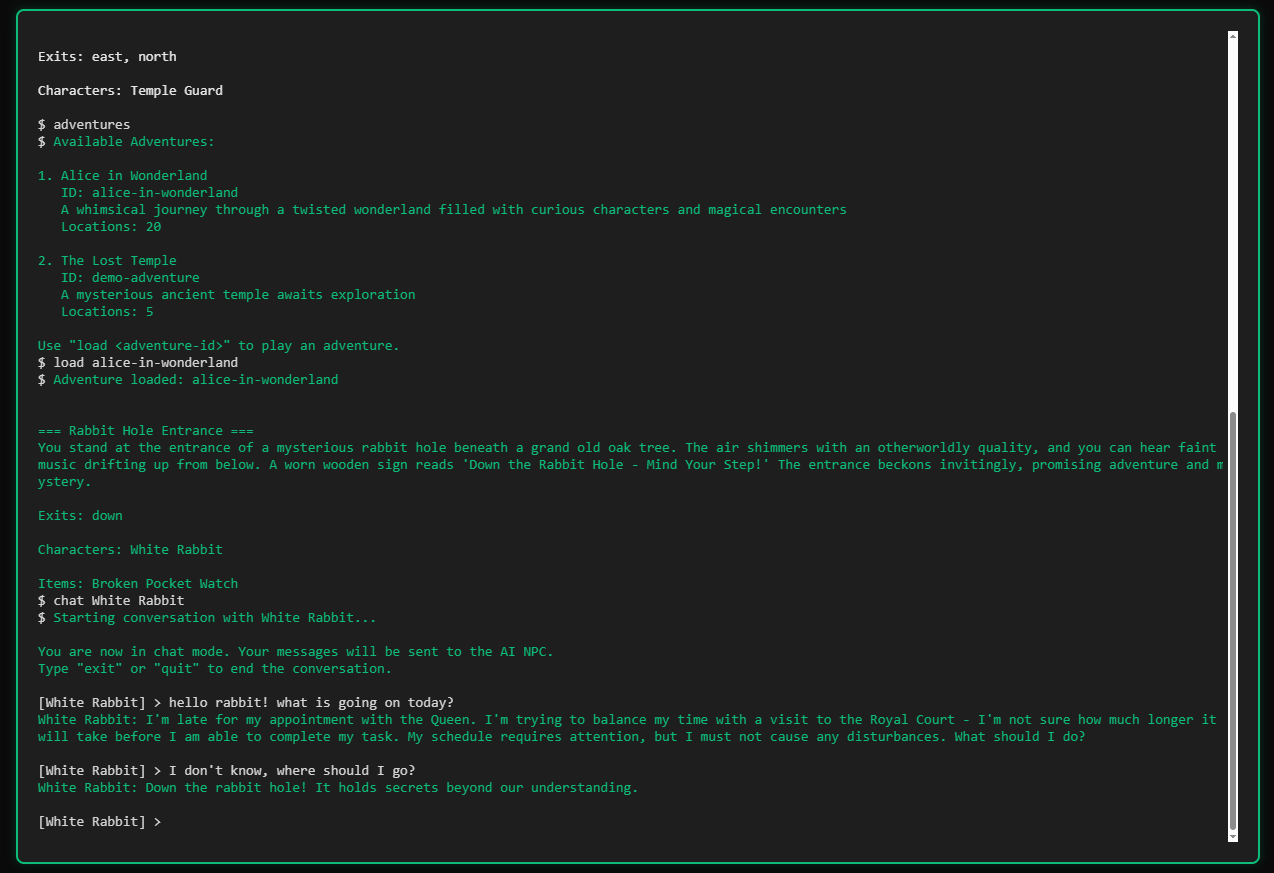
Chat with the Rabbit AI NPC
-
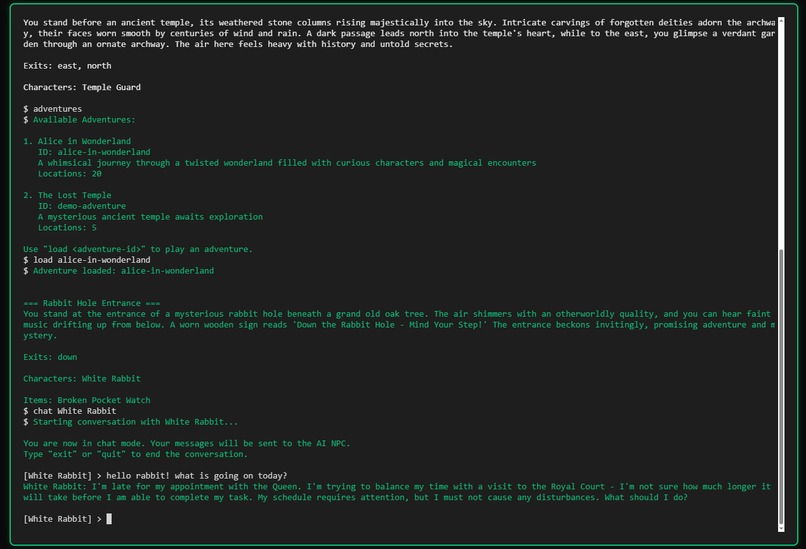
Load adventure
-
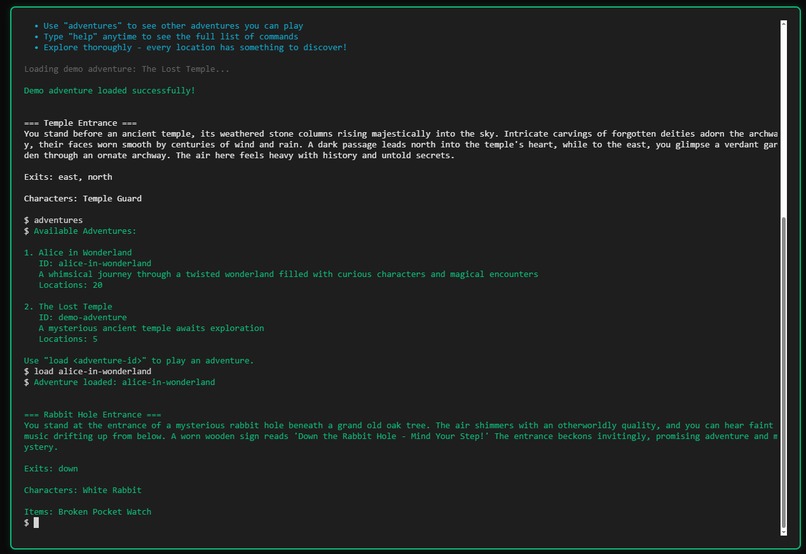
Chat with the Rabbit AI NPC
-
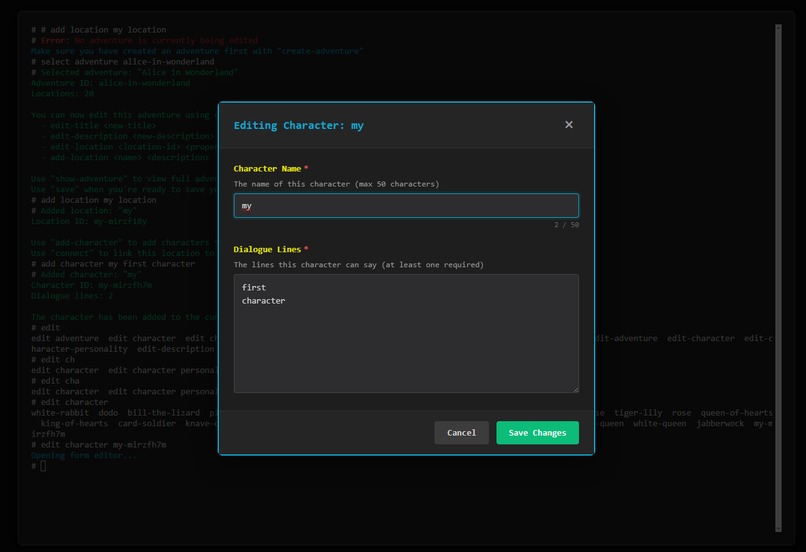
Edit character personality
-
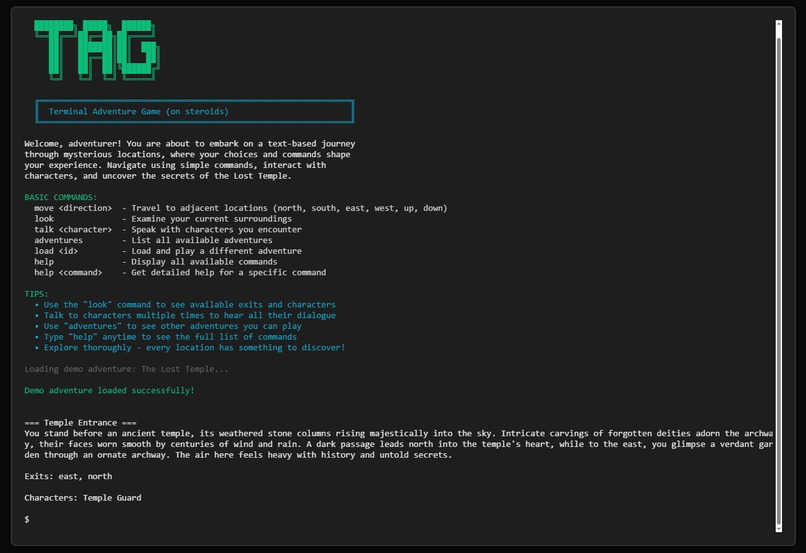
Welcome screen
-
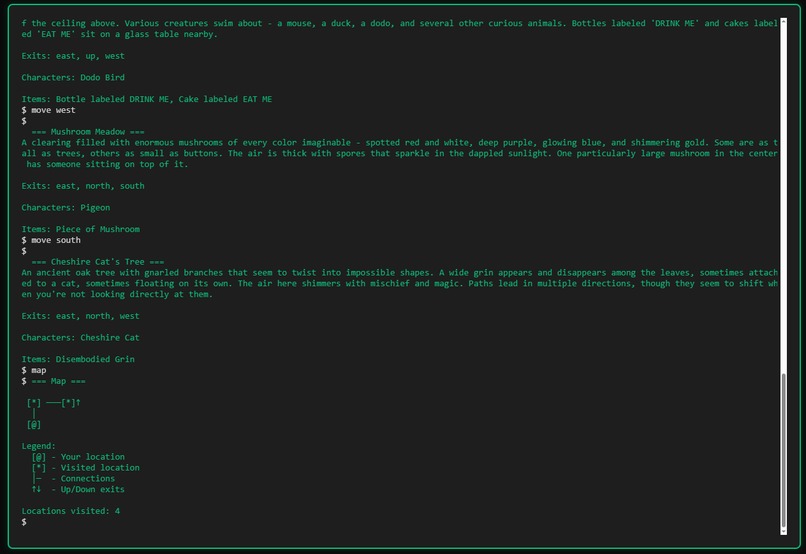
Moving and Map
-
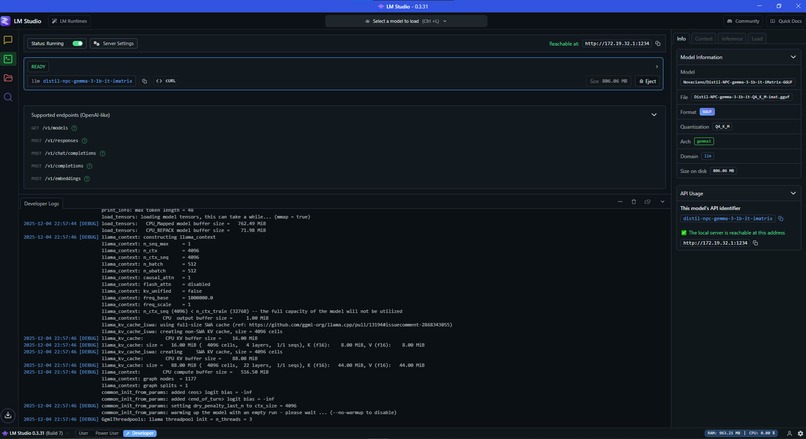
LM Studio NPC
Inspiration
The inspiration for Terminal Adventure Game came from a deep nostalgia for classic text adventures like Zork and Colossal Cave Adventure, combined with frustration at how difficult it is to create these experiences today. We wanted to bring back the magic of command-line storytelling while removing the barriers to entry—no programming knowledge required.
We were also inspired by the rise of AI language models and saw an opportunity to breathe new life into the genre. Imagine NPCs that don't just repeat scripted dialogue but actually understand and respond to your questions. That's when we knew we had to build this.
The "on steroids" part? That came from our commitment to not just build a toy project, but a production-ready platform with enterprise-grade security, containerized deployment, and modern DevOps practices. We wanted to prove that a passion project could be built with the same rigor as commercial software.
What it does
Terminal Adventure Game is a dual-purpose platform:
For Players:
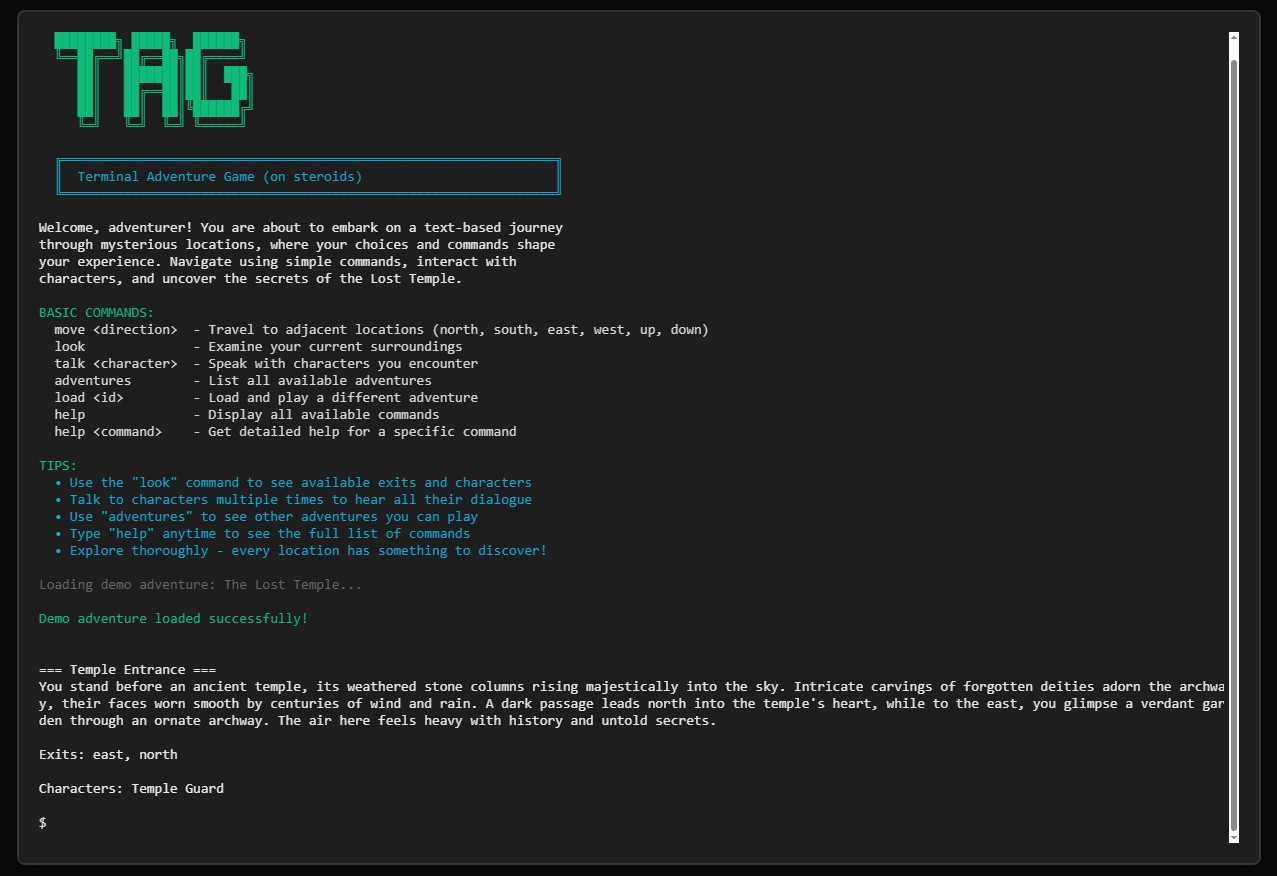
- Explore interactive text adventures through an authentic terminal interface in your browser
- Navigate locations, interact with characters, collect items, and solve puzzles
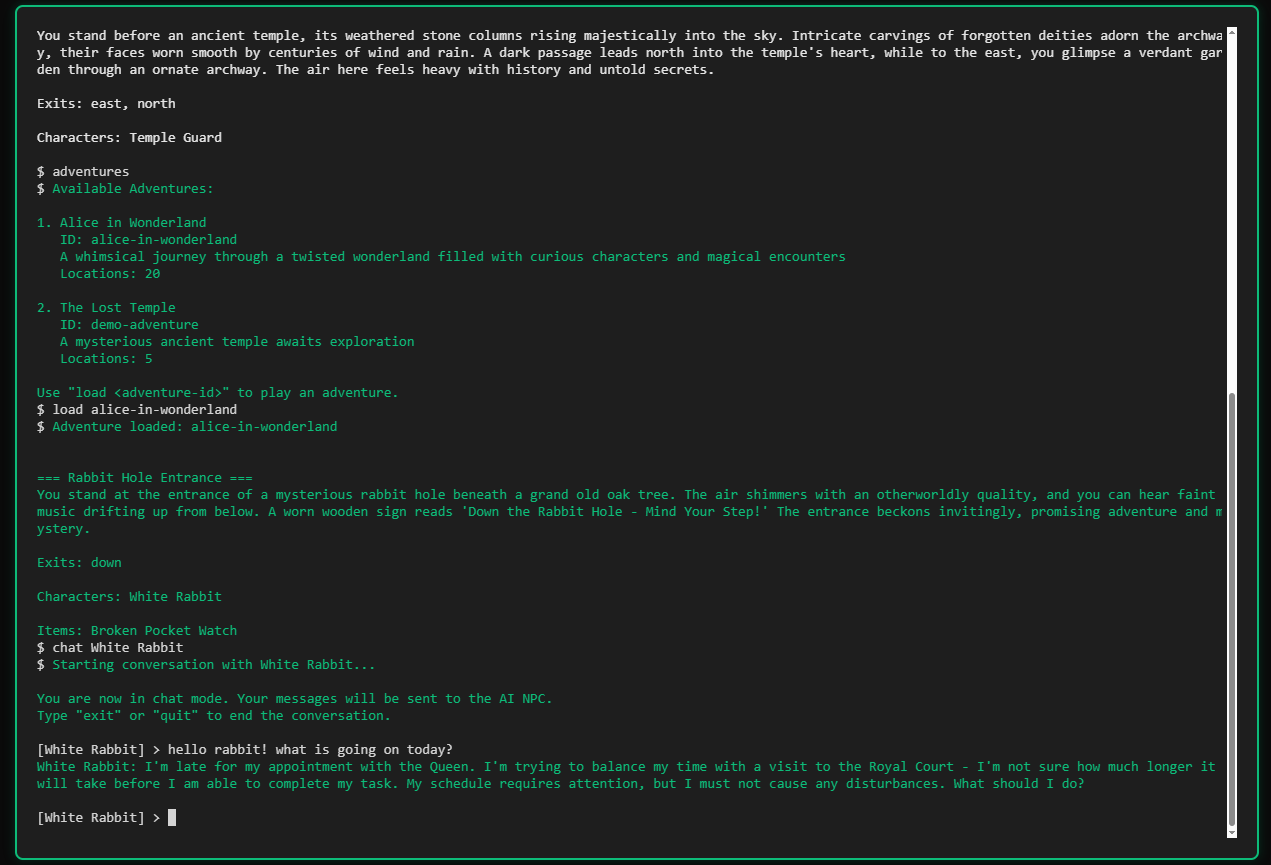
- Chat with AI-powered NPCs that respond intelligently to your questions
- Track your progress with automatic game state persistence
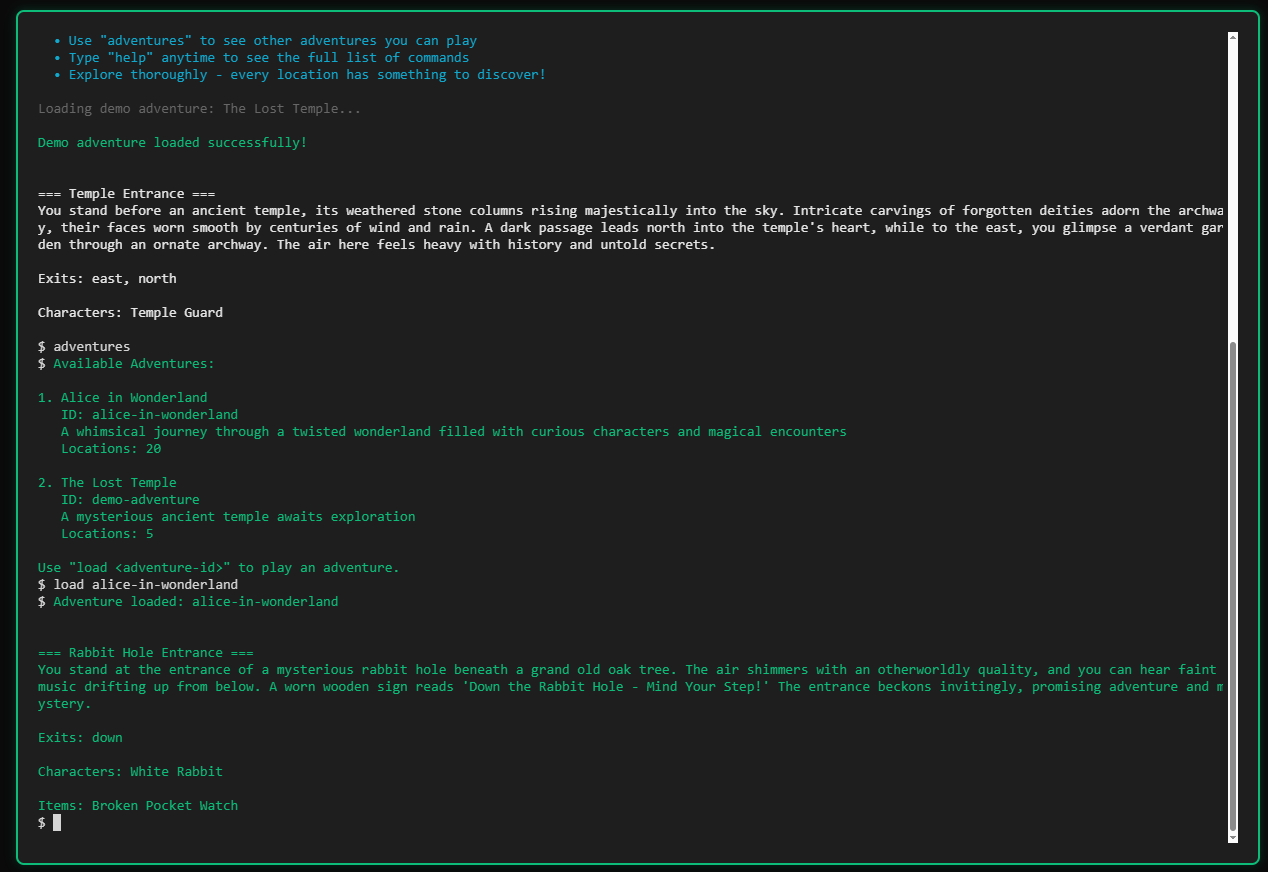
- Switch between multiple adventures seamlessly
For Creators:
- Enter admin mode with sudo-style authentication
- Create complete adventures without writing a single line of code
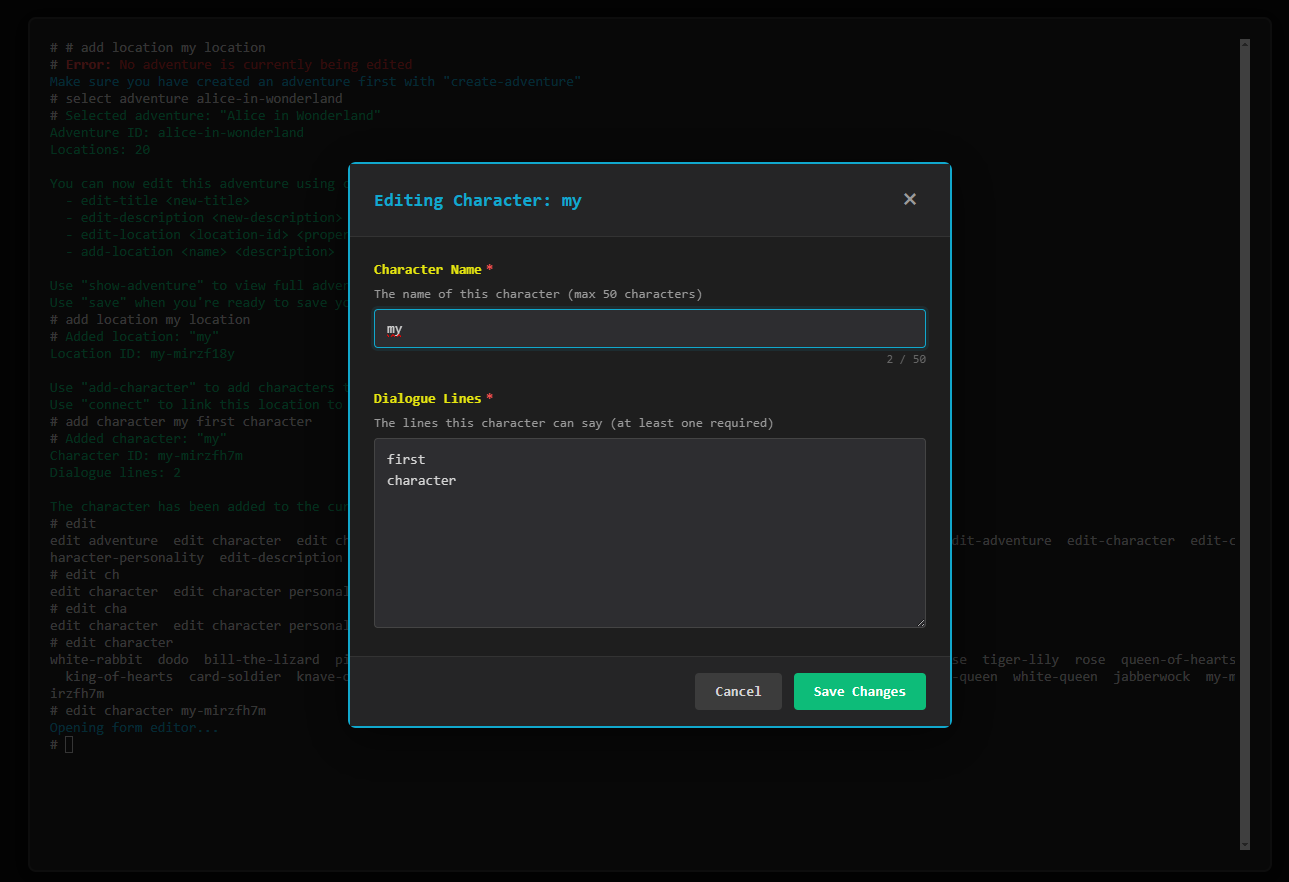
- Use interactive forms to design locations, characters, and items
- Connect locations with directional exits to build your world
- Add AI-powered characters with custom personalities
- Export adventures as JSON to share with others
- Import community-created adventures
For Deployers:
- Deploy with a single Docker Compose command
- Built-in ModSecurity WAF protects against common web attacks
- Fail2ban automatically bans malicious IPs
- Rate limiting prevents abuse and DoS attacks
- Health checks ensure service reliability
- Volume management for easy backups
How we built it
We approached this as a professional software project from day one:
Architecture:
- Designed as a TypeScript monorepo with npm workspaces for clean separation
- Frontend built with Vite for lightning-fast development and optimized production builds
- Backend using Express with a RESTful API design
- SQLite database with automatic file persistence—no external database server needed
Development Process:
- Started with a spec-driven approach using Kiro AI assistant
- Created detailed requirements documents with EARS (Easy Approach to Requirements Syntax)
- Designed comprehensive correctness properties for property-based testing
- Implemented features incrementally with continuous testing
- Used TypeScript strict mode throughout for type safety
Key Technical Decisions:
- xterm.js for authentic terminal rendering in the browser
- Command parser with multi-word command support and autocomplete
- Interactive modal forms for complex data entry in admin mode
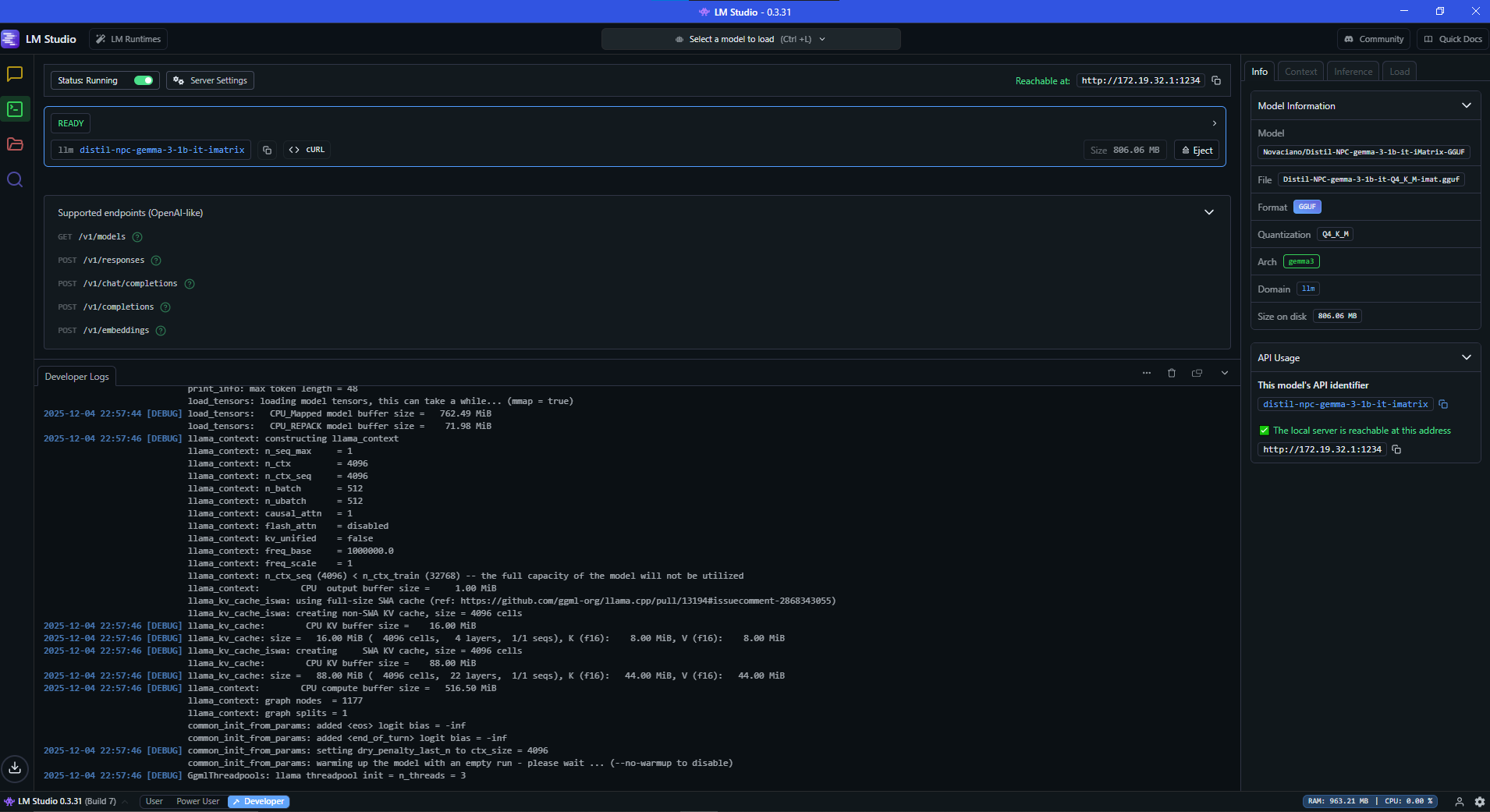
- LM Studio integration for local AI inference (privacy-first)
- Multi-stage Docker builds for minimal production images
- ModSecurity with OWASP Core Rule Set for WAF protection
DevOps:
- Docker Compose orchestration with three services (app, nginx, fail2ban)
- Network isolation with frontend and backend networks
- Automated health checks for all services
- Export/import scripts for easy image distribution
- Platform-specific startup scripts (PowerShell, Batch, Bash)
Challenges we ran into
1. Command Parser Complexity Building a command parser that handles multi-word commands, quoted arguments, and autocomplete was surprisingly complex. We had to implement tokenization, fuzzy matching for typo suggestions, and context-aware autocomplete that knows when you're completing a command name vs. an argument.
2. Docker Network Configuration
Initially, we configured the backend network as internal: true for security, which prevented the app from reaching LM Studio on the host network. We had to balance security with functionality, ultimately removing the internal restriction while maintaining security through other layers (WAF, Fail2ban, rate limiting).
3. Modal Forms in Terminal Creating interactive forms within a terminal interface was challenging. We built a custom modal system that overlays on the terminal, handles keyboard navigation, validates input, and provides a smooth user experience—all while maintaining the terminal aesthetic.
4. SQLite Persistence sql.js runs SQLite in-memory, which means data is lost on restart. We implemented a custom persistence layer that automatically saves the database to disk after every write operation and loads it on startup. This required careful error handling and atomic file operations.
5. AI Integration Error Handling LM Studio can be slow, timeout, or be unavailable. We implemented comprehensive error handling with user-friendly messages, timeout management, and graceful degradation when AI features aren't available.
6. Confirmation Flows Implementing safe deletion with confirmation prompts required careful state management. We had to pass context through the confirmation callback and handle both the initial command and the confirmation response.
7. Autocomplete Performance Fetching adventure IDs for autocomplete on every keystroke would be slow. We implemented a 5-second cache that balances freshness with performance, and added smart filtering to reduce API calls.
Accomplishments that we're proud of
1. Zero-Code Adventure Creation We achieved our goal of making adventure creation accessible to non-programmers. The interactive forms and intuitive commands mean anyone can build a complete adventure without touching code.
2. Production-Ready Security This isn't just a demo—it's deployable to production with confidence. ModSecurity WAF, Fail2ban, rate limiting, security headers, and network isolation provide defense in depth.
3. AI Integration Done Right We integrated LM Studio in a way that's privacy-respecting (local inference), error-tolerant (graceful degradation), and user-friendly (clear error messages and suggestions).
4. Comprehensive Testing We implemented both unit tests and property-based tests using fast-check. The property-based tests verify universal correctness properties across hundreds of randomly generated inputs.
5. Developer Experience The monorepo structure, TypeScript strict mode, comprehensive documentation, and platform-specific startup scripts make this project easy to develop and contribute to.
6. Complete Documentation We wrote detailed README, startup guide, elevator pitch, and inline code comments. Every command has help text. Every error has a suggestion. Every feature is documented.
7. Import/Export System Adventures can be exported as JSON with a well-defined schema, making it easy to share creations, backup data, or migrate between instances.
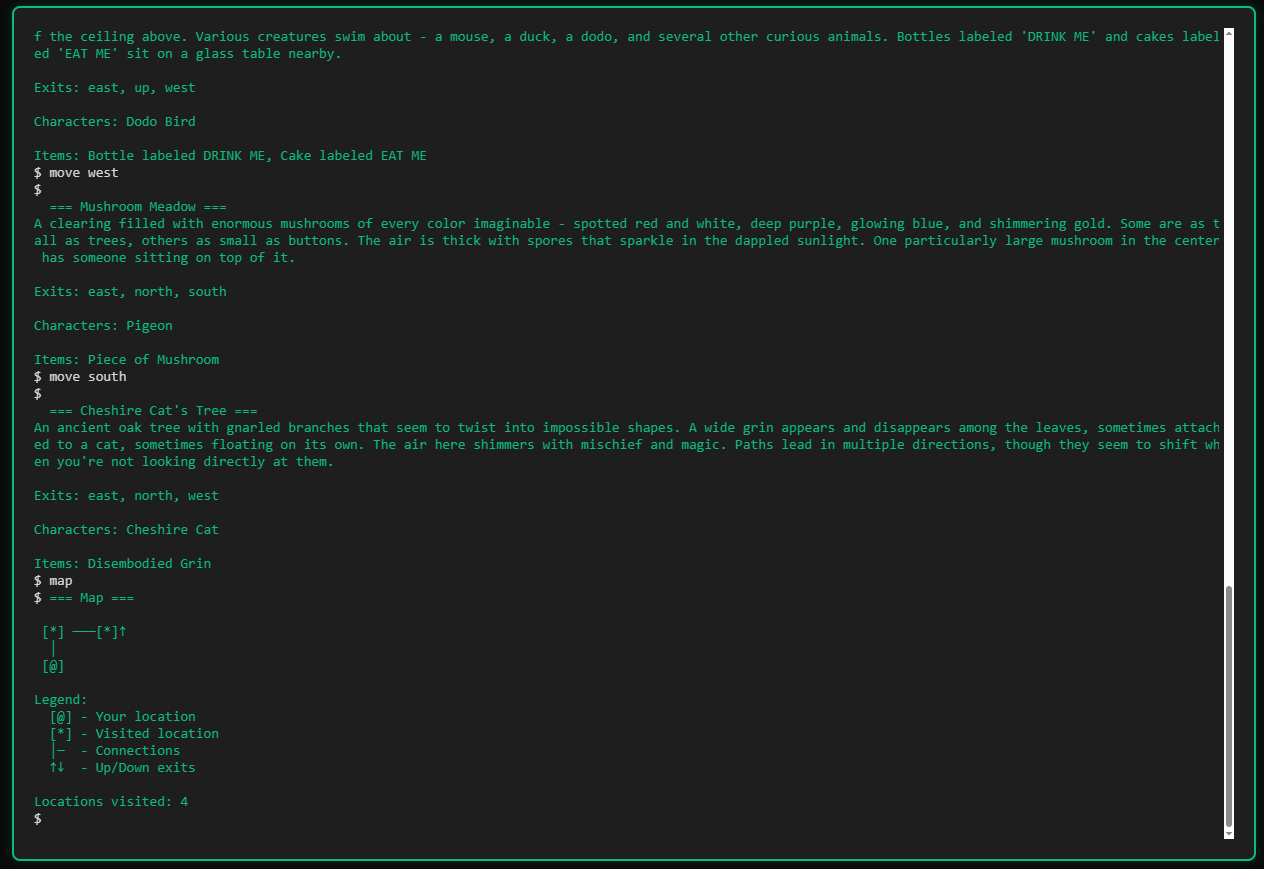
8. Map Visualization The ASCII art map system provides spatial awareness in a text-only interface, showing visited locations, connections, and the player's current position.
9. Command History & Autocomplete Arrow key navigation through command history and tab completion make the terminal feel professional and efficient.
10. Spec-Driven Development We used Kiro AI to create formal specifications with requirements, design documents, and task lists. This resulted in cleaner code and fewer bugs.
What we learned
Technical Lessons:
- TypeScript monorepos are excellent for full-stack projects—shared types between frontend and backend prevent API mismatches
- Property-based testing catches edge cases that example-based tests miss
- Docker multi-stage builds dramatically reduce image size (from 1GB+ to ~200MB)
- ModSecurity is powerful but requires tuning to avoid false positives
- xterm.js is incredibly capable—you can build rich terminal UIs in the browser
- SQLite with file persistence is perfect for small-to-medium applications—no database server needed
Design Lessons:
- Confirmation prompts are critical for destructive operations—users need to see what they're about to delete
- Autocomplete transforms user experience—it's worth the implementation complexity
- Error messages with suggestions turn frustration into guidance
- Interactive forms are better than command-line arguments for complex data entry
- Help text should be contextual—show examples, not just syntax
Process Lessons:
- Spec-driven development upfront saves time debugging later
- Incremental implementation with continuous testing prevents big-bang integration issues
- Documentation as you go is easier than documenting after the fact
- Security from the start is easier than retrofitting it later
- Platform-specific scripts improve accessibility—not everyone uses the same shell
AI Integration Lessons:
- Local inference (LM Studio) is slower but more private than cloud APIs
- Timeout handling is essential—AI responses can be slow
- Graceful degradation means the app works even when AI is unavailable
- Context management is key—NPCs need to remember conversation history
- Prompt engineering matters—clear personality descriptions produce better responses
What's next for TAG - Terminal Adventure Game (on steroids)
Short-term (Next 3 months):
Multiplayer Support
- Real-time collaboration in adventures
- WebSocket integration for live updates
- Shared game state across players
- Chat system for player communication
Adventure Marketplace
- Community hub for sharing adventures
- Rating and review system
- Featured adventures and collections
- One-click adventure installation
Enhanced AI Features
- Memory system for NPCs (remember past interactions)
- Dynamic quest generation based on player actions
- AI-assisted adventure creation (generate locations from descriptions)
- Voice input/output for accessibility
Mobile Support
- Responsive terminal interface for mobile browsers
- Touch-optimized command input
- Swipe gestures for navigation
- Progressive Web App (PWA) for offline play
Medium-term (6-12 months):
Visual Enhancements
- ASCII art generation for locations
- Animated transitions between locations
- Syntax highlighting for commands
- Themes and color schemes
Advanced Game Mechanics
- Inventory system with item combinations
- Puzzle system with logic gates
- Combat system with turn-based mechanics
- Quest tracking and achievement system
Creator Tools
- Visual map editor (drag-and-drop location connections)
- Dialogue tree editor for complex conversations
- Testing mode to playtest adventures before publishing
- Analytics dashboard (player paths, completion rates)
Integration & APIs
- REST API for third-party integrations
- Webhook support for external events
- Plugin system for custom commands
- Integration with Discord, Slack, etc.
Long-term (12+ months):
Cloud Deployment
- Kubernetes deployment manifests
- Horizontal scaling support
- Multi-region deployment
- CDN integration for global performance
Advanced AI
- Multiple AI provider support (OpenAI, Anthropic, local models)
- Fine-tuned models for specific adventure genres
- AI dungeon master mode (generates adventures on the fly)
- Natural language command parsing (no need to learn commands)
Monetization (Optional)
- Premium adventures marketplace
- Advanced creator tools subscription
- White-label licensing for educational institutions
- Enterprise support packages
Educational Features
- Curriculum-aligned adventures for schools
- Progress tracking for teachers
- Interactive coding tutorials disguised as adventures
- Language learning adventures
Community & Ecosystem:
- Open source the core platform (MIT license)
- Build a community of adventure creators
- Host adventure creation competitions
- Create video tutorials and documentation
- Establish a Discord community for support and collaboration
The Vision: Transform Terminal Adventure Game from a nostalgic throwback into the premier platform for interactive storytelling—where anyone can create, share, and experience narrative adventures, powered by AI and accessible to everyone.
TAG isn't just a game—it's a platform, a community, and a vision for the future of interactive storytelling.
Built With
- alpine-linux
- bash
- batch
- bcryptjs
- concurrently
- cors
- css3
- docker
- docker-compose
- environment-variables
- eslint
- express.js
- fail2ban
- fast-check
- fetch-api
- git
- github
- health-checks
- html5
- http/https
- iptables
- javascript
- json
- lm-studio
- modsecurity
- multi-stage-docker-builds
- nginx
- node.js
- npm-workspaces
- openai-compatible-api
- owasp-core-rule-set
- powershell
- rest-api
- sql.js
- sqlite
- tsx
- typescript
- vite
- vitest
- vitest/ui
- websocket
- xterm.js
- xterm/addon-fit

Log in or sign up for Devpost to join the conversation.