-
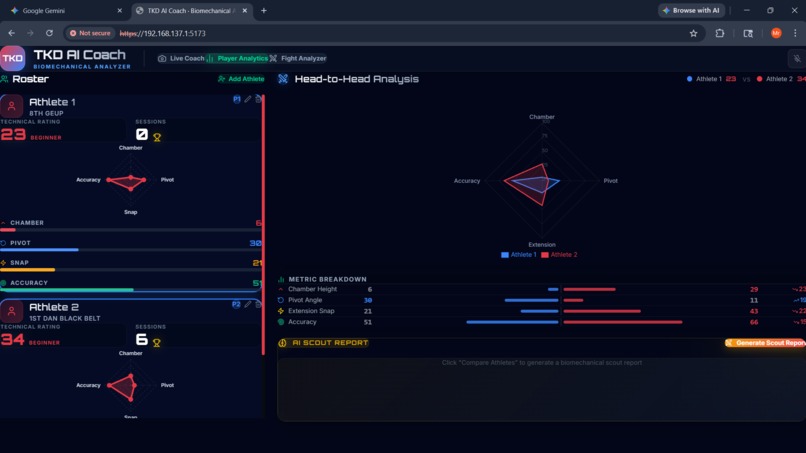
compare and analysis page
-
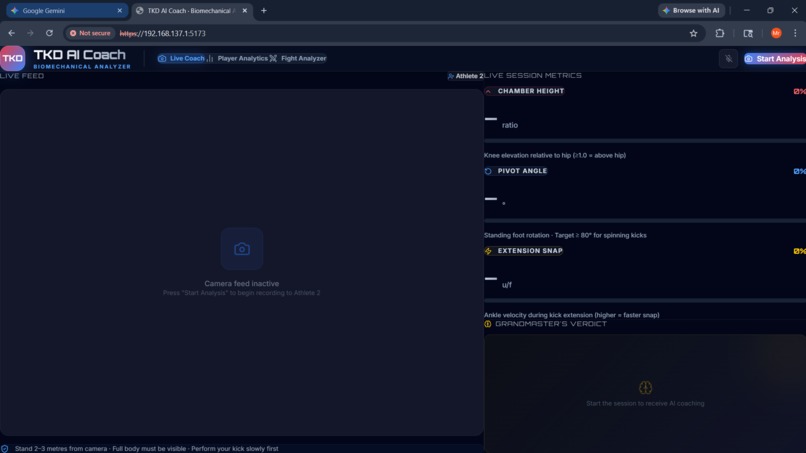
AI coach and live tracking and guiding
-
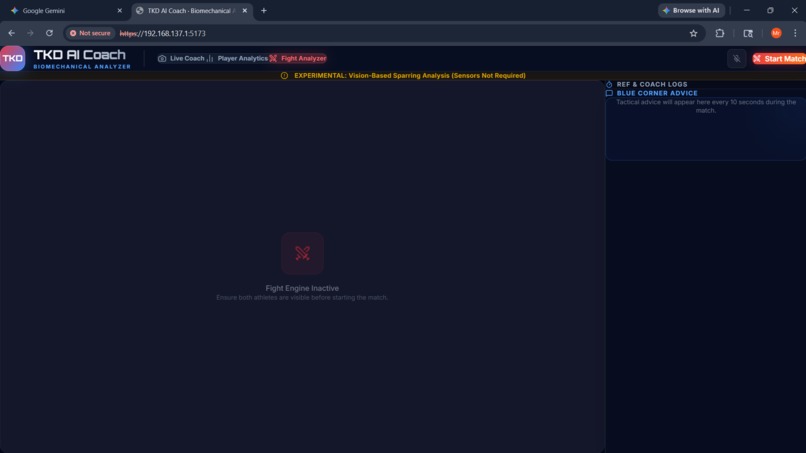
AI live fight analyzer and AI coach adviser
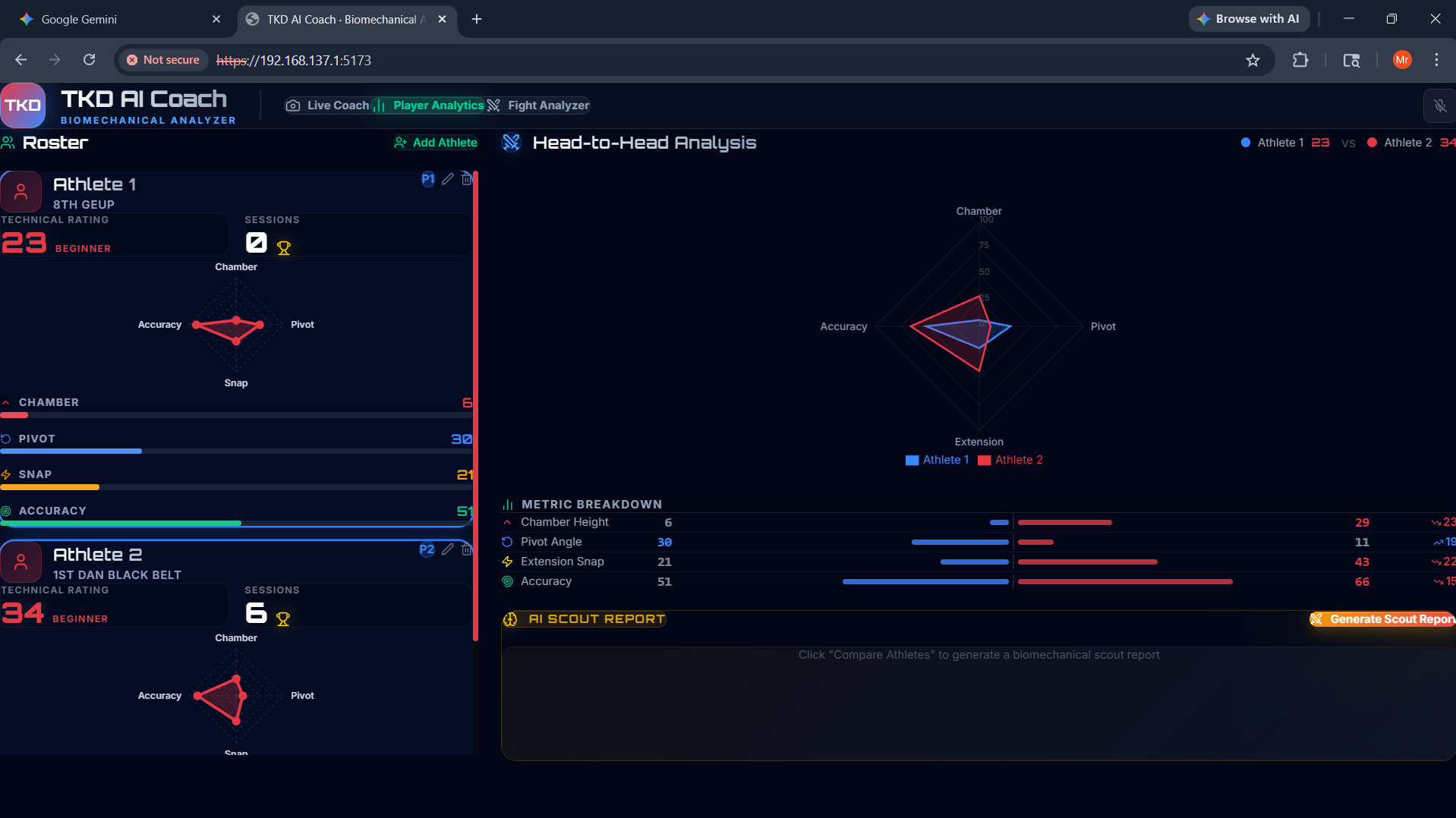
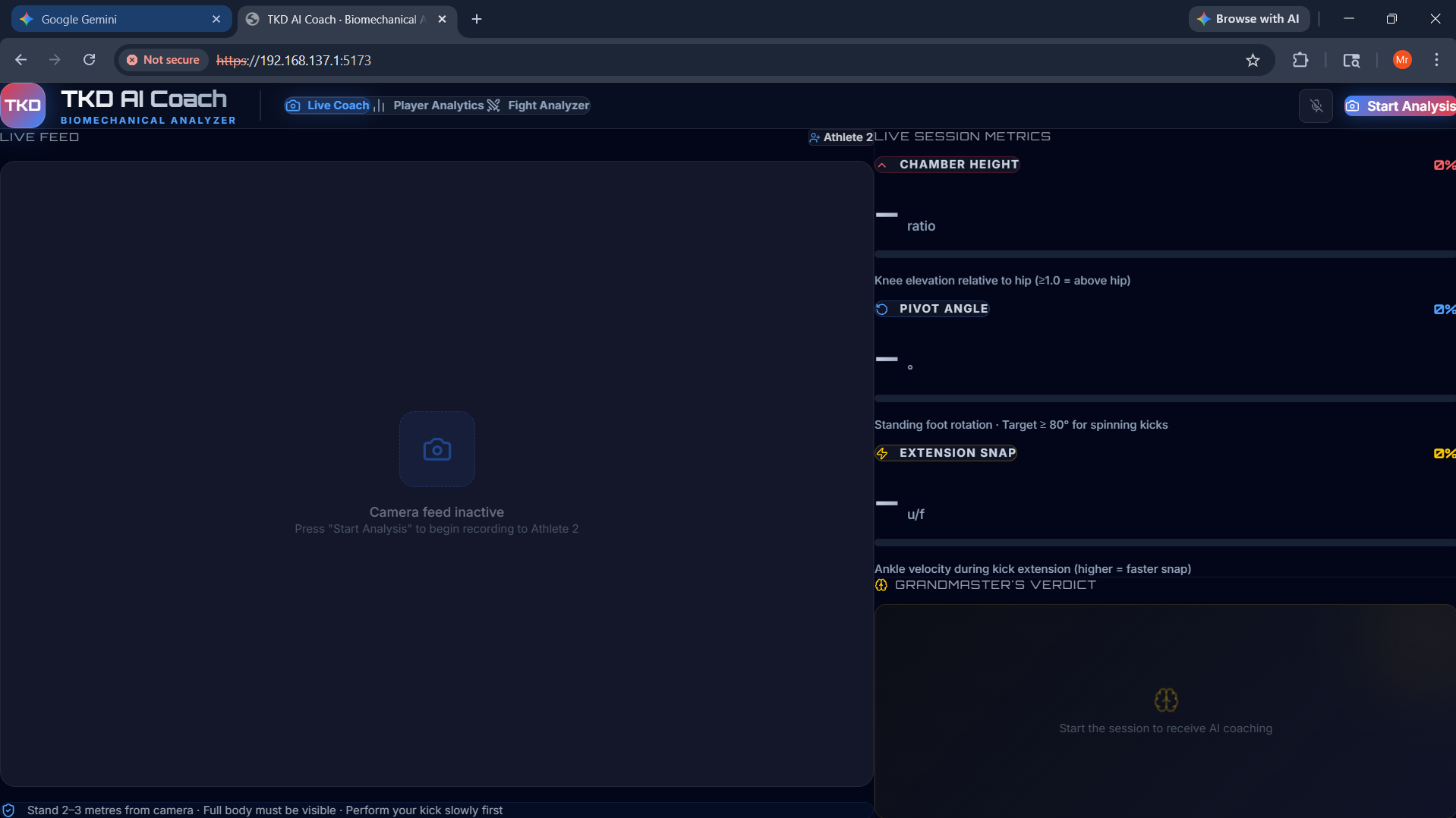
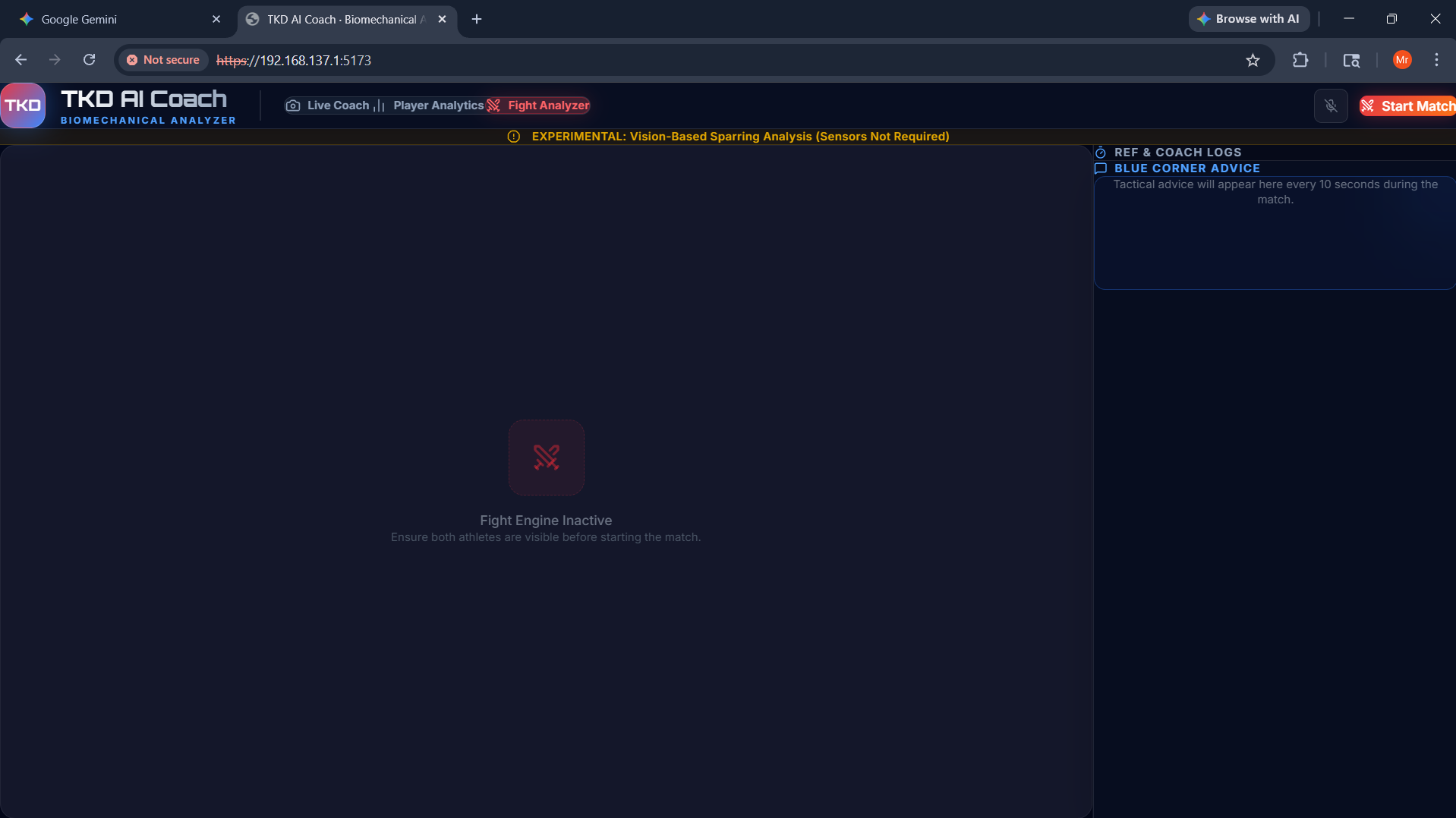
InspirationAs a 1st Dan Black Belt, I’ve seen the "technology gap" in martial arts firsthand. At international levels, athletes use expensive Electronic Protective Scoring Systems (PSS) costing over $5,000. Local clubs and individual students are often left behind. I was inspired to build TKD AI Coach to democratize elite training, creating a "Software-Defined Dojo" that provides world-class biomechanical analysis and fight scoring using nothing but a standard laptop webcam.What it doesTKD AI Coach is a comprehensive training and analysis suite. It uses Computer Vision to track 33 body landmarks in real-time.Virtual PSS: Simulates electronic gear by detecting scoring contact on "Ghost Hitboxes" (Head/Body) and identifying penalties like falling or stepping out of bounds.Live Coach: Uses Gemini Nano to provide 9th-Dan-level technical feedback on chamber height, pivot angles, and "snap" velocity.Performance Analytics: Features a Player Stats Maker and Comparison Tool that visualizes athlete data on Radar Charts to identify the "Winning Gap."Corner Selection: Allows users to toggle between Red and Blue corners for personalized strategic advice during a live fight.How we built itThe project is built on an On-Device First architecture for zero latency and total privacy:Vision Engine: Integrated MediaPipe Pose to process video at 30 FPS.Intelligence: Utilized Chrome’s built-in LanguageModel API (Gemini Nano) for real-time technical reasoning without cloud costs.Biomechanical Math: Developed a physics engine to calculate the Snap Velocity ($v$) and Pivot Angle ($\theta$):$$v = \frac{\sqrt{(x_2 - x_1)^2 + (y_2 - y_1)^2}}{\Delta t}$$$$\theta = \arccos\left(\frac{\vec{a} \cdot \vec{b}}{|\vec{a}| |\vec{b}|}\right)$$Frontend: Built with React, TypeScript, and Tailwind CSS v4 in the Antigravity IDE for rapid, agent-assisted development.Challenges we ran intoThe "No-Sensor" Problem: Detecting a "hit" without pressure sensors required complex spatial collision logic and trajectory prediction to differentiate between a near-miss and a valid impact.Browser API Volatility: Navigating the experimental 2026 LanguageModel states (like the downloadable status) required deep debugging of Chrome flags and session management.Multi-Person Occlusion: Maintaining "Sticky IDs" for Red and Blue players when they overlap or clinch during a fight was a major algorithmic hurdle.Accomplishments that we're proud ofI am proud to have built a Hardware-Free PSS that actually works. Achieving real-time, multi-person tracking on standard hardware like my Lenovo LOQ (RTX 3050) proves that high-level sports tech can be accessible. Successfully bridging my identity as a martial artist and a developer into one functional product is my biggest win.What we learnedI learned that AI is the ultimate equalizer. You don’t need $5,000 in sensors to solve complex problems; you need clever spatial reasoning and powerful on-device models. This project deepened my understanding of vector mathematics, low-latency state management, and the future of built-in browser AI.What's next for Taekwondo AI CoachThe next step is to integrate Multi-Modal Video Analysis via Gemini 1.5 Pro to allow for "Post-Match Scouting Reports" from uploaded sparring footage. I also plan to add Bluetooth support for low-cost DIY wearable sensors to combine the accuracy of hardware with the intelligence of my software-defined vision engine.


Log in or sign up for Devpost to join the conversation.