Tactograph
Helping people experience images through touch.
Inspiration
Like many of us, we grew up playing with pin art toys: those mesmerizing boards filled with hundreds of pins that could capture the shape of a hand, a face, or any object pressed against them.
What started as a childhood curiosity sparked a bigger question:
What if a pin art toy wasn't static? What if it could actively create shapes on demand?
As we explored that idea, we realized the potential extended far beyond novelty. Dynamic tactile displays could help make visual information more accessible to individuals who are blind or have low vision, opening new possibilities for education, exploration, and interaction.
Tactograph was born from the desire to transform a nostalgic childhood toy into a tool for accessibility and inclusion.
What It Does
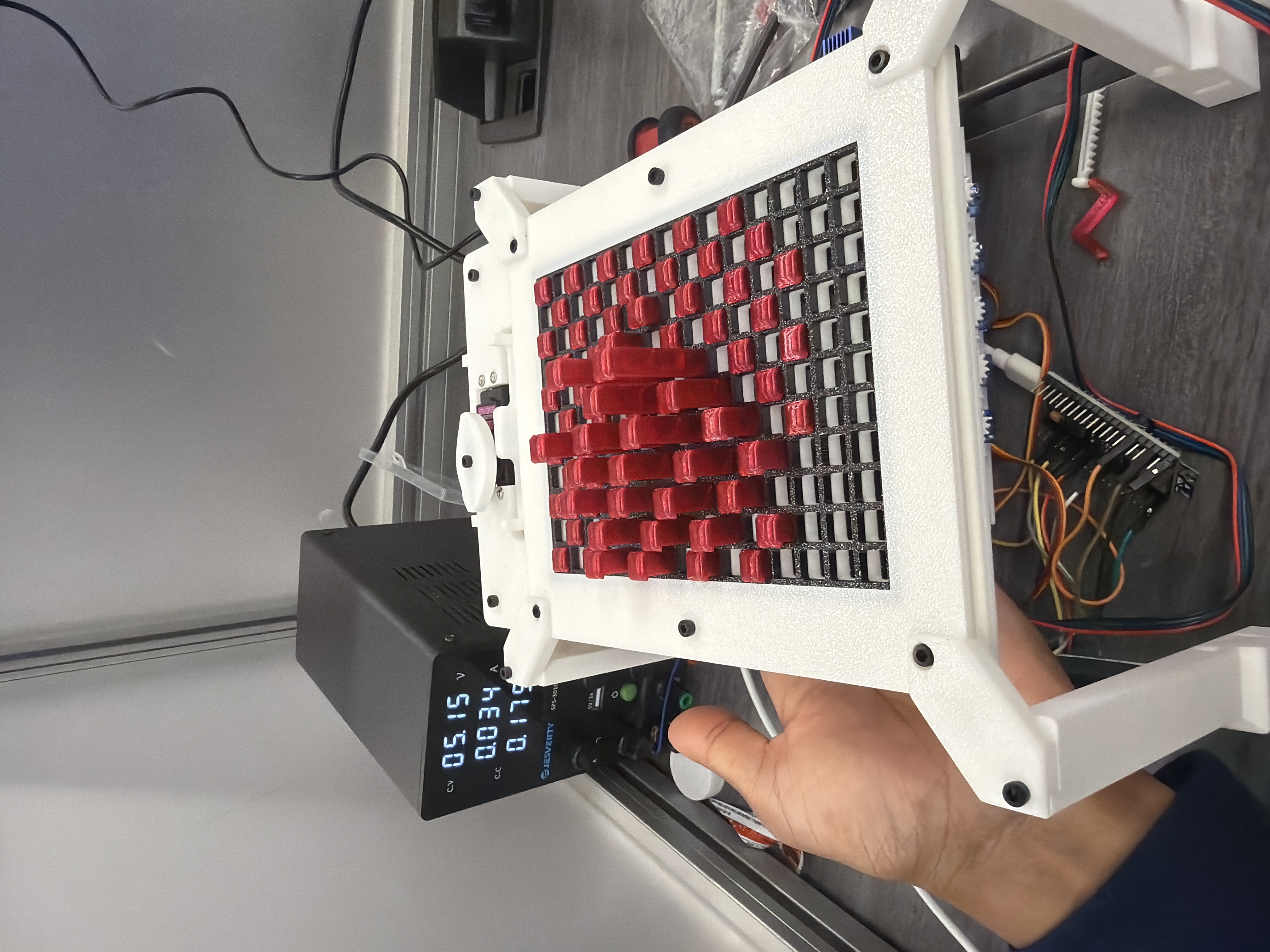
Tactograph is a dynamic tactile display that transforms digital information into physical, touchable forms.
Using a matrix of movable pins, the system can create shapes, patterns, and tactile representations that users can explore through touch. Whether displaying simple graphics, terrain-like surfaces, or future tactile interfaces, Tactograph makes information tangible.
Our vision is a future where important information can be experienced not only visually, but physically.
How We Built It
At first glance, the obvious solution seemed simple:
- One pin
- One motor
Unfortunately, that approach doesn't scale.
A display containing hundreds of pins would require hundreds of motors, making the system expensive, power-hungry, and mechanically complex.
Instead, we reimagined the architecture entirely.
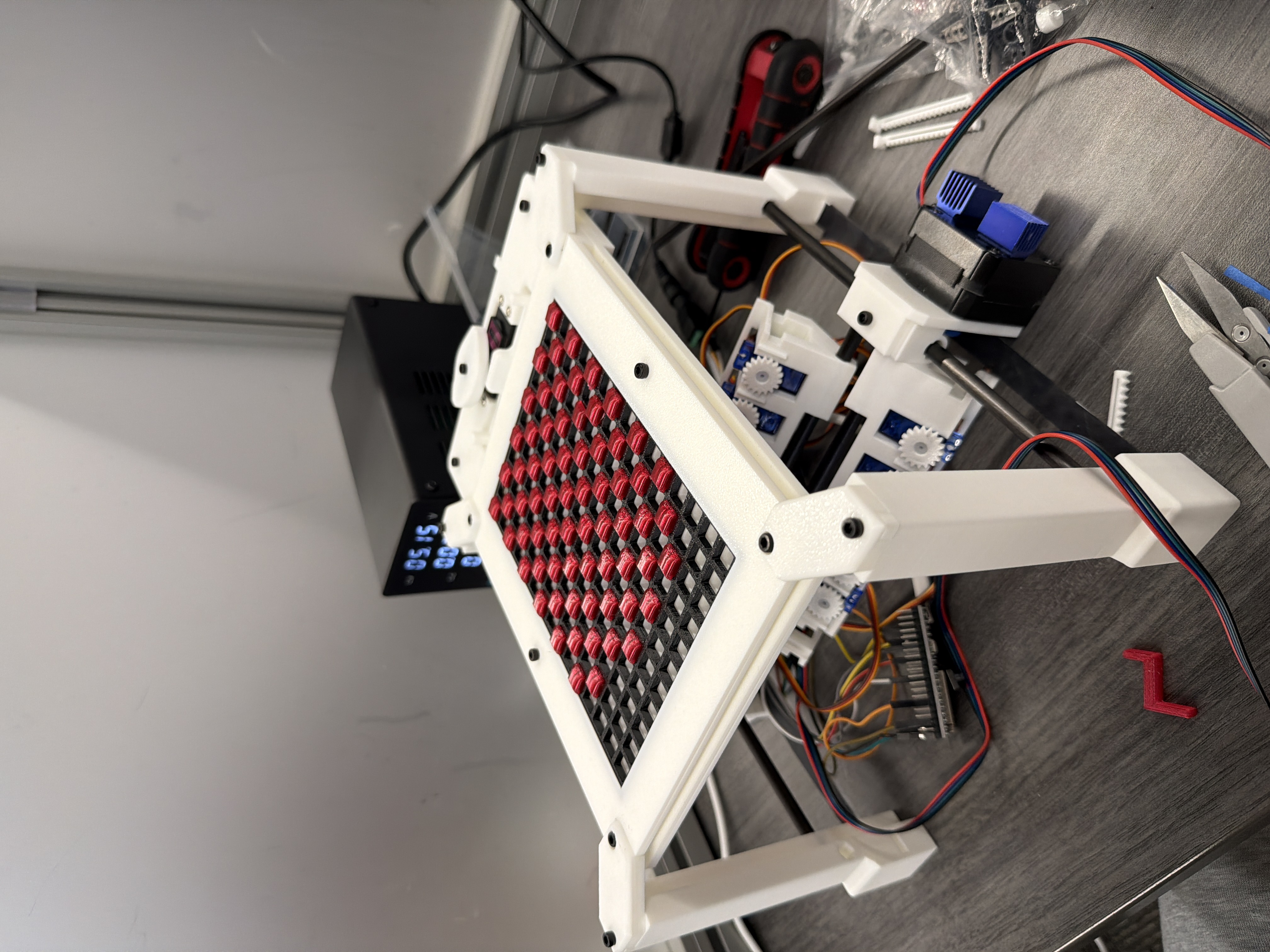
Pin Matrix
The top of the system contains a grid of vertically moving pins. Once a pin is pushed into position, it remains there until manually reset.
This means the system does not need to continuously power each pin, significantly reducing energy consumption.
Single-Axis Gantry
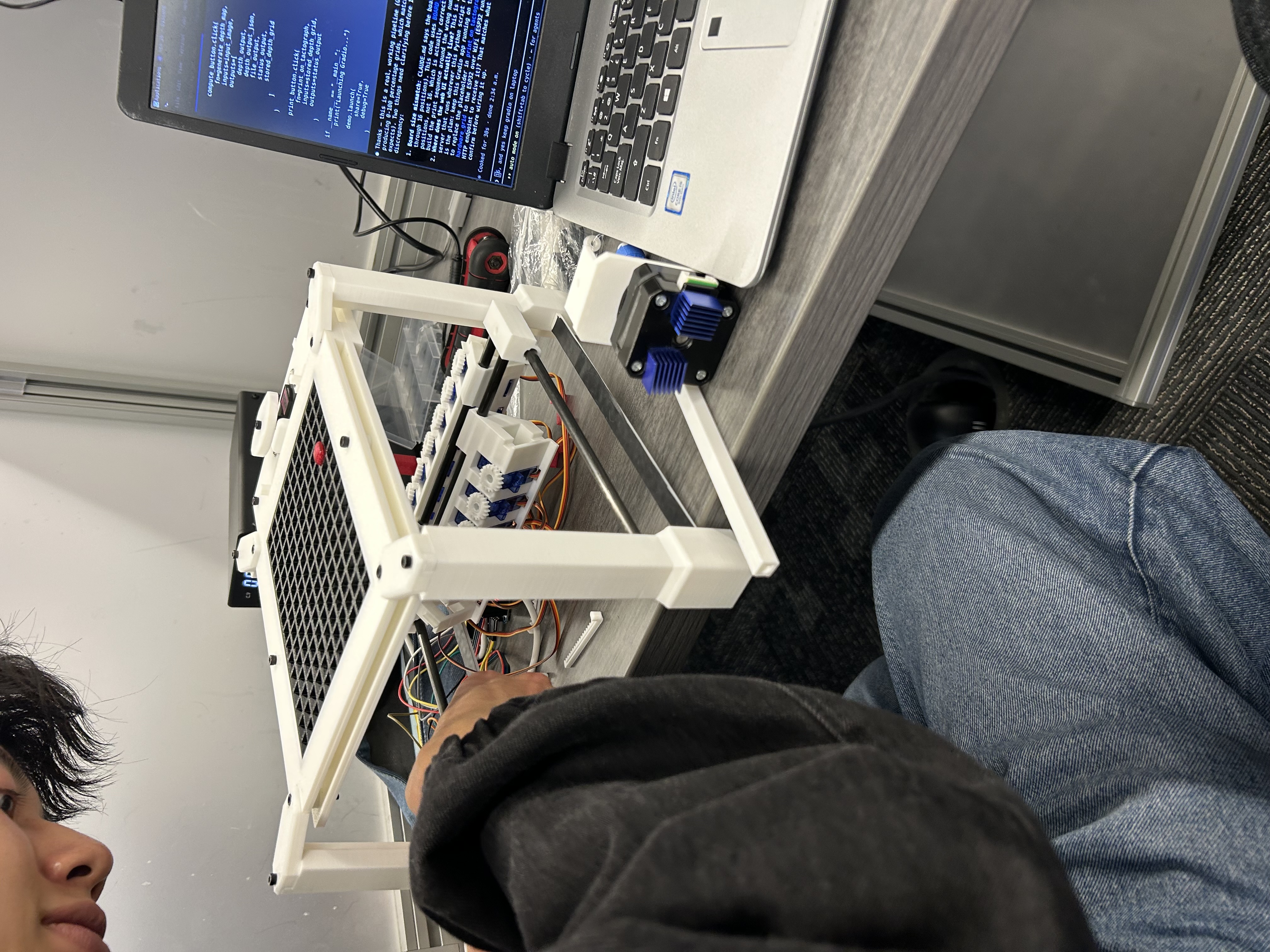
Rather than using a large and expensive X-Y positioning system, we designed a gantry that moves in only one direction.
A stepper motor drives the gantry beneath the pin board, allowing it to align with individual rows of pins.
Shared Servo Actuation System
The most innovative aspect of the project is our actuator-sharing architecture.
Instead of dedicating a motor to every pin, we use a row of servos positioned beneath the moving gantry.
When the gantry aligns with a row:
- The gantry moves into position.
- Individual servos rotate.
- A rack-and-pinion mechanism converts rotational motion into linear motion.
- Selected pins are pushed upward.
- The pins remain latched in place.
- The gantry advances to the next row.
This allows a single row of actuators to control an entire matrix of pins.
Why It Matters
We interact with an enormous amount of visual information every day, yet most of it can only be experienced through a screen.
Tactograph explores a different possibility: making digital information physically tangible.
The ability to convert images into touchable surfaces has applications far beyond a single use case. In healthcare, medical imagery such as X-rays, CT scans, and anatomical models could be explored through touch, providing a new way to understand spatial structures. In architecture and design, floor plans and 3D models could become tactile experiences rather than static visuals. In education, maps, diagrams, and scientific concepts could become interactive physical learning tools.
More broadly, Tactograph represents a step toward a future where information is not limited to pixels on a display. By making digital content tangible, we can create richer, more intuitive, and more inclusive ways for people to learn, explore, and understand the world around them.
Challenges We Faced
Designing a Pin Retention System
One of our biggest challenges was keeping pins raised after actuation without continuously consuming power.
To solve this, we designed a custom friction plate system that allows pins to remain in position after being raised. Finding the right balance between holding force and smooth movement required multiple design iterations and extensive testing.
Building a Fully Custom Mechanical System
Every major component of Tactograph was designed from scratch. From the pin matrix and friction mechanism to the gantry, actuator mounts, and rack-and-pinion assemblies, the entire system had to be engineered specifically for this project.
As the design evolved, maintaining proper tolerances, alignment, and manufacturability became increasingly challenging.
Managing 3D Printing Constraints
Because the prototype is entirely custom-built, every structural and mechanical component had to be 3D printed.
Different parts required different material properties, leading us to use three separate filament types to balance strength, flexibility, durability, and print quality. Managing print tolerances and ensuring reliable assembly across so many components became a significant challenge in itself.
CAD Complexity
What began as a simple concept quickly evolved into a highly detailed mechanical system.
The final design consists of:
- 165+ custom-designed parts
- 30.32 hours of 3D printing
- 3 specialized filament materials
Every subsystem required multiple rounds of prototyping, testing, and redesign before reaching a reliable and manufacturable solution.
Balancing Simplicity and Scalability
Traditional pin displays scale poorly because they typically require a dedicated actuator for every pin.
Our challenge was designing a system that could produce the same tactile output while remaining compact, affordable, and energy-efficient. Developing a reusable actuator architecture that controls an entire matrix with only a small number of motors required significant mechanical problem-solving and iteration.
What We Learned
This project taught us that accessibility challenges often require creative engineering solutions.
We learned:
- Mechanical design and CAD iteration
- Motion control systems
- Actuator optimization
- Prototyping and rapid design validation
- The importance of designing with accessibility in mind from the beginning
Most importantly, we learned that reducing complexity can sometimes lead to better solutions than simply adding more hardware.
What We're Proud Of
We're most proud of transforming a nostalgic toy into something with real potential impact.
Tactograph is more than a display of moving pins.
It's an exploration of how technology can make information more accessible, tangible, and inclusive.
By combining a childhood inspiration with modern engineering, we've taken a step toward a future where information can be seen, heard, and felt.
What's Next
We're excited to continue developing Tactograph by exploring:
- Higher-resolution displays
- Faster refresh speeds
- More compact actuation systems
- Tactile graphics for education
- Interactive maps and diagrams
- Real-time tactile visualization
Our long-term vision is simple:
Make information accessible through touch. Because everyone deserves a way to explore and understand the world around them.
Built With
- 3dprinting
- accessibility
- c
- cad
- esp32
- huggingface
- onshape
- python
- raspberry-pi
- servos
- stepper


Log in or sign up for Devpost to join the conversation.