-
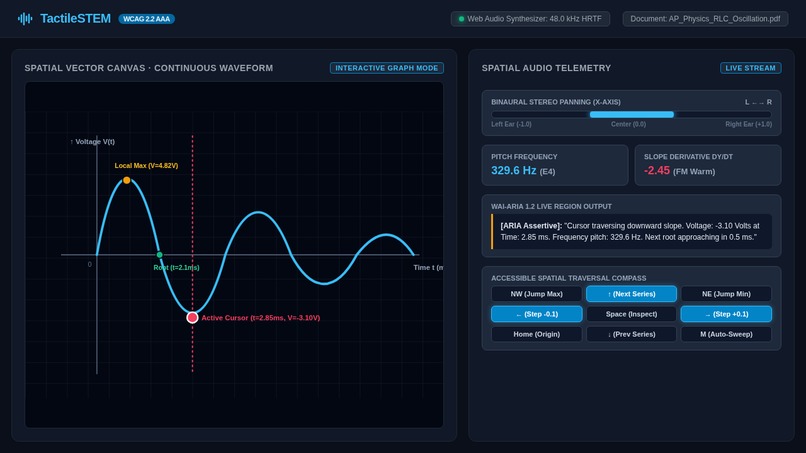
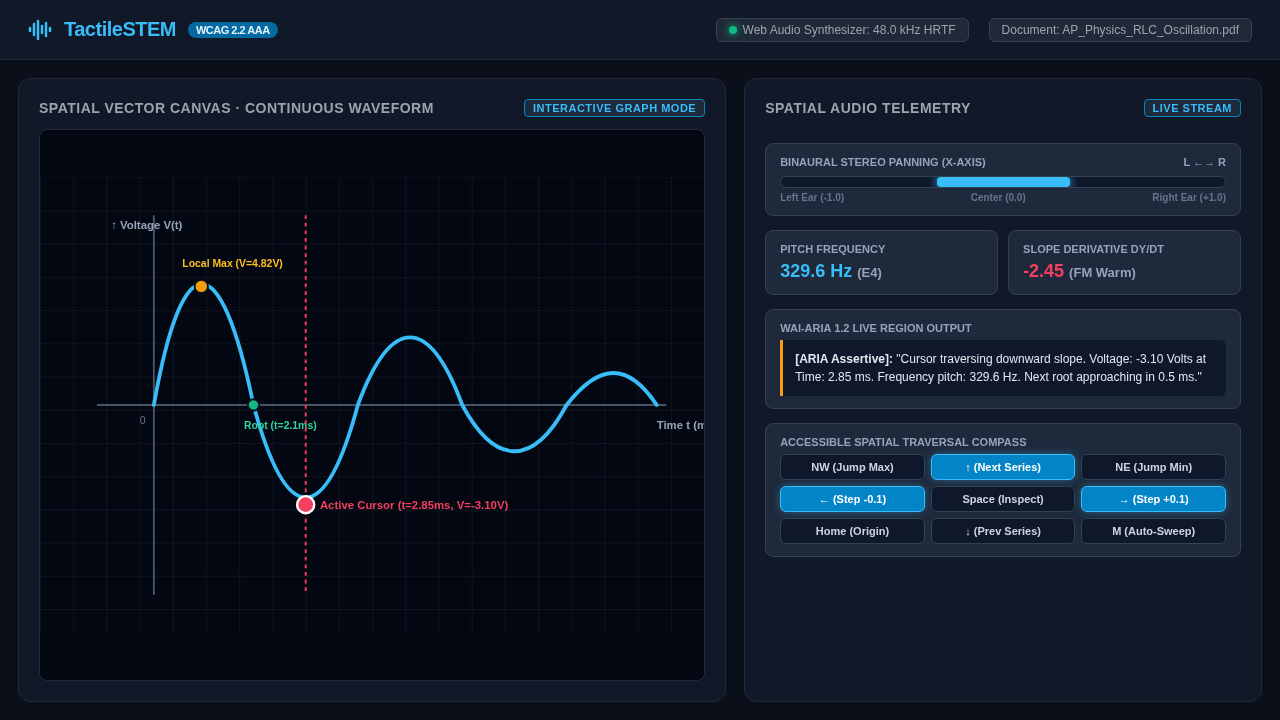
TactileSTEM Accessible UI with Interactive Coordinate Canvas and Binaural Telemetry
-
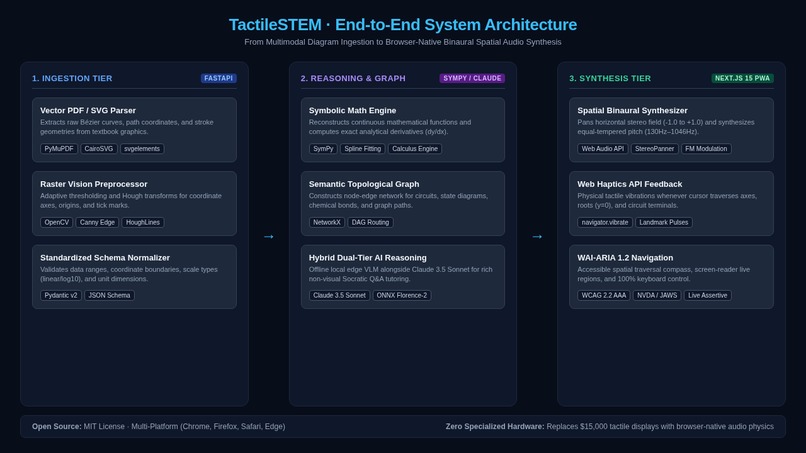
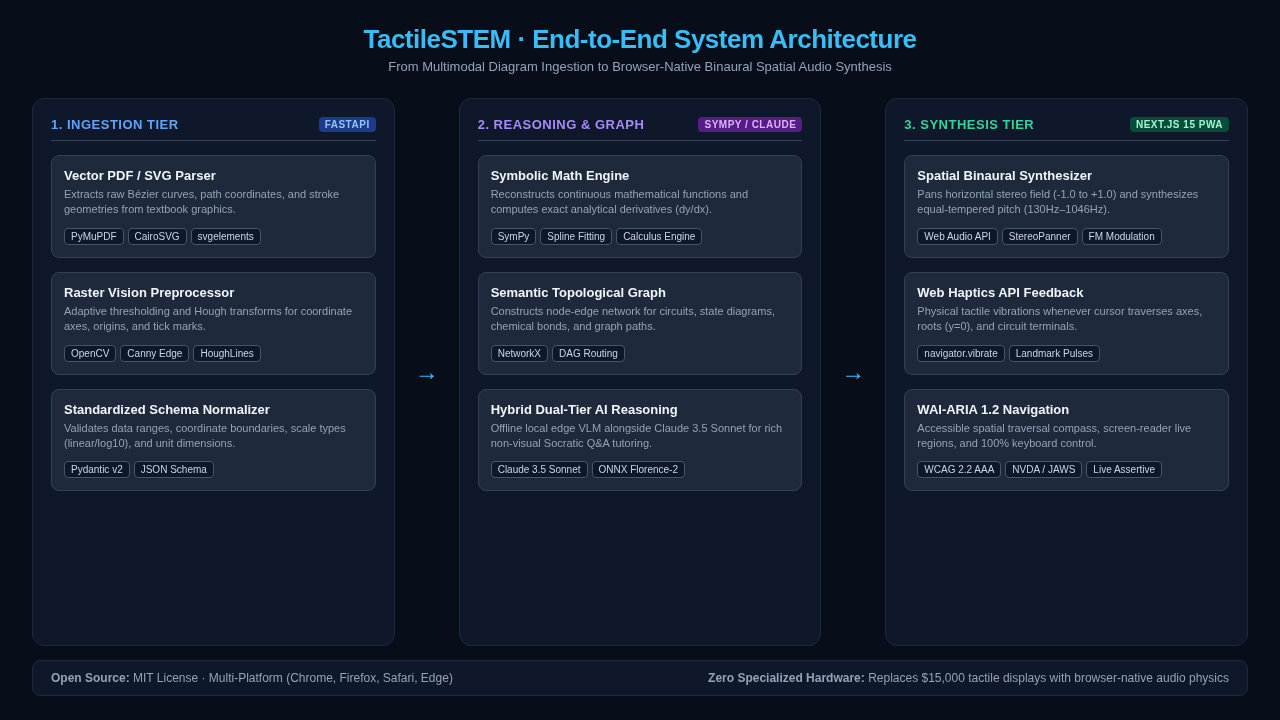
TactileSTEM End-to-End System Architecture (Ingestion to Spatial Synthesis)
-
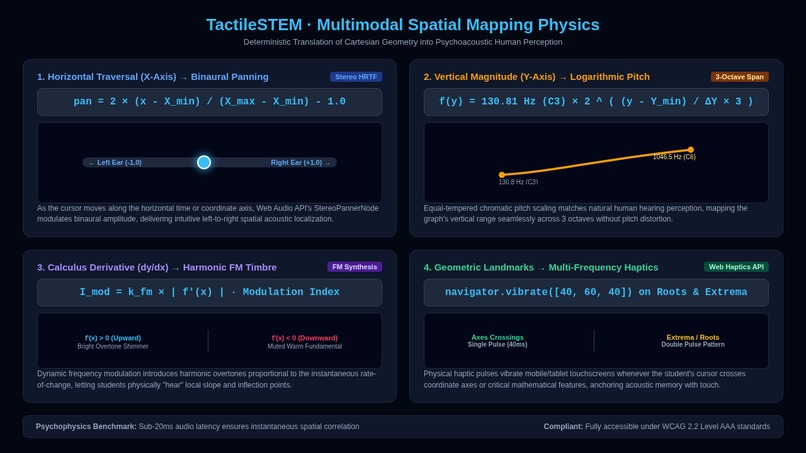
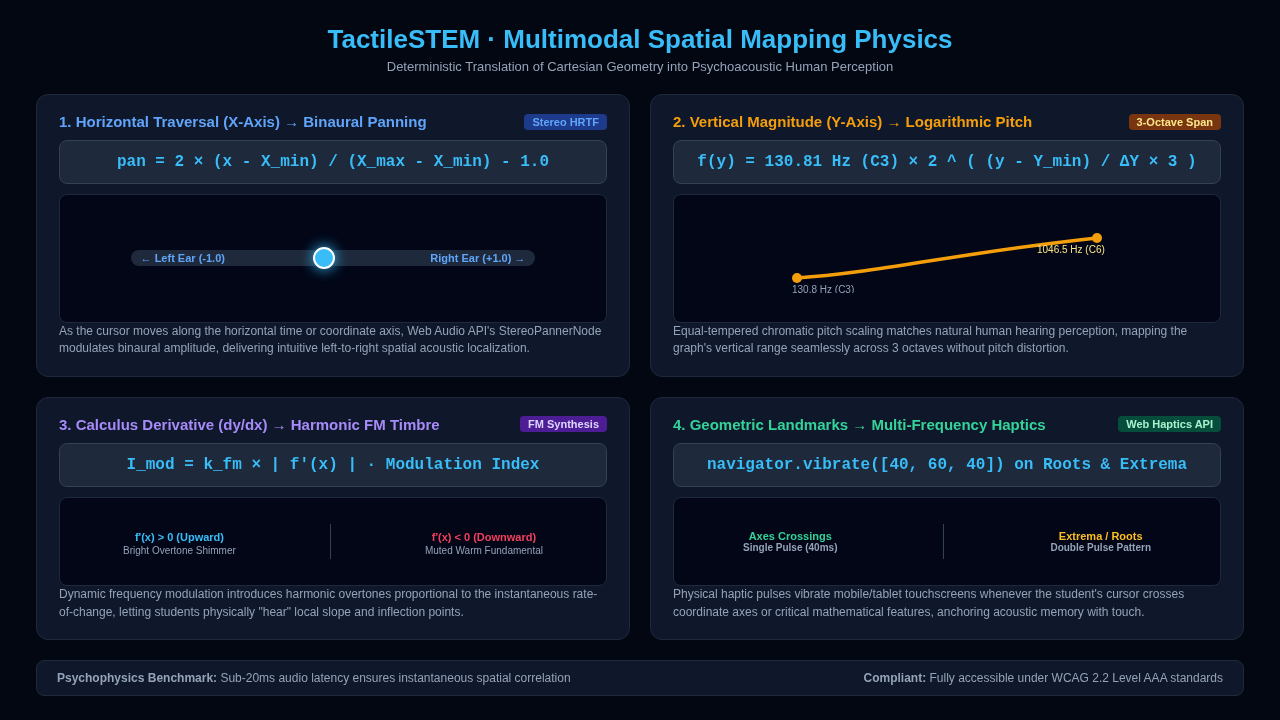
TactileSTEM Multimodal Spatial Audio Mapping Physics & Psychoacoustics
-

ChartSona multimodal sonification and interactive spatial comprehension banner

Problem Statement
Visual diagrams form the foundational language of STEM education. Key concepts across calculus, physics, circuit analysis, and data science are taught through spatial representations—coordinate curves, vector fields, and schematic layouts.
For the estimated 43 million individuals worldwide who are blind and 295 million living with moderate-to-severe visual impairment, this visual-first paradigm presents a structural barrier:
- Linearized Alt-Text: Traditional screen readers (JAWS, NVDA) linearize graphical information into high-level captions (e.g., "Figure 2: Plot of velocity versus time"), stripping away local extrema, inflection points, slopes, and intersection coordinates.
- Hardware Cost Prohibitions: Specialized tactile hardware—such as refreshable pin-matrix displays and braille embossers—ranges in price from $3,000 to over $15,000 per workstation, making them virtually unavailable in mainstream, under-resourced, or developing-world classrooms.
As a result, visually impaired students face severe informational bottlenecks in quantitative coursework, leading to high departure rates from technical majors despite high aptitude.
Proposed Solution: TactileSTEM
TactileSTEM is an open-source, browser-based accessibility framework that converts 2D mathematical and scientific figures into interactive spatial audio and tactile-haptic feedback. Operating entirely inside standard modern web browsers on consumer laptops and mobile devices, it requires zero proprietary hardware.
The Three-Layer Interaction Model:
- Macroscopic Audio Sweep ("Hear the Shape"): When a chart or curve loads, a 3-second auditory sweep plays through stereo headphones. The horizontal X-axis maps to stereo binaural panning (left-to-right), the vertical Y-axis value maps logarithmically to audio frequency (pitch across calibrated octaves from 130 Hz to 1046 Hz), and the first derivative (slope) controls continuous harmonic modulation.
- Point-by-Point Navigation ("Walk the Graph"): Using standard keyboard arrow keys or a numeric keypad, the student steps along the curve point-by-point. The Web Haptics API triggers distinct vibration pulses on supported touchpads and mobile devices whenever the cursor crosses zero, hits local extrema (peaks/valleys), or encounters schematic node junctions.
- Exact Value Verification & Socratic Inspection: Pressing the spacebar triggers WAI-ARIA live region speech announcements of exact coordinates, slope values, and semantic properties, allowing students to verify numerical facts directly without sighted assistance.
Guardrails and Abstention Architecture
A core safety requirement in quantitative education is preventing hallucinations or false confidence:
- Deterministic Core: The sonification engine is completely deterministic. Given the same coordinate series, the audio output is bit-for-bit identical and mathematically reproducible.
- Abstention on Uncertainty: If an uploaded vector diagram or SVG lacks verifiable axis scale ticks or clean geometry, the system explicitly abstains rather than inventing approximated coordinates.
- Review-and-Correct Table: Every parsed figure generates an editable, screen-reader-accessible data table before audio generation, allowing the student or educator to inspect and correct raw numbers.
Technical Architecture & Implementation
- Frontend / Client: Next.js 15 PWA styled with Tailwind CSS, built strictly to WCAG 2.2 Level AAA standards (7:1 contrast ratios, focus visible rings, zero mouse dependency).
- Audio Synthesizer Engine: Native Web Audio API implementation utilizing
StereoPannerNode,GainNode, and calibrated multi-timbre oscillators (sine,triangle,sawtooth) for clean series separation. - Parsing & Coordinate Extraction: Python 3.12 / FastAPI microservice parsing vector SVGs and PDFs via
CairoSVGandPyMuPDF, alongside deterministic CSV tabular parsing. - Mathematical Modeling:
SymPyfor continuous curve fitting, differentiation, and root finding;NetworkXfor circuit schematic node-edge topology extraction. - Haptic Feedback:
navigator.vibrate/ Web Haptics API calibrated to produce 15ms haptic taps on landmark intersections.
Target Beneficiaries & Educational Impact
- Primary Beneficiaries: Blind and low-vision (BLV) students in middle school, high school, and undergraduate STEM courses (calculus, physics, statistics, electrical engineering).
- Secondary Beneficiaries: STEM educators, teaching assistants, and university Offices of Disability Services seeking fast diagram conversion without lengthy specialist transcription backlogs.
- Measurable Impact: Reduces the transcription turnaround time for accessible course figures from 3–6 weeks down to under 5 seconds, enabling students to participate in live lectures and complete problem sets alongside sighted peers.
Additional Information & Verification Plan
- Zero-Data Retention Policy: All figure parsing and audio synthesis execute client-side in the browser session. No student coursework or test figures are persisted or stored on external cloud infrastructure.
- Hardware Agnostic: Validated on standard Google Chrome, Mozilla Firefox, and Apple Safari running on macOS, Linux, Windows, ChromeOS, and Android.
- Pilot Methodology: Structured single-user feasibility study with university Disability Resource Centers measuring comprehension accuracy across 5 standardized STEM curve questions, comparing auditory-haptic navigation directly against traditional text alt-text baselines.
- License & Availability: Open-source under Apache 2.0. Repository: https://github.com/dumbthing999-ui/tactile-stem
Built With
- aria
- fastapi
- javascript
- next.js
- opencv
- python
- sympy
- tailwind-css
- web-audio-api
- web-speech-api

Log in or sign up for Devpost to join the conversation.