Inspiration
As a medical graduate, I’ve witnessed the challenges of surgical training, especially for procedures like mastoidectomy that require precise drilling near critical structures. My friend, an otolaryngologist specializing in plastic reconstruction, often shared her struggles with training residency students due to a lack of adequate tools for mastoidectomy.
Traditional options such as cadavers or animal models are expensive, limited in availability, and often raise ethical concerns. Additionally, these methods typically require specific professionals to facilitate the learning process, which can create scheduling challenges and limit the time students have to engage with these resources (Robbins et al., 2008; Guze, 2015).
In contrast, virtual reality (VR) systems offer several advantages, including broad accessibility, ease of use without requiring specialized instructors, and the elimination of the need for dedicated physical spaces. However, despite these benefits, current VR systems fall short in providing tactile realism and haptic feedback. This limitation significantly impacts their effectiveness in teaching psychomotor skills, which rely on realistic touch and feel to develop competency (Botden et al., 2008).
As a mom, I enjoy playing with my child, and one day, I realized her wax toys had quite suitable tactile properties. This discovery inspired me to explore the possibility of combining such a tactile medium with VR to develop a cost-effective and reusable training tool with realistic potential.
Logitech's MX Ink MR Stylus further opened the door to enhanced realism by providing a tool that may resemble how surgeons hold and manipulate a drilling burr. With these elements combined, we envisioned a solution that could help bridge the gap in current training methods while being ethical, cost-effective, and scalable.
What it does
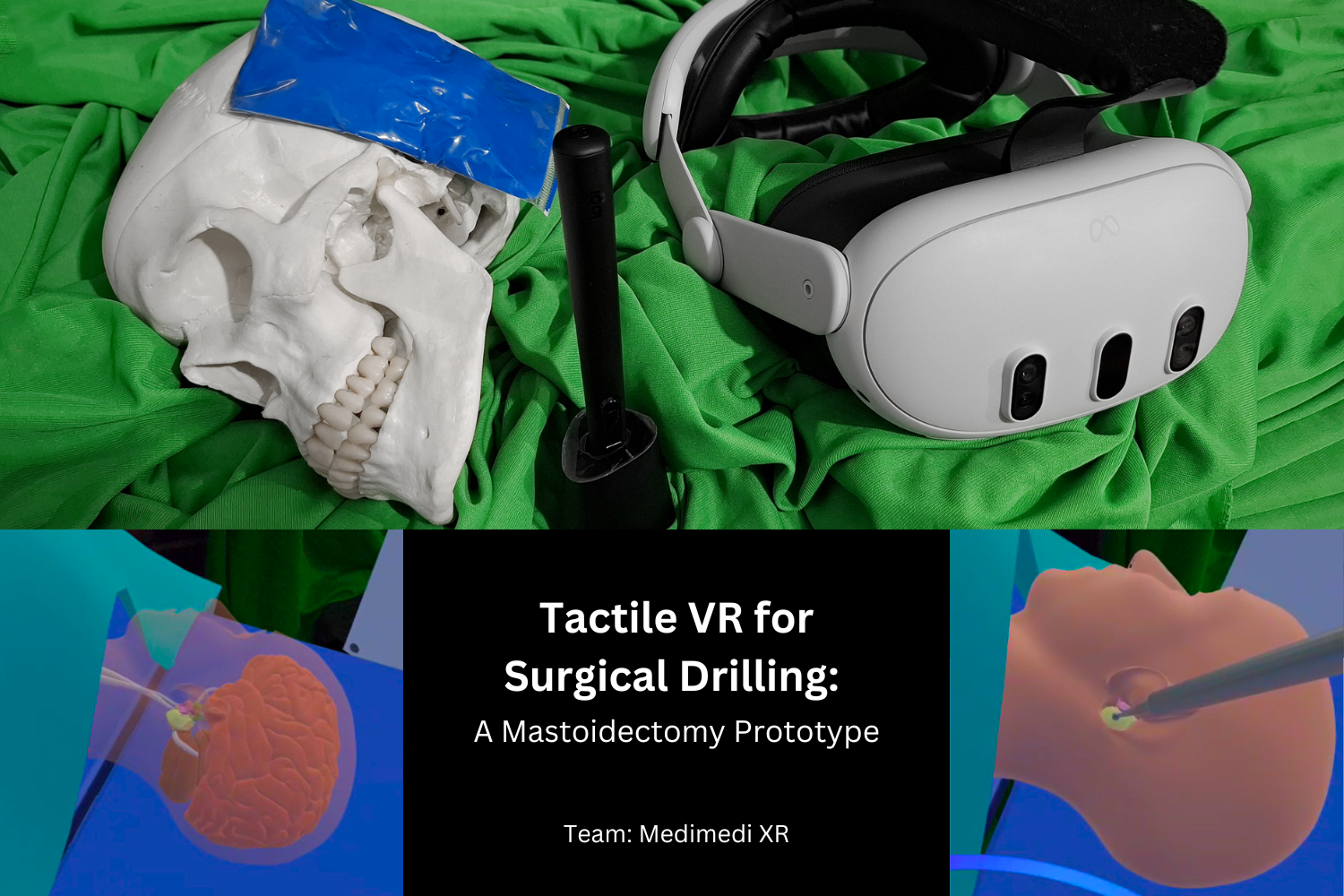
Tactile VR for Surgical Drilling is a training platform that combines:
- A stylus (Logitech's MX Ink MR Stylus) to simulate a surgical drill, providing realistic feedback and control.
- A tactile medium, tested on a dummy skull combined with wax toys at the mastoid part of the temporal bone, replicating the resistance and texture of real bone.
- A VR environment developed using Simlab Soft, offering detailed anatomical overlays to guide trainees and highlight critical structures such as the facial nerve and sigmoid sinus. The system shows potential to improve psychomotor skill training and provide an ethical, scalable supplement to traditional methods.
How we built it
- 3D models development: we build mastoid surgical area combining various sources. (Attribution: The 3D model is a derivative of "Anatomy of the Inner Ear" by Annie Campbell (licensed under CC BY-NC-SA 4.0), which itself is a derivative of "3D Ear" by W. Robert J. Funnell, PhD; Sam Daniel, MD, CM; and Daren Nicholson, MD, CM (licensed under CC BY-NC-SA 1.0), as well as Z-Anatomy (licensed under CC BY-SA 4.0) and BodyParts3D - The Database Center for Life Science (licensed under CC BY-SA 2.1 Japan), and this derivative work is licensed under CC BY-NC-SA 4.0.)
- Tactile Medium Development: Inspired by wax toys, we tested various reusable and/or cost-effective materials on a dummy skull, focusing on the mastoid part of the temporal bone. These tests were conducted on top of a skull mannequin (owned by the Department of Anatomy, Universitas Indonesia).
- VR Environment and Stylus Integration: Using Simlab Soft Platform
Challenges we ran into
- Material Realism: Finding a tactile medium that felt realistic, affordable, and reusable was challenging. However, given time constraints and the primary goal of demonstrating the feasibility of using a tactile medium with VR and a stylus, we decided to proceed with the best option available to continue development.
- Virtual-Physical Integration: Aligning the tactile medium, stylus, and virtual object to work seamlessly posed technical challenges.
- Time Constraints for Full VR Implementation: While we initially planned for a fully immersive VR environment, time limitations led us to implement a mixed reality setup instead. This allowed us to focus on enhancing the tactile interaction and stylus functionality while still demonstrating the system's potential. Transitioning to full VR remains a future goal.
Accomplishments that we're proud of
- Innovative Integration: Successfully combining the Logitech MX Ink MR Stylus, tactile medium, and Simlab Soft VR to create a cost-effective training tool.
- Potential to ethically complement cadavers and animal models with a scalable and reusable solution, reducing some barriers to surgical training.
What we learned
- The Value of Collaboration
- Innovation in Everyday Objects: Inspiration can come from unexpected places, such as children’s toys, to solve complex problems.
- Ethics and Accessibility Matter: Creating an equitable and sustainable training solution can make a significant difference in global medical education.
What's next for Tactile VR for Surgical Drilling: A Mastoidectomy Prototype
- Transitioning to Full VR: Explore transitioning from the current mixed reality setup to a fully immersive VR environment, aiming to provide a more engaging and realistic training experience
- Enhanced Realism: Conduct further research to refine the tactile medium and stylus integration, aiming to match the fidelity of cadaver-based training.
- Broader Applications: Expand the system for other procedures like cranial burr holes, dental surgeries, and orthopedic drilling.
- Advanced Analytics: Integrate AI to provide deeper insights into trainee performance and customized feedback.
- Replacing the Skull Mannequin: Investigate the use of more accessible, everyday objects to replace the skull mannequin, making the system easier to adopt and more cost-effective for wider use.
- Global Accessibility: Develop portable kits for medical schools and hospitals in resource-limited areas, ensuring equitable access to advanced training tools.
References: Botden, S. M. B. I., Torab, F., Buzink, S. N., & Jakimowicz, J. J. (2008). The importance of haptic feedback in laparoscopic suturing training and the additive value of virtual reality simulation. Surgical Endoscopy, 22(5), 1214–1222. https://doi.org/10.1007/s00464-007-9589-x Guze, P. A. (2015). Using Technology to Meet the Challenges of Medical Education. TRANSACTIONS OF THE AMERICAN CLINICAL AND CLIMATOLOGICAL ASSOCIATION, 126. Robbins, B. D., Tomaka, A., Innus, C., Patterson, J., & Styn, G. (2008). Lessons from the dead: The experiences of undergraduates working with cadavers. Omega: Journal of Death and Dying, 58(3), 177–192. https://doi.org/10.2190/OM.58.3.b
Built With
- simlabsoft


Log in or sign up for Devpost to join the conversation.