
About the TactileText Project 📖✨
Inspiration 💖
A gut-wrenching realization hit me: 253 million people globally are visually impaired, with a significant majority in my home country, India. The existing solutions for their education, such as Digital Braille Displays, cost thousands of dollars – an exorbitant sum for those in developing nations. This financial barrier leads to a tragic deprivation of basic education for a massive segment of society. Witnessing this profound inequality, I was compelled to leverage my skills to create an affordable and practical solution that could truly make a difference.
What It Does 🚀
TactileText is a revolutionary two-part solution, combining custom hardware with intuitive software, to empower the visually impaired:
Hardware 🖨️ (Affordable Digital Braille Cell)
- A custom-designed and prototyped digital braille cell.
- Composed of 6 electromagnetic actuators for dynamic braille dot formation.
- Driven by a Darlington transistor array via an Arduino Uno microcontroller.
Software 📱 (Intelligent Mobile App)
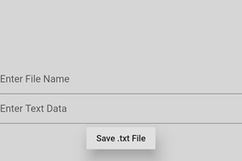
- Developed with Flutter for cross-platform compatibility.
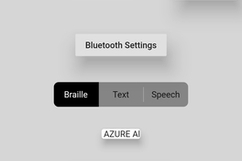
- Communicates with the braille cell via Bluetooth for real-time data transmission.
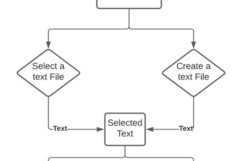
- Integrates Azure Cognitive Services to seamlessly convert:
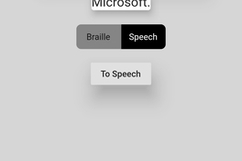
- Digital text to braille and speech.
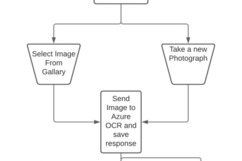
- Printed text (via OCR) to braille and speech.
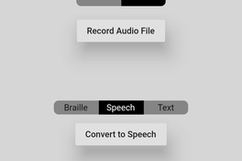
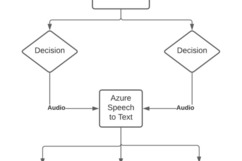
- Spoken words (via speech-to-text) to braille and speech.
- Provides comprehensive educational content accessibility, ensuring a visually impaired person can truly understand and learn.
How I Built It 🏗️
The journey of TactileText began with the core idea of building a truly affordable braille cell. However, I quickly realized that access to content was just as crucial as the display itself. This insight sparked the development of the mobile application.
The app connects to the braille display via Bluetooth, utilizing serial communication to transmit data. This data, formatted into bytes, is precisely manipulated to control the PORTB of the ATMEGA328 on the Arduino, thereby actuating the braille dots in real-time. The mobile app leverages Azure Cognitive Services to transform diverse educational content (digital text, scanned printed text, and speech) into dynamic braille and spoken output.
Challenges I Ran Into 🚧
My biggest hurdle was diving into app development. As primarily a hardware enthusiast, I had zero experience with mobile applications. Suddenly, I was tasked with creating a complex app under tight deadlines, making my first-ever API calls, and mastering multipart POST requests to communicate with Azure Cognitive Services – all while operating as a one-man team. It was incredibly demanding, but the moment everything clicked and worked as intended, the sheer joy of the "maker spirit" was indescribable.
Accomplishments That I'm Proud Of ✨
- Cost-Effective Innovation: Successfully created a hardware braille solution costing less than $20 USD, a monumental reduction from the thousands of dollars current competitors charge. This makes it truly accessible to those in developing nations.
- Full-Stack Integration: Developed an app that seamlessly integrates Azure Cognitive Services for content conversion and communicates in real-time with a custom-built digital braille display via Bluetooth.
- Pioneering Real-time Actuation: Designed a unique, custom protocol for real-time data transmission from a mobile app to an array of linear actuators, a novel approach I haven't seen implemented elsewhere.
What I Learned 💡
This past month has been a whirlwind of learning! I transitioned from being solely a microcontroller and hardware lover to immersing myself in the world of app development. I discovered the incredible ease of integrating sophisticated features, even those mimicking human-level cognition, into software. More importantly, I learned the profound beauty of giving back – not through donations, but by dedicating my time and intellect to solving a critical problem that affects 253 million people, a challenge often heartlessly ignored by the rest of the world.
What's Next for TactileText 🚀
- Robustness: Improving exception handling for a more resilient user experience.
- Language Expansion: Extending language preferences by leveraging the vast support of Azure Cognitive Services for almost every major language.
- User-Centric Refinement: Spending more time with visually impaired students to gather continuous feedback and drive further improvements.


Log in or sign up for Devpost to join the conversation.