-
-
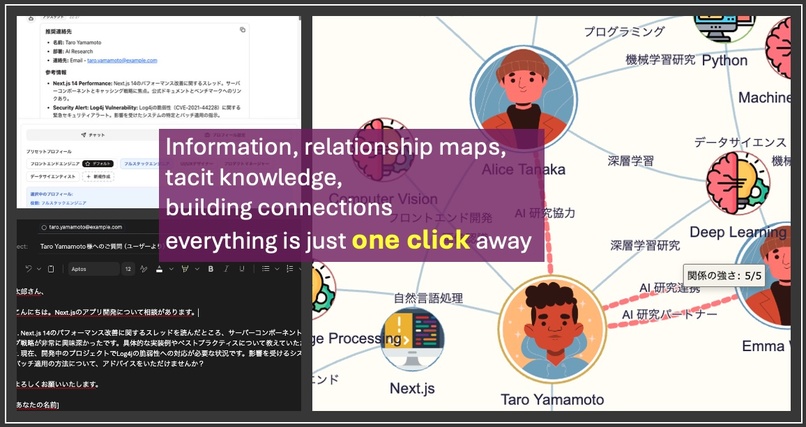
TacitAi: Information, relationship maps, tacit knowledge, building connections everything is just one click away
-
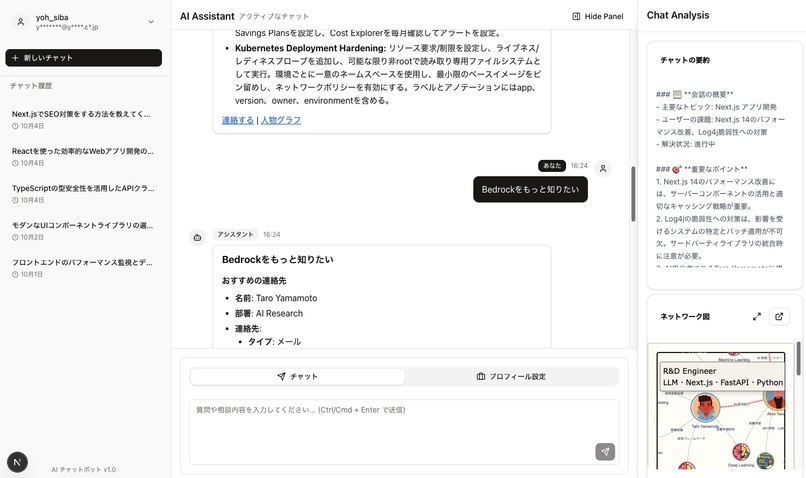
TacitAi: Chat, Summary and Graph


Inspiration
Tacit knowledge is a profound and difficult problem faced by all projects. AI agents offer new possibilities for solutions.
Types of tacit knowledge related to a project and their causes:
Tacit knowledge: Buried in vast amounts of documentation, and the tacit knowledge itself is numerous and complex.
External information: Programming rules for specific platforms, best practices for specific programming languages.
Lack of explicit documentation: Lack of time, belief that "you should know."
We focus on the most common and influential 1 and 3.
What it does
Based on the user's identity and skills, the system retrieves relevant information from the knowledge base, along with tacit information, and then searches for the most suitable contact person and creates the appropriate contact method. If a user still cannot understand the information provided due to unwritten tacit information and wishes to contact the most suitable contact person, a textual question and background information is automatically generated, guiding the user to quickly contact the contact using the most appropriate method. The generated text is also automatically translated into the appropriate language based on the most suitable contact information, enabling fast and efficient tacit information exchange.
How we built it
Building TacitAi (タシタイ) required a sophisticated multi-layered approach that combined cutting-edge AI orchestration with enterprise-grade infrastructure. Our journey began with recognizing that traditional monolithic AI systems couldn't effectively capture and leverage the nuanced, tacit knowledge that flows through organizations daily.
Core Architecture & AI Orchestration We chose AWS as our foundation, implementing a serverless architecture using Lambda functions, API Gateway, and DynamoDB for scalability and cost-effectiveness. The heart of our system is the StrandsAgents orchestration platform, which we enhanced with parallel execution capabilities. Our three-agent pipeline includes InfoCollector for keyword extraction, PeopleFinder for human expertise mapping, and ResponseBuilder for persona-aware responses.
Intelligent Knowledge Search We integrated keywords and semantic search to deliver context-aware, high-relevance results across work task analysis. A Keywords Finder extracts domain terms and quoted phrases, while semantic similarity uses cosine scoring with weighted title, excerpt, and context signals. Historical learning captures team patterns in DynamoDB, updating success rates and recommendations. Feedback loops refine models, ensuring faster discovery and ranked, actionable insights aligned to team workflows.
Security & Compliance Framework We implemented comprehensive IAM roles, VPC isolation, and encryption at rest and in transit. Our authentication system integrates with SAML/IAM Identity Center, supporting attribute-based access control (ABAC) to ensure users only access information they're authorized to see. All resources follow our automated tagging governance policy for compliance and cost allocation.
Development & Testing Strategy Our approach included infrastructure as code using AWS CDK, comprehensive test suites achieving 100% pass rates across 43 test scenarios.
Challenges we ran into
Multi-Agent Orchestration Complexity Our biggest technical challenge was designing an agent orchestration system that could handle complex dependencies while maintaining performance. Initially, our sequential agent execution was taking over 2 seconds per query. We solved this by implementing hybrid orchestration strategies, combining parallel execution for independent agents (info search and tacit search) with sequential processing for dependent operations. This required careful state management and error isolation to prevent cascading failures.
Integrated keywords and semantic search We integrated keywords and semantic search to deliver context-aware, high-relevance results across work task analysis. Beyond documents, our greatest innovation is fusing explicit knowledge (“normal information”), tacit knowledge inferred, and routing to the most suitable contact person. A Keywords Finder extracts domain terms and quoted phrases; semantic similarity uses cosine scoring over titles, excerpts, and context. While expertise mapping identifies experts, accelerating discovery and action across teams.
Accomplishments that we're proud of
Performance Excellence & System Reliability We achieved remarkable performance improvements through intelligent optimization. Our agent pipeline with search operations completing in half the time through parallel execution. Most importantly, we maintain a 100% success rate across our test suites.
Comprehensive Test Coverage & Quality Assurance We're particularly proud of our rigorous testing approach, achieving 100% pass rates across 43 comprehensive test scenarios. Our test suite covers system integration (12 tests), user acceptance testing (16 tests), performance validation (8 tests), security validation (5 tests), and requirements compliance (2 tests). This thorough approach caught potential issues early and gives us confidence in our production readiness.
Revolutionary Tacit Knowledge Capture Our greatest innovation is combining normal information, tacit informationa and the most suitable contact person.
Enterprise-Grade Security & Compliance We implemented comprehensive security measures that meet enterprise standards. Our authentication system supports SAML/IAM Identity Center integration with attribute-based access control, ensuring users only access authorized information. We maintain encryption at rest and in transit, implement VPC isolation, and follow automated resource tagging for compliance. Security validation found zero critical vulnerabilities across our entire system.
Intelligent Agent Orchestration Platform The StrandsAgents orchestration system we developed represents a significant advancement in multi-agent AI systems. Our platform supports multiple execution strategies (sequential, parallel, conditional, hybrid). This foundation enables future expansion and provides a model for other organizations building similar systems.
Real-World Business Impact Our system demonstrates measurable business value through improved knowledge accessibility and decision-making speed. Teams can now quickly find relevant expertise within their organization, access tacit knowledge that would otherwise be lost, and finding the best person to contect to gain deep tacit information.
What we learned
Multi-Agent Systems Require Sophisticated Orchestration Building TacitAi taught us that effective multi-agent systems need more than just chaining AI models together. We learned the critical importance of intelligent orchestration strategies, state management, and error isolation. Our experience showed that parallel execution can dramatically improve performance (50% in our case), but only when carefully designed to handle dependencies and failure modes. The investment in building robust orchestration infrastructure pays dividends in system reliability and maintainability.
Tacit Knowledge is Organizational Gold We discovered that tacit knowledge—the informal conversations, decision contexts, and experiential insights shared in daily team interactions—represents enormous untapped value in organizations. Traditional search systems miss this entirely, focusing only on formal documents. Our work revealed that finding the best conteat person is the powerful appraoch to find deep tacit information.
Infrastructure as Code Accelerates Development Using AWS CDK for infrastructure as code dramatically accelerated our development cycle. We learned that treating infrastructure with the same discipline as application code—version control, code review, automated testing—creates more reliable and maintainable systems. Our automated deployment pipelines and resource tagging governance provide confidence in production deployments.
What's next for TacitAi (タシタイ):a tacit knowledge AI assistant
Advanced AI Capabilities & Learning Systems We can develope next-generation features that will make TacitAi even more intelligent and valuable. Our roadmap includes implementing machine learning models that continuously improve knowledge extraction and relevance ranking based on user interactions. We plan to introduce adaptive orchestration that automatically switches execution strategies based on load patterns and historical performance data. Additionally, we're building an experimental A/B testing framework to optimize agent pipeline configurations in real-time.
Expanded Enterprise Integration & Ecosystem TacitAi will soon support additional enterprise platforms including Salesforce, ServiceNow, Notion, and Microsoft SharePoint. We're developing a pluggable agent marketplace that will allow organizations to add custom agents for specialized domains like financial analysis, legal research, or technical documentation. Our vision includes creating an ecosystem where third-party developers can contribute agents, expanding TacitAi's capabilities across industries and use cases.
Advanced Analytics & Business Intelligence We're building sophisticated analytics capabilities that will provide organizations with insights into their knowledge flows, expertise networks, and decision-making patterns. These features will include visual knowledge maps showing how information flows through teams, expertise identification algorithms that highlight subject matter experts, and trend analysis that identifies emerging knowledge gaps or areas of innovation.
Our ultimate vision is to make TacitAi the leading platform for capturing, preserving, and leveraging organizational tacit knowledge—transforming how organizations learn, collaborate, and innovate.
Built With
- bedrockagentcore
- cognito
- ecr
- ecs
- fastapi
- next.js
- node.js
- python
- strandsagents
- typescript


