
Inspiration
Given Toyota's sponsorship at this event, we brainstormed how technology could revolutionize the car-buying experience. Our answer was visualization. The car financing process is overwhelming with countless options, confusing terms, and complex trade-offs. We wanted to create a tool that transforms this abstract financial maze into something visual, explorable, and intuitive. Instead of spreadsheets and calculators, why not explore your financing options like you're navigating through space? The emergence of Google's Gemini 2.0 gave us the perfect foundation to make personalized financial recommendations feel like an adventure through the stars.
What it does
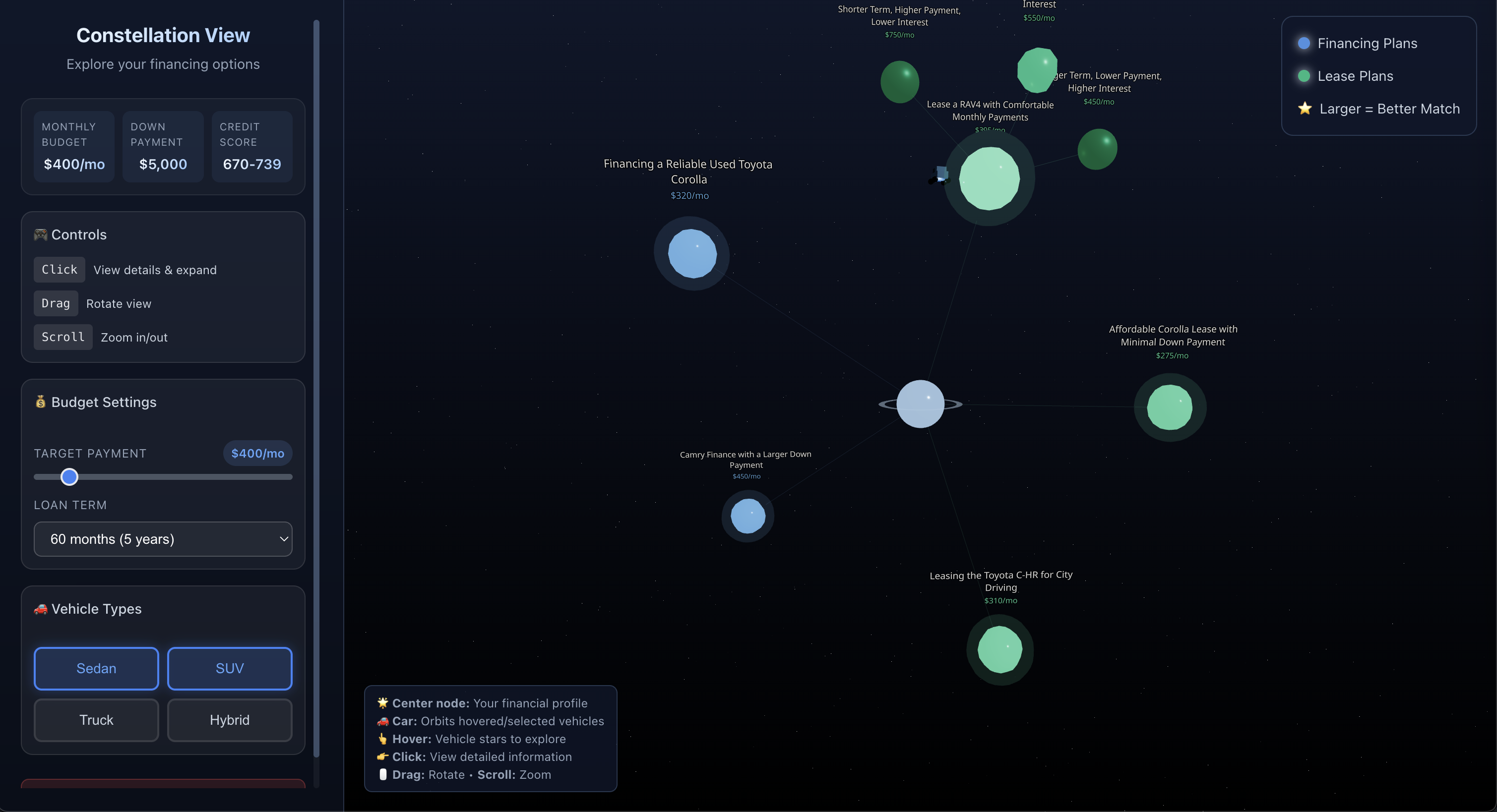
Tachyon guides users through a conversational AI interview, gathering their financial profile, vehicle preferences, and budget constraints. The system then generates a personalized 3D constellation where each star or planet represents a unique financing scenario tailored to the user's situation.
Users can click any node to expand it, revealing deeper branches of financial alternatives. Each expansion explores a different aspect like payment structures, trim levels, warranties, insurance options, maintenance plans, and even trade-in scenarios. The nodes use visual cues like size to show how well each option matches your needs, and colors to distinguish financing plans in blue from lease plans in green. As you explore deeper, the constellation grows into a sprawling universe of possibilities, letting you discover financing paths you never knew existed.
How we built it
- Frontend: React, TypeScript, and Three.js with React Three Fiber
- Backend: Python, FastAPI, with Google Gemini 2.0
- Database: SQLite, SQLAlchemy
- Authentication: Google OAuth
Challenges we ran into
- Implementing ADK models and connecting the workflow so that data processing is efficient and organized
- Managing Google Gemini API rate limits and switching from the experimental model (50 requests/day) to Gemini 2.0 Flash (1,500 requests/day) without losing performance.
- Preventing node collisions in 3D space as the constellation grew, requiring sophisticated collision detection with retry mechanisms and z-axis variability.
- Creating intuitive camera controls that kept clicked nodes centered while keeping the information modal visible.
- Designing four distinct node styles that were both beautiful and meaningful.
Accomplishments that we're proud of
- Building a 10-level deep exploration system that lets users dive into incredibly specific financing scenarios, from basic monthly payments all the way to refinancing and alternative vehicle options.
- Designing an AI agent system that conducts natural conversations and generates contextually relevant scenarios in real-time.
- Making complex financial data feel approachable and even fun through stunning 3D visuals with planetary rings, glowing effects, and smooth animations.
What we learned
- How to orchestrate multiple AI agents working together, each with specialized roles and structured outputs.
- That financial data becomes engaging when presented through intuitive visual metaphors like stars and planets instead of tables and charts.
- Strategic API usage and model selection are crucial for managing costs in AI-powered applications.
What's next for Tachyon
We'd love to expand Tachyons' use cases, deploying it for all to try and fiddle with for themselves!


Log in or sign up for Devpost to join the conversation.