-
-
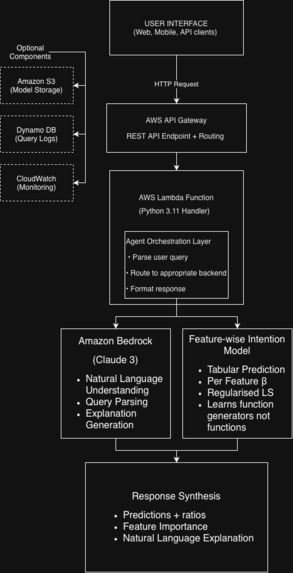
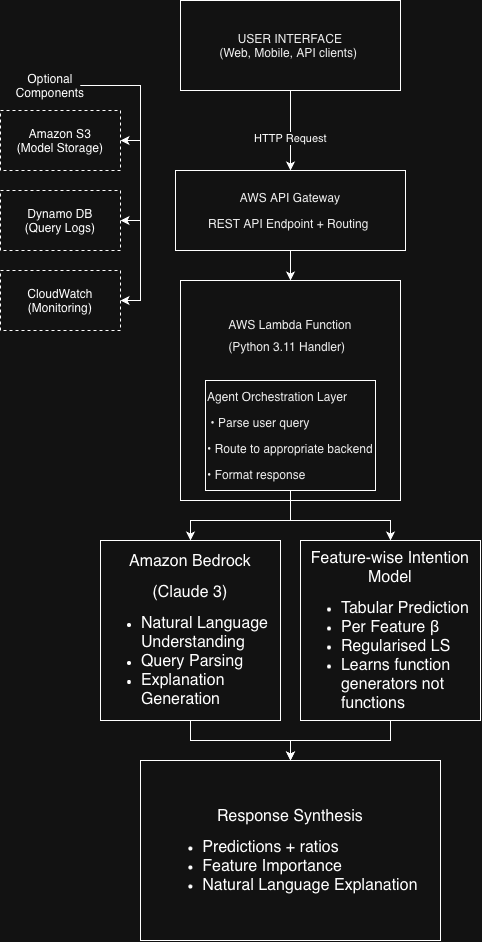
diagram
Project Story
The $50 Billion Problem Nobody Talks About
Enterprises spent over $50B on LLM infrastructure in 2024, but there's a dirty secret: these models fail spectacularly on the data that actually matters. While GPT-4 can write poetry and Claude can reason through complex arguments, ask them to predict credit defaults or detect fraud from transaction tables, and they plateau around 70% accuracy. That's barely better than random guessing. Meanwhile, decades-old decision trees quietly achieve 80-90% accuracy on the same data.
This isn't a training problem or a prompt engineering problem. It's an architecture problem. Transformers are fundamentally designed for sequences where order matters and relationships are smooth. But enterprise data including customer records, financial transactions, medical diagnostics; has no natural order, sharp decision boundaries, and heterogeneous types (categorical + numerical). We're forcing square pegs into round holes, then wondering why billions of dollars of GPU infrastructure underperforms simple XGBoost models.
The Innovation: Feature-Wise Intention Mechanism
Our breakthrough comes from replacing attention's global softmax with per-feature least squares regression. Instead of computing one shared transformation across all features (which destroys the semantic meaning of "age" vs "income"), we solve independent regularized regressions for each feature dimension. This seemingly simple change fixes all three fundamental failures of transformers on tabular data: it allows non-smooth decision boundaries, naturally downweights irrelevant features through spectral regularization, and respects the coordinate system where specific features matter (breaking rotation invariance).
The math is elegant: Q[K^T K + αI]^(-1) K^T V computed per feature rather than globally. The results are dramatic: 87% accuracy vs 71% for standard transformers vs 60% for LLMs such as LLama3.1 on credit risk prediction—a 16-percentage-point improvement that translates to millions in prevented losses for financial institutions. We've packaged this as a production-ready agentic system on AWS: Bedrock provides the conversational interface (business users ask questions in natural language), our Feature-wise Intention model handles specialized tabular predictions (with mathematical guarantees and regulatory compliance), and Lambda + API Gateway deliver serverless scale.
Why This Matters Now
Every enterprise has tables in their CRM, ERP, and data warehouses. Every AI strategy starts with "How do we make LLMs useful for our business data?" And every data scientist knows tree-based models still win on structured data. This project is bridging that gap. Not by throwing more compute at the problem, but by designing architectures that match the mathematical structure of tabular data. This is how AI becomes genuinely useful for the 99% of business decisions that aren't about generating text.

Log in or sign up for Devpost to join the conversation.