-
-
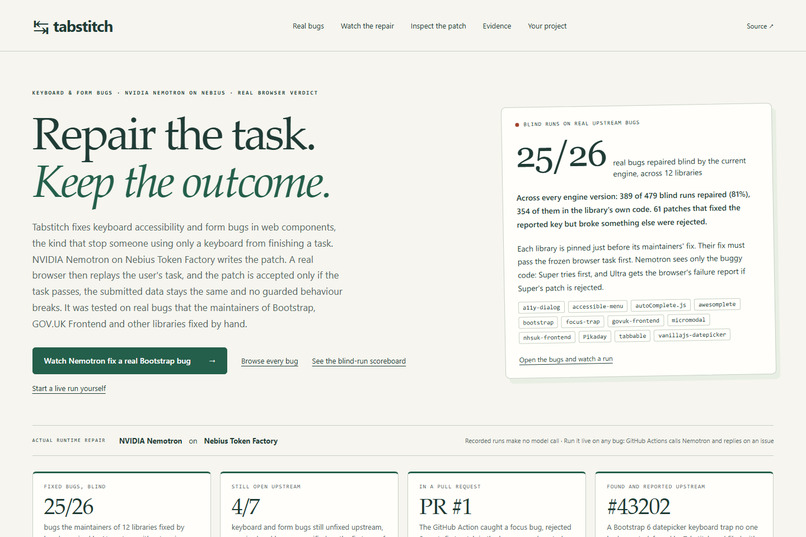
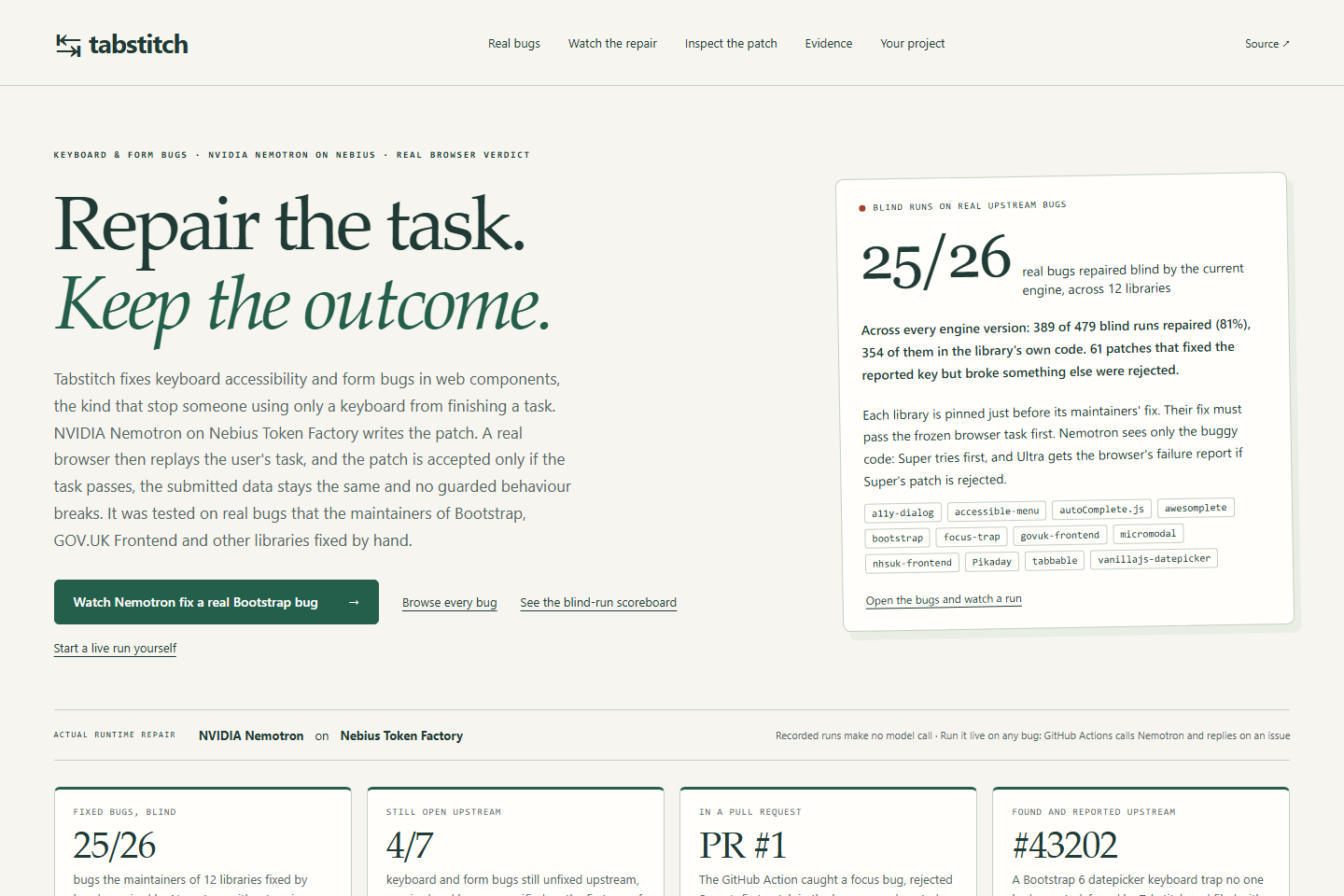
Tabstitch repairs keyboard and form bugs with NVIDIA Nemotron on Nebius, then verifies each patch in Chromium.
-
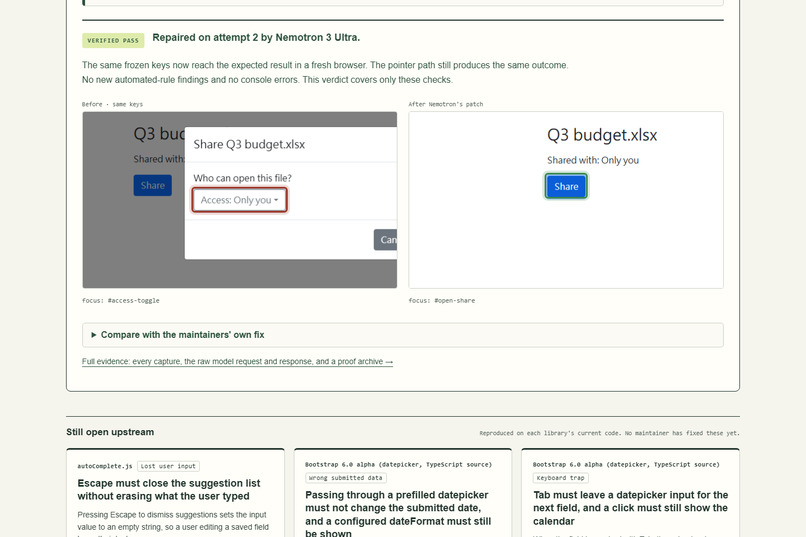
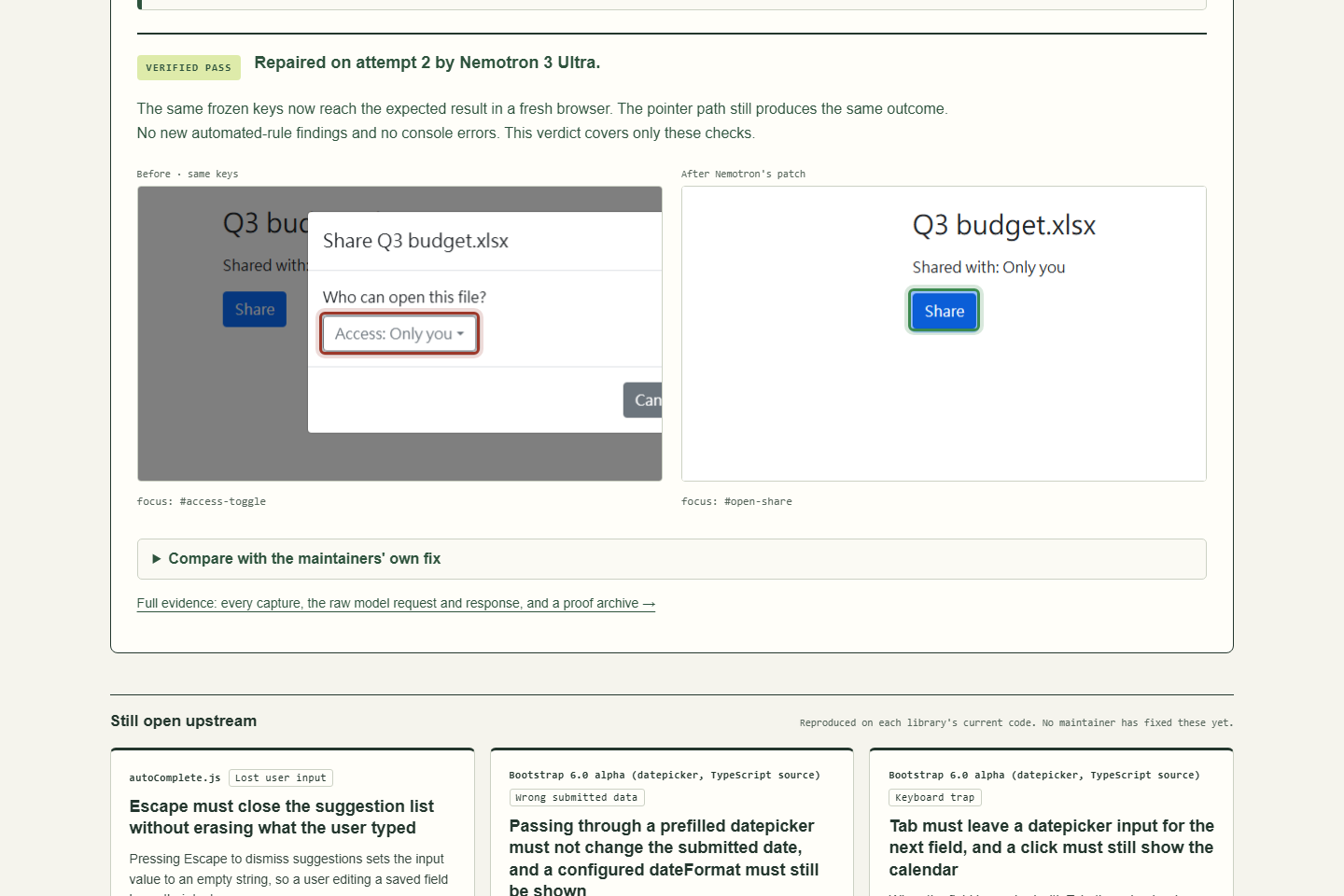
Before and after: Escape leaves the Bootstrap modal stuck open; the verified repair closes it and returns focus to Share.
-
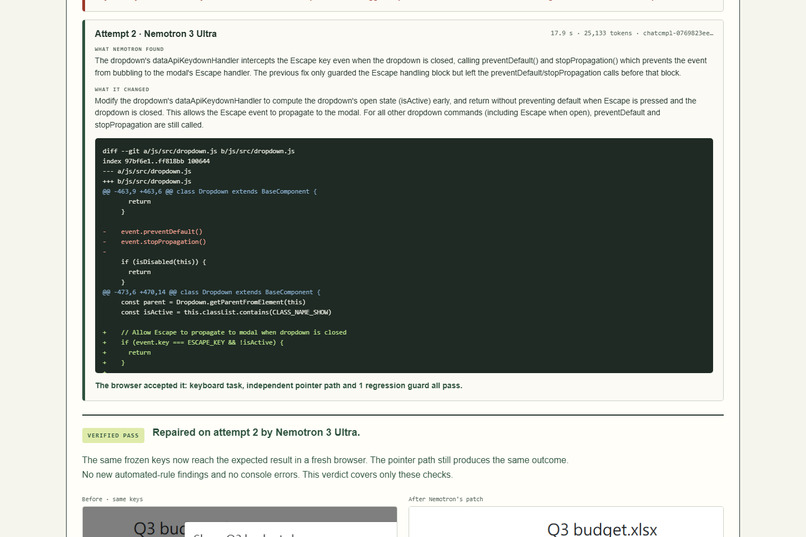
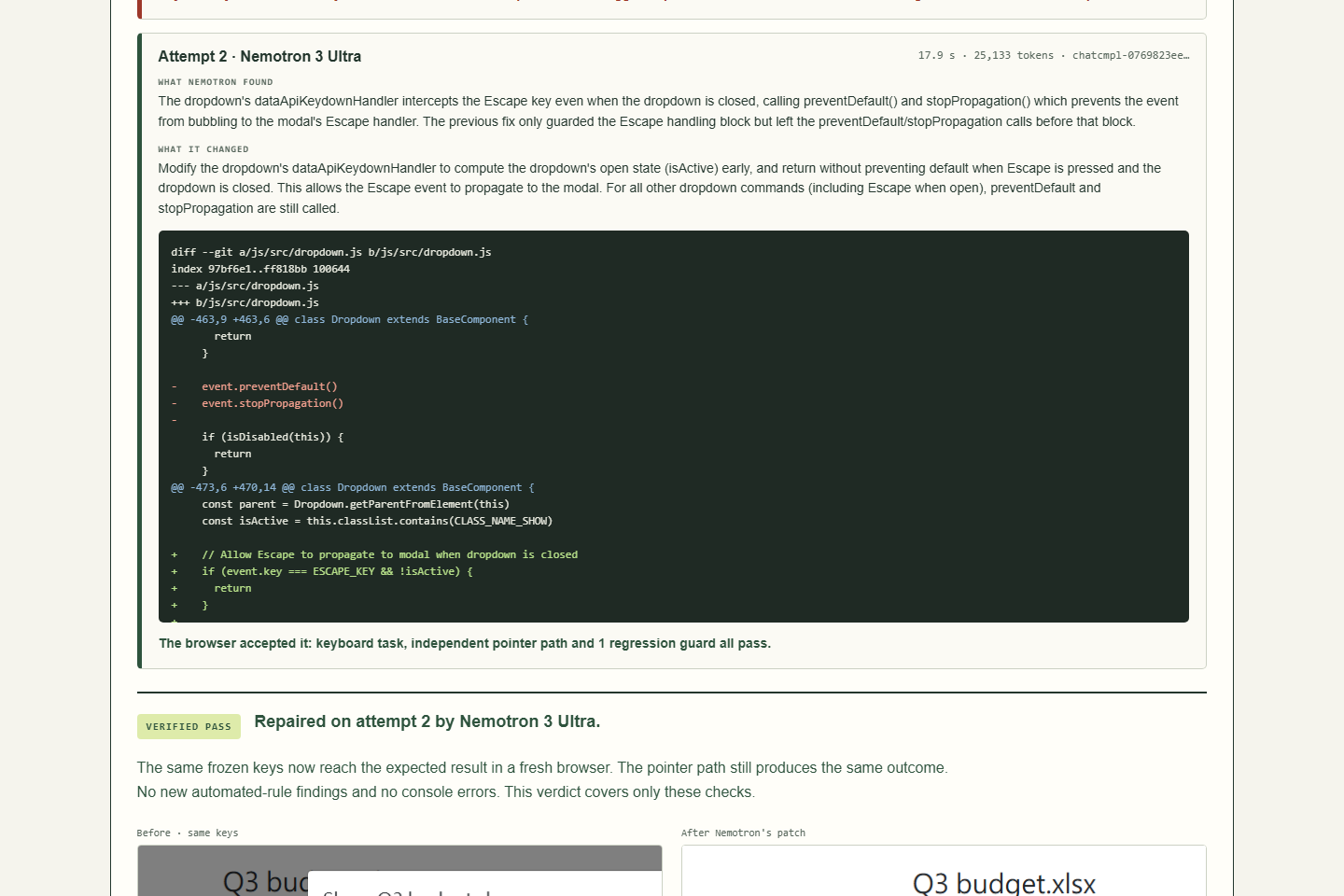
Nemotron 3 Ultra's patch passes the frozen keyboard task, independent mouse path and regression guard.
Try it as a judge
- Open Tabstitch and click Watch Nemotron fix a real Bootstrap bug. This replays a recorded repair; no login is needed.
- Inspect the before/after comparison, patch and Full evidence.
- For fresh inference, click Run it live on a bug card, sign in to GitHub and submit the prefilled issue. GitHub Actions runs Nemotron on Nebius and replies with the verdict and evidence, usually within 3–10 minutes. No API key is required from you.
Inspiration
A page can look correct and still fail someone using only a keyboard. Escape may leave them trapped in a dialog, Tab may never leave a date field, or a form may submit a different value from the one displayed.
AI can propose a plausible fix in seconds. The difficult part is checking whether it actually restores the task without breaking something else. That is why we built Tabstitch.
What it does
Tabstitch uses NVIDIA Nemotron on Nebius Token Factory to propose and verify repairs for keyboard and form bugs.
A developer first freezes the keyboard task, expected submitted data, an independent mouse path and regression checks. Nemotron 3 Super edits a disposable copy of the source. Chromium replays the checks. If the patch fails, Nemotron 3 Ultra receives the concrete failure report and retries.
Each result includes the patch, browser captures, assertions and raw model requests and responses. Developers can use a workbench, CLI or GitHub Action that posts a browser-verified patch on a pull request.
The public site provides recorded repairs. “Run it live” opens a GitHub issue that triggers a fresh Nemotron repair through GitHub Actions, capped at US$0.50 of sponsor credits.
Try Tabstitch · Example pull request
How we built it
The engine uses Node.js, Playwright, Chromium, axe-core and SHA-256 manifests. It checks source hashes, applies bounded edits and verifies candidates in fresh browser contexts.
Token Factory serves three NVIDIA models through one OpenAI-compatible integration: Super proposes the first repair, Ultra retries with browser evidence, and Nano drafts task files. Drafted tasks require review before they can become the requirements for a repair.
Token Factory's model catalog supplies prices so the engine can reserve a conservative cost allowance before sending each request. Requests, responses, usage and latency are retained with the evidence.
Feedback on NVIDIA models · Feedback on Nebius
Challenges we ran into
A passing keyboard task was sometimes insufficient. Review found four patches that passed earlier checks but introduced other regressions. Each gap became a stricter task before the next inference.
Models also returned malformed JSON, edits that did not match the source, and patches hardcoded to the test page. The engine rejects invalid edits and sends the failure back for another attempt.
Our own mistakes remain visible. Thirty-five early passing runs changed only the test page rather than the library. An early accessibility gate also wrongly rejected three patches for colour contrast that already existed.
Accomplishments that we're proud of
- Engine v13 repaired 25 of 26 previously fixed upstream bugs on their first run. Across three runs per bug, 71 of 78 runs passed, all through library-code changes. Each run allowed up to five proposals.
- Across recorded versions, the gate rejected 61 patches that passed the keyboard task but failed the mouse path or a regression check.
- Tabstitch found a previously unreported Bootstrap datepicker keyboard trap. We submitted a reduced reproduction as Bootstrap issue #43202, which a maintainer labelled confirmed.
- The GitHub Action demonstrates the complete workflow from detecting a regression to posting a verified patch.
The benchmark libraries run inside author-built pages. Maintainers' fixes pass the frozen checks first and are excluded from model requests, but public fixes may still have appeared in training data.
What we learned
The repair requirements matter as much as the model. Submitted-data assertions and independent mouse paths catch failures that the reported keyboard task alone misses.
Browser verification makes a patch easier to assess, but does not prove correctness beyond the frozen checks. Patch reviews, written with Claude Code after the browser verdict, found additional gaps.
Publishing failed attempts and earlier engine versions also helped us distinguish improvements to the repair engine from improvements to the evaluation itself.
What's next for Tabstitch
- Import repair requirements from existing end-to-end tests.
- Repair React and Vue source through source maps.
- Add Firefox and WebKit replay.
Current support covers static HTML, CSS, JavaScript and TypeScript in Chromium. Tabstitch does not perform screen-reader testing or claim WCAG conformance.
Built With
- axe-core
- chromium
- github-actions
- javascript
- nebius
- nebius-token-factory
- nemotron
- node.js
- nvidia
- playwright
- zod
