-
-
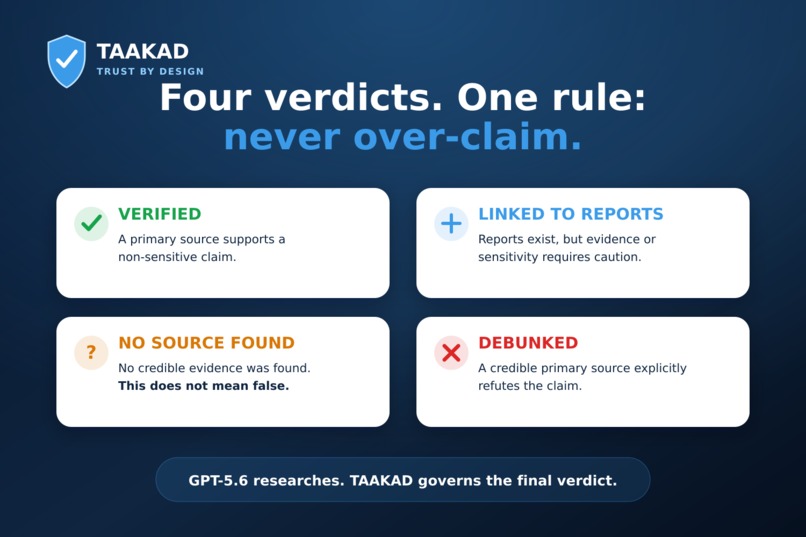
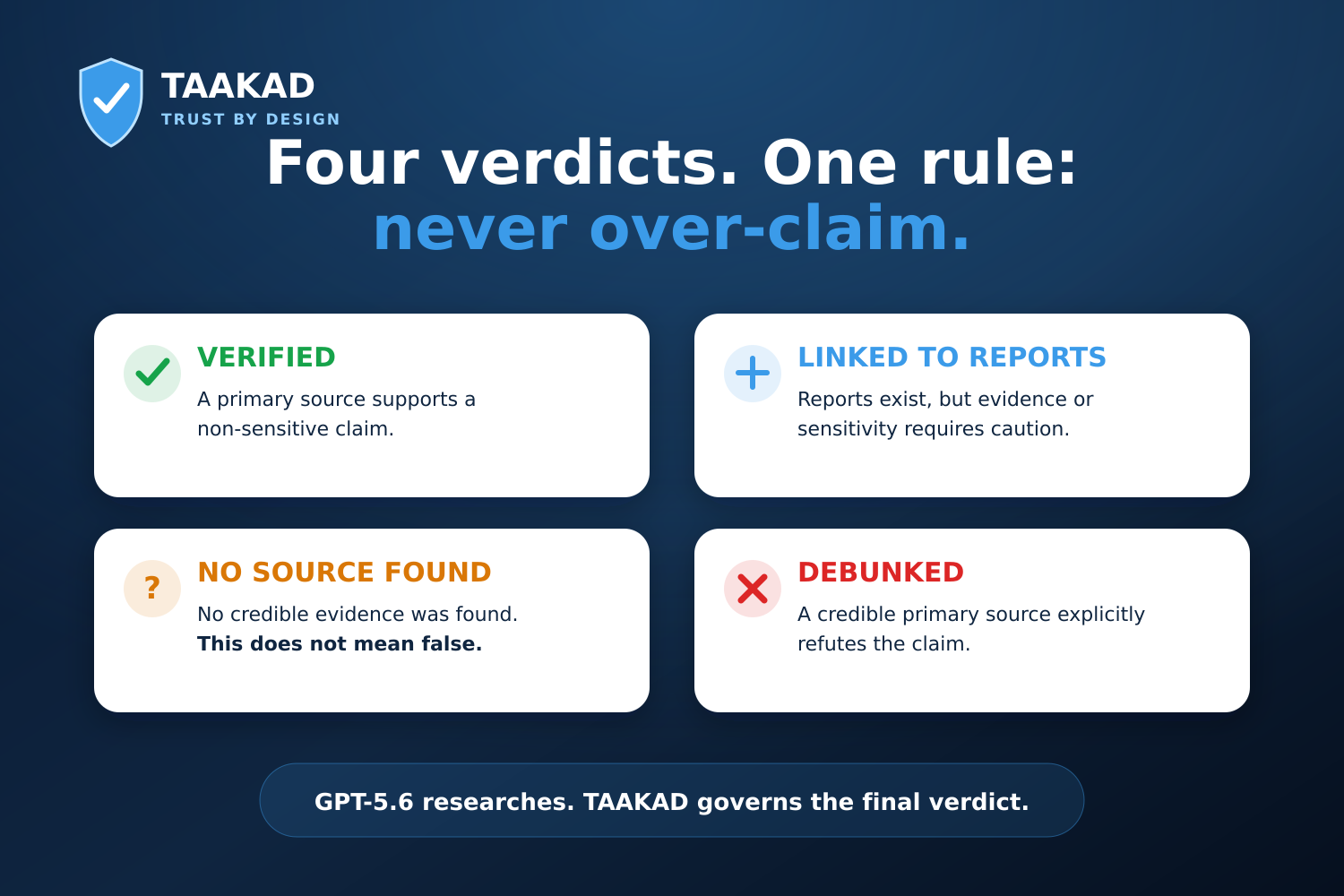
GPT-5.6 researches the evidence, while TAAKAD applies server-side rules to return Verified, Linked to reports, No source found, or Debunked.
-
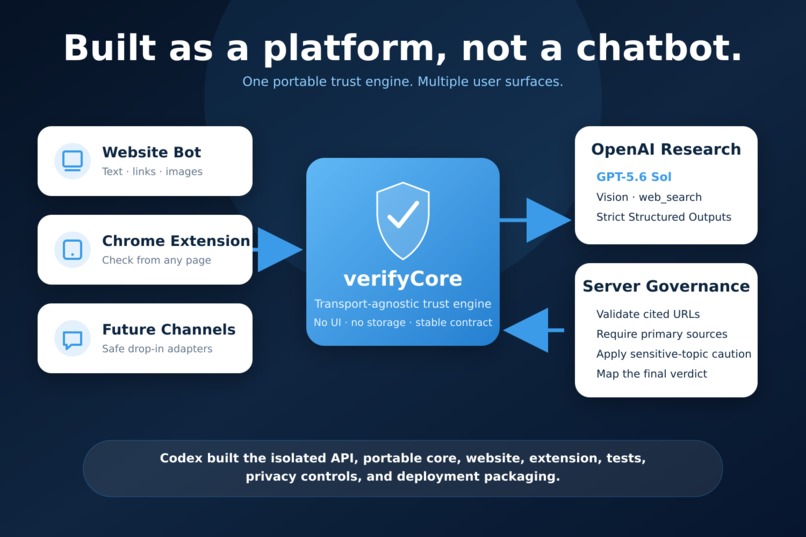
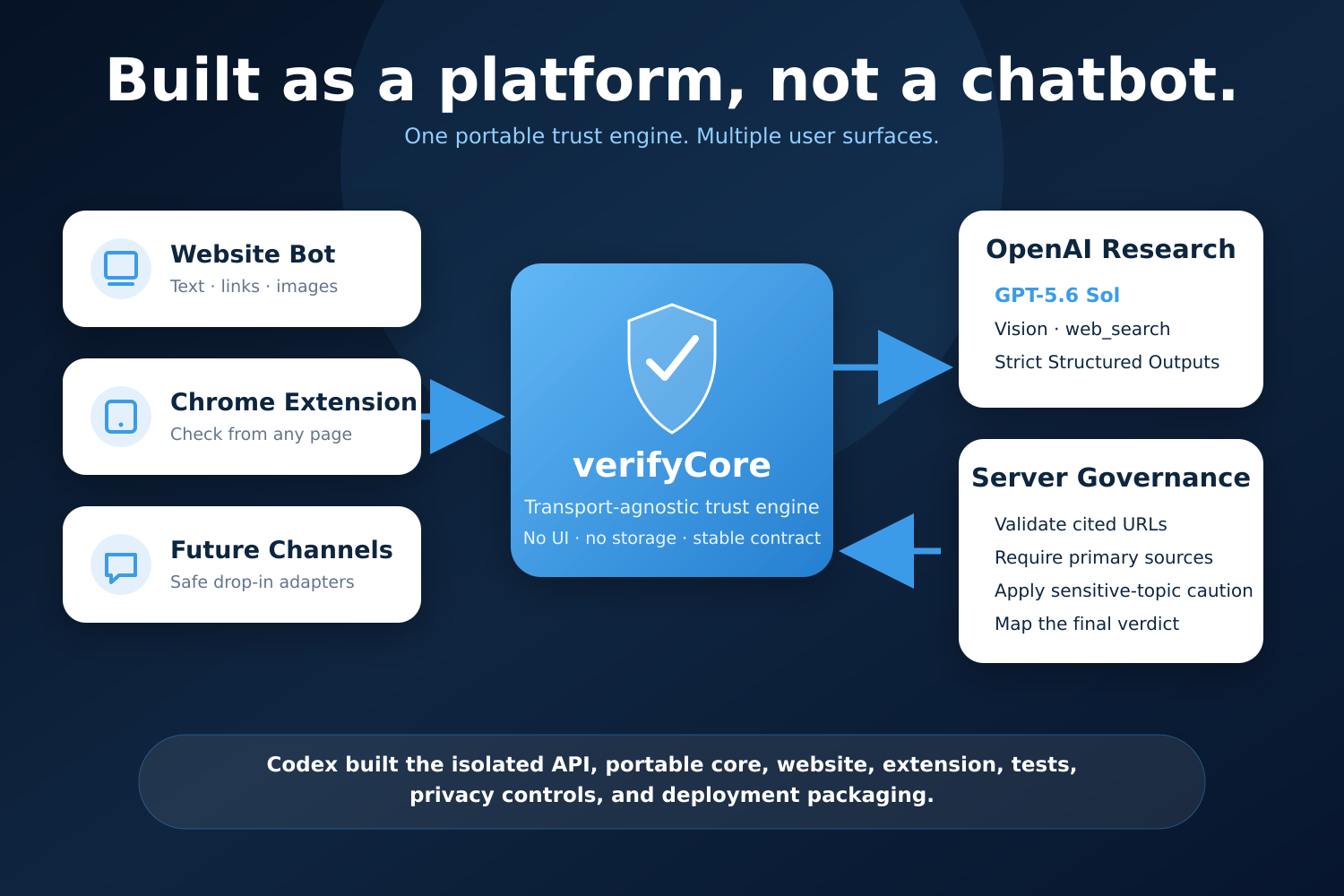
Codex helped build an isolated, portable platform connecting the Website Bot and Chrome Extension to verifyCore, GPT-5.6 research.
-
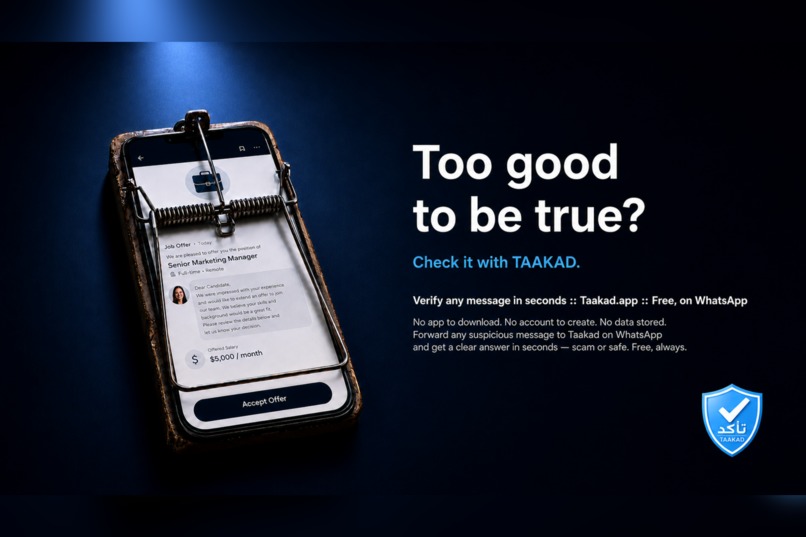
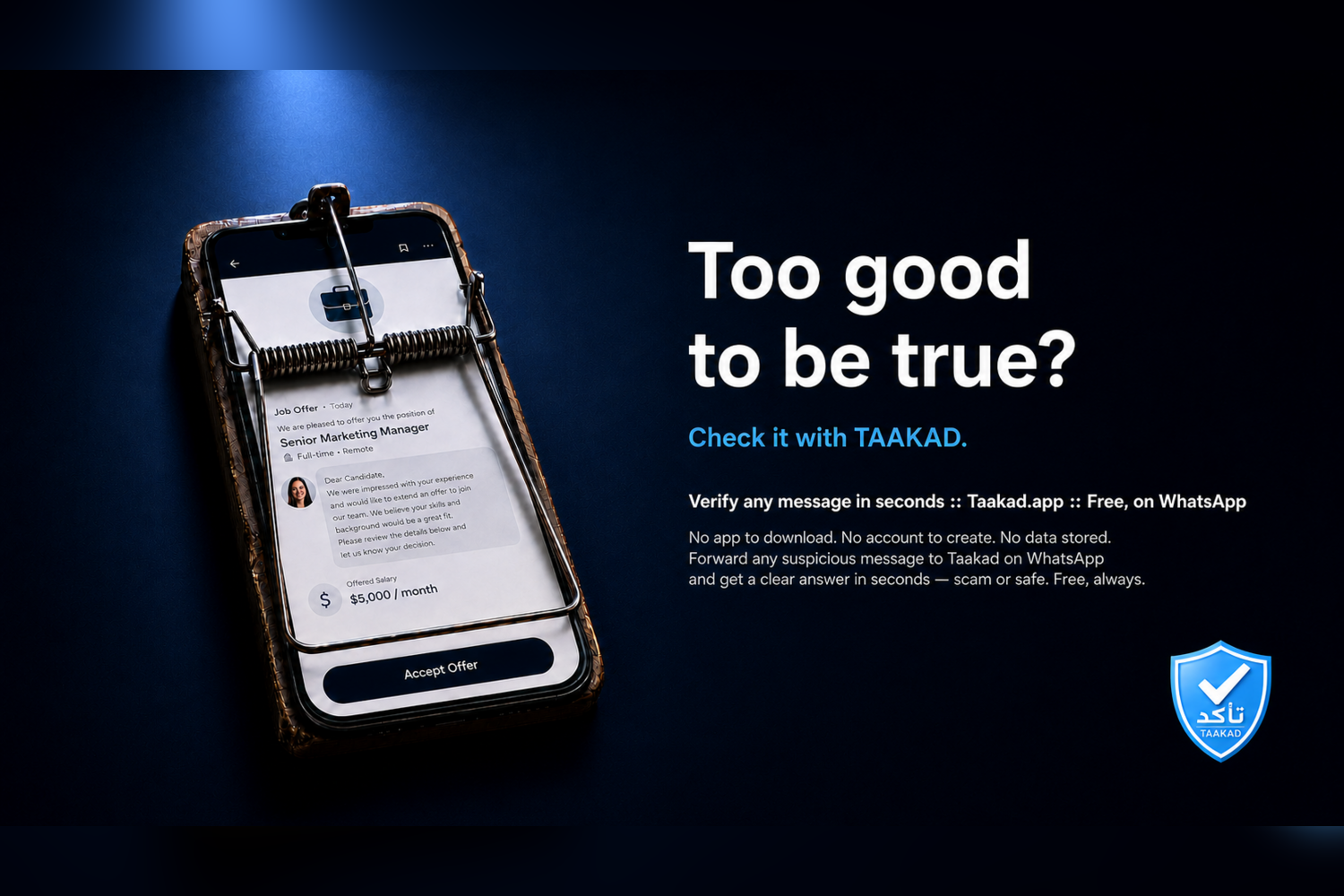
The problem that started TAAKAD: convincing job offers and urgent messages can hide dangerous social-engineering scams.
-
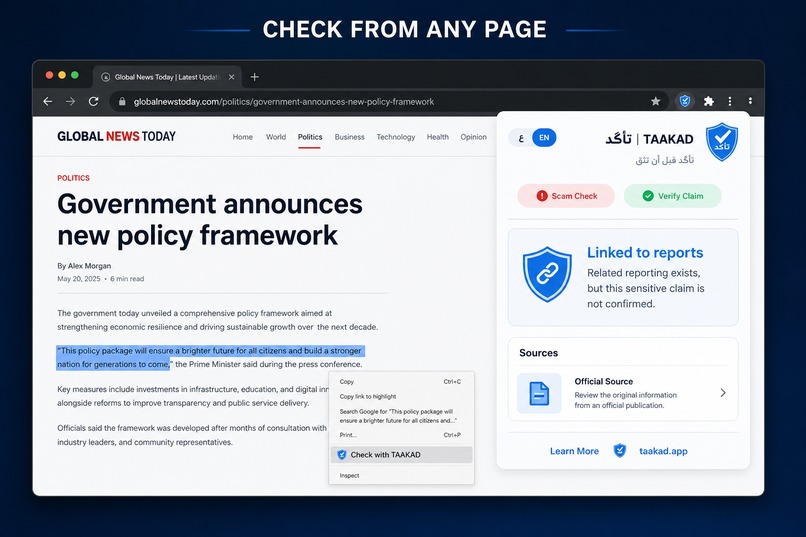
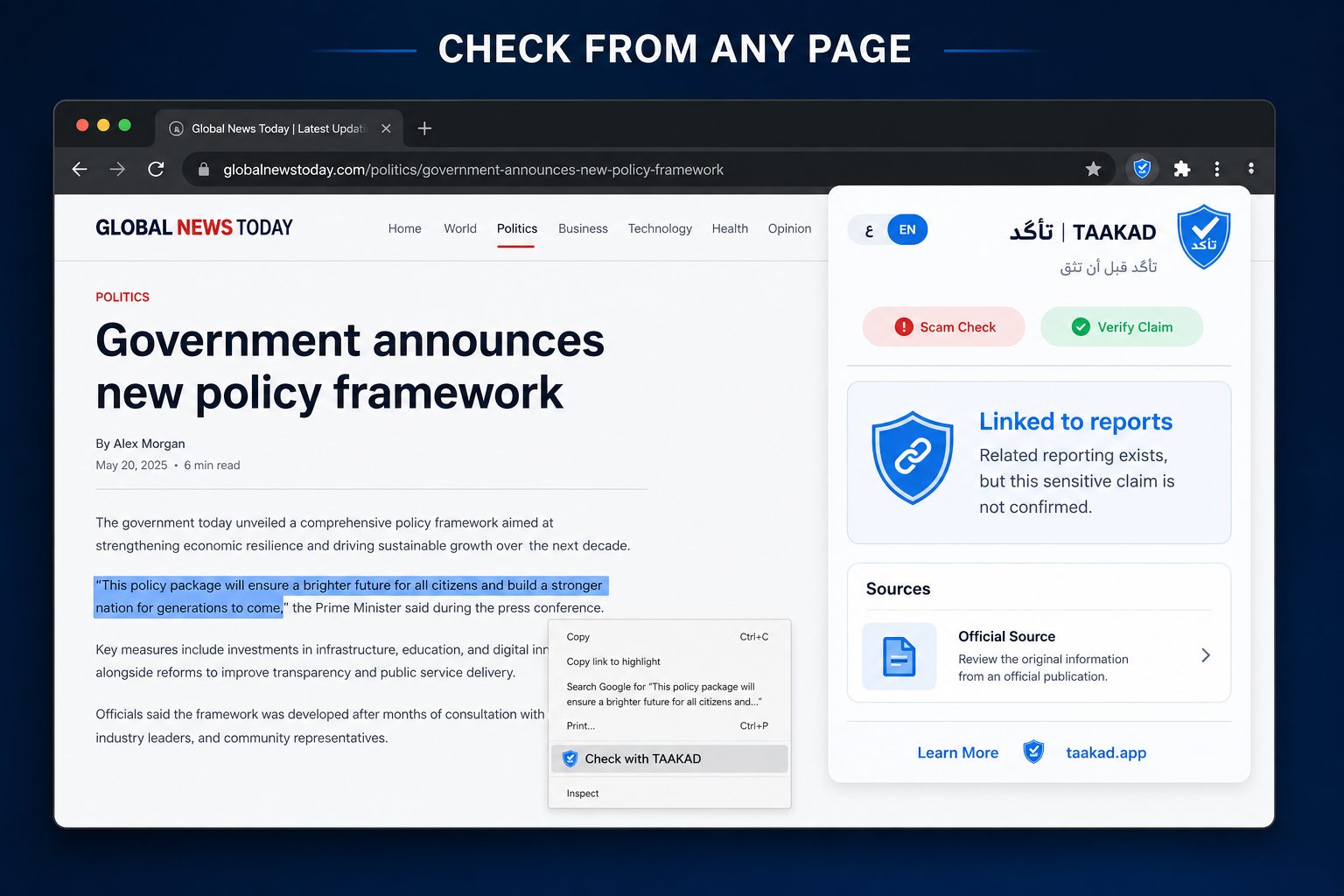
The Chrome extension lets users check selected text or a visible image from any webpage and review an explainable verdict with sources.
-
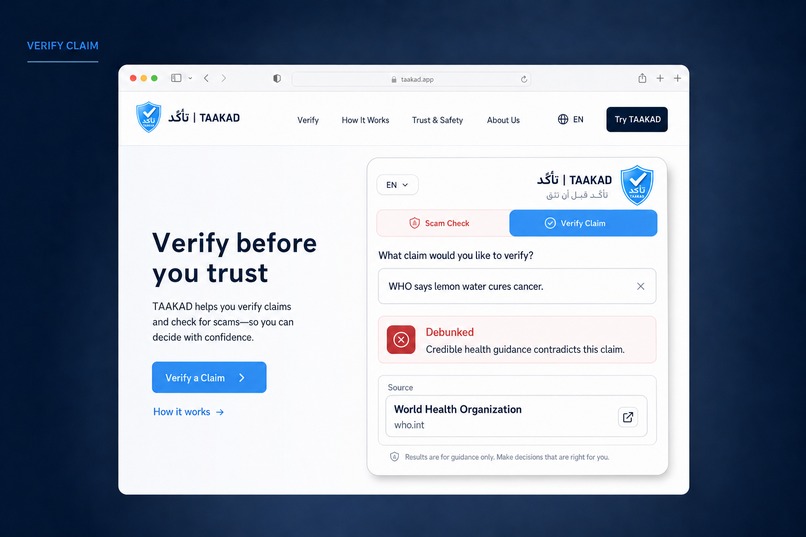
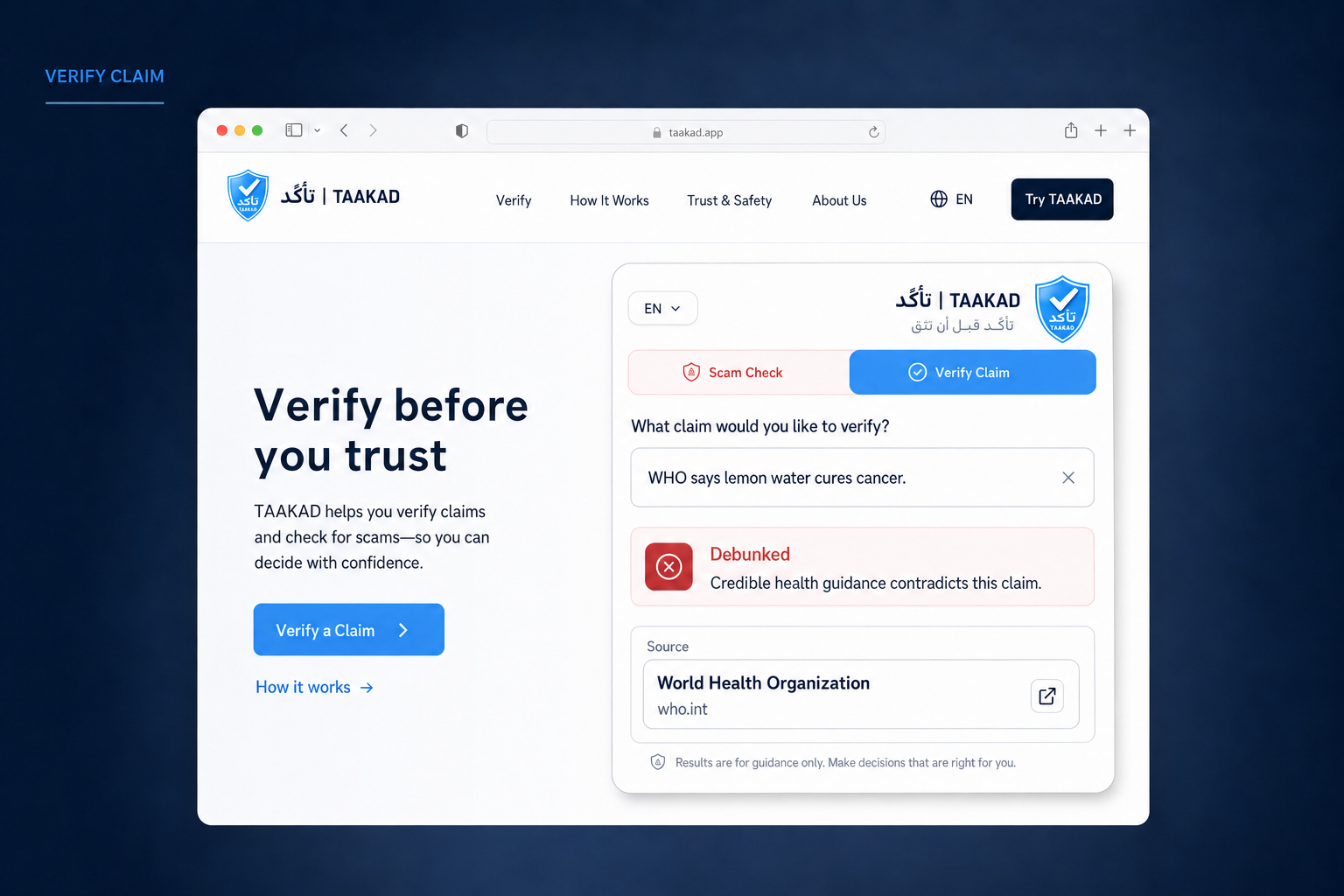
The TAAKAD Website Bot verifies a health claim, returns a Debunked verdict, explains why, and links to a primary WHO source.
-
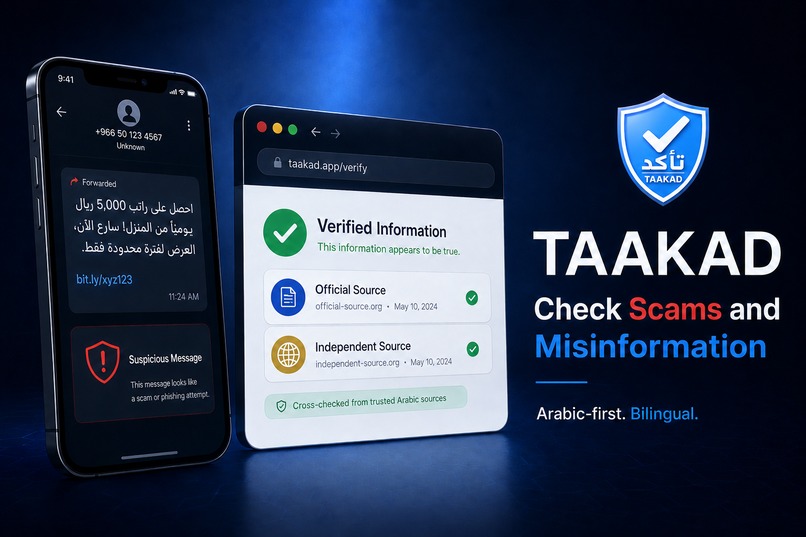
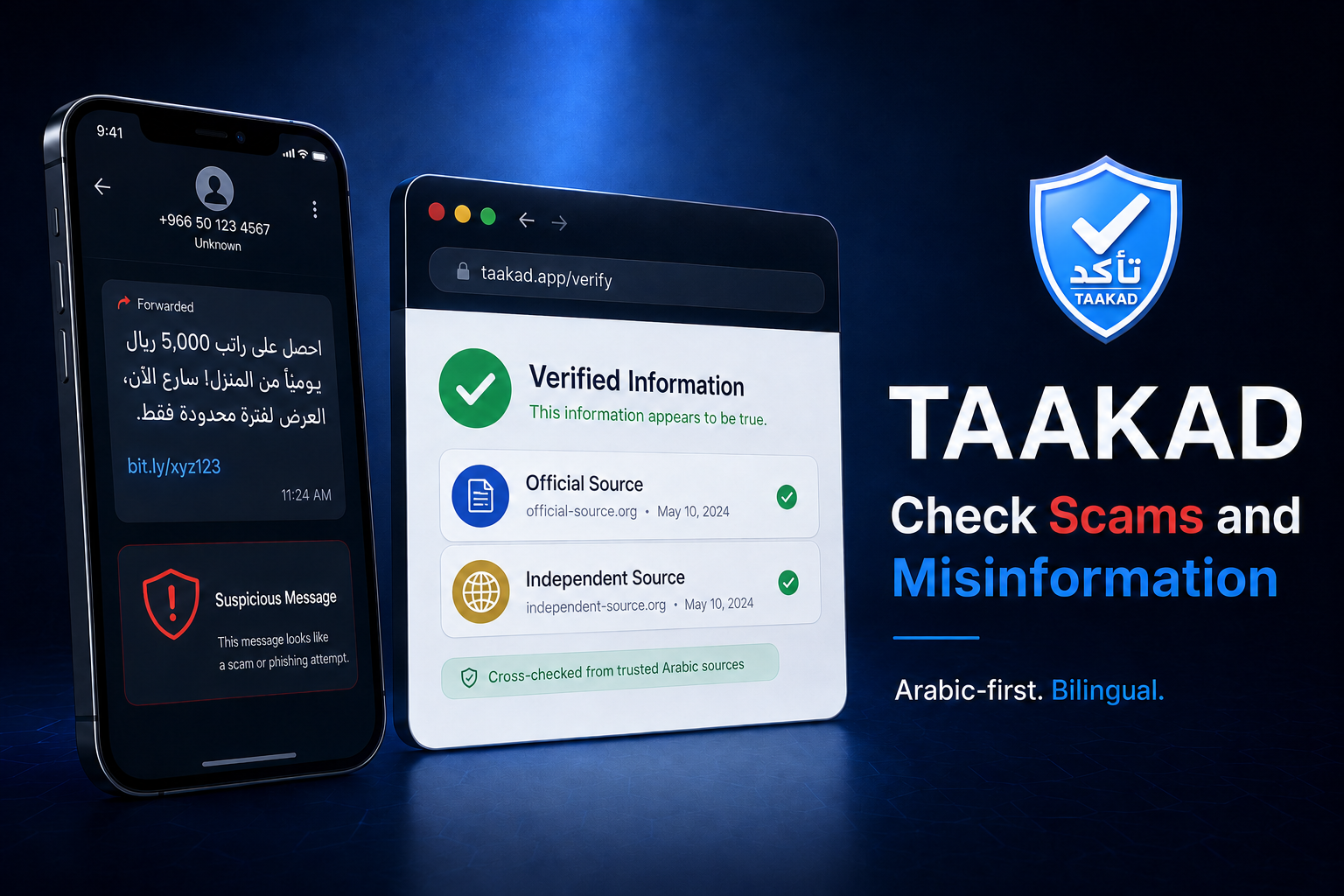
TAAKAD is an Arabic-first, bilingual trust platform that helps families check scams and misinformation across the Gulf and Jordan.
Inspiration
TAAKAD began with a simple observation: when people receive a suspicious message, they rarely need another security dashboard. They need a clear answer, in their language, at the moment they are deciding whether to trust, click, pay, or forward.
We first built TAAKAD as a working WhatsApp scam-checking service for Arabic and English users in the Gulf and Jordan. Families could forward suspicious job offers, payment requests, links, screenshots, or messages claiming to be from a bank and receive an explainable risk assessment.
But the same trust problem extends beyond private messages. Misleading news, recycled images, fabricated claims, and falsely attributed reports spread across websites and social media. OpenAI Build Week gave us the opportunity to evolve TAAKAD from a WhatsApp service into a broader trust platform.
What it does
TAAKAD now provides two explicit modes:
- Scam Check analyzes suspicious messages, links, and images, identifies warning signs, explains the risk, and recommends a safer next action.
- Verify Claim researches a news claim or image, checks its source, provides citations, identifies its time context, and returns one of four carefully governed verdicts:
- Verified: supported by a primary or original source.
- Linked to reports: related reports exist, but the evidence is not strong enough for a clean confirmation.
- No source found: no credible source was found; this does not mean the claim is false.
- Debunked: a credible primary or fact-checking source explicitly refutes the claim.
The experience is Arabic-first and fully bilingual. It is available through a website bot and a Manifest V3 Chrome extension. Users can select text or right-click a visible image, choose the appropriate mode, and receive a verdict with explanations and sources.
How we built it
We used Codex to transform the product into a modular, testable platform while keeping the existing WhatsApp service completely untouched.
Codex helped us:
- Design and build an isolated Node.js and Express Demo API.
- Create
verifyCore, a transport-agnostic verification engine with a stable input/output contract. - Build the React and TypeScript website experience.
- Build the Manifest V3 Chrome extension.
- Implement multilingual UX, privacy controls, timeout handling, deployment packaging, and automated tests.
- Review and refine the architecture through small, isolated commits and explicit approval gates.
The verification engine uses GPT-5.6 Sol through the OpenAI Responses API, combining multilingual reasoning, vision, web_search, and strict Structured Outputs.
GPT-5.6 extracts and researches the claim, but it does not control the final verdict. TAAKAD validates returned citations and applies deterministic governance rules on the server. This separation between AI research and server-side judgment is central to the product.
Challenges we faced
Preventing overconfident answers
During testing, a sensitive breaking-news claim attributed to Reuters was initially treated as verified because several websites had syndicated the report. However, there was no direct Reuters source.
We changed the architecture so a clean verified verdict requires a consulted primary or original source. Syndication alone is insufficient. Sensitive politics, health, security, and breaking-news claims are deliberately mapped to the more cautious linked_to_reports result.
Distinguishing “unverified” from “false”
Arabic content is not always well indexed. Failing to find a source cannot safely be interpreted as proof that a claim is fabricated. This led us to make no_source a mandatory middle verdict rather than forcing every claim into true or false.
Balancing research quality and speed
Live source verification can take longer than ordinary chat responses. We limited search rounds, tuned search context, added clear localized progress states, and coordinated provider, client, and server timeouts so users receive an honest temporary-delay message instead of a false verdict.
Protecting the working product
The existing WhatsApp service is live. We created a separate repository, Render service, OpenAI key, API, and deployment process for Build Week. The new service has no Twilio connection and no access to production Supabase data.
Building a privacy-conscious extension
The Chrome extension uses minimal permissions. It does not fetch arbitrary remote image URLs. After an explicit user action, it captures only visible pixels, crops the selected image locally, validates its size and type, and temporarily passes it to the popup for analysis.
What we learned
The most important lesson was that source research and truth judgment are not the same task.
A capable model can discover relevant information, but a trustworthy product also needs deterministic rules, explicit uncertainty, primary-source requirements, privacy boundaries, and honest failure states.
We also learned that Codex is most valuable when used as an engineering collaborator rather than only as a code generator. It helped us reason about architecture, isolate risk, implement features, write regression tests, and repeatedly verify that a new competition capability could not affect the live product.
What is next
After Build Week, we plan to integrate verifyCore safely into additional TAAKAD channels behind feature flags, publish the Chrome extension, expand Arabic source coverage, add aggregate misinformation-impact metrics, and explore partnerships with trusted institutions and fact-checking organizations.
Our goal is to make TAAKAD the first line of defense against scams and misinformation for families across the Arab world.
Built With
- api
- chrome
- codex
- computer
- express.js
- extension
- github
- gpt-5.6
- html5
- javascript
- manifest
- node.js
- openai
- outputs
- react
- render
- responses
- rest
- search
- structured
- typescript
- v3
- vision
- vite
- web


Log in or sign up for Devpost to join the conversation.