-
-
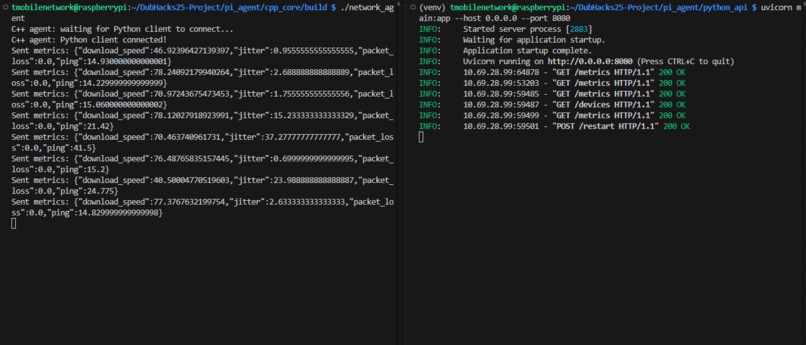
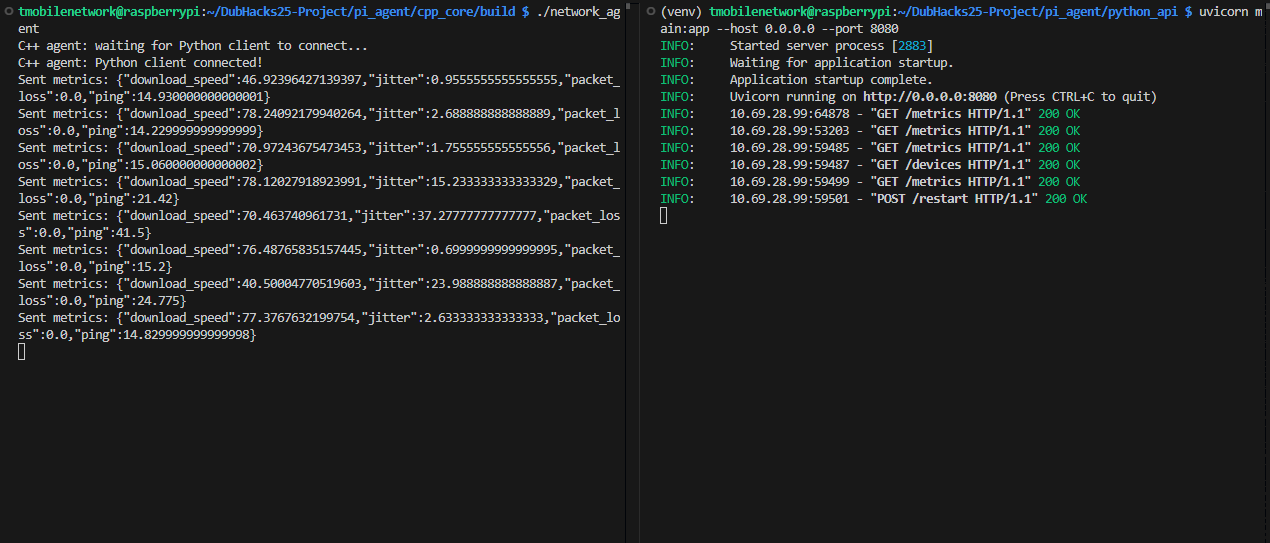
Backend logging on raspberry pi during these chats
-
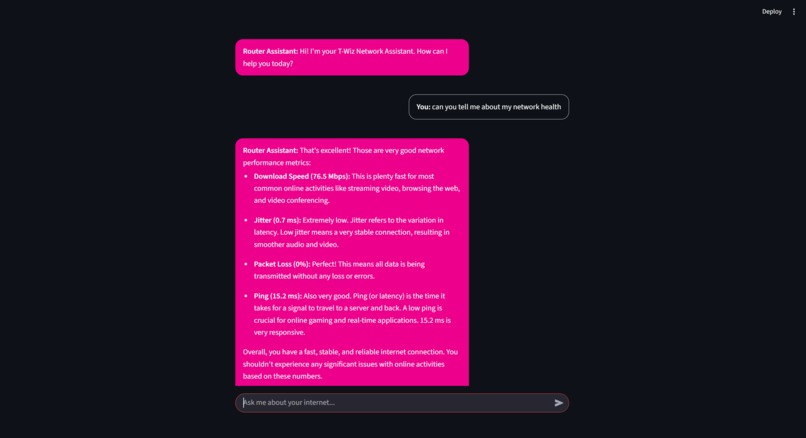
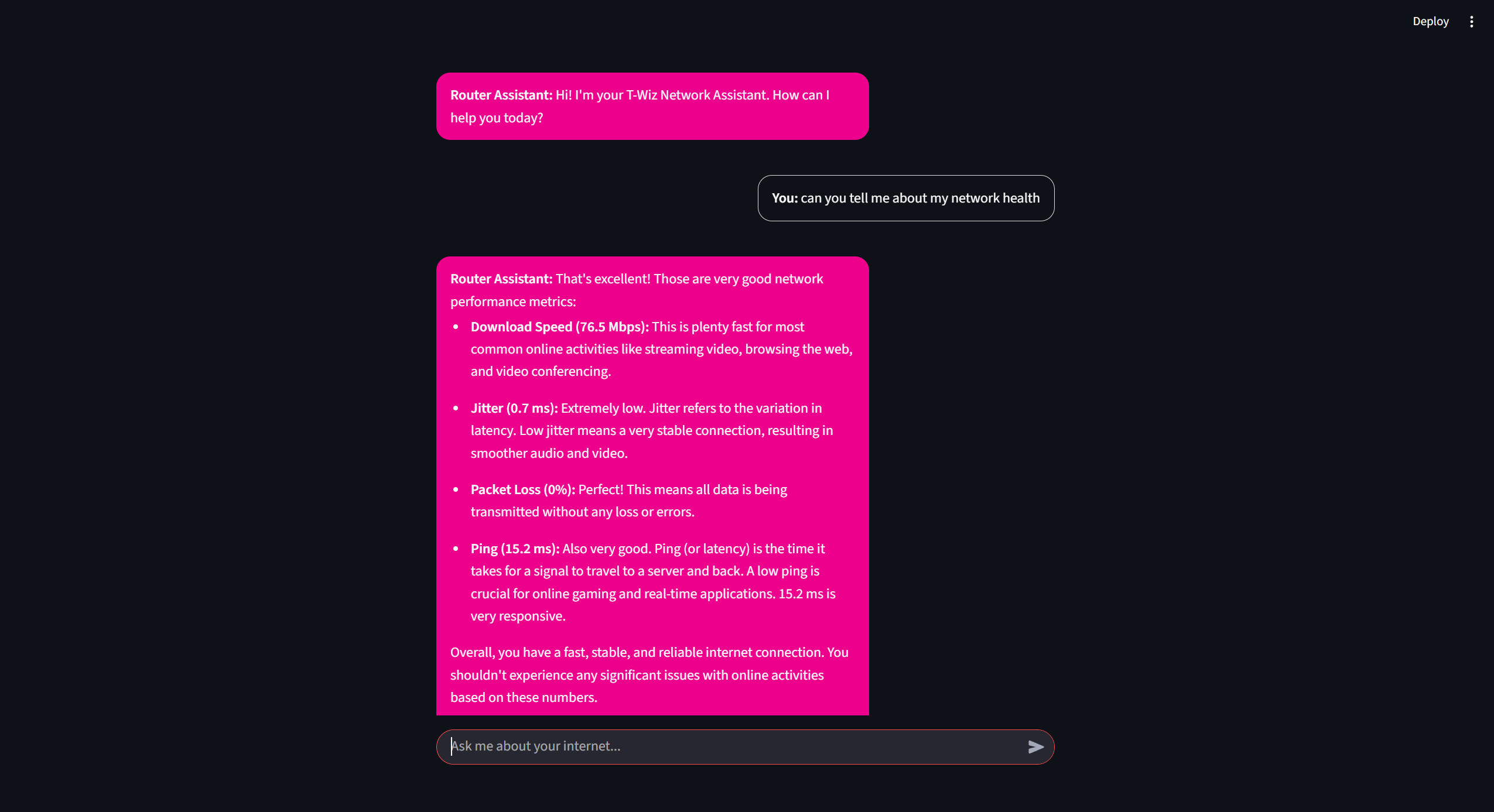
Sample user chats with assistant
-
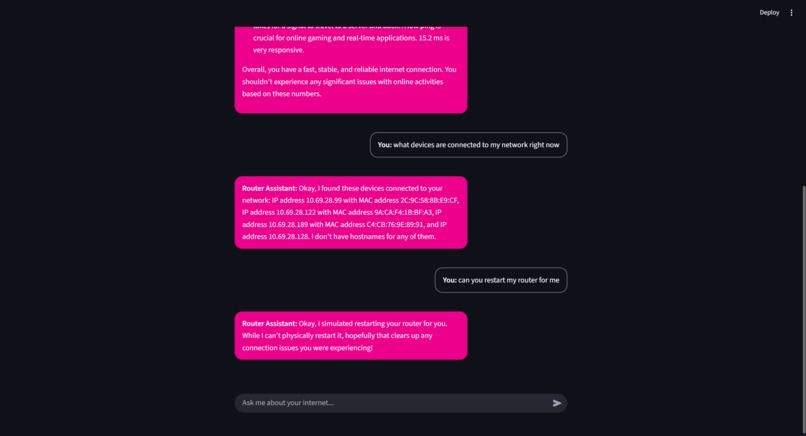
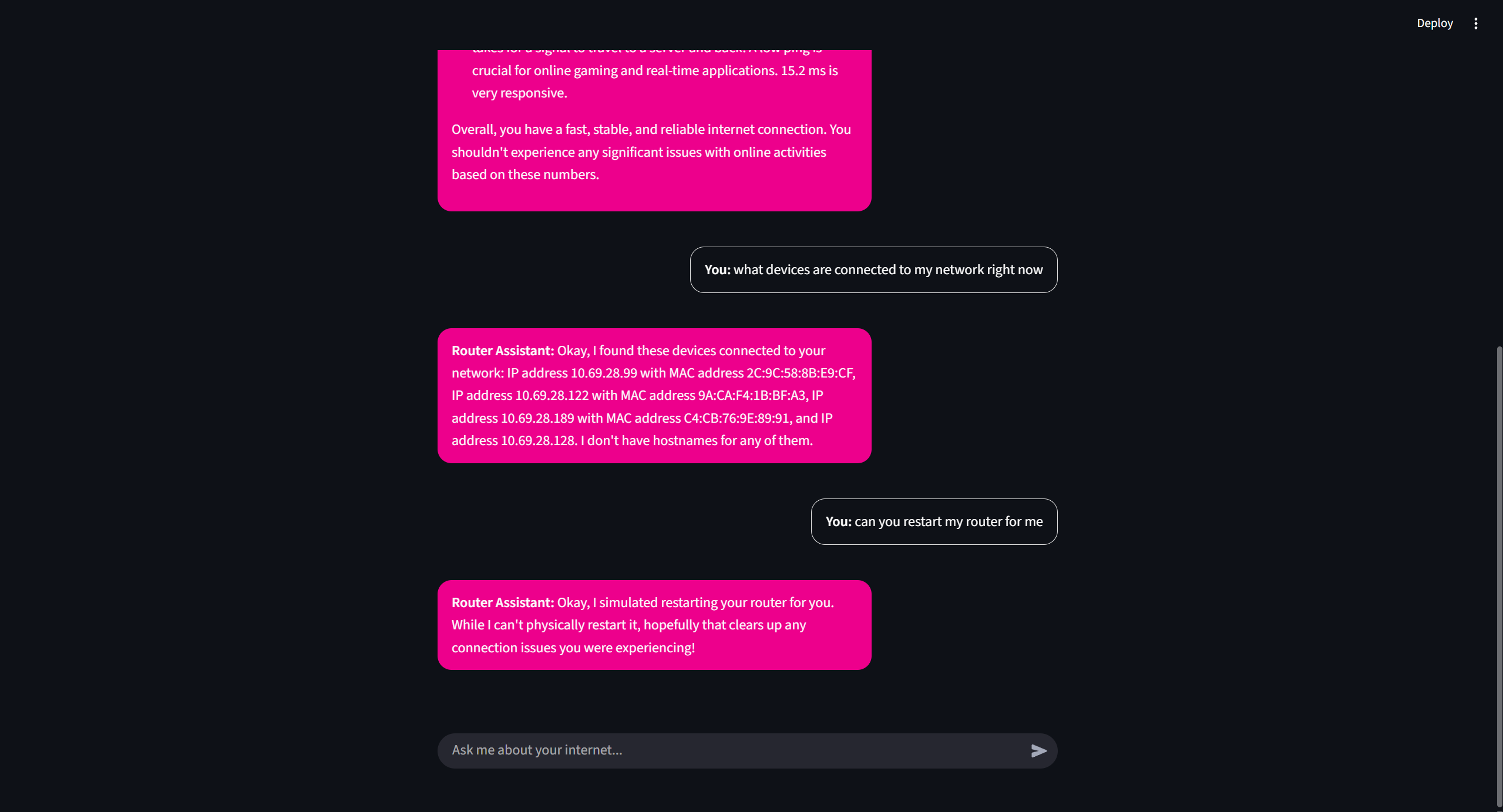
Continuation of sample user chats with assistant
Project Story
Inspiration
We took on T‑Mobile’s challenge because neither of us had worked with networking or 5G before, but we shared a strong passion for agentic AI. We realized many people—especially non‑CS users—struggle to understand and fix router problems. That gap inspired a simple idea: make your router talkable. If a router could explain diagnostics and accept safe, human‑friendly commands, everyday network troubleshooting could be far less frustrating.
What we learned
- Core network health metrics: download/upload speed, ping, jitter, packet loss, and what they mean for user experience.
- Low‑level network programming techniques for measuring and probing connectivity.
- Building agentic systems: designing tools the LLM can call and keeping decision logic auditable and safe.
- Reliable communication between edge and client: FastAPI for the pi agent and WebSockets/HTTP for real‑time interactions.
- Integrating LLMs (Gemini via Vertex SDK) into a practical app flow and how to expose limited, deterministic tools for the model to use.
How we built it
We split the system into two focused parts:
- pi_agent (runs on the router): collects diagnostics, scans the LAN for connected devices, and exposes deterministic control endpoints (e.g., restart) via a FastAPI service. Optional C++ helpers handle lower‑level measurements where needed.
- assistant_app (runs on the laptop): provides the user‑facing chat UI and an LLM agent that uses tool wrappers to call the pi_agent endpoints. The assistant uses Gemini through the Vertex SDK and decides when to invoke tools like
scan_network,get_metrics, andrestart_router.
This separation keeps sensitive, device‑level operations local to the router while offering a richer conversational UX on the client. We iterated on prompt templates, tool interfaces, and confirmation flows so actions remain safe and user‑approved.
Challenges we faced
- Measuring download speed reliably: creating reproducible, lightweight tests on constrained hardware without depending on third‑party services was tricky and required experimentation.
- Scanning the local network for devices: dealing with different router environments and permissions made robust discovery (ARP, ping sweeps, parsing DHCP tables) a complex task.
- Tooling for the LLM: exposing useful, deterministic tools while preventing accidental destructive actions required careful design, prompting, and UX for confirmations.
- Debugging cross‑device communication: ensuring the assistant could reliably reach the pi agent across variable home network setups and NATs took multiple iterations and test cases.
Impact
The project taught us practical networking concepts and how to responsibly combine them with agentic AI to make a tangible user benefit: an approachable, conversational interface that helps people understand and fix their home network without technical jargon.# Project Story
Inspiration
We took on T‑Mobile’s challenge because neither of us had worked with networking or 5G before, but we shared a strong passion for agentic AI. We realized many people—especially non‑CS users—struggle to understand and fix router problems. That gap inspired a simple idea: make your router talkable. If a router could explain diagnostics and accept safe, human‑friendly commands, everyday network troubleshooting could be far less frustrating.
What we learned
- Core network health metrics: download/upload speed, ping, jitter, packet loss, and what they mean for user experience.
- Low‑level network programming techniques for measuring and probing connectivity.
- Building agentic systems: designing tools the LLM can call and keeping decision logic auditable and safe.
- Reliable communication between edge and client: FastAPI for the pi agent and WebSockets/HTTP for real‑time interactions.
- Integrating LLMs (Gemini via Vertex SDK) into a practical app flow and how to expose limited, deterministic tools for the model to use.
How we built it
We split the system into two focused parts:
- pi_agent (runs on the router): collects diagnostics, scans the LAN for connected devices, and exposes deterministic control endpoints (e.g., restart) via a FastAPI service. Optional C++ helpers handle lower‑level measurements where needed.
- assistant_app (runs on the laptop): provides the user‑facing chat UI and an LLM agent that uses tool wrappers to call the pi_agent endpoints. The assistant uses Gemini through the Vertex SDK and decides when to invoke tools like
scan_network,get_metrics, andrestart_router.
This separation keeps sensitive, device‑level operations local to the router while offering a richer conversational UX on the client. We iterated on prompt templates, tool interfaces, and confirmation flows so actions remain safe and user‑approved.
Challenges we faced
- Measuring download speed reliably: creating reproducible, lightweight tests on constrained hardware without depending on third‑party services was tricky and required experimentation.
- Scanning the local network for devices: dealing with different router environments and permissions made robust discovery (ARP, ping sweeps, parsing DHCP tables) a complex task.
- Tooling for the LLM: exposing useful, deterministic tools while preventing accidental destructive actions required careful design, prompting, and UX for confirmations.
- Debugging cross‑device communication: ensuring the assistant could reliably reach the pi agent across variable home network setups and NATs took multiple iterations and test cases.
Impact
The project taught us practical networking concepts and how to responsibly combine them with agentic AI to make a tangible user benefit: an approachable, conversational interface that helps people understand and fix their home network without technical jargon.


Log in or sign up for Devpost to join the conversation.