-
-
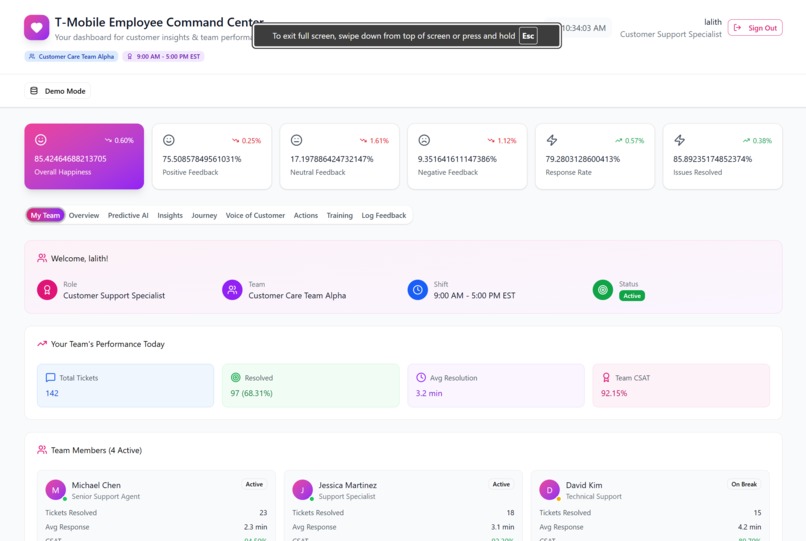
Front Page
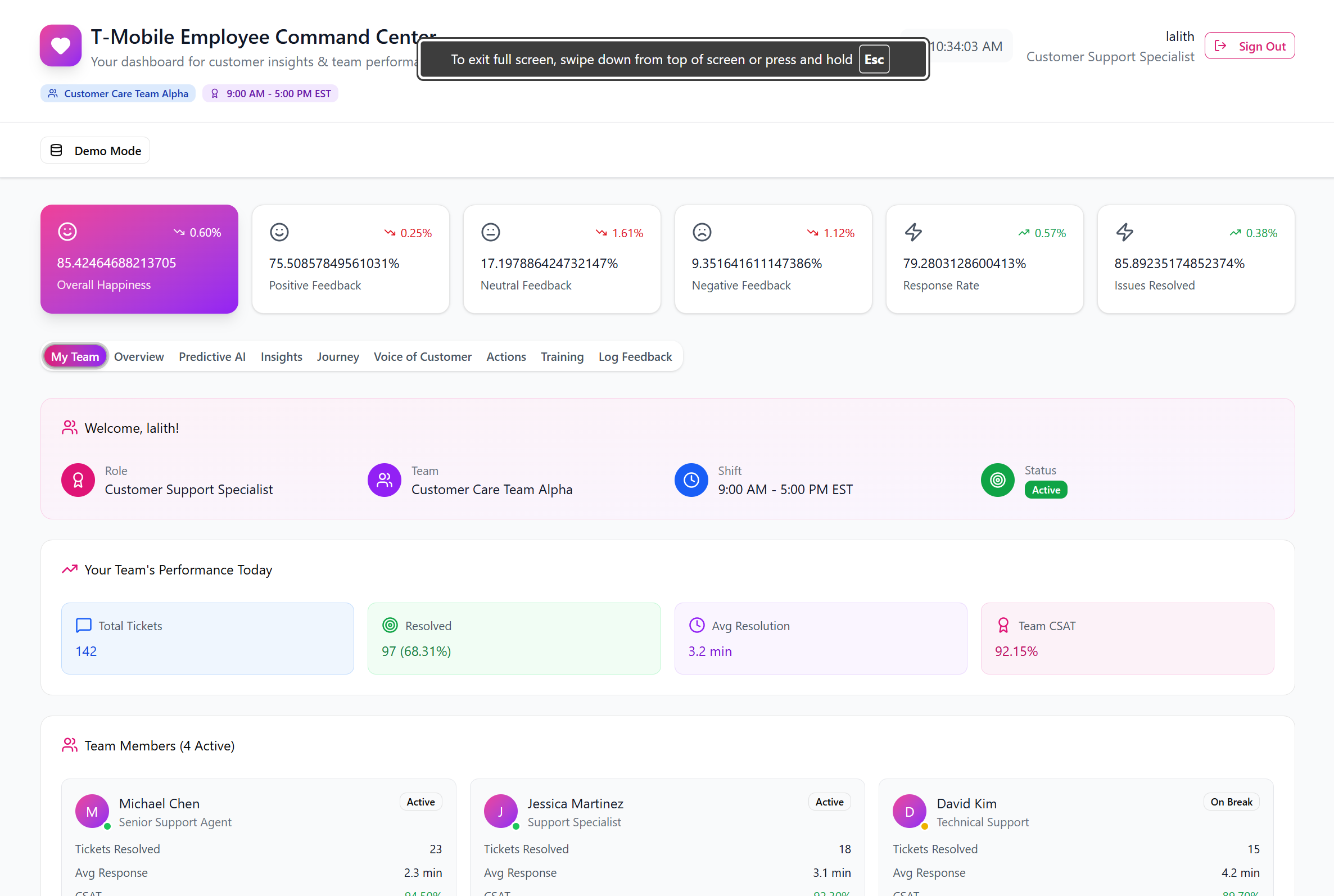
Inspiration
T-Mobile talks a lot about being the “Un-carrier,” but we noticed one thing: customer happiness usually gets measured after frustration happens. Surveys, call center logs, Twitter complaints — all reactive. We wanted to shift that into something real-time, emotional, and actionable. The idea was to create a Customer Happiness Index that reflects how people actually feel the moment they experience something good or bad.
What it does
The T-Mobile Customer Happiness Index is a real-time feedback and sentiment dashboard. Customers submit quick feedback through an interface with sentiment, category, location, and a 1–5 rating. The backend processes:
• Sentiment (positive, neutral, negative) • Emotional language cues • Category of issue (network, billing, support, etc.) • Location context
The dashboard aggregates this into insights like:
• Where happiness is rising or dropping • What problems are emerging before they trend • Moments of delight worth celebrating
It turns raw emotion into something teams can react to immediately.
How we built it
• Frontend: React + Vite + ShadCN UI components (clean, fast, mobile-friendly form) • Backend: Node/Express API for storing and processing feedback • Sentiment Logic: Lightweight text analysis with placeholders for ML upgrade • WebSocket Streaming: Real-time updates to the dashboard • UI Feedback Toasts: Built using Sonner for smooth UX
We focused on speed, clarity, and emotional UX cues (emoji sentiment, star ratings, short input steps).
Challenges we ran into
• Making feedback feel easy and natural—we iterated UI several times • Designing a sentiment scoring system that isn’t biased or oversimplified • Handling live data flow smoothly without lag • Making the dashboard meaningful, not just “numbers on charts”
Balancing simplicity and real insight was the hardest part.
Accomplishments that we're proud of
• We built a system that captures human emotion, not just numbers • The experience is smooth, fast, and intuitive • Our dashboard actually tells a story about customer happiness in real time • Built a foundation where ML models can later plug in without rewriting code
What we learned
• Small UX details dramatically change how people express themselves • Real-time systems require careful data handling to avoid noise and confusion • Feedback is not just about identifying problems — it’s about discovering delight too • Designing emotional products means thinking like both a user and an analyst
What’s next for T-Mobile Customer Happiness Index
• Upgrade to ML-powered sentiment classification (Hugging Face / AWS Comprehend) • Automatic network outage detection from sudden rating drops • Open API for customer support dashboards • Location-level heat maps for store + region managers • Predictive “Happiness Forecasting” to stop issues before they spread
This is just the first version — the vision is to make T-Mobile a carrier that truly listens in real time.
Built With
- figma
- node.js
- react
- vite
- websockets


Log in or sign up for Devpost to join the conversation.