-
-

THE HAND - The protection
-
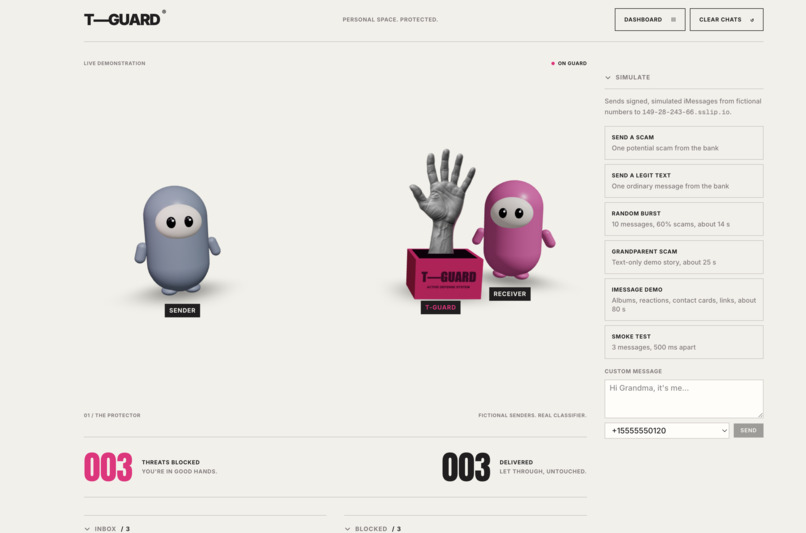
The Hand
-
T-Guard
-
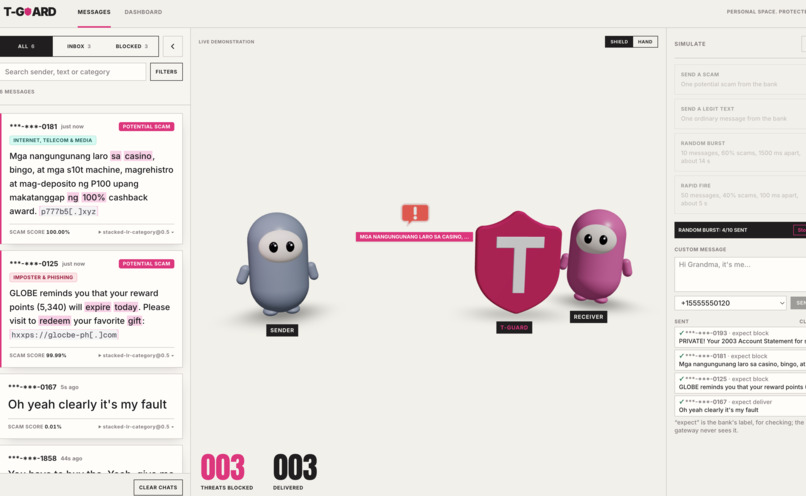
T-SHIELD
-

The Hope


T-GUARD "secure guardian in the palm of your hand"
Tracks and Why T-mobil track - FBI-reported losses among older adults increased about 59% from 2024 to 2025. PHOTON - Help us intercept phone calls. NVIDIA - high level use of Nessie that goes far beyond
UTD Tracks - DESIGN as we made a hyper unique look with a hyper technical project. MLH Tracks - VULTR is hosing are ML model because of computation as we rented a GPU.
Your Zero-Day. Place your trust in our hands
An intelligent guardian against scams, built for the people who shouldn't have to become cybersecurity experts to stay safe.
Inspiration
Technology is advancing faster than many people can adapt to it. Unfortunately, scammers are adapting just as quickly. Every day, ordinary people receive fraudulent text messages and phone calls impersonating banks, delivery companies, government agencies, and even family members. These scams exploit fear, urgency, and trust. For older adults and people with limited technological experience, distinguishing a legitimate message from a sophisticated scam can be especially difficult.
We saw a fundamental problem with traditional cybersecurity the responsibility for recognizing danger is often placed on the person least equipped to recognize it.
We wanted to change that.
Our team set out to build something that didn't require users to download another security application, understand cybersecurity terminology, or constantly question every message they received.
We wanted protection to happen before the mistake.
That became T-GUARD.
What it does
T-GUARD is an AI-powered scam protection system designed to detect, investigate, and intercept fraudulent communications before they reach the user.
Our project centers on two customer-facing features:
(MAIN CONSUMER FEATURE 1) T-Guardian — Protection against SMS scams
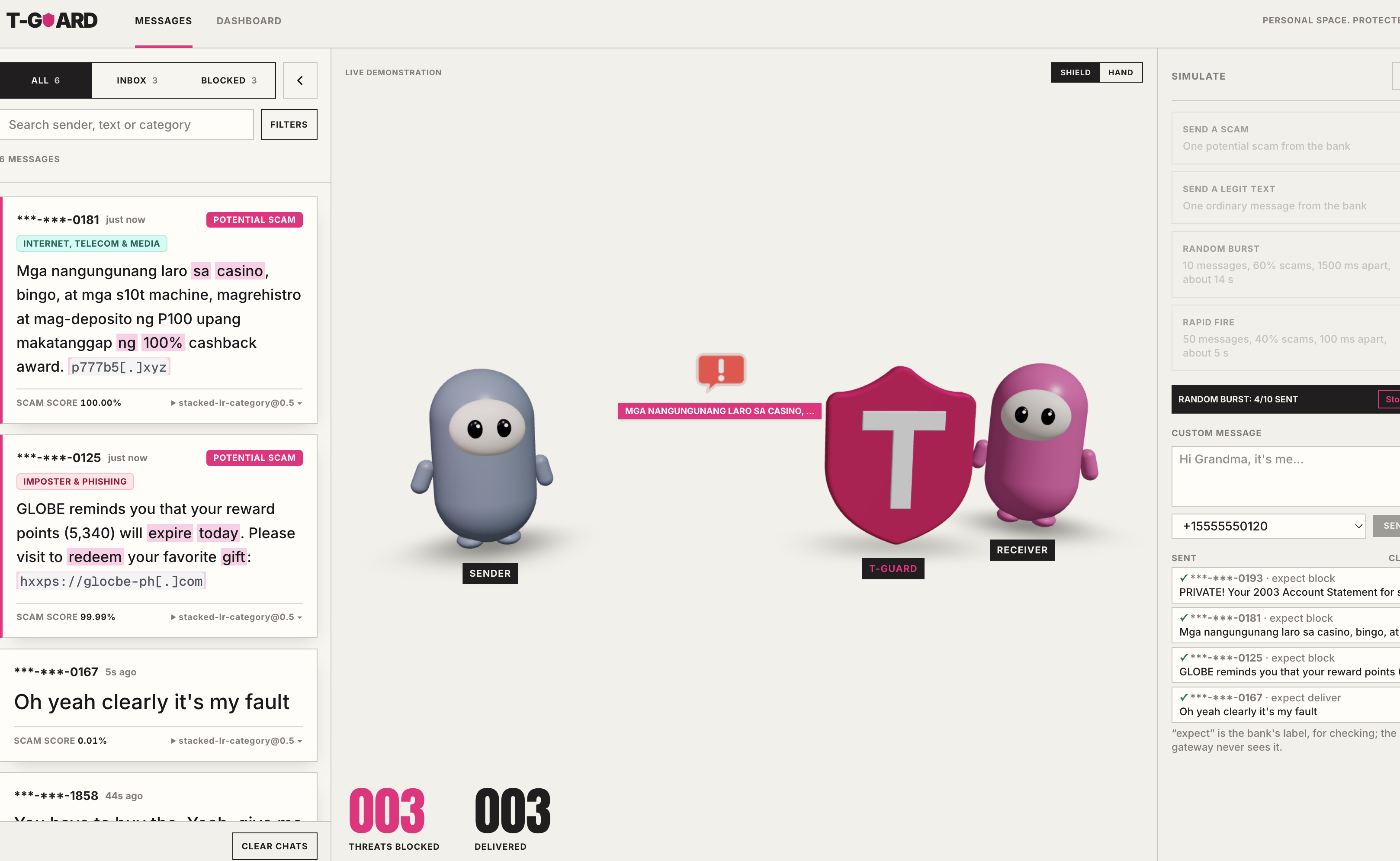
T-GUARD intercepts incoming text messages and evaluates them for potential fraud across nine scam categories. Suspicious messages are flagged or blocked, dangerous links and phone numbers are disabled within the protected experience, and users receive understandable explanations of the detected risks.
(MAIN CONSUMER FEATURE 2) Protection against fraudulent phone calls
Our voice-protection pipeline is designed to screen incoming calls, transcribe speech into text, and analyze that text using the same scam-detection architecture as our messaging system.
Both features are built around a shared, layered defense system.
Our first line of defense is a custom-trained machine learning classifier. It evaluates messages for fraudulent patterns and produces a risk assessment.
When additional verification is needed, NVIDIA Nemotron provides a second layer of analysis. Rather than simply asking another AI model whether a message looks suspicious, Nemotron can investigate the claims being made.
For example, imagine receiving a message claiming that you owe money for a service you never purchased.
Nemotron can determine what financial information would help verify that claim, then use Capital One's Nessie API to examine simulated banking records.
The result is a system that doesn't just ask, "Does this look like a scam?"
It also asks, "Does what this person is claiming actually make sense?"
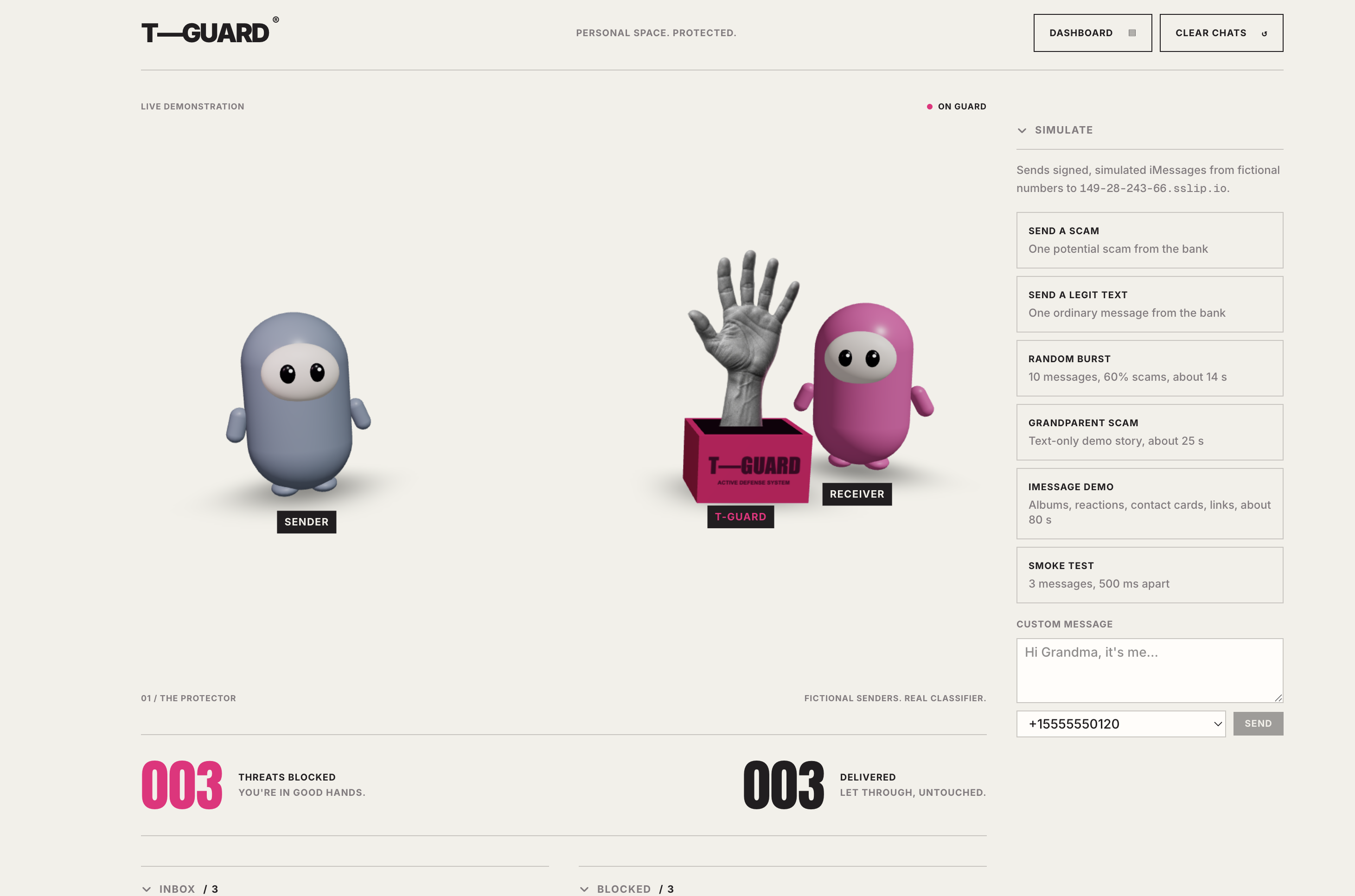
Our customer-facing experience includes an intercepted-message inbox, highlighted suspicious language, confidence scores, a security dashboard, an interactive 3D guardian, and a simulation interface.
How we built it
We made a deliberate engineering decision early in development: just because large language models are powerful doesn't mean they should be responsible for every task.
Rather than immediately building another LLM-powered chatbot, we wanted to investigate whether classical machine learning could provide fast, specialized, and computationally efficient scam detection.
Our team spent approximately 16 hours training, testing, and calibrating our machine learning system, because the accuracy of our first line of defense was critical.
We developed a stacked classification architecture covering nine scam categories, achieving approximately 95% accuracy in our primary model evaluation and a reported 98.5% end-to-end accuracy on held-out real text messages in our broader testing.
Our architecture connects several technologies:
Classical Machine Learning: Our primary detection layer, designed to classify suspicious messages efficiently without requiring an LLM call for every interaction.
*NVIDIA Nemotron: * Our secondary reasoning layer, which interprets suspicious claims and determines what additional verification may be useful.
*Capital One - Nessie API: * Provides simulated financial information that Nemotron can query to evaluate claims involving payments, accounts, and transactions.
(Nemotron + Nessie) = Our second line of defense against scams after our well trained machine learning model.
Photon: Supports our communications integration, including message and call events.
LiveKit: Supports the voice-processing pipeline, connecting call audio and speech transcription to our detection system.
Vultr: Hosts our backend infrastructure and supports processing incoming communication events.
Interactive frontend: Presents intercepted messages, risk explanations, security information, and our guardian experience. We have the shield and the hand just comedic representation of how one goes about expressing the fundamentals of machine learning.
Our approach separates fast initial classification from more expensive contextual reasoning. This is intended to reduce unnecessary LLM usage, control token costs, and keep the system responsive.
For our prototype, financial verification uses mock banking data rather than real customer financial records.
Challenges we ran into
Building around mobile communications infrastructure
One of our largest challenges was working with text messaging and calling systems, particularly the restrictions surrounding platforms such as iMessage.
Unlike a conventional web application, our project required us to coordinate communications infrastructure, incoming events, backend processing, and customer-facing interventions.
Building a reliable first line of defense
We didn't want to rely entirely on a large language model to classify every message.
This meant dedicating considerable time to training, testing, and calibrating a specialized machine learning model.
We had to balance accuracy, processing speed, false positives, and the possibility of scams slipping through the initial detection layer.
Connecting language-model reasoning with financial data
Integrating Nemotron with Nessie introduced a different engineering challenge.
It wasn't enough to ask an LLM to classify a message. We needed it to understand a suspicious claim, determine what financial information would be relevant, request that information through an API, and incorporate the result into a second opinion.
Turning technical detection into meaningful protection
A classification score alone doesn't help someone who doesn't understand cybersecurity.
We needed to translate technical risk assessments into an experience that communicates danger clearly, explains uncertainty, and reduces opportunities for harmful interactions.
Accomplishments that we're proud of
Our greatest accomplishment is building a system that goes beyond conventional scam classification.
We are particularly proud of:
95.9% end-to-end accuracy in our reported evaluation on held-out real text messages, while recognizing that performance on a test dataset does not guarantee the same results in deployment.
Approximately 16 hours dedicated to machine learning development, rather than relying exclusively on an off-the-shelf LLM.
Nine scam categories supported by our classification architecture.
Contextual financial verification, connecting NVIDIA Nemotron's reasoning capabilities with Capital One Nessie's simulated banking information.
A layered defense strategy that uses specialized machine learning first and escalates to additional AI analysis when appropriate.
A customer-facing protection experience that displays intercepted messages, highlights suspicious content, communicates uncertainty, and disables risky interactions.
A shared detection architecture designed to support both text messages and phone-call transcripts.
Most importantly, we're proud that we approached this as an engineering problem with a human purpose.
We didn't want to build technology simply because it was impressive.
We wanted to build technology that could protect someone.
What we learned
One of our most important lessons was that the newest technology isn't automatically the best technology for every problem.
Large language models are powerful, but using them indiscriminately can introduce unnecessary latency, computational expense, and operational complexity.
By using classical machine learning as our primary defense, we explored how specialized models and LLMs could complement one another instead of competing for the same responsibility. We also learned that detecting a scam and preventing a scam are two different engineering challenges.
Detection requires recognizing suspicious patterns. Prevention requires intervening at the right moment and communicating risk in a way that people can understand.
Finally, we learned how challenging it is designing training and calibrating the model AI model specifically the classical Machine Learning model was found.
Telephony infrastructure, speech transcription, machine learning, AI reasoning, financial APIs, backend services, and frontend design all had to contribute toward the same objective.
The result reinforced something we believe strongly: the best technology is not necessarily the most complicated system, but the system that makes a difficult problem simpler for the person using it.
What's next for T-GUARD
Our long-term vision is to make T-GUARD a proactive guardian that can protect everyday people across their digital communications.
Our next priorities include
Our long-term vision is to make T-GUARD a proactive guardian that can protect everyday people across their digital communications. Adopt all these feature in the context of a carrier level e.i T-Mobil which then have higher flexibility
Expanding call protection: Completing and validating our real-time voice-screening pipeline so suspicious phone calls can benefit from the same layered defenses as text messages.
Scam-specific guidance: Providing clear instructions explaining what users should do when a threat is detected, along with simple explanations of the techniques scammers use. We thought of being able to interact with the
A shared scam intelligence network: Exploring MongoDB Atlas to store privacy-conscious scam fingerprints, helping the system recognize recurring attack patterns across communications without unnecessarily retaining personal message content.
Stronger privacy controls: Introducing automatic data-retention limits, more restrictive access controls, and safeguards around external AI processing.
Broader financial verification: Exploring additional authorized financial integrations to help verify suspicious claims beyond our simulated banking environment.
Real-world evaluation: Testing against more diverse scam examples, measuring false positives and missed threats, and evaluating usability with older adults and other intended users.
Ultimately, we envision T-GUARD as a protective layer that operates that shall protect the world.
We are T-Guard! A guardian in your palm
Built With
- claude
- linked
- livekit
- llm
- machine-learning
- mongodb
- nessie
- nvidia
- openai
- photon
- python
- vultr
