
Inspiration
Across North America, ongoing plans for data centers (such as recent proposals in Mississauga and Hamilton) and AI-related projects have sparked significant debate on the environmental cost of progress. Despite this, consumers are either mostly unaware of these impacts or the scale of impact on them and their local community. These facilities require massive amounts of electricity, water, and physical infrastructure, yet most consumers have little understanding of how their everyday AI usage contributes to these demands. We created TAIME (pronounced time) to bridge this gap. Our goal was to make the hidden environmental costs of AI visible, understandable, and personally relevant. By connecting individual AI usage to environmental metrics and local community impacts, we hope to encourage more informed conversations about the future of AI and the infrastructure that powers it.
What it does
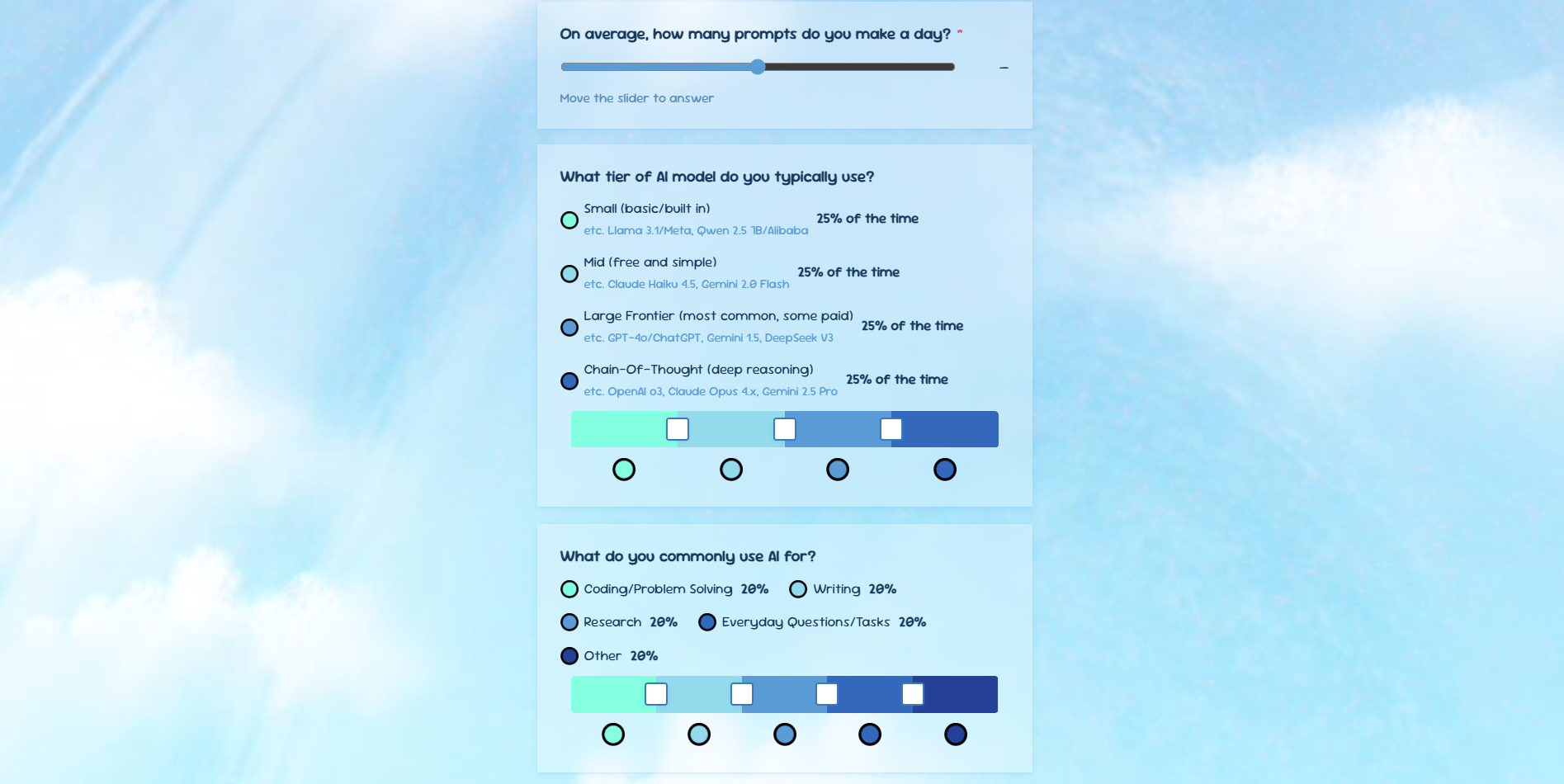
TAIME is an interactive transparency platform that estimates the environmental footprint of an individual's AI usage through a survey-based model. Users answer questions about their AI habits, including frequency of AI use, types of models used, image, video, and text generation activity, and duration and intensity of usage. Using publicly available research and infrastructure estimates, TAIME generates personalized impact metrics, including estimated electricity consumption, estimated carbon emissions, estimated water usage, as well as show the potential impacts of AI infrastructure on local communities through utility bills and cognitive function.
How we built it
with hopes and dreams?
Taime was built by a team of four over the course of JAMHacks using a Node.js backend with a Typescript, HTML, and CSS frontend. The calculation engine uses user-submitted usecases to estimate the number of tokens, which can be used to find energy and water consumption. This required us to do large amounts of research into the energy consumption created by different models and it's relevant cost found in areas such as Ontario.
Challenges we ran into
- Accurate quantitative sources on AI power consumption are often biased and few and far between, and we tried finding citable and defensible sources
- The environmental impact on an individual level was much lower than expected, meaning we had to adjust some features
- Being able to build a product that feels personal and impactful to the user
- elliot is a beautiful chadlite and claude is an ltn
Accomplishments that we're proud of
- Being beginner hackers, we were really proud that we managed to pick up so many skills on the fly and ultimately create a product we are proud of.
- Cool visual elements
- Finding the really awesome 213 page MIT study
What we learned
"meow. wait no i learned that coding. is evil. and that everyone that works in tech and ai is kind of evil. "
- Elliot
"we learned a lot about ai and it's actual impacts on the environment, challenging our assumptions such as energy and water usage."
- Kyle
"and I LEARNED how to use claude"
- Lucas
"i learned about the power of friendship and that my head fits perfectly under a chair that blocks out light so i can sleep in hour intervals"
- Andrew
What's next for T(AI)ME
We think that our product could be further integrated to LLMs via plug-ins or browser extensions that would allow users to understand their impact and usage during sessions. Further research must also be conducted on the resource consumption, as data is still unreliable.

Log in or sign up for Devpost to join the conversation.