-
-
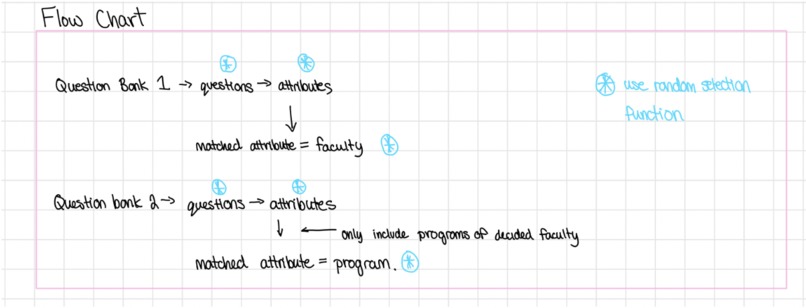
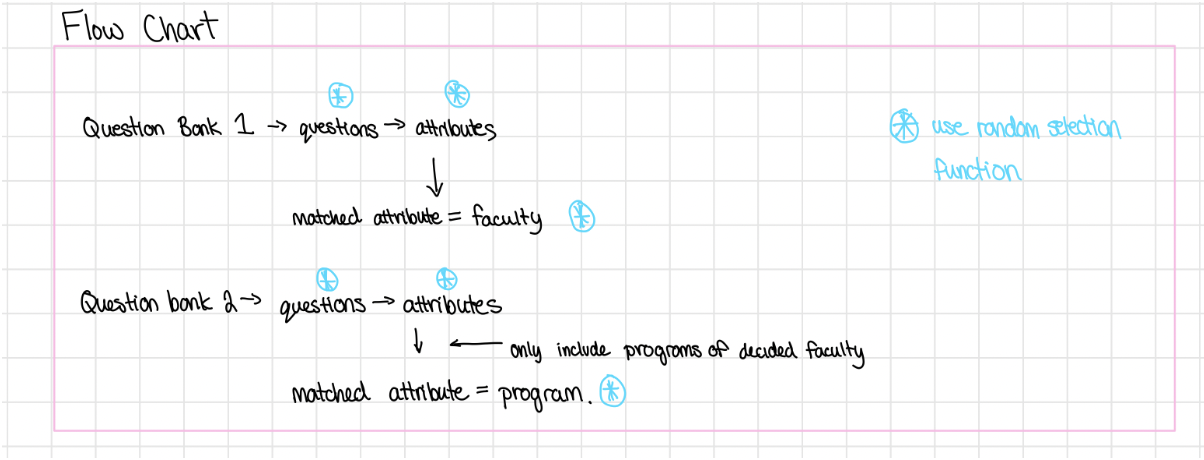
Flow chart of question selection algorithm
Inspiration
After speaking with mentors and presenters throughout the day about how they entered the STEM field, and possible factors that would have deterred them from choosing their career paths, we have identified that many girls do not choose to pursue STEM programs in post secondary school due to the lack of information they receive regarding these careers. In society, there is a lack of representation of women in STEM, and as a result, many girls do not explore these fields and do not picture themselves in a STEM career. Especially in schools without resources such as computer science and engineering classes, many girls are not exposed to how their problem solving skills, creativity, and artistic talent could be extremely valuable in STEM fields.
What it does
Our app aims to provide this education by suggesting post secondary STEM programs to girls based on their talents and interests in a simple and engaging way. sySTEM sends daily notifications to students looking to explore post-secondary options and suggests an academic program based on the answers to the daily questions. The format of a single career suggestion a day allows exploring STEM to be less intimidating, as it simplifies the process of searching through lists of hundreds of different programs and encourages girls to think about their career for small amounts of time each day. Overall, this time investment will compound into more time spent researching different options and will give girls the confidence to make an informed decision and make the decision to get involved in STEM. Each program suggestion will also be accompanied with examples of successful women in this field, so that girls can have role models and can picture themselves in STEM careers.
How we built it
The low-fidelity prototype of the project was built using Figma. It features interactive elements and a user-friendly interface to provide exposure for high school-aged females to the field of STEM. The hard-code for the project has not yet been implemented, but the code outline is as follows:
Front-end design and elements built with React and Javascript, with the help of libraries such as Bootstrap for design elements. MongoDB to store the login information of the user and the archived favourite programs of the user. REST API to communicate with the server and the data stored within the database.
The algorithm to determine the program shown to the user is as follows:
Question Selection Algorithm - store a pre-made set of questions, a random function will pull a question each day. From the selected question, there will be many possible answers linked to each question, but four will be randomly selected from a bank of answers. That selected answer will narrow down the program options to the faculty of science, technology, engineering, or maths. If the answer is an attribute of one or more faculty, the faculty will be chosen with the help of a random selection function.
Once the faculty has been decided, a question will be selected randomly from a second set of more specific questions. Once again, there will be four answers selected randomly from a bank of answers per question. The answer selected by the user is then specifically matched with attributes of programs belonging to the decided faculty from the first question. If more than one program shares the same selected attribute, the random function will be executed once again to display a program for the user.
This system allows for the same question to be asked repeatedly, but for different programs to be shown for the answers each time while still being tailored to the user.
This decreases the amount of initial information being imputed into the database, but increases the amount of programs a user could be shown.
A timer function will be used to reset the questions, so that the process is repeated daily and program exploration can be accomplished.
A flow chart is included in our presentation.
Challenges we ran into
A challenge we faced when working on this problem was narrowing down the problem statement to address a specific issue of inequality in STEM. Under the given time constraints, it was difficult to establish what product aspects were most valuable to solving the given problem.
Accomplishments that we're proud of
We are most proud of seeing the product through to completion of a low-fidelity interactive prototype. We are proud of how we worked as a team and encouraged each other to bring ideas forward.
What we learned
We learned a lot about the inequalities within the STEM fields, as different women grow up with different opportunities to learn about STEM. Additionally, we learned a lot about rapid prototyping and hack design in a constrained period of time.
What's next for sySTEM
Next steps for this project would be adding more internal resources and hyperlinks for each program to provide users with more information on the app itself, without needing to find information from external sources. This would involve expanding the current database and adding visual components on the user interface in order to relay this information to our users. Additionally, we intend to extend this app to a classroom setting. For this, users can be either teachers or students, where teachers can track the progress of their students, to ensure the questionnaire is completed each day.
Built With
- figma

Log in or sign up for Devpost to join the conversation.