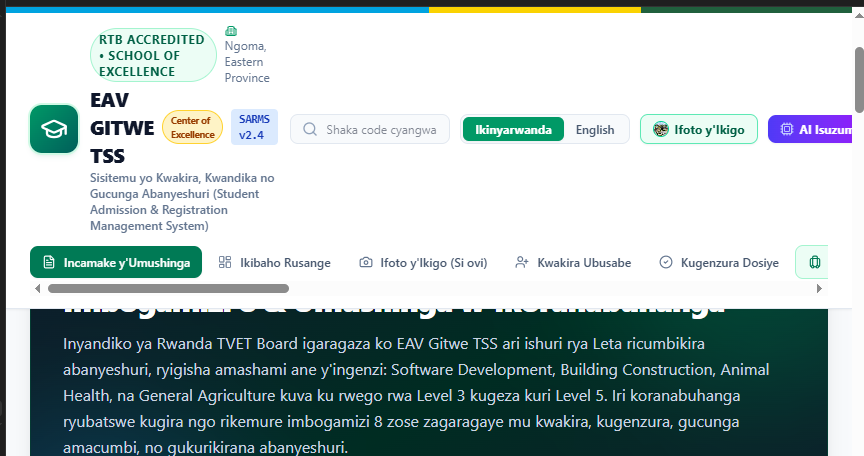
EAV Gitwe TSS SARMS is an all-in-one digital campus management ecosystem covering the complete institutional lifecycle: Instant Student Intake & Auto-ID Card Issuance: Enforces Rwandan NIDA compliance (16-digit National ID) and standard Rwandan phone validation (07...). Automatically allocates an institutional matriculation number (EAV/2026/[TRADE]/[NUMBER]). Instantly generates a print-ready Student ID Card with the student’s uniform photograph, RTB trade badge, QR code, and boarding status right after registration. 5-Point Digital Dossier Verification: Inspects and validates O-Level transcripts, birth certificates, medical fitness documents, bank payment slips, and passport photos. Physical Reception Desk & Parent Arrival Alerts: Verifies baggage, clearance status, and triggers an automated SMS to parents the moment their child sets foot on campus. Zero-Airtime Staff Hub & Sudden Emergency Meeting Dispatch: Eliminates cellular airtime costs by providing a real-time digital briefing board. Dispatches urgent meeting calls with 1-tap RSVP tracking (Attending, Tentative, Excused). Nightly Boarding Roll-Call & Kitchen Rationing Calculator: Allows the Metron (Girls) and Patron (Boys) to take 1-tap nightly bed checks across 4 blocks. Dynamically calculates kitchen ingredient portions (posho, beans, rice, vegetables) based on exact headcounts present that night. 40-Point Conduct & Demerit Tracking: Deducts disciplinary points from a 40/40 baseline and triggers automatic parent SMS notifications whenever an infraction occurs. Tuition Ledger & Multi-Channel Fee Reconciliation: Distinguishes Boarders (145,000 RWF) and Day Scholars (65,000 RWF), reconciling Bank of Kigali (BK), MTN/Airtel MoMo, and Cash with printable receipts. Academic Management & RTB Modular Grading: 30% Continuous Assessment Tests (CAT), 40% Practical Workshop Projects, and 30% Final Examination. Parent & Student Self-Service Portal: Enables parents and students to view attendance, disciplinary standing, and download termly report cards remotely. AI Pre-Hosting System Auditor: Powered by Google's Gemini 3.8 Flash model, performing automated multi-pillar security, database, and RTB compliance stress tests before cloud deployment. How I built it Frontend Architecture: Built using React 19 and TypeScript bundled with Vite. Styled with Tailwind CSS using institutional emerald, teal, and slate color palettes, complete with bilingual toggles (English & Kinyarwanda). Backend & API Layer: Developed an Express.js REST server running on Node.js mounted on Port 3000 (server.ts). Database & Dual Storage Engine: Relational Layer: Configured for MySQL / MariaDB (XAMPP / phpMyAdmin) with normalized schemas for students, classes, transactions, and audit records. Resilient Fallback Engine: Engineered an automated JSON file-based database (data/eav_database.json) and browser storage layer so the app never crashes even if the external MySQL server drops offline. Instant SQL Query Generator: Generates clean, sanitized SQL insertion statements directly from the web intake form for rapid XAMPP database synchronization. Intelligent AI Integration: Integrated the @google/genai TypeScript SDK utilizing Gemini 3.8 Flash via server-side proxy routes to analyze system telemetry and evaluate institutional operational readiness. Print Engine: Implemented @media print CSS style layers to render pixel-perfect, wallet-sized PVC Student ID Cards, official RTB Admission Letters, and financial receipts. Challenges I ran into Local MySQL vs. Cloud Environment Connectivity: Problem: When running the frontend in modern cloud sandbox environments, direct TCP connections to a user’s local localhost:3306 MySQL instance are blocked by browser cross-origin and loopback security policies. Solution: Created a dual-strategy architecture: a built-in server-side proxy combined with an instant "Copy SQL Query" and .sql file generator that lets registrars transfer intake batches into phpMyAdmin in under 15 seconds, backed by a local JSON persistence layer. Instant Student Card Rendering Without Page Re-renders: Problem: Generating the Student ID Card immediately after clicking "Submit" required coordinating the auto-generated matriculation code, uniform photo assignment, and boarding allocation without racing against the database write. Solution: Implemented a centralized state callback pipeline with an asynchronous trigger that provisions the new student record, attaches the uniform avatar based on gender/trade, and seamlessly transitions into the ID Card modal with print styles. Bilingual Localization Consistency: Problem: Handling complex technical terms across English and Kinyarwanda (such as RTB modular grading, conduct demerits, and hostel rationing) while maintaining readable UI layouts across mobile and desktop viewports. Solution: Created a modular localization dictionary with key-value fallbacks ensuring clean typography and responsive layouts. Accomplishments that I'm proud of Instant Student ID Card Pipeline: Creating a zero-latency workflow where registering a student immediately outputs a high-definition, verified PVC card with barcode/QR code, photo, and official institutional credentials. Zero-Airtime Staff Hub: Solving a real-world administrative expense for Rwandan schools by replacing costly bulk cellular airtime calls with an instant digital emergency assembly system. Authentic Institutional Representation: Embedding high-fidelity visual representations of EAV Gitwe TSS students in official uniforms across ICT coding labs, construction workshops, and veterinary farms. Comprehensive Multi-Role Support: Designing tailored interfaces and workflows for every member of the school hierarchy—Principal, Registrar, Bursar, Metron/Patron, Teacher, Student, and Parent. Robust Verification & Build Pipeline: Passing both tsc --noEmit and Vite production compilation checks with 0 lint and type errors. What I learned Deep Rwandan TVET Domain Knowledge: Gained deep appreciation for RTB and NESA curriculum guidelines, particularly the 30-40-30 modular assessment distribution and boarding hostel accountability. Hybrid Storage Architectural Patterns: Mastered patterns for building web applications that function offline or in local network environments (like rural school LANs with XAMPP) while retaining cloud scalability. Print Styling Mastery: Learned how to master @page, page breaks, and @media print CSS rules to turn complex web components into clean, official physical documents without needing third-party canvas or PDF bloat. Practical AI Grounding: Discovered how to leverage Google's Gemini models not as novelty chat widgets, but as rigorous automated system auditors that inspect operational data, security roles, and regulatory compliance. What's next for system Hardware Smart Card & RFID Integration: Connecting USB NFC/RFID card readers to the physical gate and dining hall, allowing students to tap their newly printed ID cards for instant cafeteria meal access and gate entry. Direct Rwanda MoMo & IremboPay API Webhooks: Integrating live MTN Mobile Money and Bank of Kigali automated payment webhooks to automatically reconcile school fee payments without manual bank slip uploads. Biometric Hostel Check-In: Introducing fingerprint or facial recognition support for the Matron and Patron during late-night roll-calls. Offline PWA & Android APK Deployment: Packaging the system into an offline-first Progressive Web App (PWA) with background sync capabilities for rural TVET schools with intermittent internet access.
Smart Student Hub
A smart web platform that helps students manage their academic information, access learning resources, and track their educational progress in one place.
Updates

Leave feedback in the comments!