-
-
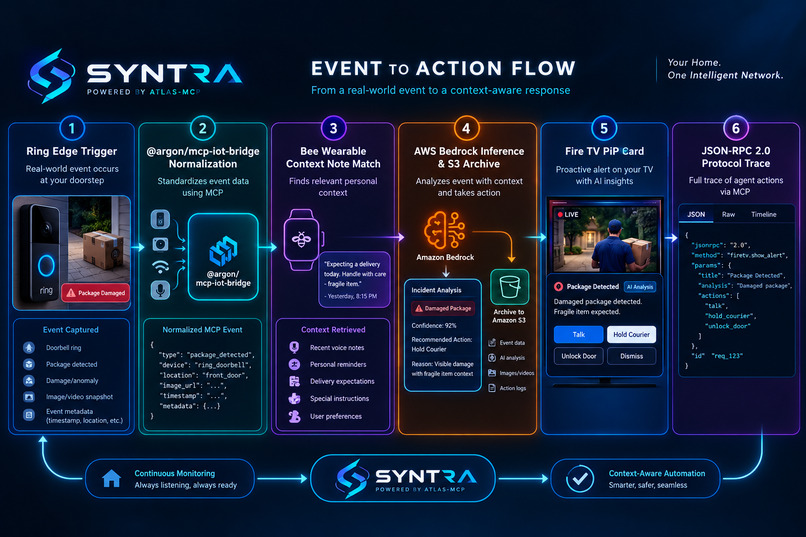
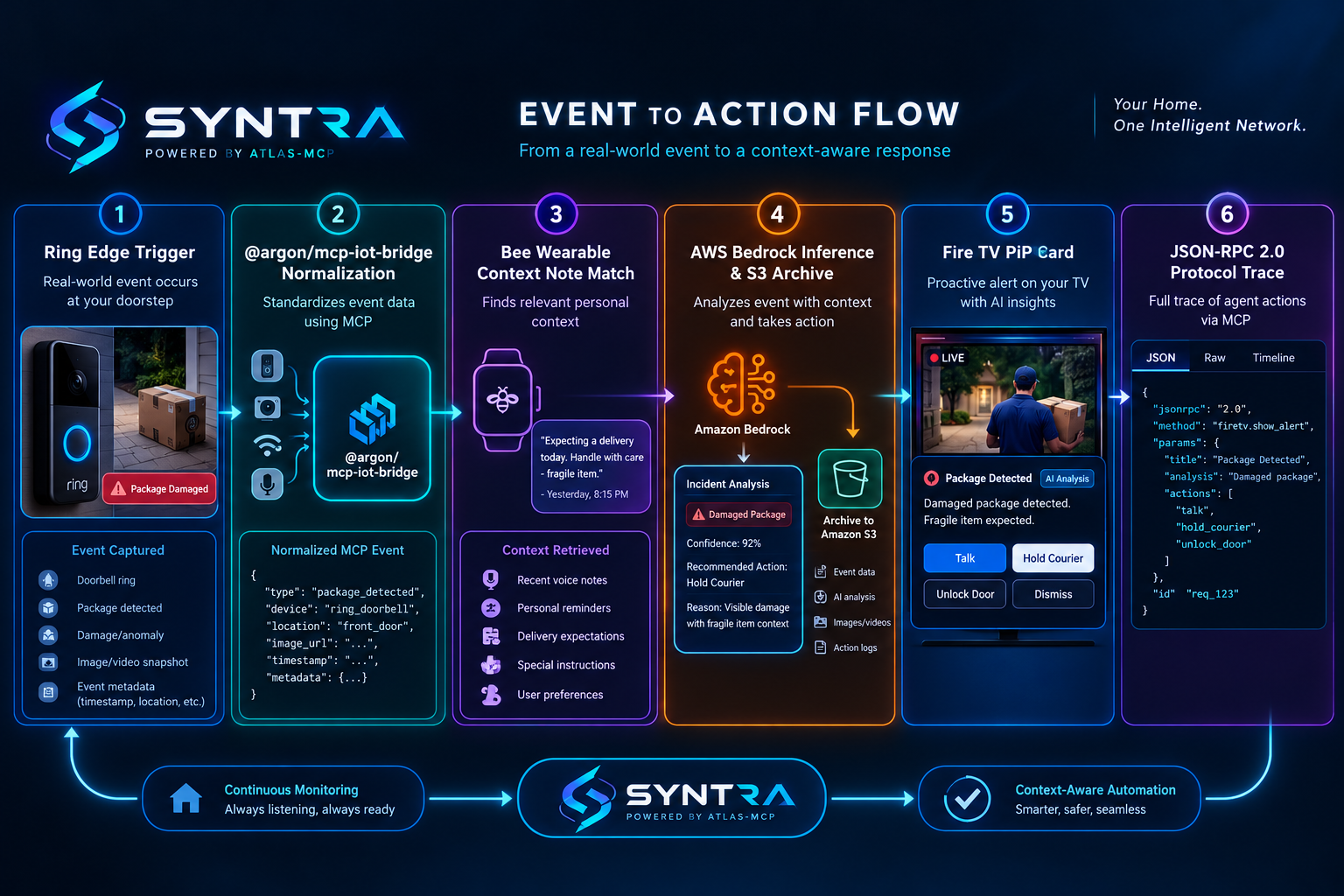
Workflow Diagram
-
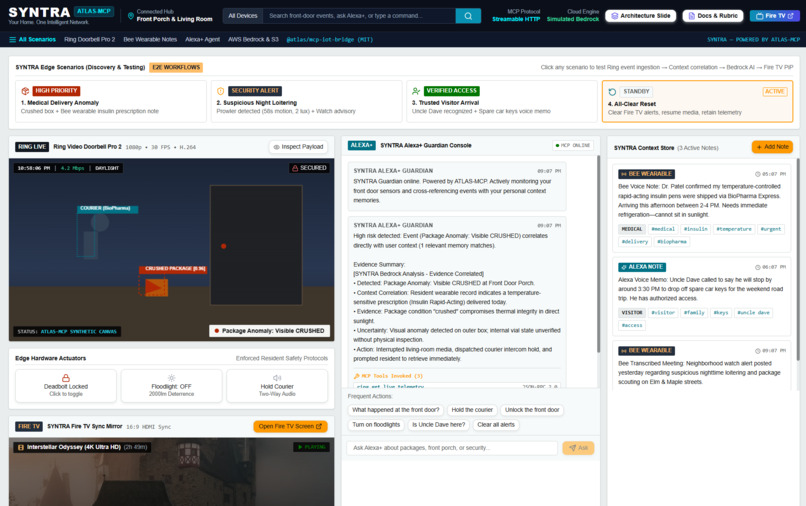
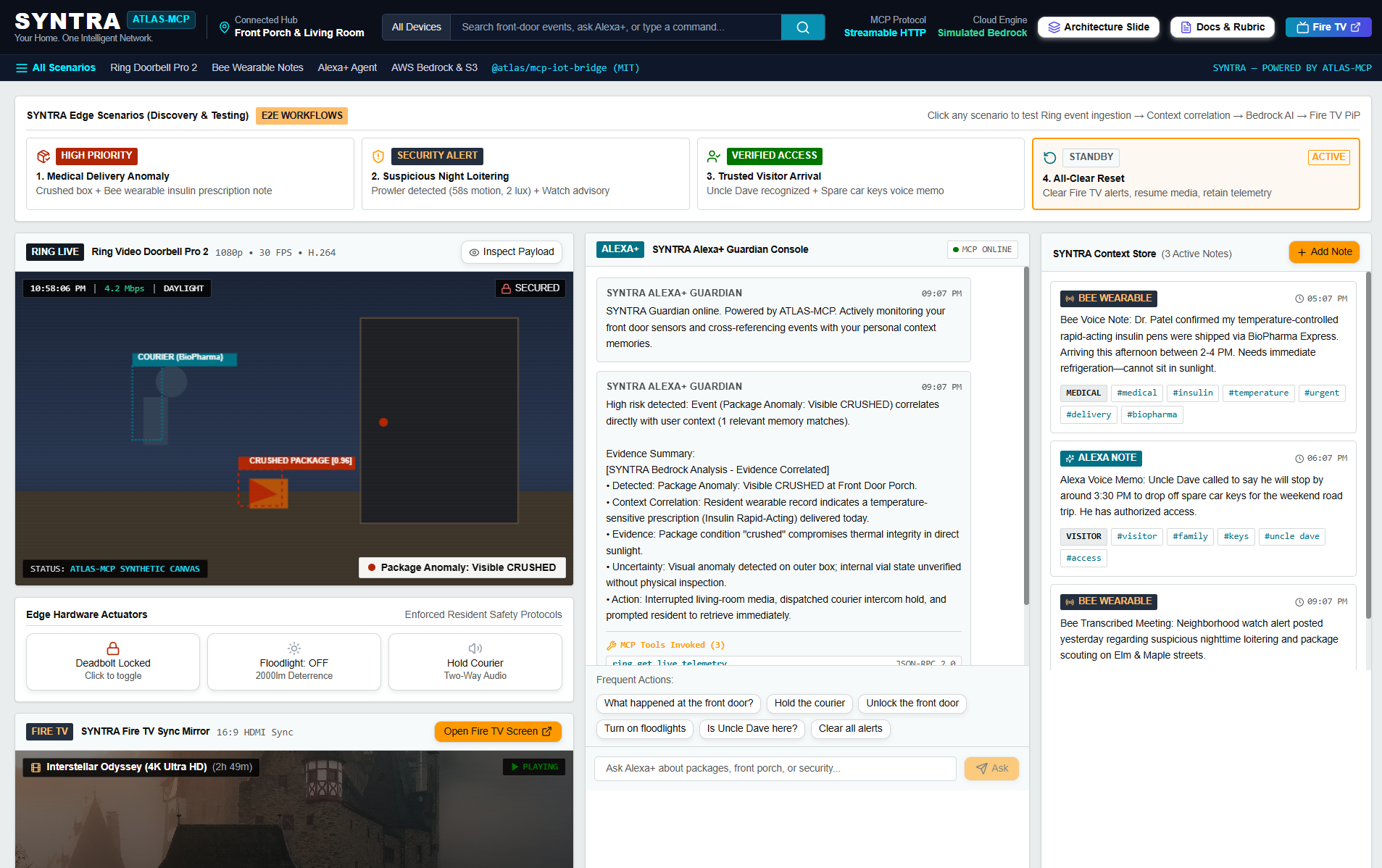
Dashboard - 2
-
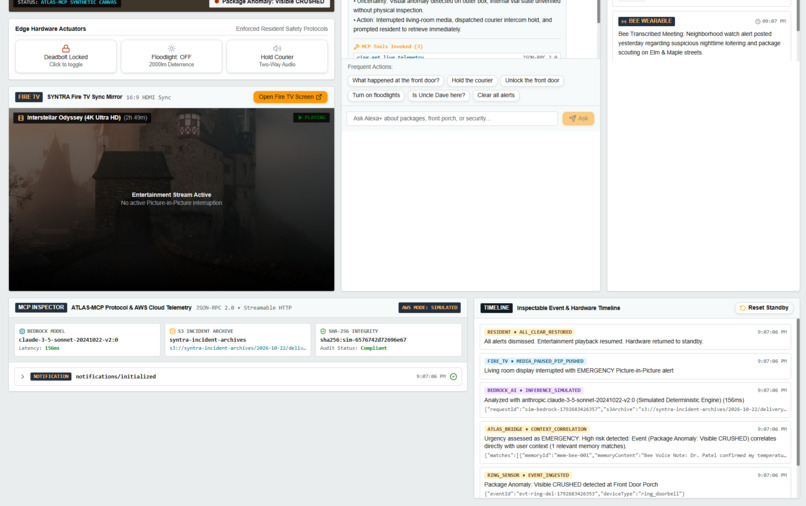
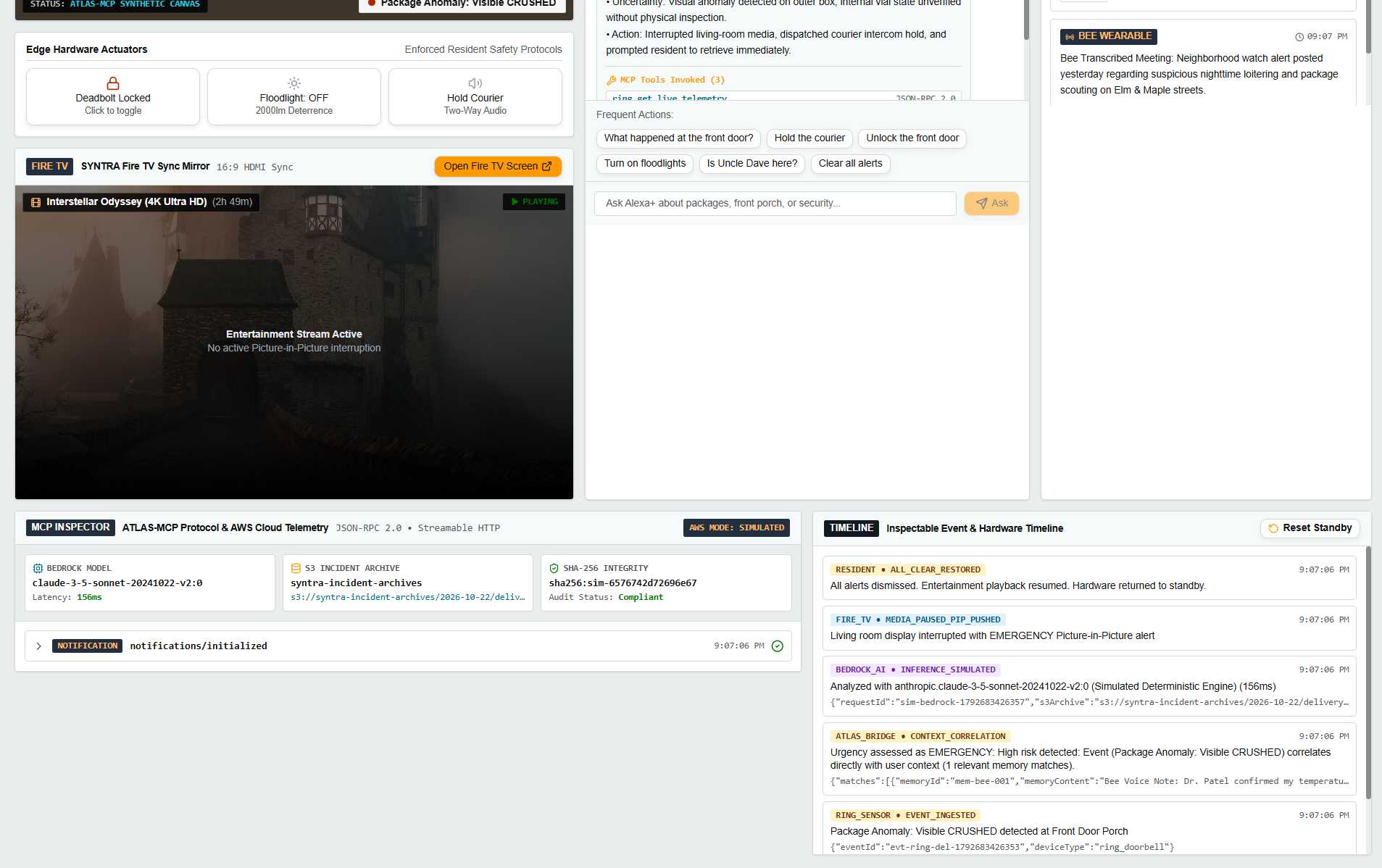
Dashboard - 1
-
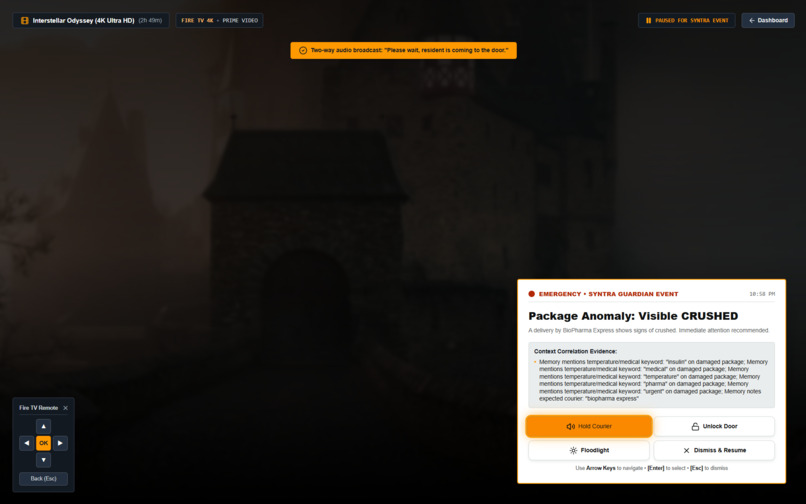
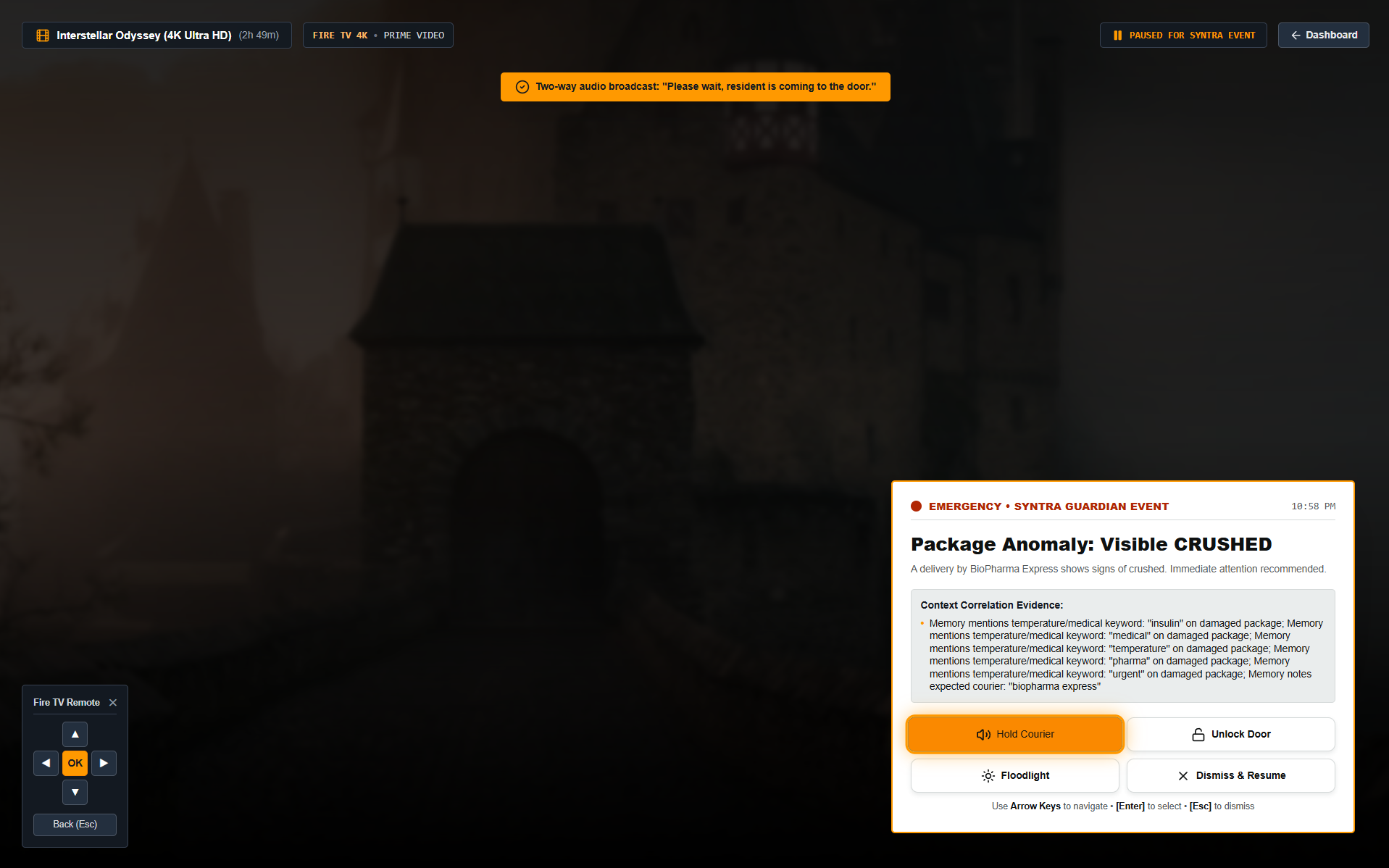
FireTV Alert Demo
Inspiration
Smart homes are connected, but their experiences are still fragmented. A doorbell rings while someone is watching a movie, a delivery arrives with visible damage, or an unexpected visitor approaches the front door—and the user must manually switch between apps, inspect notifications, and decide what to do next.
We wanted to explore a different approach: a home that understands events in context and brings the right information and actions to the user at the right moment.
SYNTRA was built around one question: What if your home could connect what's happening at the front door with what you're doing in the living room, reason about the situation, and help you respond without breaking your flow?
By combining the Model Context Protocol (MCP), IoT event simulation, contextual AI, and a television-first interface, we set out to demonstrate a more connected and proactive smart-home experience.
What it does
SYNTRA is an MCP-powered smart-home orchestration platform that connects simulated front-door events, personal context, AI-assisted incident analysis, and an interactive Fire TV-style interface.
When a doorbell, motion event, or package anomaly occurs, SYNTRA processes the event through a standardized integration layer, retrieves relevant context where available, and evaluates the incident using the configured AI workflow.
The system can then surface an actionable Picture-in-Picture-style alert on the living-room interface, allowing the user to inspect the situation and select an appropriate response.
Key capabilities include:
- Event-driven orchestration: Simulates Ring-style events and routes them through the application workflow.
- MCP integration: Exposes tools and resources through a Model Context Protocol server using JSON-RPC 2.0 and Streamable HTTP.
- Context-aware analysis: Combines event information with relevant wearable-style contextual notes when available.
- AI-assisted incident assessment: Uses the configured Amazon Bedrock integration to support risk analysis and recommended actions.
- TV-first interaction: Demonstrates actionable alerts, media controls, and directional remote navigation.
- Incident auditing: Integrates Amazon S3 for structured incident archival when cloud credentials and permissions are configured.
- Protocol observability: Provides an inspector for examining MCP requests, tool invocations, and responses.
SYNTRA demonstrates how these components can work together in a single event-to-action workflow instead of leaving users to coordinate multiple disconnected applications.
How we built it
We designed SYNTRA as a modular system with separate responsibilities for event ingestion, protocol integration, contextual reasoning, cloud services, and user interaction.
The application uses a web-based dashboard for Mission Control, an architecture view for explaining the processing pipeline, and a television-oriented interface for displaying alerts and interacting with incident actions.
The MCP layer uses the @modelcontextprotocol/sdk to expose tools and resources through JSON-RPC 2.0 and Streamable HTTP. These interfaces provide a consistent way to access telemetry, retrieve contextual information, control supported application workflows, and inspect tool execution.
Our integration layer, developed under the ATLAS-MCP Bridge naming convention, normalizes device-style events into structured inputs for the orchestration workflow.
The configured Amazon Bedrock Runtime integration supports AI-assisted incident analysis, while the Amazon S3 SDK provides the mechanism for storing incident manifests and audit artifacts. A simulated wearable context stream demonstrates how personal notes can enrich an event assessment.
The Fire TV-style web client presents the resulting incident through an interactive overlay. Directional input handling and explicit focus management support remote-style navigation.
The project also includes a protocol inspection experience that makes the underlying tool calls and responses visible, helping developers understand how the workflow operates.
Challenges we ran into
1. MCP session management
Integrating Streamable HTTP MCP with web API routes raised questions about session lifecycle, persistence, and requests reaching different execution instances. We had to account for session validation and the limitations of relying exclusively on in-memory state.
2. Proactive event orchestration
MCP tool invocation alone does not automatically solve the problem of delivering an incoming device event to an active user experience. We needed an event-handling layer that connects incoming webhooks with the subsequent orchestration workflow.
3. Television remote navigation
Dynamic overlays and media elements can compete for keyboard or remote focus. We addressed this through dedicated navigation and focus-management logic for the TV-style interface.
4. Context aggregation
Event metadata and contextual notes must be represented consistently before they can be used together. We structured the workflow so event normalization, context retrieval, analysis, and response generation remain distinguishable.
5. Cloud integration and reliability
Bedrock model access, S3 permissions, configuration, and failure handling introduce operational requirements beyond the user interface. We designed the integrations to keep their responsibilities explicit and to support transparent testing.
These challenges helped us treat SYNTRA as an end-to-end orchestration system rather than just a smart-home dashboard.
Accomplishments that we're proud of
We are proud to have brought together several technologies into one demonstrable event-to-action experience.
- A unified workflow: Connected device-style events, contextual information, AI-assisted analysis, and user-facing actions within a single application.
- An MCP-first architecture: Made tools, resources, and protocol interactions central to the design rather than treating MCP as an afterthought.
- A television-first experience: Designed an actionable alert interface for the living room, where users can respond without relying exclusively on their phones.
- A transparent technical demo: Made the architecture and MCP execution trace inspectable so viewers can understand the system beyond its visual interface.
- A modular integration approach: Separated event normalization from orchestration to make future device integrations easier to extend.
- A foundation for safer automation: Structured the workflow around incident assessment and explicit actions, creating a basis for more robust authorization and confirmation controls.
Most importantly, SYNTRA demonstrates a practical direction for connecting AI agents with real-world events and the devices people already use.
What we learned
We learned that building a useful AI-powered IoT experience requires more than a capable model. Event delivery, context quality, protocol design, session management, interface behavior, and authorization all influence the reliability of the final experience.
MCP provides a useful abstraction for exposing tools and resources, but asynchronous device events still require deliberate orchestration. Similarly, AI-generated recommendations are most useful when users can inspect the situation and retain control over consequential actions.
We also learned the importance of designing for the destination device. A television interface has different interaction constraints from a desktop dashboard, particularly around directional navigation, visibility, and minimizing interruptions.
Finally, we learned to distinguish a convincing simulator from a production-connected system. Simulated events are valuable for repeatable testing, while physical device integrations and cloud operations must be verified independently.
What's next for Syntra: MCP-Powered Smart Home AI
Our next goal is to evolve SYNTRA from a demonstration into a more reliable, extensible smart-home orchestration platform.
- Secure live device integrations: Connect supported hardware and event sources with explicit authorization and reliable event delivery.
- Low-latency video: Explore encrypted WebRTC streaming for responsive front-door monitoring.
- On-device event filtering: Evaluate edge processing to reduce unnecessary cloud inference and improve response times.
- Safer autonomous actions: Introduce policy-based permissions, confirmation requirements for sensitive actions, audit trails, and clear failure handling.
- Multi-room experiences: Extend incident alerts and intercom handoff to additional displays and compatible audio devices.
- Reusable MCP integration tooling: Develop the bridge into a documented, open-source component that other developers can use to connect IoT events to MCP-enabled applications.
Our long-term vision is a home that responds intelligently to context while keeping its actions understandable, observable, and under the user's control.
Built With
- ai-agents
- alexa+
- amazon-bedrock
- amazon-web-services
- aws-sdk
- event-driven-architecture
- fire-tv
- iot
- javascript
- json-rpc
- model-context-protocol
- next.js
- node.js
- open-source
- react
- smart-home
- streamable-http
- typescript
- web-speech-api

Log in or sign up for Devpost to join the conversation.