Inspiration
Organizations hold countless meetings every day, yet turning conversations into execution remains a manual and error-prone process. Action items are forgotten, decisions become buried in notes, and teams spend valuable time on follow-ups instead of meaningful work.
We asked ourselves a simple question: What if a team of AI agents could attend meetings alongside humans, collaborate with each other, and autonomously drive work forward?
That vision inspired Syntra AI—a multi-agent system that doesn't just understand conversations but coordinates execution across an organization.
What it does
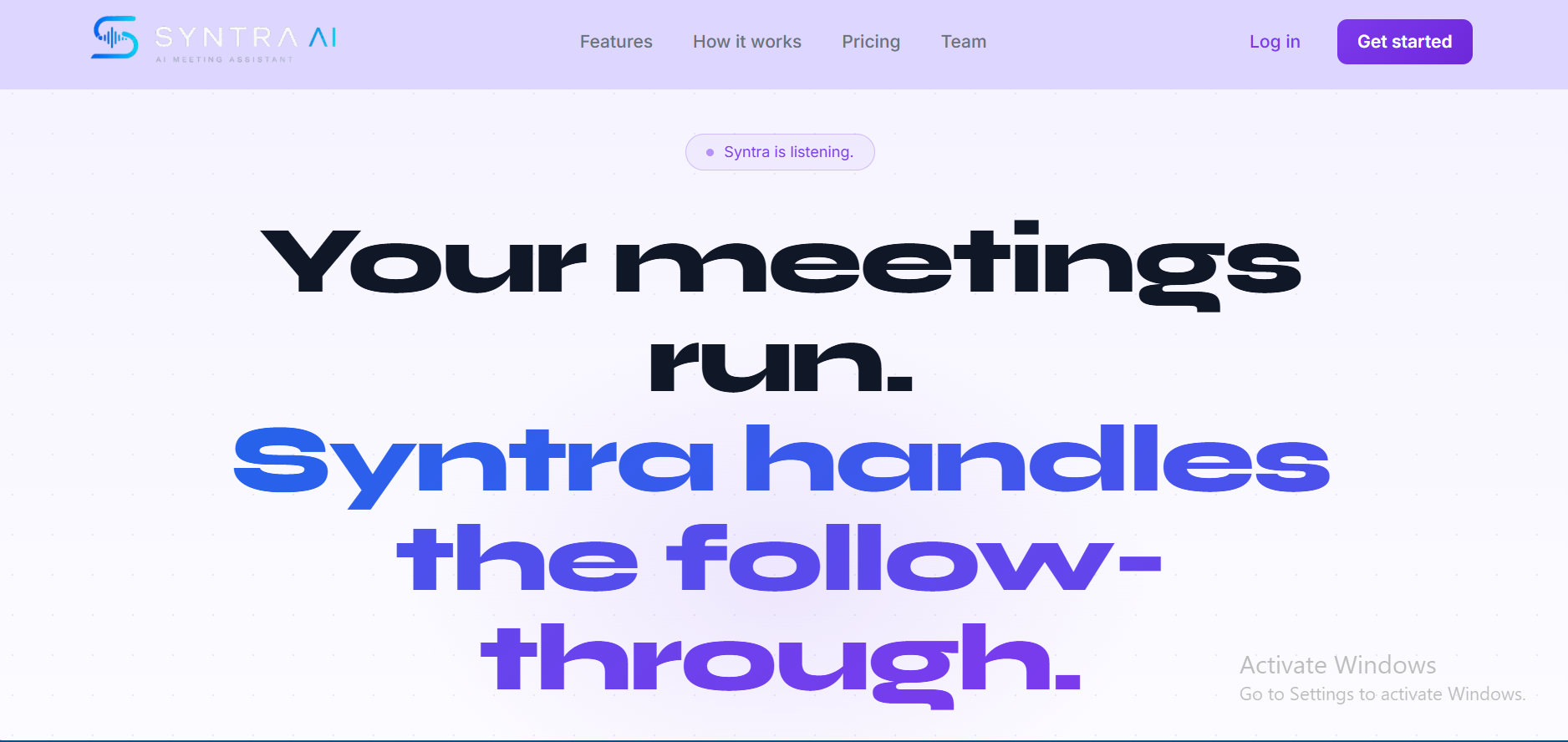
Syntra AI is a multi-agent AI platform that transforms meetings into autonomous workflows.
During a meeting, specialized AI agents work together to:
Join and transcribe meetings in real time. Understand conversations and identify key topics. Extract tasks, decisions, deadlines, and owners. Detect missing information and request clarification. Generate structured meeting summaries and reports. Organize tasks into dashboards for tracking and accountability. Allow participants to interact with the AI using natural voice commands.
Instead of acting as a simple meeting assistant, Syntra AI behaves like an intelligent team of AI co-workers that collaborate to help organizations execute faster and more accurately.
How we built it
We designed Syntra AI as a collaborative multi-agent architecture powered by modern AI models.
Different agents are responsible for specialized responsibilities, including speech recognition, conversation understanding, task extraction, decision analysis, reporting, and workflow management. These agents communicate with one another to exchange context, validate outputs, and coordinate execution.
The platform combines speech recognition, large language models, structured workflow orchestration, cloud services, and persistent memory to provide a production-ready foundation for enterprise automation.
Challenges we ran into
One of our biggest challenges was designing effective collaboration between multiple AI agents instead of relying on a single large language model.
Another challenge was ensuring that agents could handle ambiguous conversations while maintaining accuracy and knowing when to involve humans for clarification. Balancing autonomous decision-making with human oversight was essential for building a trustworthy system.
We also focused on designing an architecture that can scale from meeting intelligence to broader enterprise workflows.
Accomplishments that we're proud of
We're proud of building a system that treats AI agents as collaborative team members rather than isolated assistants.
Instead of creating another meeting transcription tool, we developed a multi-agent platform capable of understanding conversations, coordinating specialized AI agents, and transforming discussions into structured execution.
We're also proud of designing an extensible architecture that can grow into a broader enterprise automation platform.
What we learned
Building Syntra AI taught us that the future of enterprise AI is not a single powerful model, but multiple specialized agents working together.
We learned the importance of agent collaboration, memory management, workflow orchestration, and human-in-the-loop validation when building production-ready AI systems. We also discovered that AI delivers the greatest value when it helps teams execute work rather than simply generating information.
What's next for Syntra AI
Our vision is to evolve Syntra AI into a complete enterprise multi-agent operating system.
Future development includes:
Persistent memory across meetings and projects. Intelligent agent negotiation for complex business workflows. Integration with Zoom, Google Meet, Microsoft Teams, Jira, Asana, Slack, and CRM platforms. Autonomous follow-up and task completion. Enterprise knowledge retrieval across historical meetings. Adaptive AI agents that continuously improve through user feedback and organizational memory.
Our long-term goal is to create an AI workforce where specialized agents collaborate seamlessly with humans, transforming conversations into continuous execution across every part of an organization.
Built With
- ai
- firebase
- gemini
- github
- google-calendar
- meet
- nextjs
- tailwindcss
- typescript


Log in or sign up for Devpost to join the conversation.