-
-
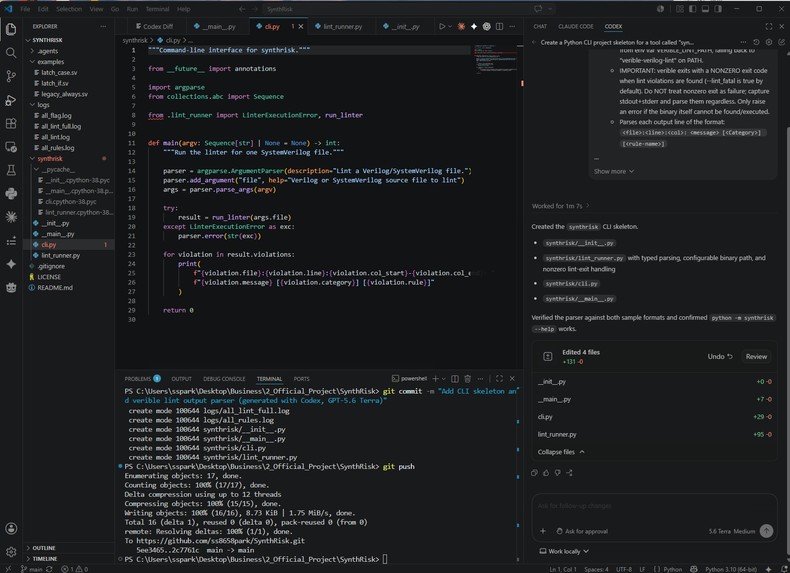
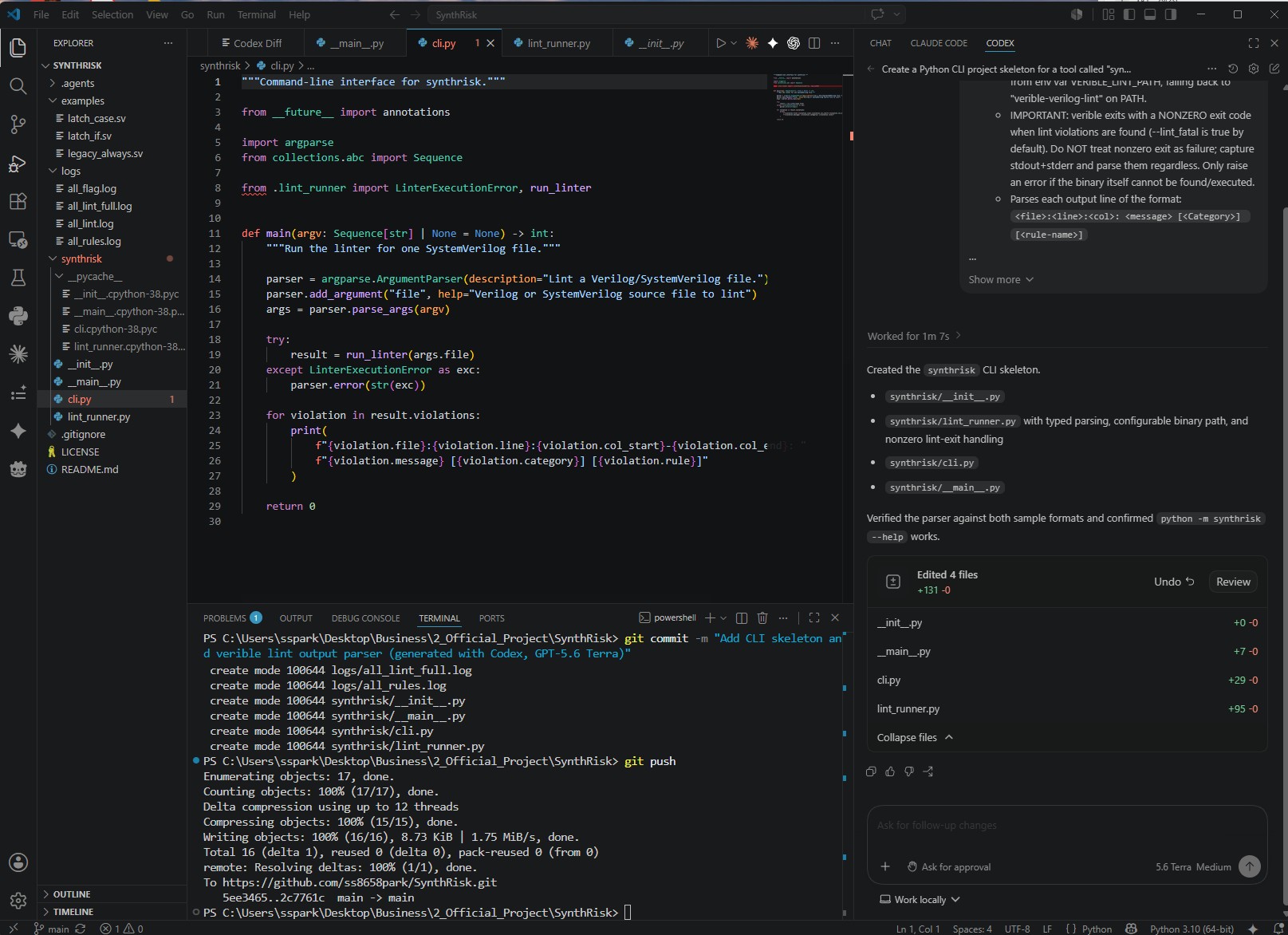
Codex (GPT-5.6 Terra) generating the CLI skeleton and Verible lint-output parser — first commit pushed to the repo.
-
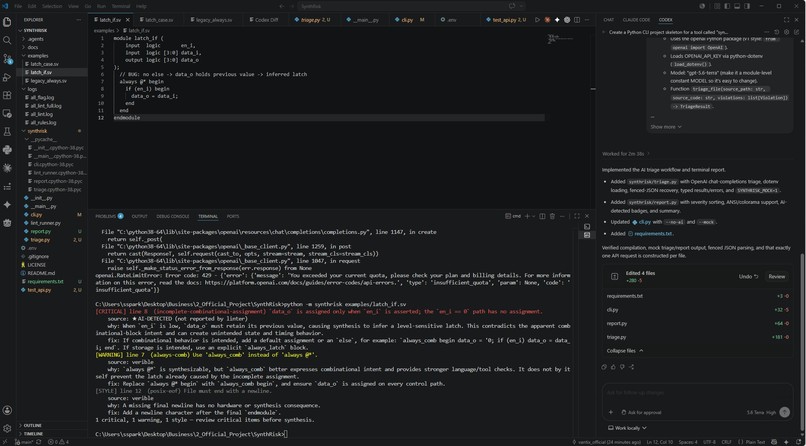
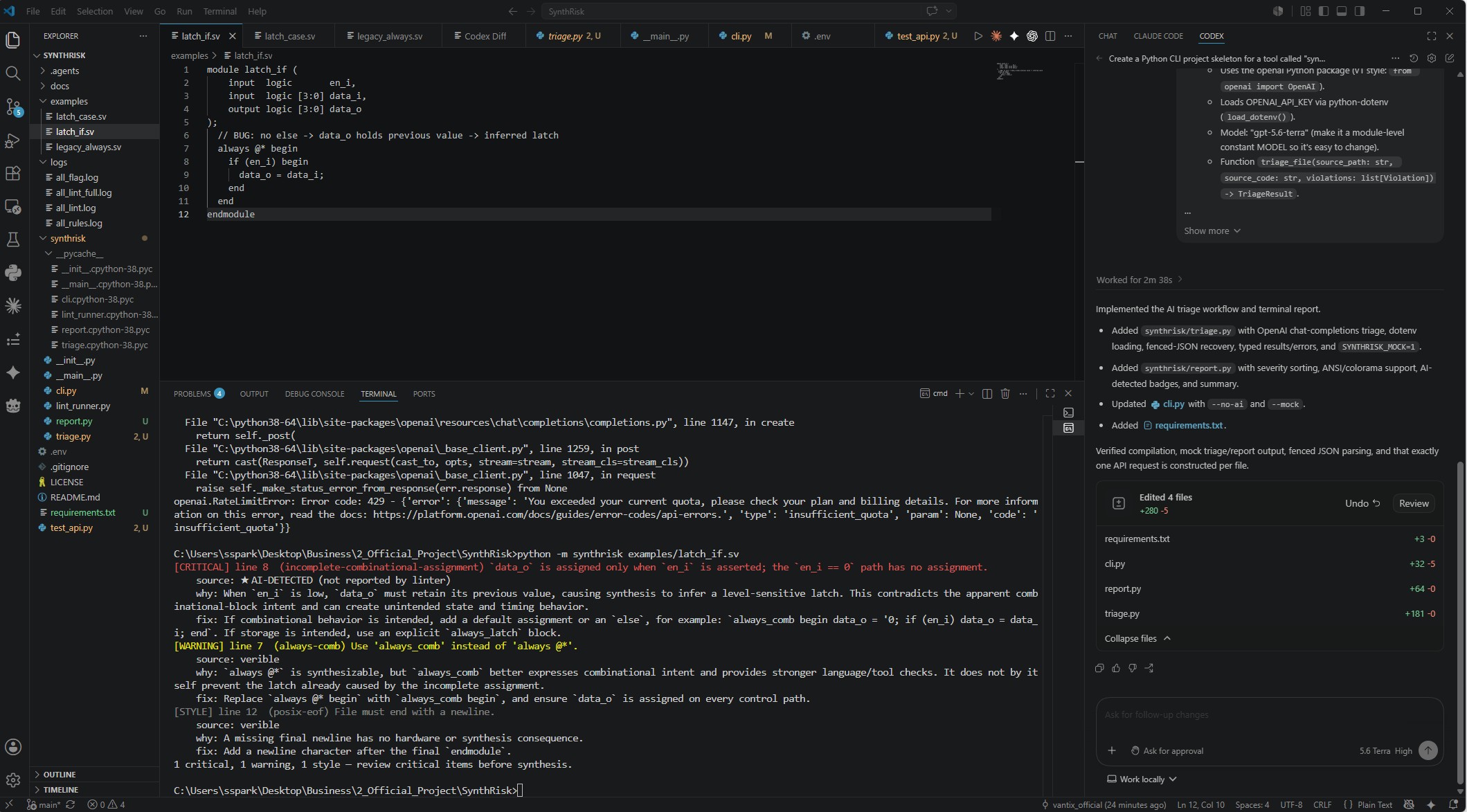
Codex building the GPT-5.6 triage engine. After hitting an API quota error, a real call succeeded — AI caught a latch bug the linter missed.
-
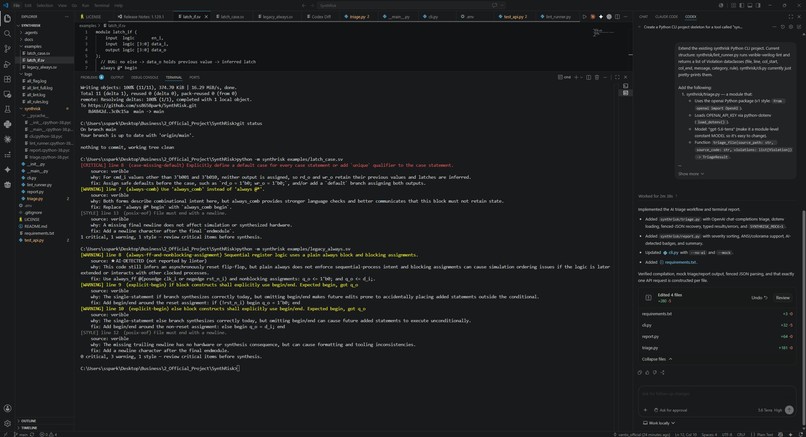
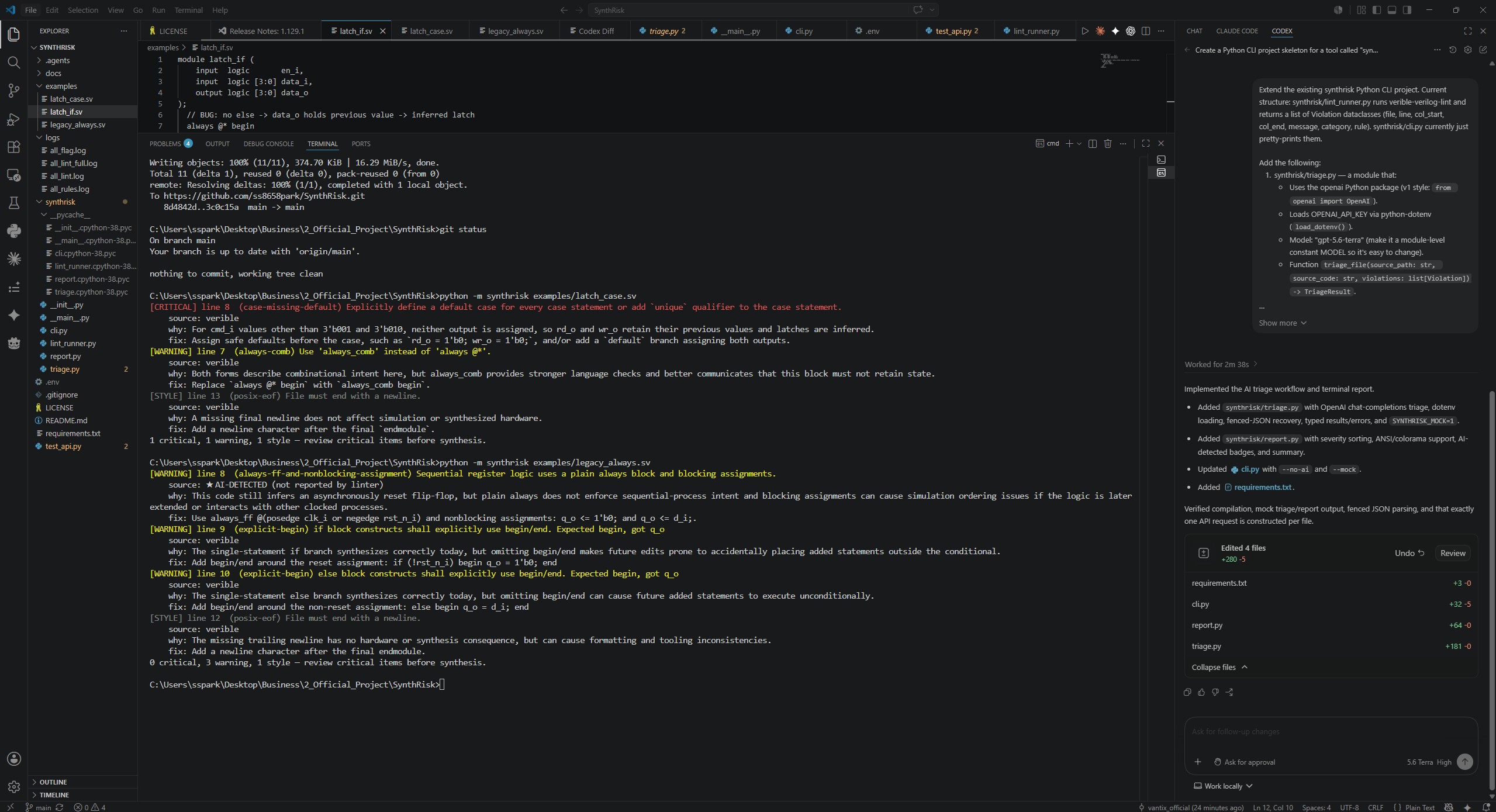
Verible's case-missing-default flagged as CRITICAL, and a blocking-assignment risk AI-detected that the linter never reported.
-
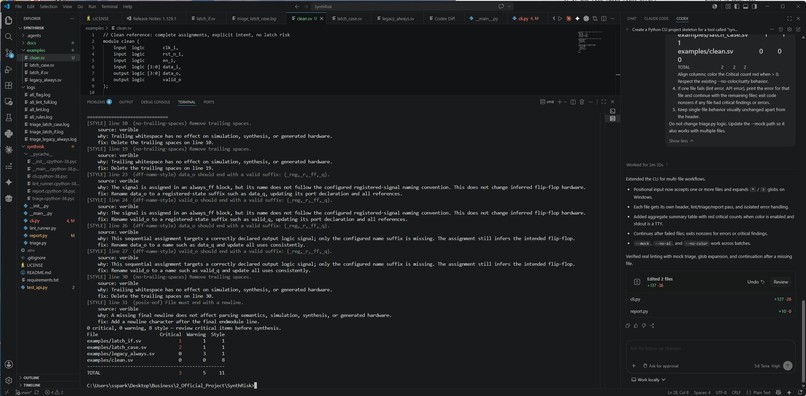
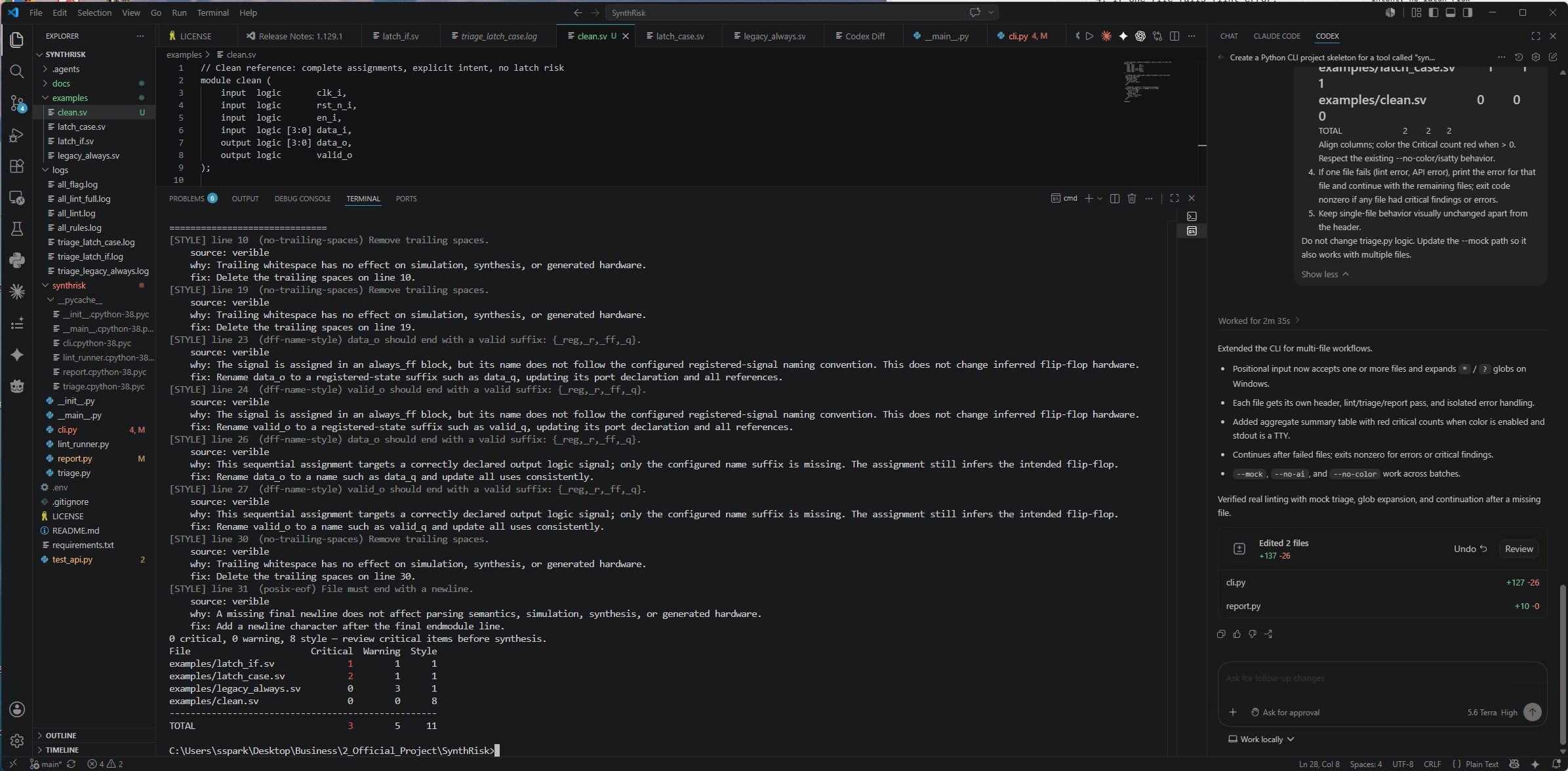
Codex adding multi-file support. Summary table shows the clean reference file scoring 0 critical findings — no false alarms.
Inspiration
I'm a digital circuit designer working on the base die of HBM (High Bandwidth Memory). Every day I write RTL — the code that describes physical circuits — and every day I run lint tools to catch problems before they reach silicon. But RTL lint has two frustrating gaps. First, a linter reports rule violations, not circuit consequences: a missing else in combinational logic silently synthesizes into an inferred latch, yet the linter often says nothing about it. Second, a linter treats every warning equally — a missing newline and a latch-inferring case statement are printed with the same weight. On a real design that's hundreds of lines of output, and the one issue that becomes broken hardware drowns in the noise. In software you can patch a bug after release. In silicon you can't — a respin costs millions. I wanted a tool that reads lint output the way a senior designer does: by consequence, not by rule.
What it does
SynthRisk wraps an RTL linter (Google's open-source Verible) with GPT-5.6 and adds the one thing a linter lacks — judgment about circuit impact. For each SystemVerilog file it:
- runs verible-verilog-lint and collects every violation;
- sends the violations plus the full source to GPT-5.6, which classifies each one by synthesis risk — critical / warning / style;
- independently inspects the source and reports latch-inference risks the linter never flagged (e.g. a combinational if with no else), tagged as [!] AI-DETECTED;
- prints a risk-sorted report, each finding with a plain-language why and a suggested fix, plus a cross-file summary table.
Crucially, it only suggests fixes — it never rewrites RTL. In hardware, automatic edits are too dangerous; the designer decides.
How we built it
The entire tool was built with Codex (GPT-5.6 Terra) in a spec-driven workflow: each module — the lint-output parser, the triage engine, the report renderer, the multi-file runner — was generated from a detailed prompt in a single Codex session, verified against real Verible output, and committed immediately. The commit history documents each Codex-generated change.
The runtime triage engine calls gpt-5.6-terra via the OpenAI API, one request per file, with the source and violations batched into a single structured prompt that returns JSON.
Challenges we ran into
- The linter's silence was the real problem. Early on I confirmed that Verible — even with --ruleset=all — never reports the missing-else latch or the blocking-assignment risk in sequential logic. That turned a "nice-to-have" into the core feature: GPT-5.6 had to detect risks from the source directly, not just re-rank existing warnings.
- Keeping the AI honest. LLM-based detection is a heuristic, not formal analysis. The tool is positioned to complement the linter, not replace it, and the model was tuned to avoid over-flagging — verified against a clean reference file where it correctly reports zero synthesis risks despite eight style warnings.
- Robust output. Handling Verible's nonzero exit code on violations, parsing both single-column and range positions, and stripping stray markdown fences from JSON responses all had to be solid before the demo. ##Accomplishments that we're proud of
- GPT-5.6 correctly detects an inferred-latch risk that the linter stays completely silent on — and explains why it becomes a latch, in language a software engineer can follow.
- The triage is genuinely discriminating: on the same run, a latch risk is critical, a legacy always block is a warning, and a missing newline is style — no flat wall of equal-weight noise.
- Zero false alarms on clean code.
- Built end-to-end in about a day, entirely with Codex.
What we learned
RTL lint is a solved problem for detection but an unsolved one for prioritization and consequence. An LLM turns out to be a natural fit for exactly that gap — not for finding rule violations (a deterministic linter is better at that), but for reasoning about what a violation means for the resulting circuit. The right architecture wasn't "AI instead of lint," it was "AI on top of lint."
What's next for SynthRisk
- Support additional linters (Synopsys SpyGlass and others) behind the same triage layer — the wrapper design is linter-agnostic.
- CI / git-hook integration so triage runs on every pull request.
- Timing-risk hints alongside latch-risk detection, moving from "will this synthesize wrong?" toward "where will this hurt performance?"
Built With
- cli
- codex
- colorama
- digital-circuit
- dotenv
- eda
- gpt-5.6
- hardware-design
- hbm
- lint
- openai-api
- python
- rtl
- static-analysis
- systemverilog
- verible

Log in or sign up for Devpost to join the conversation.